 Write to the booksellers
-
Type
Book (1756)
Magazine (8)
Old papers (1)
Photographs (3)
-
Latest
Last 24h (2)
Last 3 days (12)
Last month (42)
Last week (2)
-
Language
English (2)
French (1765)
Spanish (1)
-
Century
16th (8)
17th (14)
18th (214)
19th (204)
20th (289)
21st (29)
-
Countries
Brazil (5)
Côte d'Ivoire (7)
France (1478)
Italy (1)
Netherlands (174)
Switzerland (103)
-
Syndicate
CNE (20)
ILAB (1238)
NVVA (270)
SLACES (96)
SLAM (1142)
La Participation aux bénéfices. Étude théorique et pratique.
Paris, Arthur Rousseau, 1898. In-8 de VIII-310 pp., demi-chagrin brun, dos orné à nerfs, pièces de titres en maroquin brun (reliure de l'époque).
Édition originale. Ouvrage couronné par la Musée social (concours de 1896). École Nationale des Mines. Prix Rivot 1899.
Memento d'économie politique permettant au candidat de revoir les matières la veille de l'examen.
Couverture souple. Broché. 16 x 25 cm. 56 pages. Rousseurs. Couverture légèrement défraîchie, manques au dos.

Livre. Editions T. Vaquette, 1891.
Projet d'une dixme royale. Qui supprimant la taille, les Aides, les Doüanes d'une Province à l'autre, les Décimes du Clergé, les Affaires extraordinaires, & tous autres Impôts onéreux & non volontaires: Et diminuant le prix du Sel de moitié & plus, produiroit au Roi un revenu certain et suffisant, sans frais; & sans être à charge à l'un de ses Sujets plus qu'à l'autre, qui s'augmenteroit considérablement par la meilleure culture des Terres. Huitième édition, faite sur un Exemplaire corrigé & augmenté en plusieurs endroits de la main propre de l'Auteur. Où l'on a ajouté la vie de l'Auteur par Mr. de Dontenelle, Secrétaire perpétuel de l'Académie des Sciences.
No place, 1708-09. 2 volumes in 1. viii, 270, (2) pp.; 21 pp. 12mo. Contemporary polished calf, spine gilt with raised bands, label with gilt lettering, joints rubbed and with short splits, corners lightly bumped, red edges. INED 4397; Kress 2606; cf.: Goldsmiths 4432; Stourm 63; Bourgeois & André 6702; Carpenter, Economic bestsellers X, 13. Collation: *4, A-2, M4,; A12 (last blank). The second part with a separate titlepage, with sphere on title.The Projet d'une Dixme Royale is an outstanding work in the field of public finance. Its two most notable features are its understanding of the central role of fiscal policy in economic reform - the result of an exceptionally comprehensive grasp of the economic process - and its use of detailed numerical data to substantiate conclusions. Schumpeter called the work 'unsurpassed, before or after, in the neatness and cogency of the argument ..... Purposefull marshalling of all the available data was the essence of his analysis. Nobody ever understood better the true relation between facts and argument. It is this that makes him an economic classic in the eulogistic sense of the work, and a forerunner of modern tendencies' (Schumpeter, History of Economic analysis, p. 204).


(NVVA, )
Phone number : 31 20 698 13 75
Projet d'une dixme royale. Qui supprimant la taille, Les Aydes, les Doüanes d'une Province à l'autre, les Décimes du Clergé, les Affaires extraordinaires; & tous autres Impôts one reux & non volontaires: Et diminuant le prix du Sel de moitié & plus, produiroit au Roy un Revenu certain et suffisant, sans frais; & sans être à charge à l'un de ses Sujets plus qu'à l'autre, qui s'augmenteroit considerablement par la meilleure Culture des Terres. Par Monsr. le Maréchal De Vauban, Chevalier des Ordres du Roy, & Gouverneur de Lille.
No place, 1707. Quaerendo tree on title. With 4 folding tables. xii, 264 pp. 12mo. Contemporary calf, spine gilt with raised bands, joints and extremities somewhat worn, covers somewhat shaved, short split in upper joint. INED 4397; Bourgeois & André 6702; Stourm 63; Carpenter, Economic bestsellers, X, 2; Kress 2584-5; Goldsmiths 4432. One of the at least 7 different issues of the 12mo edition, published in the year of the first edition. The Projet d'une Dixme Royale is an outstanding work in the field of public finance. Its two most notable features are its understanding of the central role of fiscal policy in economic reform - the result of an exceptionally comprehensive grasp of the economic process - and its use of detailed numerical data to substantiate conclusions. Schumpeter called the work 'unsurpassed, before or after, in the neatness and cogency of the argument ..... Purposefull marshalling of all the available data was the essence of his analysis. Nobody ever understood better the true relation between facts and argument. It is this that makes him an economic classic in the eulogistic sense of the work, and a forerunner of modern tendencies' (Schumpeter, History of Economic analysis, p. 204).
(NVVA, )
Phone number : 31 20 698 13 75
Projet d'une dixme royale. Qui supprimant la taille, Les Aydes, les Doüanes d'une Province à l'autre, les Décimes du Clergé, les Affaires extraordinaires; & tous autres Impôts onéreux & non volontaires: Et diminuant le prix du Sel de moitié & plus, produiroit au Roy un Revenu certain et suffisant, sans frais; & sans être à charge à l'un de ses Sujets plus qu'à l'autre, qui s'augmenteroit considérablement par la meilleure Culture des Terres.
No place (Rouen?), 1707. With one folding table. (8), 204, (20) pp. 4to. Contemporary calf, spine gilt with raised bands, gilding faded, a bit rubbed, inner hinge front cover cracked but binding solid. En Français dans le Texte, 134; Bourgeois & André 6702; Stourm 63; Kress 2583; Goldsmiths 4431; McCulloch, p. 342f; Masui, p. 396; Carpenter X (1); this edition not in INED and Einaudi, OCLC and RLIN locate only three copies at Keio, Yale and Minnesota. Very rare first edition, with B4 in cancelled state: on p. 16, a setier is correctly given as weighing 240 pounds, and a notable rarity, of 'an erudite economic work much in advance of its time, and distinguished both by accuracy of method and breadth of view' (Palgrave), 'creditable alike to the heart and the head of its illustrious author' (McCulloch). 'Though the book was published anonymously, and only a few copies issued (for circulation among friends), Vauban had to submit to the mortification of seeing it 'pilloried' by the parliament, while he himself incurred the displeasure of the king (Louis XIV). A few weeks later he died' (Palgrave). The copy of the author himself contained four pages of manuscript in which statements were to be found which could not be printed and in which Vauban, among other things, clearly distinguishes between nobles which have earned their title and position by their actions, whether by their ancestors and by themselves and are an honour to the State, and those who have purchased their titles and are of no use at all to the State. The Projet d'une Dixme Royale is an outstanding work in the field of public finance. Its two most notable features are its understanding of the central role of fiscal policy in economic reform - the result of an exceptionally comprehensive grasp of the economic process - and its use of detailed numerical data to substantiate conclusions. Schumpeter called the work 'unsurpassed, before or after, in the neatness and cogency of the argument ..... Purposefull marshalling of all the available data was the essence of his analysis. Nobody ever understood better the true relation between facts and argument. It is this that makes him an economic classis in the eulogistic sense of the work, and a forerunner of modern tendencies' (Schumpeter, History of Economic analysis, p. 204).According to Boislisle, the first edition was printed in Rouen in 1706 at the initiative of the Abbé de Beaumont (who is actually credited with the authorship of the work by Boisguilbert). Vauban had the sheets bound by the widow of a certain Fétil, and took great pains that the book did not have any public circulation. It was prohibited on 14 February 1707, but apparently the police were only able to seize two copies. To the police, the binder declared she had had 264 copies in total, 12 bound in morocco, the rest in calf. The two copies seized at the Abbé de Beaumont's were described as in 'veau fauve' and marbled parchment. See Arthur Michel de Boislisle, La Proscription du projet de Dime Royale et la mort de Vauban (Mémoire lu à l'Académie des sciences morales et politiques), Paris, 1875. - The folding plate is a very well done xerox on old paper.
(NVVA, )
Phone number : 31 20 698 13 75
Projet d'une dixme royale qui supprimant la taille, Les Audes, les Doüanes d'une Province à l'autre, les Décimes du Clergé, les Affaires extraordinaires; & tous autres Impôts onereux & non volontaires: Et diminuant le prix du Sel de moitié & plus, produiroit au Roy un Revenu certain et suffisant, sans frais; & sans être à charge à l'un de ses Sujets plus qu'à l'autre, qui s'augmenteroit considerablement par la meilleure Culture des Terres. Par: Monsr. le Maréchal De Vauban, Chevalier des Ordres du Roy, Commissaire General des Fortifications, & Gouverneur de la Citadelle de Lille.
No place, 1707. Sphere on title. With 4 folding tables. xii, 268 pp. 12mo. Modern vellum, red label with gilt lettering. INED 4397; Bourgeois & André 6702; Stourm 63; Carpenter, Economic bestsellers, X, 3 or 5; Kress 2584 & 2585; Goldsmiths 4432. One of the at least 7 different issues of the 12mo edition, published in the year of the first edition. The Projet d'une Dixme Royale is an outstanding work in the field of public finance. Its two most notable features are its understanding of the central role of fiscal policy in economic reform - the result of an exceptionally comprehensive grasp of the economic process - and its use of detailed numerical data to substantiate conclusions. Schumpeter called the work 'unsurpassed, before or after, in the neatness and cogency of the argument ..... Purposefull marshalling of all the available data was the essence of his analysis. Nobody ever understood better the true relation between facts and argument. It is this that makes him an economic classic in the eulogistic sense of the work, and a forerunner of modern tendencies' (Schumpeter, History of Economic analysis, p. 204). - Old handwritten ownership's entry in blank portion of title-page.
(NVVA, )
Phone number : 31 20 698 13 75
Projet d'une Dixme royale. Qui supprimant la Taille, les Aydes, les Doüanes d'une Province à l'autre, les Décimes du Clergé, les Affaires extraordinaires, & tous autres Impôts onereux & non volontaires [...].
S. l., 1707. 1707 In-12, veau, dos à nerfs orné (reliure de l'époque). - X (avec erreur de pagination) + 268 pp. Orné de quatre grands tableaux repliés. Quelques usures, déchirures sans manque à deux tableaux , ff. B6 & B7 en déficit (jamais reliés).Édition in-12 publiée la même année que l'originale de ce texte fondamental

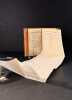
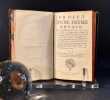
Sébastien Le Prestre de VAUBAN (1633-1707), est un génie universel, son traité de l’attaque et de la défense des places, a révolutionné l’art de la guerre. Ses mémoires, qu’il nommait ses oisiveté donnent un tableau incomparable de la société du 17e siècle, tant du point de vue du commerce, que de l’agronomie, de l’urbanisme ou la démographie. Conscient de l’ineptie de la chasse au Huguenots, Vauban rédigera courageusement un placet pour demander au roi l’arrêt de cette folie. Son dernier ouvrage, le projet d’une Dixme royale, et probablement le plus révolutionnaire dans sa conception, ce n’est ni plus ni moins que l’établissement d’un impôt proportionnel au revenu qui remplacerait toutes les autres taxes, toutes classes confondues. Illustré de tableaux dépliants tendant à prouver la bonté et l’excellence de la Dixme royale. L’ouvrage fut interdit et son auteur condamné à l’exil, Vauban décédant en 1707L’arrêté en date du 14 mars 1707, précédât de quelques mois le décès de Vauban la même année. Les éditions in12 circulèrent de manière clandestines, telle celle-ci à la marque de la sphere. Exemplaire malheureusement incomplet de deux feuillets, mais complet de ses plans dépliants reliés en pleine basane d’époque
Du commerce de la France en 1820 et 1821.
In-8, broché, couverture de papier moderne, tranches citron, (2) f., (2), 207 p. Paris, C.J. Trouve et Goujon, 1822.
Edition originale. Etude sur le commerce de la France et plaidoyer pour le libre échange divisé en trois chapitres. Le troisième est entièrement consacré au commerce des colonies, particulièrement des Antilles. Statistiques.Importante personnalité de la période, homme politique et homme de lettres, le comte Vincent-Marie Viénot de Vaublanc (1756-1845) devint Baron d'Empire, en 1810, puis ministre de l'intérieur ultra-royaliste en 1815, député de Seine-et-Marne, puis du Calvados (1820), préfet de la Moselle, puis des Bouches-du-Rhône (Coquelin & Guillaumin, II, 820. Kress C.1001. Manque à Goldsmiths et Einaudi).Très bon exemplaire, très frais.
60 Milliards D'économies !
Paris Albin Michel 2013 Grand In 8 " Plus la France s'enfonce , plus nous renforçons le modèle de l'Etat dépensier qui nous ruine , et plus nous avons peur de le réformer . Un rapport confidentiel de l'Inspection des finances commandé avant l'alternance dressait pourtant une liste des économies possibles pour redresser le pays . Les réformateurs - dont quelques ministres - sont broyés par la machine administrative qui protège ses propres intérêts " Nous dit l'éditeur . - 240 p. , 450 gr.

Couverture souple Comme neuf 1ère Édition
Nouveau plan de finances et d'impositions, formé d'après les décrets de l'Assemblée nationale.
Paris, Imprimerie nationale, 1790. 46 pp. 8vo. Modern half morocco, gilt lettering to spine. Not in Kress; not in Goldsmiths; not in Einaudi; not in INED; Stourm, p. 189; Martin & Walter 33378. First edition. Théodore Vernier (1731-1818) studied in Besançon. He later became a barrister and was elected deputy for the third estate at the Estates General where he dealt mainly with financial questions. He was elected president of the Assemblée constituante on the 26th of August 1791. Vernier was one of the most intelligent and ardent defenders of the principal of a progressive tax and his writings were both influential and among the best written on the subject in the period (see: A. Soboul, Dictionnaire Historique de la Révolution Française, pp. 1085-1086 and the entry Impot Progressif, p. 562.)'Grand travail .... passant en revue tout le système fiscal. Impôt territorial et subvention personnelle: leurs bases. Anciens impôts à conserver' (Stourm).
(NVVA, )
Phone number : 31 20 698 13 75
Meditazioni sulla economia politica. Prima Edizione Napoletana.
Napoli, Nella Stamperia di Giovanni Gravier, 1771. With title-vignette, title printed within engraved border. (8), 212 pp. 8vo. Later boards. Kress 6828; Goldsmiths 10722 (edition without place or publisher); not in Einaudi (listing three other editions from 1771); Higgs 5167; Mattioli 3734-36, all different editions, not this one; Kress, Italian Economic Literature, i, 406; Carpenter, Economic Bestsellers before 1850, xxv/2. One of four editions from 1771: the Livorno edition is the first, in the listing by Carpenter and in the Italian Economic Literature this Napels edition is given as the second in the sequence and is followed by the other 1771 editions. The work was an immediate succes and went through some 6 editions in a short period; Verri's publishing history outside Italy was remarkable -- four French editions, two in German, at least one, perhaps two in Dutch, and a partial Russian translation (Carpenter), and more recently, into English. "Verri's Meditazioni (Meditations on Political Economy) is a complete treatise on political economy, reminiscent of Turgot's work (1766) with its tight, logical framework and division into fairly short sections. The work was highly appreciated when it appeared and could be found, for example, in the library of Adam Smith. His work, though now largely ignored, may therefore have exerted greater influence than is generally believed" (New Palgrave, volume iv, p. 807)."This work (the Meditazioni) firmly embraces free trade, and anticipates (especially the concept of money as a universal commodity, the theory of value, and the dynamics of the laws of the marketplace) the Wealth of Nations of Adam Smith" (Encyclopedia of the Enlightenment, vol. 4, p. 221).Pietro Verri (1728-1797) was an Italian economist, administrator and philosopher. His work includes several anti-Physiocratic views: for example on tax issues and on the importance of agriculture. His work contains a number of original contributions. Not only did he do historical research of importance, but he also was a true econometrician. Schumpeter states: "Count Pietro Verri ...... would have to be included in any list of the greatest economists." Verri also belonged to the 'Illuministi" of Italy and founded the important but short-lived periodical 'Il Caffé', together with Beccaria and others. - Somewhat browned and spotted throughout, title-page and some other pages somewhat heavier, in a contemporary hand written onto title "del c. verri milanese", rather thick lettering.
(NVVA, )
Phone number : 31 20 698 13 75
Le Droit du Seigneur au Moyen Age.
, Paris, Vivès, 1854; in-12, broché, couv. bleue imprimée XXVIII pp., 467 pp.- EDITION ORIGINALE. Veuillot entreprit ce travail à la suite d’un article de l’avocat Dupin sur les Coutumes locales d’Amiens dans lequel ce dernier relatait des exercices de droit de cuissage pratiqués par des gens d’Eglise. Coutumes médiévales et survivances modernes : redevances bizarres, Saint-Louis et ses Etablissements, comment l’Eglise améliora les barbares, Serfs en Russie, nègres en Amérique, ouvriers en Angleterre, esclavage moderne, affranchissement, la question des grenouilles - Droit de Dieu, le mariage et le maritagium.- Caractère de pudeur au Moyen Age.- Histoire de la calomnie ( droit de cuissage) depuis ,son origine (XVI e s.), établissement du préjugé, dictionnaire de Trévoux, Voltaire, le Cazzagio, les religieux de Nevers, l’abbé de Sorrèze, le Jus cunni, Montaigne, etc. Qq. rouss.
Population. Mouvements, structures, répartitions.
In-8, br., 266 pp. Paris, Arthaud, 1959.
Édition originale. Nombreux tableaux statistiques.
La réduction de la durée du travail de l'employé.
In-8, broché (couverture renforcée), vii, 172 p. Paris, A. Rousseau, 1910.
Envoi autographe signé de l'auteur à M. Besse.
Les doctrines économiques et morales de Saint Bernard sur la richesse et le travail.
In-8, broché, couverture imprimée, 43 p., non coupé. Paris, Marcel Rivière, 1928.
De la monnaie à l'économie en France (1933-1938). Préface de Louis Baudin.
In-12, broché, 222 p., non coupé. Paris, L.G.D.J., 1938.
Edition originale. Ex-libris gravé "Couto Rosado".Bon exemplaire.
Economie politique chrétienne, ou recherches sur la nature et les causes du paupérisme, en France et en Europe, et sur les moyens de le soulager et de le prévenir.
Bruxelles, Méline, Cans et Compagnie, 1837. In-4 à deux colonnes de 676 pp., demi-basane brune, dos orné à nerfs, tranches marbrées (reliure de l'époque).
Deuxième et dernière édition publiée trois ans après l'originale. Ce livre essentiel initie un courant fort de l'économie politique de la seconde moitié du siècle, le catholicisme social, pour lequel il est nécessaire de moraliser le monde économique et d'effacer les méfaits trop rudes de son industrialisation afin de sauvegarder la dignité de l'Homme. Il constitue une exposition claire et assez objective des tendances économiques de l'époque. Libéral, Villeneuve-Bargemont admettait cependant l'intervention de l'État en faveur des classes les plus défavorisées, c'est-à-dire les lois sociales.8 planches dépliantes : 1 vue, 1 plan et 6 cartes. Einaudi, 5910 (pour l'édition originale). Très bon exemplaire.
Economie politique chrétienne, ou recherches sur la nature et les causes du paupérisme, en France et en Europe, et sur les moyens de le soulager et de le prévenir.
Paris, Paulin, 1834. 3 vol. in-8 de (4)-509-(2) pp. ; (4)-652 pp. ; (4)-603 pp., demi-veau havane, dos orné à nerfs (reliure de l'époque).
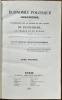
Édition originale illustrée de 9 planches (2 vues, 1 plan et 5 cartes repliées). Ce livre essentiel initie un courant fort de l'économie politique de la seconde moitié du siècle, le catholicisme social, pour lequel il est nécessaire de moraliser le monde économique et d'effacer les méfaits trop rudes de son industrialisation afin de sauvegarder la dignité de l'Homme. Il constitue une exposition claire et assez objective des tendances économiques de l'époque. Libéral, Villeneuve-Bargemont admettait cependant l'intervention de l'État en faveur des classes les plus défavorisées, c'est-à-dire les lois sociales.Très bon exemplaire. Einaudi, 5910.
Histoire de l'économie politique, ou études historiques, philosophiques et religieuses sur l'économie politique des peuples anciens et modernes.
Paris, Guillaumin, 1841. 2 vol. in-8 de 484 pp. (mal chiffrées 474) ; 453-(1) pp., demi-basane verte, dos lisse orné de filets dorés (reliure de l'époque).
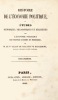
Édition originale. Né dans une grande famille de noblesse immémoriale, Villeneuve-Bargemont est auditeur au Conseil d'Etat (1810) puis fait comme ses frères Joseph et Ferdinand, une carrière préfectorale interrompue sous les Cent Jours et reprise à la Restauration. C'est comme préfet du Nord (1828) qu'il est ému par la condition ouvrière et qu'il découvre la question sociale. Refusant le serment de fidélité à Louis-Philippe, il accompagne la duchesse de Berry, du 3 mai au 7 mai 1832, d'Aix à Plassac. Il remplit plusieurs mandats de député du Var (1830-31) puis du Nord (1840-1848) et prend place parmi les légitimistes. C'est lui qui fait voter la loi du 20 mars 1841 réglementant le travail des enfants, premier jalon de la législation sociale.Goldsmiths, 30830 ; Kress, C.5031 ; Einaudi, 5911. Bon exemplaire. Des rousseurs.
Économie politique chrétienne, ou recherches sur la nature et les causes du paupérisme, en France et en Europe, et sur les moyens de le soulager et de le prévenir.
Paris, Paulin, 1834. 3 vol. in-8 de (4)-509-(3) pp. ; (4)-652 pp. ; (4)-603 pp., demi-veau havane, dos lisse orné (reliure de l'époque).
Édition originale illustrée de 9 planches (2 vues, 1 plan et 6 cartes repliées). Ce livre essentiel initie un courant fort de l'économie politique de la seconde moitié du siècle, le catholicisme social, pour lequel il est nécessaire de moraliser le monde économique et d'effacer les méfaits trop rudes de son industrialisation afin de sauvegarder la dignité de l'Homme. Il constitue une exposition claire et assez objective des tendances économiques de l'époque. Libéral, Villeneuve-Bargemont admettait cependant l'intervention de l'État en faveur des classes les plus défavorisées, c'est-à-dire les lois sociales.Très bon exemplaire. Einaudi, 5910.
Économie politique chrétienne, ou recherches sur la nature et les causes du paupérisme, en France et en Europe, et sur les moyens de le soulager et de le prévenir.
Paris, Paulin , 1834. 3 vol. in-8 de (4)-509-(3) pp. ; (4)-652 pp. ; (4)-603 pp., demi-veau taupe, dos orné à nerfs (reliure de l'époque).
Édition originale. Ouvrage illustré de 8 planches : 1 vue, 2 plans dont 1 dépliant et 5 cartes dépliantes. Ce livre essentiel initie un courant fort de l'économie politique de la seconde moitié du siècle, le catholicisme social, pour lequel il est nécessaire de moraliser le monde économique et d'effacer les méfaits trop rudes de son industrialisation afin de sauvegarder la dignité de l'Homme. Il constitue une exposition claire et assez objective des tendances économiques de l'époque. Libéral, Villeneuve-Bargemont admettait cependant l'intervention de l'État en faveur des classes les plus défavorisées, c'est-à-dire les lois sociales. Provenance : Prosper de Barante.Bel exemplaire Infimes rousseurs. Einaudi, 5910.
Des associations ouvrières.
In-16, broché, couverture bleue imprimée, (4), 104 p. Paris, Pagnerre, Paulin et Cie, 1849.


Edition originale publiée dans les "Petits Traités" édités par l'Académie des Sciences Morales et politiques. Après avoir dressé un historique de l'émancipation des "classes défavorisées" depuis 1789, Villermé étudie les modalités de cette évolution, en particulier à travers les organisations ouvrières. Appuyant son essai sur des statistiques et des enquêtes de terrain, il conclut par une défense du mutualisme et par la mise en garde contre une substitution générale et forcée de l'association qui aboutirait à l'omnipotence de l'Etat. (Coquelin & Guillaumin, II, 833. M. Perrot, 'Enquête sur la condition ouvrière', p. 63).Bon exemplaire, frais, non rogné.
Du rôle de l'Etat dans l'ordre économique.
1882 Guillaumin, Pedone-Lauriel, Paris, 1882. Un volume in-8 broché, couverture grise, XVI pp avant-propos, XII pp préface, 482pp. Charnière du premier plat faible, légers manques de papier aux coiffes et premier plat, exemplaire non coupé.
La librairie est ouverte du mardi au samedi de 9h30 à 12h30 et de 13h30 à 19h00. Commandes par courriel ou téléphone. Envoi rapide, emballage soigné.
De l'organisation sociale et en particulier de l'organisation industrielle.
Paris, Imprimerie de Bourgogne et Martinet, 1836. In-8, 2 ff. et 128 pp., couv. muette de l'époque.
Editiion originale rare. Emile Vincens (Nimes 1764- Paris 1850). "C'est, à notre avis, ce que M. Vincens a produit de plus remarquable comme style et comme pensée. Il y réfutait les accusations portées contre l'organisation industrielle, non seulement contre les reveurs et le utopistes des temps modernes, mais aussi contre ces économistes de l'école sentimentale qui ont mis en vogue, sous différentes formes, le socialisme philanthropique.". A.E. Cherbuliez, Juillet 1850. H2
Analisi economiche. Serie prima.
Bologna, Zanichelli, 1940, in-4°, 465 p., non rogné, brochure originale.
Contiene 20 capitoli, tra i quali: Le tre fasi delle dottrine economiche / I movimenti del risparmio / La popolazione e la ricchezza delle città / Prezzi e redditi / L'organizzazzione del lavoro / Analisi di un gruppo di bilanci di guerra.
(SLACES, NVVA)
Phone number : 41 (0)26 3223808

