Write to the booksellers
-
Type
Book (517)
Magazine (1)
-
Century
16th (1)
17th (7)
18th (11)
19th (9)
20th (24)
21st (10)
-
Countries
Belgium (95)
Canada (3)
France (417)
Switzerland (3)
-
Syndicate
ALAC (3)
ILAB (145)
NVVA (3)
SLACES (3)
SLAM (139)
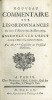
NOUVEAU COMMENTAIRE SUR LES ORDONNANCES AOUT 1669 A MARS 1673. ENSEMBLE SUR L'EDIT DU MOIS DE MARS 1673 TOUCHANT LES EPICES relie avec NOUVEAU COMMENTAIRE SUR L’ORDONNANCE du COMMERCE du mois de mars 1673
A Paris Debeure 1756. In-8° relié (17 X 10 centimètres), pleine basane de l’epoque, dos orné à nerfs, XII-251-344 pages. Assez bon état, frottement au dos,aux coiffes et coins.
texte bon etat,infimes mouillures en marge de qques feuillets et bord 1er plat- Les commentaires de Jousse ne sont plus à présenter : ils forment la meilleure explication des dispositions du droit ancien, et furent salués comme des classiques dès leur parution. Dupin (1832), 1138. Relié à la suite, du même auteur : Nouveau commentaire sur l"Ordonnance du commerce du mois de mars 1673. Par M***, Conseiller au Présidial d"Orléans. deuxième édition, après celles de 1755 . Dupin (1832), 2144. 146878 Remise de 20% pour toutes commandes supérieures à 200 €
NOUVEAU COMMENTAIRE SUR LES ORDONNANCES DES MOIS D'AOÛT 1669 & MARS 1673. Ensemble sur l'édit du mois de Mars 1673 touchant les épices. Par M*** Conseiller au Présidial d'Orleans
Pars Chez Debure l'aîné 1761 in 12 (17,5x10,5) 1 volume reliure plein veau fauve de l'époque, dos à nerfs orné de caissons dorés avec fleuron floral central, tranches teintées rouge, XII et 334 pages [1]. Très bel exemplaire, reliure très fraîche ( Photographies sur demande / We can send pictures of this book on simple request )
Très bon Couverture rigide
NOUVEAU COMMENTAIRE SUR LES ORDONNANCES DES MOIS D’AOÛT 1669 ET MARS 1673. ENSEMBLE SUR L’ÉDIT DU MOIS DE MARS 1673 TOUCHANT LES ÉPICES
, Paris, Debure l’aîné 1755, 2 t. en 1 vol. in-12, pl. veau fauve raciné, tit. sur pc. jaune et brune sur dos à 5 nerfs orné de fleurons, et filets encadrants dorés, tr. rouges, roulette dorée sur coupes, bandeaux et lettrines, (épidermures sur les plats, coiffes absentes, coupes et coins émoussés avec mq.), intérieur frais, [Provient de la bibliothèque personnel de Gérard de Chapel d’Espinassoux acquise par la Famille Filâtre de Longchamps], XII-251-345p.-[2ff.].


Phone number : 01 43 29 46 77
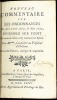
NOUVEAU COMMENTAIRE SUR LES ORDONNANCES DES MOIS D’AOÛT 1669 ET MARS 1673. ENSEMBLE SUR L’ÉDIT DU MOIS DE MARS 1673 TOUCHANT LES ÉPICES, et NOUVEAU COMMENTAIRE SUR L’ORDONNANCE DU COMMERCE DU MOIS DE MARS 1673, nouvelleéd. corrigée et augmentée
, Paris, Debure 1775, 2 t. en 1 vol. in-12, plein veau brun marbré, tit. doré sur pc. de maroquin noisette, dos à 5 nerfs orné de fleurons, nerfs surlignés de roulettes dorées, (épidermures, 2 trous de vers dont un non traversant et un traversant en marge, mq. la coiffe inf.), bon état, XII-444p.

Phone number : 01 43 29 46 77
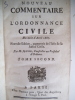
Nouveau commentaire sur l’ordonnance civile du mois d’avril 1667.
Nouveau commentaire sur l’ordonnance civile du mois d’avril 1667. Nouvelle édition augmentée de l’idée de la justice civile. Tomes second sel In 12 plein cuir fauve raciné à nerfs, pièces de titre, et tomaison, fers, roulette, palmette, caissons dorés, roulette dorée sur coupes, 100x175mm, titre 568 pages, tranches rouges. A Paris chez Debure Paris 1767. Très bon état


Une petite tache circulaire, apparaît sur certaines photos à fond clair; elle est due à un problème d'objectif de mon appareil
NOUVEAU COMMENTAIRE SUR L’ORDONNANCE CIVILE DU MOIS D’AVRIL 1667, Nouvelleéd. augmentée de l’Idée de la Justice Civile
, Paris, Debure père 1767, 2 vol. in-12, pl. veau brun raciné, tit. & tom. dorés sur pc. brune et bordeaux, dos à 5 nerfs orné de fleurons, frises et doubles filets encadrants dorés, tr. rouges, (coiffes accidentées, coins et tranches frottés avec des épidermures, plats frottés, qq. rousseurs, qq. trous de vers traversant sans atteintes au texte), VIII-XXXVII-414 / 568 p.

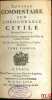
Phone number : 01 43 29 46 77
NOUVEAU COMMENTAIRE SUR L’ORDONNANCE CIVILE DU MOIS D’AVRIL 1667, Nouvelleéd. augmentée de l’Idée de la Justice Civile
, Paris, Debure père 1767, 2 vol. in-12, pl. veau brun raciné, tit. & tom. dorés sur pc.bordeaux, dos à 5 nerfs orné de fleurons, frises et doubles filets encadrants dorés, nerfs ornés de roulettes dorées à froid, chants de plat ornés d’un filet doré, tr. rouges, (coiffes accidentées, or passé, pc. de tit. du t.II manquante, nerfs et couv. frottés avec manques de cuir, coins et bords émoussés), int. assez frais, XXXVIII-302/ [2ff.]-[345-788]p. [pagination continue].

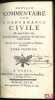
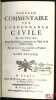
Phone number : 01 43 29 46 77
NOUVEAU COMMENTAIRE SUR L’ORDONNANCE des mois d’Août 1669 & Mars 1673. ENSEMBLE SUR L’ÉDIT du mois de Mars 1673, touchant les épices. Nouvelle éd. corrigée & augmentée, suivi du COMMENTAIRE SUR L’ORDONNANCE DU COMMERCE du mois de Mars 1673
, Paris, Debure l’aîné 1761, 2 t. en 1 vol. in-8, plein veau brun raciné, tit. doré sur dos à 5 nerfs ornés de fleurons et doubles filets encadrants dorés, roulette sur les nerfs, tr. jaspées, (coiffes accidentées, coins et coupes émoussés avec de petits mq.), intérieur frais, XII-230 p. / 324p.

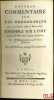
Phone number : 01 43 29 46 77
RECUEIL CHRONOLOGIQUE DES ORDONNANCES, ÉDITS & ARRÊTS DE RÈGLEMENT CITÉS DANS LES NOUVEAUX COMMENTAIRES SUR LES ORDONNANCES DES MOIS D’AVRIL 1667. AOÛT 1669. AOÛT 1670. & MARS 1673; t. I (sur 3): Depuis 1453 jusqu’en 1686 inclusivement
, Paris, Debure l’aîné 1757, in-8, plein veau fauve moucheté, tit. et tom. dorés sur pc. bordeaux et noires, dos à 5 nerfs ornés de fleurons et filets encadrant dorés, tr. rouges, (mors fendus, coiffes accidentées, coins émoussés avec des mq., dos et nerfs frottés avec de petites épidermures, qq. rousseurs marginales), XXX-656p.

Phone number : 01 43 29 46 77
RECUEIL CHRONOLOGIQUE DES ORDONNANCES, ÉDITS & ARRÊTS DE RÈGLEMENT CITÉS DANS LES NOUVEAUX COMMENTAIRES SUR LES ORDONNANCES DES MOIS D’AVRIL 1667, AOÛT 1669, AOÛT 1670 & MARS 1673: t. I: Depuis 1453 jusqu’en 1686 inclusivement; t. II: Depuis 1687 jusqu’en 1714 inclusivement, (mq. t. III)
, Paris, Debure l’aîné 1757, 2 vol. in-12, plein veau fauve moucheté, tit. & tom. dorés sur pc. bordeaux et noires, dos à 5 nerfs ornés de fleurons, frises & filets encadrant dorés, tr. rouges, filet doré sur les coupes, (plats frottés avec qq. épidermures, coins lég. émoussés avec qq. petits mq.), bel exemplaire, XXX-656p. / XXXII-642p.

Phone number : 01 43 29 46 77
RECUEIL CHRONOLOGIQUE DES ORDONNANCES, ÉDITS & ARRÊTS DE RÈGLEMENT CITÉS DANS LES NOUVEAUX COMMENTAIRES SUR LES ORDONNANCES DES MOIS D’AVRIL 1667, AOÛT 1669, AOÛT 1670 & MARS 1673: t. I: Depuis 1453 jusqu’en 1686 inclusivement; t. II: Depuis 1687 jusqu’en 1714 inclusivement, (mq. t. III)
, Paris, Debure l’aîné 1757, 2 vol. in-12, plein veau fauve moucheté, tit. & tom. dorés sur pc. bordeaux et noires, dos à 5 nerfs ornés de fleurons, frises & filets encadrant dorés, tr. rouges, filet doré sur les coupes, (plats frottés avec qq. épidermures, coins lég. émoussés avec qq. petits mq.), intérieur frais, XXX-656p. / XXXII-642p.

Phone number : 01 43 29 46 77
Within Walls, Experience of Enclosure in Christian Female Spiritualities (From Late Antiquity to Early Modern Period)
, Brepols - Harvey Miller, 2025 Hardback, 311 Pages, Size:178 x 254 mm, Illustrations:2 b/w, 15 col., Language: English. *new ISBN 9782503599342.
What different mechanisms did women religious use to interpret the communal and individual aspects of enclosure throughout history? To what extent was enclosure a pivotal feature of Christian spiritual, social and cultural life? How did social and political contexts shape the strategies of nuns and beatas in accepting or rejecting strict enclosure? Within Walls explores the diverse experiences of enclosure within female Christian spiritualities, presenting it as a crucial concept for a deep understanding of the history of women religious. The volume primarily aims to show the different ways in which women religious lived, negotiated and redefined enclosure in its material and symbolic dimensions. Covering the period from the New Testament era to the late sixteenth century, and spanning regions from the Holy Land and Egypt to Western Europe and colonial Mexico, it explores the evolving meanings and uses of the confined life as experienced and shaped by women religious in Christianity. The case studies presented in this volume?from the strategies of seclusion of early Christian anchoresses to the plethora of voices of Mediaeval and Early Modern female communities and the authority wielded by individual nuns, pilgrims, prioresses, reformers and mystics?argue that there was by no means a single form of enclosure in female Christian religious life. Instead, inspired by Philip Sheldrake?s interpretation of sacred spaces as polyphonic, this volume stresses the multivocality and multilocality of the term. Adopting an interdisciplinary approach that integrates microhistory, human geography, the cultural analysis of materiality, literary studies, feminist and gender studies, indigenous methodologies, art studies, postcolonial anthropology and the philosophy of religion and spirituality, Within Walls provides fresh perspectives on the most intricate dimension of religious life in history. TABLE OF CONTENTS List of illustrations Contributors Preface Acknowledgements Introduction. The Potentiality of Clausura. From the Confined Place to Spaces of Enclosure Julia Lewandowska and Araceli Rosillo-Luque Part I: Enclosure, Society and Ecclesiastical Power The Origin of Double Monasteries. Gender Parallel Leadership in the Liturgy Ally Kateusz The Ambivalent Enclosure. Iberian Nuns and the Dynamics of Authority (Sixth to Tenth Centuries) Araceli Rosillo-Luque Behind the Cloister Wall. The Power of Female Enclosure in the Middle Ages Silvia Carraro Enclosure and the English Fontevraudine Nuns of Amesbury, Nuneaton, and Westwood Priories Joyce Beelman Enclosure & Reform. St Colette of Corbie and the Reform of the Poor Clares Anna Campbell Part II: Enclosure, Spaces and Textualities Virgines et Cubicula: (En)closed Women in Late Antiquity. The Origins of Female Monasticism Lorena Garri-Catchot A Fixed Point in Time. Enclosed Textuality in the Anchorhold Brenna Duperron Following in Their Footsteps. Virtual Pilgrimage, Women on Pilgrimage, and Navigating Enclosure in Mid to Late Medieval Europe Pelia Werth De Linnage Muit' Alt (?) e Gran Crerizía?. Gendered Spaces, Material Culture, and Enclosure in Iberian Female Monasteries and Beyond Mercedes Pérez Vidal ?Cell of One?s Own?. The Notion of Female Enclosure in the Teresian Reform in Spain Julia Lewandowska Sources and Bibliography
The Capital's Charterhouses and the Record of English Carthusianism
, Brepols, 2023 Hardback, xvi + 300 pages, Size:152 x 229 mm, Illustrations:23 col., Language: English. ISBN 9780888448361.
Summary This volume offers a substantial and versatile contribution to the history and culture of the late-medieval Carthusians in England. The nine essays presented here focus primarily on the double charterhouses built on the outskirts of London, at Smithfield and Sheen. Syon Abbey, the Bridgettine house which stood a short distance from Sheen, and was founded at the same time, is also drawn into the conversation because of its sympathetic and practical links to the Carthusians. Particular attention is paid to the London Charterhouse. This institution is revaluated here as an engineered and ornamented structure, a sanctuary nourished by books and texts, a beacon of religion, a theatre of devotion and political manoeuvres and, in the wake of its dissolution, both a dwelling-place for affluent citizenry and a lieu de mémoire for the English Carthusians in exile. TABLE OF CONTENTS llustrations Abbreviations James P. Carley ? Preface Julian Luxford ? Introduction Part 1: The Material Record Julian Luxford ? The London Charterhouse: Iconography, Buildings, and Art Glyn Coppack ? Water and the Carthusians: The Contribution of the London Charterhouse to Knowledge of the Order's Plumbing Part 2: Spiritual Writings and Textual Transmission Marlene Villalobos Hennessy ? British Library, MS Egerton 1821: Devotional Practice and Book Production at the London Charterhouse Michael G. Sargent ? The Transmission by the English Carthusians of Some Late-Medieval Spiritual Writings: A Reconsideration of Walter Hilton and Nicholas Love Vincent Gillespie ? Preaching to the Choir: Another Look at English Carthusian Transmission of Vernacular Spiritual Writings Part 3: Religious Conscience, Politics, and Afterlife Ann M. Hutchison ? United in Devotion and Martyrdom: The English Carthusians and Bridgettines and Their Fate Diarmaid MacCulloch ? The End of the Carthusians at the London Charterhouse James P. Carley ? After the Dissolution: John Leland and His Neighbours in Charterhouse Square Peter Cunich ? Maurice Chauncy and the Burdens of the English Reformation Epilogue Martyn Percy ? A Eucharist for Martyrs: ?A Fragrant Offering and Sacrifice? - A Sermon Preached at the London Charterhouse on 3 September 2016 Contributors Index
Les prieurés de Saint-Victor de Paris (XIIe-première moitié du XVIe siècle). Implantation et fonctionnement d'un réseau canonial entre Senlis et Orléans
, Brepols, 2023 Hardback, 1068 pages, Size:178 x 254 mm, Illustrations:1 col., 73 tables b/w., 17 maps b/w, 41 maps color, Language(s):French, Latin.*New. ISBN 9782503607764.
Summary Fondée en 1113 au pied de la montagne Sainte-Geneviève, l'abbaye de Saint-Victor de Paris s'est rapidement dotée de petits établissements, des prieurés simples et des prieurés-cures, pour gérer un patrimoine dispersé et desservir des églises paroissiales entre Senlis et Orléans. Le réseau prioral victorin, de taille réduite, reste très dynamique aux XIIe-XIIIe siècles, période d'intense essaimage et de développement des domaines gérés par les chanoines forains. À partir de 1330 et jusqu'au milieu du XVe siècle, ces petites dépendances directes subissent de plein fouet les crises. Mais dès 1460, le grand mouvement de reconstruction économique donne l'occasion aux prieurs d'être plus actifs dans l'administration de leurs établissements et d'utiliser de nouvelles méthodes de gestion. En analysant les aspects institutionnels, économiques, sociaux et spirituels de la vie des frères dans les petites dépendances directes de l'abbaye, cette étude approfondie met en lumière le fonctionnement des prieurés canoniaux du XIIe au XVIe siècle. Ce volume montre comment les relations mère-fils évoluent au cours du temps en fonction des réformes abbatiales et révèle la fossé qui sépare parfois la conception du réseau édictée par l'abbé et le convent, et l'attitude des chanoines forains sur le terrain. TABLE OF CONTENTS Avant-propos Introduction Première partie : Les sources Chapitre premier : Présentation des archives victorines Chapitre II : Étude des sources priorales et abbatiales Deuxième partie : Création et structuration du réseau prioral victorin (début XIIe - milieu du XIVe siècle) Chapitre premier : Fondation et développement du réseau prioral Chapitre II : Consolidation économique et seigneuriale du réseau de dépendances victorines Chapitre III : Le contrôlé économique des paroisses Chapitre IV : L'attractivité religieuse des prieurés Conclusion de deuxième partie Troisième partie : Détérioration et redressement des prieurés victorins (milieu du XIVe siècle - première moitié du XVIe siècle) Chapitre premier : Les prieurés face aux malheurs du temps (milieu du XIVe siècle - seconde moitié du XVe siècle) Chapitre II : Reconstruction priorale et reprise en main du réseau par Saint-Victor (v. 1370-1420) Chapitre III : Reconstruction matérielle et reconquête des biens et des droits (v. 1460-1540) Chapitre IV : De nouvelles dynamiques économiques et judiciaires (v. 1460-1540) Chapitre V : Les nouvelles dynamiques religieuses et institutionnelles au sein du réseau (fin XVe - première moitié du XVIe siècle) Conclusion de troisième partie Conclusion générale Répertoire des seize prieurés victorins Présentation de la base de données Ambert - Ambertus (Notre-Dame) Amponville - Amponvilla (Notre-Dame) Athis - Athiis (Saint-Denis) Bois-Saint-Père - Nemus Sancti Petri (Notre-Dame) Bray-sur-Aunette - Brayum (Saint-Victor) Bucy-le-Roi - Buciacum Regis (Saint-Pierre) Chanteau - Cantolium (Notre-Dame) Corbeil - Corbolium (Saint-Guénault) Faronville - Farunvilla (Sainte-Madeleine/Saint-Éloi) Fleury-en-Bière - Floriacum (Notre-Dame) Montbéon - Montebeonis (Notre-Dame) Puiseaux - Puteolis (Notre-Dame) Saint-Donain - Sanctus Donnini Saint-Paul-des-Aulnois - Sanctus Pauli de Alnetis Vaujours - Vallegaii (Saint-Nicolas) Villiers-le-Bel - Villaribellum (Saint-Didier) Annexes Sources et bibliographie Index des noms de personnes Index des noms de lieux Cahier de planches en couleur
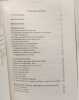
Le Monachisme En Perse: La Reforme D'abraham Le Grand Pere Des Moines De L'orient (Subsidia T.121 - Corpus Scriptorum Christianorum Orientalium Vol.622)
Peeters uitgeverij 2008 293 pages 16 002x2 032x23 368cm. 2008. Broché. 293 pages.
proche du très bon état intérieur propre bonne tenue
Sacred and the Secular in Renaissance Florence. Vallombrosan Exorcisms and the Rise of Observant Mendicancy
, Brepols, 2026 Hardback, Pages: 434, Size:156 x 234 mm, Illustrations:1 b/w, Language: English. ISBN 9782503585499.
Summary Seeking to heal people possessed by demons, stave off Lorenzo de' Medici's predations, and compete with the meteoric rise of Observant Mendicants - Franciscans and Dominicans - monks known as Vallombrosans performed multiple exorcisms in Florence and its countryside in the latter half of the fifteenth century. The accounts they wrote to publicize their efforts present an unusually lively survey of a little-studied sea change in late medieval religious life. In a religious landscape populated by Mendicant charlatans dressed as John the Baptist, concupiscent clerics, and pompous prelates, the Vallombrosans positioned themselves as committed to the decorous healing of Florentine peasants and nobles while weighing in on contemporary politics and claiming insight into Medici-related affairs such as the recent Pazzi Conspiracy. Yet traditional religious orders like the Vallombrosans and the Benedictines could not match the publicity, popularity, and secular political support garnered by Observant Mendicants in urban areas, and the latter's ascendance left religion at the end of the fifteenth century looking very different from what it had at its beginning. By the century's end, Observants predominated in influence, prestige, and patronage in cities across all of Europe. Sanctioning economic gain, addressing worldly moral dilemmas, and moving away from the older monastic focus on the dead and the afterlife, they shifted their focus to contemporary concerns. As over a traditional focus on communal life and monastic healing, Observants inaugurated individualistic forms of piety and fostered alternative forms of lay sociability and healing in the form of confraternities and urban hospitals. This rich study of the forces which impelled a group of Florentine monks to perform exorcisms opens a kaleidoscopic window onto religious practice, political and religious entanglements, and a decisive shift in religious and political life that transformed the fifteenth century. TABLE OF CONTENTS Introduction Vallombrosa and its Historians Observance and Reform; Political Flattery Laxity and Reform; Creativity and Vitality Observant Mendicancy Country and City: Political Self-Fashioning Method Uniqueness and Representation: Historiographies of Exorcism Publicity, Instrumentality, and Religious Conviction Historiographies Sacred and Secular 'Church-State' Relations at Florence Threats to Medieval Monasticism Chapter 1. Exorcisms, Miracles, And Manuscripts: How Vallombrosans found their Calling Recognizing Demoniacs Vallombrosans and their Exorcisms Chapter 2. Lorenzo De' Medici: Commenda and Observant Reform, Conspiracy and Monastic 'Decline' Lorenzo and Commenda Obeisance and Submission Chapter 3: Internal Schism: Observance, Organization, and Reputation Reform and Schism The Shape of Reform Undermining the Salvini Chapter 4. Peasants, Mules, and City-Country Divides City and Country The Social Profile of a Rural Monastery Vallombrosa and the Laity Conversi Vallombrosa's Radical Beginnings Laypeople, Clerics, and Observant Orthodoxy Chapter 5. Observant Mendicants: Devotional Change and Religious Rivalry Observance Preaching Theatrics and Spectacularity Affect and Emulation Observant Franciscans Confraternities and Good Deaths Augustinians Dominicans Chapter 6: Florence: Humanism, Fat Prelates, and Political Counsel Civicism Humanism Florentinity and Peasant Culture Religion at Florence: Traditional Saints Fat Prelates and Murmuring Seculars: Florence's Diocesan Church Medici Devotions Secular Control of the Countryside Chapter 7. Restoring Order: Pastoralism, Statebuilding, and Peacemaking Pastoral Care Exorcism and Sin; Preaching by Proxy Confession, Concupiscence, and Female Piety Biblicism Domestic Disruption Discord and Resolution From Family to Community Peacemaking, Communal Distress and Violence Chapter 8. Conclusions, Epilogues, and Legacies The Politics of Religious Ritual: Lorenzo and Savonarola Archives and the Future of Early Modern Studies Appendix: Fifteenth-Century Exorcism Manuscripts Bibliography Index
Church and Cistercians in Medieval Poland. Foundations, Documents, People
, Brepols, 2023 Hardback, 347 pages, Size:156 x 234 mm, Illustrations:14 b/w, 5 tables b/w., 6 maps b/w, Language: English. ISBN 9782503598024.
Summary In this volume, the research of Józef Dobosz, one of Poland's leading historians of the Middle Ages, is made accessible in English for the first time. It brings together nineteen studies focused on the role of the Church, the Cistercian Order, and other religious institutions in the history of the Piast realm from which Poland emerged. The introduction offers a broad outline of the first two centuries of the rule of the Piast dynasty after the Baptism of Poland in 966 until the fragmentation of the Piast patrimony during the twelfth century. The subsequent essays examine the circumstances of the foundation of Poland's leading Cistercian monasteries in Sulejów, J?drzejów, W?chock, Owi?ska, and ?ekno. The author analyses the means of their establishment, evaluates the existing sources, and places these within the context of the Piast dynasty's economic, political, and social policies. The studies offer an in-depth analysis of the motivations of the leading dynasts, magnates, and prelates in supporting the mission of the Church in Poland and enabling further embedding of Christianity across all strata of the society. The author examines the oldest Polish documents related to Cistercian monasteries and canons regular (in particular foundation charters) including early medieval charter forgeries. The volume's key conclusions about the impact of Christianity on nascent Poland are based on a detailed examination of medieval charters, the role of scriptoria, identities of significant people of the Church, and the wider historical record. TABLE OF CONTENTS Introduction Chapter 1. The Church and Christianity in Poland before 1300 Part I - Foundations Chapter 2. The Piasts, the Premonstratensians and Other Religious Orders of Canons Regular in the Twelfth Century Chapter 3. The Earliest Evidence for Kazimierz II as Patron and Founder Chapter 4. The Foundation of ?ekno Abbey in the Context of Twelfth-Century Polish Cistercian Institutions Chapter 5. The Foundation Process and the Early Endowment of J?drzejów Abbey Chapter 6. The Circumstances of the Founding of the Cistercian Monastery at Sulejów Chapter 7. The Founder and the Beginnings of the Cistercian Monastery at W?chock Chapter 8. Churches in the Endowments to Polish Cistercian Monasteries in the Twelfth and Early Thirteenth Centuries Chapter 9. The Foundation of Owi?ska Abbey in the Light of the Earliest Written Records Part II - Documents Chapter 10. The Written Document in Medieval Poland Chapter 11. Research on the Documents and Scriptoria of the Polish Cistercians? Chapter 12. Forgeries as a Subject of Research of Polish Diplomatics of the Middle Ages Chapter 13. Legitimisation of Forged Documents in Twelfth- and Thirteenth-Century Poland Chapter 14. The False Thirteenth-Century Documents of the Cistercian Abbeys at Sulejów and J?drzejów Chapter 15. The Diploma of Mieszko III for the Canons Regular in Trzemeszno (28 April 1145) Chapter 16. The Foundation Charter of the Cistercian Abbey at ?ekno Part III - People Chapter 17. Maur, Bishop of Kraków Chapter 18. Archbishop Janik and His Successors: Preparation for the Reform of Henryk Kietlicz Chapter 19. Thirteenth-Century Abbots of the Cistercian Abbey at W?chock Chapter 20. The Cistercians in Ma?opolska and Their Position in the Economy and Culture of Thirteenth-Century Poland Bibliography Index
The Monastic Holy Man and the Christianization of the Early Solomonic Ethiopia (Studien zur Kulturkunde)
Franz steiner verlag 1984 150 pages in8. 1984. Broché. 150 pages. Cet ouvrage académique examine le rôle des saints hommes monastiques dans la christianisation de l'Éthiopie durant la période salomonienne précoce (1270-1468). Il analyse leur émergence dans le contexte social politique et religieux de l'époque ainsi que leurs fonctions au sein des sociétés chrétiennes et non-chrétiennes en s'appuyant sur la littérature hagiographique de l'Église éthiopienne
Bon état intérieur propre bonne tenue
Klára Benesovská, Tanja Michalsky, Daniela Rywiková, Elisabetta Scirocco (eds)
Reference : 64777
Royal Nunneries at the Center of Medieval Europe. Art, Architecture, Aesthetics (13th-14th Centuries)
, Brepols, 2022 Paperback, 165 pages, Size:210 x 270 mm, Language: English. ISBN 9788028000233.
Summary The contributions of this special issue - proceedings of the conference on royal nunneries that took place in Prague in July 2020 - focus on the monasteries connected to the ruling houses, which were endowed with special privileges and enriched by royal and aristocratic donations, often serving as instrumenta regni. They are introduced as active cultural hubs, stages for royal and courtly promotion, and places of personal and dynastic self-representation. This includes female monasteries, the agency of female élites in medieval society and their role as patrons and addressees of works of art. TABLE OF CONTENTS Jakub Adamski, Pjotr Pajor The Architecture of Poor Clares' Nunnery in Stary S?cz and Early Fourteenth-Century Artistic Relations between Lesser Poland and Upper Rhineland Angelica Federici Rome, Barons and Nunneries Art, Architecture and Aesthetics in Convents in Medieval Latium Jenny Vl?ek Schurr Function and Faith: Revisiting the Role of Hospital, Church, and Chapel in the Convent of St. Francis, Prague Giulia Rossi Vairo Seeing Double in Odivelas Nuns and Monks at the Monastery of St Dinis, a Royal Pantheon in Late Medieval Portugal Susan Marti Networking for Eternal Salvation? Agnes of Habsburg, Queen of Hungary and Co-Founder of Königsfelden Agnieszka Pata?a The Medieval Furnishings of the Convent of Poor Clares in Breslau Eszter Konrád 'Helisabet filia Stephani regis ungarorum illustris' Image of a Saintly Nun of the Arpad Dynasty as Reflected in Hagiographic Sources Michaela Zöschg Beyond Naples. Fourteenth-Century Royal Widows and their Clarissan Foundations in a Trans-Regional Perspective
INVENTAIRE DES ARRÊTS DU CONSEIL DU ROI, JANVIER-FÉVRIER 1740
, Paris, Sirey 1940, in-8, br., non rogné, très bon état, 268p.
Phone number : 01 43 29 46 77
LES DÉPUTÉS DU COMMERCE ET L’ORDONNANCE DE MARS 1673, Les juridictions consulaires: Principe et compétence, Préface de Jean Imbert
, Paris, Cujas 1979, in-8, br., ENVOI DE L’AUTEUR, (couv. légt insolée), bon état, 153p.

Phone number : 01 43 29 46 77
LES DÉPUTÉS DU COMMERCE ET L’ORDONNANCE DE MARS1673, Les juridictions consulaires: Principe et compétence, Préface de Jean Imbert
, Paris, Cujas 1979, in-8, br., bon état, 153p.
Phone number : 01 43 29 46 77
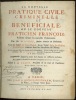
LA NOUVELLE PRATIQUE CIVILE, CRIMINELLE ET BENEFICIALE, OU LE NOUVEAU PRATICIEN FRANÇOIS, réformé suivant les nouvelles Ordonnances, par feu M.LANGE. Avec un traité du DROIT D’INDULT, & un traité de la JURISDICTION ECCLÉSIASTIQUE, trouvez dans les manuscrits de l’auteur. Et un nouveau Stile des Lettres de la Chancellerie, suivant l’usage qui se pratique à présent: par M.PIMONT, Conseiller Rapporteur Référendaire en la même Chancellerie. Augmentée depuis la mort de l’Auteur en différents endroits. On a inséré à la fin differents Modèles de Requêtes & Écritures d’Avocats. Dédiée à M.TALON, Président en la cour de Parlement, 11èmeéd.
, Paris, Jean & Michel Guignard 1717, 2 t. en 1 vol. in-4, basane brune, dos à nerfs orné, tr. jaspées, vignettes et lettrines, Ex-Libris en p. de tit., (plats frottés, épissures sur 2ème plat, mors sup. fendus, ors passés, mq. la coiffe de tête et de queue, coins fortement émoussés avec mq. sur 6 cm2, qq. piqures), exemplaire fatigué, (5 f.)- 464/ 396p.

Phone number : 01 43 29 46 77
DÉCISIONS SOMMAIRES DU PALAIS, MISES PAR LETTRE ALPHABÉTIQUE, ILLUSTRÉES DE NOTES autorisées par l’Usage et la Jurisprudence des Arrêts
, Bordeaux, Simon Boudé/ Charles Labottière / Raymond Labottière (?) 1725 (?), in-folio, rel. pl. veau brun, dos à nerfs orné, lettrines, vignettes et culs-de-lampe, (reliure en très mauvais état avec manques et épidermures, p. de tit. et début de la première Table alphabétique manquants jusqu’à la lettre “P”, gardes tachées et abîmées, mouillures et taches d’encre), 6 f.-539p. + table alphabétique.

Phone number : 01 43 29 46 77
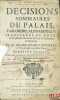
DÉCISIONS SOMMAIRES DU PALAIS, PAR ORDRE ALPHABÉTIQUE, ILLUSTRÉES DE NOTES & DE PLUSIEURS ARRÊTS DE LA COUR DE PARLEMENT DE BORDEAUX, dernièreéd. revue, corrigée & augmentée d’un grand nombre de Décisions & d’Arrêts recueillis des Mémoires de plusieurs Illustres Sénateurs de ce Parlement
, Bordeaux, Nicolas de la Court / Guillaume Boudé-Boé 1717, in-folio, basane brune mouchetée, dos à nerfs orné, tit. doré au dos, tr. mouchetées, lettrines, vignettes et culs-de-lampes, Ex-Libris manuscrits anciens, (éraflures, épidermures, manques sur les plats, au dos, aux coupes et aux coins, contre plats tachés, p. de tit. détachée, fanée avec manques et taches, rousseurs et mouillures, déchir. à la p. 209-210, restaurée, dernier ff. partiellement détaché), (5 f.) -540p.- 3 f.

Phone number : 01 43 29 46 77