 Write to the booksellers
-
Type
Book (714)
Magazine (3)
Music sheets (3)
-
Latest
Last 3 days (2)
Last month (11)
Last week (1)
-
Language
Dutch (1)
English (1)
French (715)
Latin (3)
-
Century
16th (19)
17th (21)
18th (46)
19th (54)
20th (191)
21st (20)
-
Countries
Belgium (125)
Brazil (1)
Canada (7)
Denmark (23)
France (408)
Germany (3)
Netherlands (73)
Switzerland (80)
-
Syndicate
ALAC (7)
CLAM (8)
CNE (3)
ILAB (209)
NVVA (14)
SLACES (14)
SLAM (148)
L'éloge de la folie, traduit du Latin d'Erasme par M. Gueudeville. Nouvelle édition revue & corrigée sur le texte de l'édition de Bâle, et ornée de nouvelles figures, avec des notes.
O.O., 1757. 8°. (6) XXIV, 222 S., (1) Bl. Mit 1 gest. Frontispiz u. 1 gest. Titelvignette sowie 13 gest. Tafeln u. 2 gest. Textillustr. Lederband der Zeit mit Rückenvergoldung.
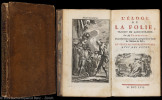
Mit Exlibris. Papier gebräunt und stockfleckig. Der Einband berieben und bestossen. Die Einbandgelenke angeplatzt.

Erasmus von Rotterdam, Desiderius (eig. Gerard Gerads) (1466?-1536):
Reference : 686CG
(1600)
Niederl. Humanist u. Theologe.
Um 1600. Kupferstich (Brustbild) mit der Ansicht der Stadt Rotterdam von Bleujwyk (?). Blattgrösse: 14 x 8,5 cm.
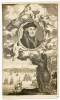
Knapp beschnitten.
URANIUM. UN ESPOIR, UNE MENACE, UN PROBLEME.
ANDRE BONNE. 1960. In-12. Broché. Etat d'usage, Couv. légèrement passée, Dos plié, Intérieur frais. 225 pages. Premier plat illustré en noir et blanc. Quelques planches de photos en noir et blanc.. . . . Classification Dewey : 621-Energie
Classification Dewey : 621-Energie

URANIUM un espoir, une menace, un problème.
EDITIONS ANDRE BONNE. 1960. In-12. Broché. Bon état, Couv. convenable, Dos satisfaisant, Intérieur frais. 225 pages. Quelques photographies en noir et blanc, hors texte. Etiquette de classement sur le dos. Tampon de l'institution sur la page de titre et sur quelques pages.. . . . Classification Dewey : 530-Physique

Traduit de l'allemand par André Pougetoux Classification Dewey : 530-Physique
URANIUM un espoir, une menace, un problème. [Paperback] ERWIN ERASMUS KOCH
Broché bon état. Contenu propre . Plis dos . Coins cornés. 1960. 225 pages . URANIUM un espoir, une menace, un problème.PHOTOS SUR DEMANDE
Merci de nous contacter à l'avance si vous souhaitez consulter une référence dans notre boutique à Authon-du-Perche.
Ethno-Psychologie - suite à la Revue de Psychologie des Peuples - Publication du Centre Universitaire de Psychologie des Peuples- ethnologieSommaire : Erasme et l'Europe Un témoin de l'Europe - Erasme et la psychologie des peuples ( Jean-Claude Margolin ) Erasme jadis et aujourd'hui ( Werner Kaegi ) - Erasme pélerin de l'Europe ( " civisme européen " ) - Erasme et la France ( André Stegmann ) - Il n'est pire que sourd. Erasme et Rucellai ( Bernard Guillemain ) - Le socialisme de Vivès ( Alain Guy ) - Bibiographie - Chronique - Nouvelles du Centre
1970 1 vol in-8 broché - 110 pages - 25ème année - N° 4 - décembre 1970
Bon état de conservation
Spiritualisme érasmien et théologiens louvanistes. Un changement de problématique au début du XVIe siècle
Louvain / Gembloux, Publications Universitaires de Louvain / Duculot 1956 xxvi + 201pp., 26cm., dans la série "Universitas Catholica Lovaniensis. Dissertationes ad gradum magistri in Facultate Theologica vel in Facultate Iuris Canonici consequendum conscriptae" Series 3 Tomus 3, brochure originale, non coupé, très bel état, texte en français, R74369
Etudes Rabelaisiennes - tome XXXIX (La santé des monstres : tératologie et thérapeutique dans le Quart Livre de Rabelais (François Rigolot) - Lesperon de discipline d'Antoine Du Saix (1532) et l'imprimeur de Pantagruel, Claude Nourry dit "le Prince" - Notes sur les enchaînements dans l'oeuvre de François Rabelais - ...)
N° 344 - grand in-8 reliure toile rouge éditeur - 2000 - 174 pages - Ed. Librairie Droz S. A. Genève - coll. Travaux d'Humanisme et Renaissance N° XXXIX
bon état
EUCHERIUS LUGDUNIENSIS (OF LYON) + RADULPHUS FLAVIACENSIS [RODULFUS TORTARIUS - RAOUL OF TOURTIER]. [+ Commentaries by ERASMUS ROTERODAMUS].
Reference : 47178
(1531)
[Eucherius:] Lucubrationes aliquot non minus piae quam eruditae, cura ac beneficio Ioannis Alexandri Brassicani iu- resulti recens editae, quarum haec est summa, : In Genesim Commentariorum Libri III In Libros Regum Commentariorum Libri IIII Formula... - [IMPORTANT BIBLICAL COMMENTARIES AND OTHER RELIGIOUS WORKS]
Basel, Froben, 1531 + Coloniae, Petrus Quentell, 1536. Folio. Bound together in a beautiful contemporary full calf binding over wooden boards. Blindstamped ornamental frames to boards. Five raised bands to spine. Remains of brass clasps to boards. Brass at corners of boards and brass strips to bottom edges of boards. A tear through the letter at the lower capital, no loss. Some scrathing of leather, mostly to back board and upper part of spine. The titles of the two works written in contemporary hand to the outer edge. The strong vellum cords, which go through the the wooden boards can be seen on the inside of the wooden boards, which also have some initials in red and blue paint, possibly from a painted leaf that has rubbed off? First title-page a bit dusty, otherwise very nice, clean, and crisp throughout. [Eucherius:] Froben printer's device to title-page, to final leaf of the first part, to the half-title of the second part (Episcopi Commentariorum in libros Regum ad Veranium & Salonium) and to the last leaf of that part. Beautiful large woodcut initial at beginning of each new work. (8), 194, (2)" 310, (2) pp.[Radulphus:] Woodcut device to title-page. Numerous beautiful woodcut, allegorical initials, both large and smaller, throughout. (4 - title, dedications), (14 - index), (6), 314 pp.
First editions of both works, being the first edition of the works [""Several Studies""] of St. Eucharius, most of them printed for the first time here, as well as the first edition of Rodulfus Tortarius' (or Radulphus Flaviacensis) commentaries of Leviticus (the third of the Books of Moses), written in Latin, in 20 books. Saint Eucherius, bishop of Lyon, (ca. 380 - ca. 449) was a high-born and high-ranking ecclesiastic in the Christian Church of Gaul. He is remembered for his letters advocating extreme self-abnegation. Henry Wace ranked him ""except perhaps St. Irenaeus the most distinguished occupant of that see"".""St. Eucherius Bishop of Lyons, theologian, born in the latter half of the fourth century"" died about 449. On the death of his wife he withdrew to the monastery of Lérins, where his sons, Veranius and Salonius, lived, and soon afterward to the neighbouring island of Lerona (now Sainte-Marguerite), where he devoted his time to study and mortification. Desirous of joining the anchorites in the deserts of the East, he consulted John Cassian, who, in reply, sent him some of his ""Collationes"", describing the daily lives of the hermits of the Thebaid. It was at this time that Eucherius wrote his beautiful letter ""De laude Eremi"" to St. Hilary of Arles (c. 428). Though imitating the virtues of the Egyptian solitaries, he kept in touch with men renowned for learning and piety, e.g. Cassian, St. Hilary of Arles, St. Honoratus, later Bishop of Marseilles, and Valerian, to whom he wrote his ""Epistola parænetica de contemptu mundi"". The fame of Eucherius was soon so widespread in southeastern Gaul, that he was chosen Bishop of Lyons. This was probably in 434"" it is certain, at least that he attended the First Council of Orange (441) as Metropolitan of Lyons, and that he retained this dignity until his death. In addition to the above-mentioned letters, Eucherius wrote ""Formularium spiritualis intelligentiæ ad Veranium"", and ""Institutiones ad Salonium"", besides many homilies. His works have been published both separately and among the writings of the Fathers."" (Catholic Encyclopedia). His ""Epistola paraenetica ad Valerianum cognatum, de contemptu mundi (""Epistle of exhortation to his kinsman Valerian, On the contempt of the world"") is an expression of the despair for the present and future of the world in its last throes shared by many educated men of Late Antiquity, with hope for a world to come. Erasmus thought so highly of its Latin style that he edited and published it at Basel in 1520. His commentaries on the work are also included here. His ""Liber formularum spiritalis intelligentiae"", which is addressed to his son Veranius is a defence of the lawfulness of reading an allegorical sense in Scripture, bringing to bear the metaphors in Psalms and such phrases as ""the hand of God"" The term anagoge [in Greek] is employed for the application of Scripture to the heavenly Jerusalem to come, and there are other examples of what would become classic Medieval hermeneutics.Rodulfus Tortarius (also known as Raoul of Tourtier, Raoul de La Tourte, Radulphus Flaviacensis) (c.1063 - c.1122) was a French Benedictine monk of the Abbey of Fleury-sur-Loire, and a poet writing in Latin. He is known both for his style of writing, his biblical commentaries and religious works, and his literary and comic tales. His commentary on ""Leviticus"" is considered important and influential. The first edition of the work is rare.
Euripidis tragoediae duae, Hecuba et Iphigenia in Aulide, latinae factae, Des. Erasmo.
Bâle, Johann Froben, 1524. In-8 de 140 feuillets [a-r8; s4] plein vélin ivoire à rabats, deux lacets, chemise, étui.
Première traduction d'une tragédie grecque.Érasme est le premier à avoir traduit en latin une tragédie grecque complète, l’Hécube d’Euripide. Il s’efforce de ne pas s’inspirer de Sénèque, dont le style lui semble trop ampoulé pour rendre justice à l’élégance d’Euripide. (Malika Bastin-Hammou: Les traductions latines du théâtre grec.) Cette traduction eut une influence considérable sur le développement du théâtre de la Renaissance jusqu’à Shakespeare. En adoptant le principe du texte grec et de la traduction latine en regard, Érasme entendait développer l’étude du Grec. C'est la seconde édition donnée par Froben (la première en 1518).Exemplaire lavé, ce qui a éclairci les nombreuses marginalia du temps. Tampon sur la page de titre (non identifé).VD16 E 4230.
EUROPE - Revue mensuelle (Janvier 1970) Erasme - Henri Hertz
1970 Paris, Europe et Les Editeurs Français Réunis, 1970, In huit, 281 pp, broché, couverture illustrée,
Numéros 489, correspondant à la 48ème année.
EUSTACHIUS DE ZICHINIS [Eustachius van Zichem] (& COPPENS Joseph, ed.)
Reference : R40184
(1975)
Eustachius de Zichinis Erasmi Roterodami canonis quinti interpretatio - le dernier écrit louvaniste anti-érasmien édité, introduit et annoté par Joseph Coppens
Brussel, Paleis der Academiën 1975 119pp.+ frontispice, [introduction en français, samenvatting in het Nederlands, textes originaux en latin], dans la série "Verhandelingen van de Koninklijke Academie voor Wetenschappen,, Letteren en Schone Kunsten van België. Klasse der Letteren" jg.37 1975, bel état, R40184
EUSTACHIUS DE ZICHINIS [Eustachius van Zichem] (& COPPENS Joseph, ed.)
Reference : R117668
(1975)
Eustachius de Zichinis Erasmi Roterodami canonis quinti interpretatio - le dernier écrit louvaniste anti-érasmien édité, introduit et annoté par Joseph Coppens
Brussel, Paleis der Academiën 1975 119pp.+ frontispice, [introduction en français, samenvatting in het Nederlands, textes originaux en latin], dans la série "Verhandelingen van de Koninklijke Academie voor Wetenschappen, Letteren en Schone Kunsten van België. Klasse der Letteren" jg.37 no.75, reliure cart. Solide (peu tachée), bon état, R117667
Erasme. Etude sur sa vie et ses ouvrages
Paris, Hachette 1874 xvi + 457 + [2] pp., 23cm., reliure moderne cart. (plats marbrés, dos en toile avec titre doré, br. orig. conservée), avec signet, qqs. rousseurs, bon état, G94252
Il lamento della pace (TEA)
TEA 1993 100 pages 10 9cm x 18 0cm x 1 4cm. 1993. Broché. 100 pages.
Bon état quelques rousseurs sur la tranche intérieur propre bonne tenue
FLAVII IOSEPHI ANTIQUITATUM IUDAICARUM Libri XX adiecta in fine appendicis loco Vita Iosephi per ipsum conscripta, à Sigismundo Gelneio conuersi. DE BELLO IUDAICO libri VII, ex collatione Graecorum codicum per Sig. Gelenium castigati. CONTRA APIONEM libri II, pro corruptissimis antea, iam ex Graeco itidem non solum emendati, sed etiam suppleti, opear eiusdem Gelenij. DE IMPERIO RATIONIS sive de Machabaeis liber unus à Des. Erasmo Roterodamo recognitus. Cum Indice accuratissimo.
Bâle 1559 1 Basilea: Per Hier. Frobenium et Nicol. Episcopium, 1559. In-4: 23 x 33,5 cm, 6 ff. n. chiff. [titre, tables], 886 pp. [Antiquitatum Judaicarum Liber I-XX; Flavii Josephi vita; De bello Judaico Liber I-VII; Contra Apionem Liber I-II; De Machabaeis]+ 17 ff. n. chiff. [index, colophon]. Nouvelle édition, augmentée et révisée, de ce Flavius Joseph des Froben de Bâle paru pour la première fois en 1534. Traduction latine par lhumaniste tchèque par Sigmund Gelen (1497-1554) du corpus josephien comprenant Les antiquités judaïques, La guerre des Juifs, lAutobiographie de Flavius Josèphe, Contre Apion. À cela sajoute le De Imperio rations, ou De Machabaeis, édité quand à lui par Erasme (1467-1536). Marque des Froben à la page de titre et au colophon. (Heinz Schreckenberg, Bibliographie zu Flavius Josephus, I, Leiden, 1968, p. 14)Reliure de la première moitié du XVIIIe en veau blond. Dos à cinq nerfs avec pièce de titre en maroquin rouge et caissons ornés aux petits fers. Toutes tranches rouges. Ex-libris manuscrit à la page de titre: «Renatus Guillaume Presbiter 1729». Ex-libris: «André Gutzwiller». Coupe du plat supérieure abîmée. Larges mouillures aux premiers et derniers ff., sans altération du contenu. Quelques marginalia. Désirable pour la somptueuse typographie des Froben!
FLEMISCH PAINTING From the 16th to the 18th century. Relaying ideas from Erasmus to Diderot
Turin, Umberto Allemandi & C., 2010 320pp Misure: 24 x 31 cm Illustrazioni: 320 col. Hardback english deutsch nederlands francais preface by Emmanuel Le Roy Ladurie ISBN 978884221837197.
Real? honest men?, the Brueghels took part in the intellectual epic of their day which, from humanism to the spirit of the Enlightenment, brought about a renewal in thought and laid the foundations of Modernity. Through the human adventure of the Brueghel dynasty, progressing from obscure beginnings to recognition by the very greatest, Florence de Voldere introduces us to the genius of these men who created the Flemish aesthetic identity. She takes us through the Renaissance in Flanders in the form of a story in pictures. Through this approach based on a dynamic reading of the paintings, this book shows the crucial role of art at one moment of civilization, and opens up some decidedly novel perspectives for interpreting Flemish art.
Vlaamse schilderkunst van de XVIde tot de XVIIIde eeuw.
Turin, Umberto Allemandi & C., 2010 320pp Misure: 24 x 31 cm Illustrazioni: 320 col. Hardback nederlands preface by Emmanuel Le Roy Ladurie ISBN 9788842219590.
Real honest men, the Brueghels took part in the intellectual epic of their day which, from humanism to the spirit of the Enlightenment, brought about a renewal in thought and laid the foundations of Modernity. Through the human adventure of the Brueghel dynasty, progressing from obscure beginnings to recognition by the very greatest, Florence de Voldere introduces us to the genius of these men who created the Flemish aesthetic identity. She takes us through the Renaissance in Flanders in the form of a story in pictures. Through this approach based on a dynamic reading of the paintings, this book shows the crucial role of art at one moment of civilization, and opens up some decidedly novel perspectives for interpreting Flemish art.
Das unfehlbare Weh der Ewigkeit fur die Verachter der Gnaden-Zeit. Mit grund-erwiesenem Bericht von der Hellen und ihrer Gewissheit, von der verzweifelten Hinfshrt verfluchter Seelen an den Ort der Quaal (...). - [RICHLY ILLUSTRATED WITH VARIOUS ROADS OF HELL]
Nurnberg, W.M. Endters, 1682 8vo. In a nice contemporary Cambridge-style mirror binding with four raised bands and richly gilt spine. Small paper-label pasted on to top of spine. A very nice copy. (28), 1195, (5) pp. + frontispiece and 51 engraved plates.
Rare first edition of Franciscus' extensive work richly illustrated with exotic depictions of the road to hell. A second edition was published in 1686. German Emblem Books 1531-1888: 290.
Ost- und West-Indischer wie auch Sinesischer Lust- und Stats-Garten.
Nuremberg, Johann A. Endters and Wolfgang Sel, 1668. 1668 3 parties reliées en 2 vol. in-folio (318 x 202 mm. de: [20] ff. (frontispice gravé, titre en rouge et noir, armes de Leopold I gravées par C.N. Schurtz, dédicace, liste des auteur), 1762 pp. ; [18] ff. (tables) ; 65 gravures à pleine page numérotées de 1 à 63, avec les planches 45 et 47 doublées (titre et feuillet de dédicace rognés courts, petite découpe comblée dans la marge du titre). Reliure à paneaux mosaïqués d'époque, dos à nerfs orné, titres de maroquin rouge, tranches marbrées ( dos restauré avec dos ancien conservé).
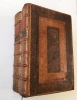
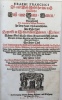
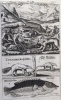
Edition originale de cet ouvrage du à Erasmus Francisci (Lübeck 1627, Nuremberg 1694). Polymath, il est surtout connu pour sa collection infatigable de toutes sortes de folklore, d'histoire naturelle et d'ethnographie; ses études massives, souvent publiées sous des pseudonymes de société, ont été des best-sellers dans l'Europe du XVIIe siècle. Il est considéré comme lune des personnalités les plus influentes de la période baroque allemande. Dans son présent ouvrage, les descriptions d'histoire naturelle sont entrecoupées de réflexions ethnographiques, de conseils homéopathiques sur les médecines traditionnelles et d'histoire de l'exploration et de l'expansion européennes, à la fois réelles et fabuleuses. Les trois livres de ce vaste ouvrage traitent de l'histoire naturelle, des coutumes et des curiosités des Indes orientales et occidentales et les Amériques, avec beaucoup de détails très curieux, dont une spéculation sur un combat entre un tigre et un dragon, l'anatomie des sirènes et les tortues volantes de Chine. Liconographie de louvrage présente des sujets multiples, beaucoup sont consacrées à la botanique. Avec une somptueuse série de planches détaillées, dont deux vues de Batavia (fondée en 1623), montrant le port rempli de jonques et divers navires. Bel exemplaire. 3 parts bound in 2 vol. in-folio of: [20] ff. ; 1762 pp., [18] ff. ; 65 full-page engravings numbered from 1 to 63, with plates 45 and 47 line. 17th-century paneled calf gilt. First edition of this work by Erasmus Francisci (Lübeck 1627, Nuremberg 1694). Polymath, he is best known for his indefatigable collection of all kinds of folklore, natural history and ethnography. His massive studies, often published under pseudonyms of society, were best-sellers in the seventeenth century Europe. He is considered one of the most influential personalities of the German Baroque period. In his present work, descriptions of natural history are interspersed with ethnographic reflections, homeopathic advice on traditional medicine and history of European exploration and expansion, both real and fabulous. The three books of this vast work deal with the natural history, customs and curiosities of the East and West Indies and the Americas, with many very curious details, including a speculation about a fight between a tiger and a dragon, the Anatomy of the sirens and flying turtles from China. The iconography presents multiple subjects, many devoted to botany. With a sumptuous series of detailed planks, including two views of Batavia (founded in 1623), showing the harbor filled with junks and various ships. Fine copy.
Franck L. Schoell - M. Ficinus, L. Gyraldus, N. Comes, D. Erasmus, G. Xylander, H. Wolfius, H. Stephanus, J. Spondanus, avec une préface par Émile Legouis
Reference : 46671
(1926)
Études sur l'humanisme continental en Angleterre à la fin de la Renaissance
1926 PARIS, H. Champion - 1926 - 1 ère Edition - In-8 - Broché - couverture rempliée - VII-268 pages + Table - Exemplaire non coupé - comme neuf
Conformément à nos conditions générales de vente :Les frais de port sont affichés à titre indicatif. Il se peut que nous devions vous contacter pour vous informer du coût de laffranchissement supplémentaire en fonction du poids et du nombre de livres, surtout pour les envois internationaux Cependant vu l'augmentation des tarifs postaux à l'internationale, nous pouvons expédier les ouvrages en point relais MONDIAL RELAY pour les pays suivants : Allemagne, Autriche, Belgique, Espagne, Italie, Luxembourg, Pays-Bas, Pologne, et Portugal. Merci de nous indiquer en retour le point relais choisi ainsi que votre numéro de téléphone mobile & adresse Courriel pour assurer le suivi du colis.N'hésitez pas à nous interroger.In accordance with our general terms and conditions of sale:Shipping costs are displayed for informational purposes only. We may need to contact you to inform you of the additional postage costs depending on the weight and number of books, especially for international shipments.However, given the increase in international postal rates, we can ship books via Mondial Relay to the following countries: Germany, Austria, Belgium, Spain, Italy, Luxembourg, Netherlands, Poland, and Portugal. Please provide us with your chosen Mondial Relay point, as well as your mobile phone number and email address to ensure package tracking.Please feel free to contact us with any questions
Franck L. Schoell - M. Ficinus, L. Gyraldus, N. Comes, D. Erasmus, G. Xylander, H. Wolfius, H. Stephanus, J. Spondanus - Avec une préface par Émile Legouis, professeur à la Sorbonne
Reference : 49651
(1926)
Études sur l'humanisme continental en Angleterre à la fin de la Renaissance
1926 PARIS, H. Champion, Bibliothèque de la Revue de Littérature Comparée, dirigée par MM. Baldensperger et Hazard - 1926 - Edition Originale - In-8 - Broché - couverture rempliée - VII-268 pages + Table - Exemplaire non coupé - comme neuf - Réf. 49651
Conformément à nos conditions générales de vente :Les frais de port sont affichés à titre indicatif. Il se peut que nous devions vous contacter pour vous informer du coût de laffranchissement supplémentaire en fonction du poids et du nombre de livres, surtout pour les envois internationaux Cependant vu l'augmentation des tarifs postaux à l'internationale, nous pouvons expédier les ouvrages en point relais MONDIAL RELAY pour les pays suivants : Allemagne, Autriche, Belgique, Espagne, Italie, Luxembourg, Pays-Bas, Pologne, et Portugal. Merci de nous indiquer en retour le point relais choisi ainsi que votre numéro de téléphone mobile & adresse Courriel pour assurer le suivi du colis.N'hésitez pas à nous interroger.In accordance with our general terms and conditions of sale:Shipping costs are displayed for informational purposes only. We may need to contact you to inform you of the additional postage costs depending on the weight and number of books, especially for international shipments.However, given the increase in international postal rates, we can ship books via Mondial Relay to the following countries: Germany, Austria, Belgium, Spain, Italy, Luxembourg, Netherlands, Poland, and Portugal. Please provide us with your chosen Mondial Relay point, as well as your mobile phone number and email address to ensure package tracking.Please feel free to contact us with any questions
Erasme et ses portraitistes Metsijs-Durer-Holbein
, Antwerpen, Mercatorfonds, 1969, 2de druk, Originele uitgeversomslag, in goede staat, 72pp., 25cm x 16,5cm, ills. in z/w.
Limited edition of 500 signed and numbered copies on Verge Hollande with watermark.
Erasmus en zijn portrettisten Metsijs Dürer Holbein
Antwerpen, Ontwikkeling 1968 59pp.+ 17 buitentekstills.

