 Write to the booksellers
-
Type
Books (701)
Magazines (3)
Music sheets (4)
-
Latest
Last 3 days (1)
Last month (9)
Last week (5)
-
Language
Dutch (1)
English (1)
French (703)
Latin (3)
-
Century
16th (20)
17th (21)
18th (45)
19th (54)
20th (191)
21st (10)
-
Countries
Belgium (125)
Brazil (1)
Canada (7)
Denmark (24)
France (394)
Germany (3)
Netherlands (73)
Switzerland (81)
-
Syndicate
ALAC (7)
CLAM (8)
CNE (3)
ILAB (211)
NVVA (15)
SLACES (15)
SLAM (148)
Magni Des. Erasmi Roterodami vita; partim ab ipsomet Erasmo, partim ab amicis aequalibus fideliter descripta. Accedunt Epistolae illustres plus quam septuaginta, quas aetate provectiore scripsit, nec inter vulgatas in magno volumine comparent, P. Scriverii, & fautorum auspiciis.
Leiden (Lugduni Batavorum), Ex officina Ioannis Maire, 1642.


12mo. (XXXIV),394,(2 blank) p. Overlapping vellum 13 cm (Ref: Breugelmans p. 494, 1642:7) (Details: Boards with blind double fillet borders. Woodcut printer's mark on the title, depicting a farmer stamping a shovel into the ground, above the head of the farmer the motto 'fac et spera'. Woodcut portrait of Erasmus in the introduction. Pages 1-160 contain the biography of Erasmus, p. 161-394 the more than 70 letters of him) (Condition: Lacking the frontispiece. Vellum age-toned, stained and soiled. Manuscript title on the back. Front hinge cracking. Title slightly thumbed and soiled. Old ownership entry on the title. Almost invisible wormhole in the blank lower margin of 50 pages at the beginning. Occasionally small and old ink notes in the margins of 19 pages. Some pencil stripes. (See the provenance for the maker of these notes)) (Note: Joannes Maire, publisher, printer and bookseller in Leiden, 1603-1657, produced during his career a number Erasmus of editions. The project 'that can be seen as a series, and which ensured Maire's reputation through the ages, is undoubtedly his edition of Erasmus's 'opera omnia' in 12mo. 23 different volumes appeared between 1641 and 1652. The first half of this book contains the introduction and the biographic sketches, the rest is filled with the letters of Erasmus) (Provenance: Inscription in small type on the title: 'Liber Guilhelmi Griffithii Anglo-Brittani Artium Magistri Cantebrigensis; emtus 1.6. 1664'. Ink annotations of William Griffith in the margins of 19 p. We couldnot find this William Griffith in J. Venn & J.A. Venn's 'Alumni Cantabrigienses: A Biographical List of All Known Students, Graduates and Holders of Office at the University of Cambridge, from the earliest times to 1900', Cambridge 1947) (Collation: *12 (minus leaf *1, the frontispiece); 2*6, A-Q12, R6) (Without the 2 conjugate leaves with the portrait and coat of arms of Thomas Neale, which according to Breugelmans only some copies have)) (Photographs on request)
Moriae Encomium, dat is De lof der zotheid. MÔRIAS EGKÔMION, id est Stultitiae Laus. (Vertaald door J.M. Vermeer-Pardoen) Tweede druk.
Utrecht, Het Spectrum, 1998.
299 p. Paperback 20 cm (39 pages with notes)
Moriae encomium, dat is De lof der zotheid. (Vert. door A. DIRKZWAGER & A.C. NIELSON.
Amst., Paris, 1949.
8,327 p. Cloth. 20 cm (Latin text & Dutch translation)
Moriae encomium, dat is De lof der zotheid. (Vert. door A. DIRKZWAGER & A.C. NIELSON. Illustraties in de marge naar de originele tekeningen van H. HOLBEIN).
Amsterdam, Paris, n.d.
331 p. Paperback (Latin text & translation)
MÔRIAS EGKÔMION. Id est Stultitiae laus. Erasmi Roterodami declamatio. Ad fidem editionis antiquae Frobenii figuris Holbenianis ornata. Cum duabus Erasmi epistolis ad Martinum Dorpium et ad Thomam Morum. Accessit dialogus Epicureus.
Leiden (Lugduni Batavorum), Apud D. Noothoven van Goor, 1851.
XL,233 p.; illustrations in the text, 2 portraits. Half calf. 24 cm (Details: Rebound in antique style. Back with 5 raised bands. Portrait of Erasmus lithographed by H.J. Backer after H. Holbein bound before the title, and a lithographed portrait of Hans Holbein at the end of the preliminary pages) (Note: This edition of 1851 is a reissue of an edition which was published earlier in the Dutch town of Hoorn in 1839. The sale of that edition apparantly fell short of expectation. The remainder was sold and was republished in Leiden in 1851. Only the title was renewed. The edition was produced by the Dutch schoolmaster Cornelis Alard Abbing, 1800-1872, who was from 1826 Rector of the 'Schola Latina' of Hoorn. (NNBW 4, col. 5/6) It contains Erasmus' satirical attack on superstitions 'Laus Stultitiae' (Praise of Folly), which follows Erasmus' own copy of the Basel edition of 1515, that was illustrated for him with pen and ink drawings by Hans Holbein Junior. Abbing also added a letter that Erasmus wrote to his friend the Louvain theologian Martinus Dorpius (Maarten van Dorp), who, instigated by enemies of Erasmus, had attacked his 'Laus Stultitiae'. Erasmus' letter was so convincing that Dorpius admitted his mistake. Added is also the text of a letter that Erasmus wrote in 1520 to his friend the English scholar Thomas Morus, to whom he had dedicated his 'Laus Stultitiae'. At the end we find one of Erasmus' Colloquia Familiaria' called 'Epicureus', which is on 'voluptas')
Opera omnia. Recognita et adnotatione critica instructa notisque illustrata, I,7.
Amst. etc., North Holland, 1995.
531 p. Cl. 26 cm (Opera omnia 1,7: Carmina ed. by H. VREDEVELD) (Heavy book, may require extra shipping costs)
Opera omnia. Recognita et adnotatione critica instructa notisque illustrata, V,4 & V,5.
Amst. etc., North Holland, 1991 - 1994.
2 vols: 8,496;422 p. Cl. 26 cm (Opera omnia 5,4 & 5,5: Ecclesiastes libri I-IV) (Heavy book, may require extra shipping costs)
Opera omnia. Recognita et adnotatione critica instructa notisque illustrata, VI,2 & VI,3.
Amst. etc., Elsevier, 2001 - 2004.
2 vols: 12,516;12,693 p. Cl. 26 cm (Opera omnia 6,2 & 6,3: Novum Testamentum ab Erasmo recognitum II & III: evangelium secundum Iohannem et Acta Apostolorum (&) Epistolae apostolicae, pars 1) (Heavy book, may require extra shipping costs)
Opera omnia. Recognita et adnotatione critica instructa notisque illustrata, VI,5, VI,6.
Amst. etc., Elsevier, 2000 - 2004.
2 vols: 12,653;12,404 p. Cl. 26 cm (Opera omnia 6,5 & 6,6: Annotationes in Novum Testamentum pars 1 & 2) (Heavy book, may require extra shipping costs)
Opera omnia. Recognita et adnotatione critica instructa notisque illustrata, VI,8.
Amst. etc., Elsevier, 2003.
12,507 p. Cl. 26 cm (Opera omnia 6,8: Annotationes in Novum Testamentum pars 4)
Opera omnia. Recognita et adnotatione critica instructa notisque illustrata, VII,6.
Amst. etc., Elsevier, 1997.
10,330 p. Cl. 26 cm (Opera omnia 7,6: Paraphrasis in omneis epistolas apostolicas, pars 3)
Opera omnia. Recognita et adnotatione critica instructa notisque illustrata, IX,3.
Amst. etc., Elsevier, 1996.
25,250 p. Cl. 26 cm (Opera omnia 9,3: Apologia ad Iacobum Fabrum Stapulensem)
Opera omnia. Recognita et adnotatione critica instructa notisque illustrata, IX,4.
Amst. etc., Elsevier, 2003.
8,424 p. Cl. 26 cm (Opera omnia 9,4)
Opus D’Erasmi Roterodami de conscribendis epistolis.... Erasme et son maître Laurent Valla : trois œuvres fondatrices de la Renaissance.
conservées dans leur première reliure estampée à froid. Strasbourg, 1523, 1525. Cologne, 1525. Argentorati, Iohannem Heruagium, 1525. [Suivi de] : Erasme. De octo orationis partium constructione libellus, tum elegans imprimis, tum dilucida brevitate copiosissimus. Erasmo roterodamo autore. A la fin « Augustae Vindelicorum, in officina D. Sigismum Grim, 11 Aout Anno 1523. » [Suivi de] : Valla. Laurentii vallae elegatiarum adeps, exeius de lingua latina libris per Bonum Accursium Pisanum studiosissime collectus. (Les élégances de la langue latine). Apud Sanctam Romanorum Colonia, 1525. Soit trois textes reliés en un volume in-8 de I/ 184 ff., le dernier blanc ; II/ (28) ff. ; III/ (1) p. de titre, 148 pp., (10) pp. d’index, (1) p.bl. Nombreuses annotations manuscrites sur les 2 derniers ff. du 1er texte. Relié en peau de truie estampée à froid sur ais de bois, dos à nerfs, attaches et fermoirs de laiton. Reliure de l’époque. 148 x 100 mm.
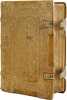
Réunion en éditions fort rares et très précoces de trois grands textes fondateurs de la Renaissance, en philologie et grammaire, d’Erasme et de son maître Laurent Valla. Laurent Valla, « le plus grand humaniste de la première moitié du XVe siècle » naquit à Rome vers 1407. (Guilio Vallese). « Profondément convaincu de la supériorité de la culture antique alors renaissante, dans laquelle il voyait un ferment incomparable de régénération, Valla, pour la défendre, n’hésita pas à courir le risque d’une condamnation devant le tribunal de l’Inquisition. Comme d’autres humanistes de ce temps, il se réclamait de l’antique morale rationaliste transmise dans les livres de la Sagesse, dont le Moyen Age avait appauvri ou perdu la signification même. » Le traité le plus célèbre de Valla qui avait le plus contribué à sa réputation « Des élégances de la langue latine », en six livres, se répandit rapidement dans toutes les écoles, et continua de faire texte d’enseignement pendant la plus grande partie du XVIe siècle. Erasme, qui professe, en beaucoup d’endroits de ses lettres, une vive admiration pour l’auteur et pour cet ouvrage en particulier, en avait fait, dans sa jeunesse, un extrait pour son usage, qui fut imprimé deux fois sans son consentement. Les observations de Valla portent sur la valeur de certaines formes de mots, sur celle de plusieurs termes difficiles, et plus encore sur les synonymies de la langue latine. Ce travail atteste une grande sagacité de recherches et un rare discernement. « Le roi Alphonse, auquel ce genre d’études plaisait singulièrement, ne se lassait pas d’entendre Valla, et le mettait quelquefois aux prises avec Antoine de Parlerme « inde ivae ». Il lui donna un diplôme enrichi d’une bulle d’or, dans laquelle il le déclarait illustre en presque toutes les sciences, ainsi qu’en la poétique. » Sont joints à cette œuvre phare de Valla les deux grands textes fondateurs qu’elle inspire à Erasme : -Le premier De Conscribendis epistolis dans la seconde édition strasbourgeoise de 1525. Son succès fut tel qu’elle fut, après celle-ci, réimprimée 77 fois pour le seul XVIe siècle. -Le second texte De Constructione octo partium orationis libellus imprimé pour la première fois en 1514, est ici dans l’édition achevée d’imprimer le 11 août 1523 chez Sigismon Grim. Elle fut suivie de 61 éditions pour le seul XVIe siècle. Magnifique exemplaire à belles marges conservé dans sa première reliure estampée à froid dont les fermoirs et les attaches sont conservés intacts. Il provient des bibliothèques Jacob Campana et Gaspar Campana et porte ces deux ex-libris manuscrits « Jacobi Campanae et Amicorum, 1530 » et « Gaspari Campanae et Amicorum ». Les Campana, illustre famille napolitaine, comptèrent parmi leurs membres César Campana, fin lettré du XVIe siècle.


Overzicht van de werken en uitgaven van Desiderius Erasmus aanwezig in de Bibliotheek der Gemeente Rotterdam.
Rotterdam, 1937.
IV,84 p. Cl. 25 cm (Rebound)
Tentoonstelling, Erasmus en Leuven. Leuven, Stedelijk Museum, 17 nov. - 15 dec. 1969.
Leuven, 1969.
456 p.; 51 plates. Stiff wrappers 23 cm (Cover somewhat worn)
Vertraute Gespräche (Colloquia Familiaria). Übertr. und eingel. von H. SCHIEL.
N.pl., Magnus Verlag, n.d. (eighties).
644 p. Cl. (Label on title; German translation only)
Vrede's weeklacht, en andere geschriften over vrede en eendracht op internationaal-politiek en kerkelijk terrein. Uit het Latijn vert. en toegel. door P.M.M. GEURTS.
Baarn, Ambo., 1989.
265 p. Cloth. 22.5 cm (Ambo Klassiek)
Éloge de la folie. Nouvellement trad. par P. DE NOLHAC, suivi de la lettre d'Érasme à Dorpius avec des ann. de M. RAT.
Paris, Garnier, 1953.
XII,327 p. Wrs. 19 cm
Éloge de la folie. Textes choisis, traduits & annotés.
Bruxelles, Lebègue, 1941.
87 p. Wrs. (Anthology, intr. & tr.)
[PICART Bernard] - Erasmus Alberus - BADIUS Conrad - LUTHER Martin
Reference : 15845
(1734)
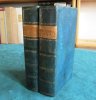
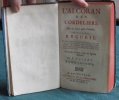
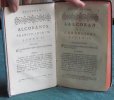
L'Alcoran des Cordeliers. 2 volumes.
L'Alcoran des Cordeliers. Tant en latin qu'en François. C'est à dire Recueil des plus notables bourdes et blasphèmes de ceux qui ont osé comparer Saint François à Jésus Christ: tiré du grand livre des Conformitez, jadis composé par frère Barthelemi de Pise, Cordelier en son vivant.Nouvelle Édition ornée de Figures dessinées par B. Picart.A Amsterdam, Aux dépens de la Compagnie - 1734 - XVIII, 396 et 419 pages. 22 gravures de Bernard Picard représentant des épisodes hagiographiques de la vie de Saint François. Dont 1 titre gravé portant la date de 1733 et 1 gravure dépliante "Les conformitez de St. François avec Jésus-Christ". Édition bilingue français-latin.Première édition illustrée d'un ouvrage qui fut initialement édité en 1542 à Wittemberg.Célèbre pamphlet, particulièrement violent, contre le livre de Barthelemi de Pise qui soulignait les similarités entre la vie de Jésus Christ et la vie de Saint François. Le livre débute par une préface de Conrad Badius et de Martin Luther, très insultant à l'égard des Papistes et des Cordeliers. L'ouvrage reprend le récit hagiographique de Saint François en lui adjoignant des notes aux bas des pages, et des critiques extrêmement sévères et virulentes. Plus largement, le livre est une attaque directe contre les Catholiques par les Protestants, les accusant d'hérésies, d'abominations, de satanisme.Bernard Picart, né le 11 juin 1673 à Paris et mort le 8 mai 1733 à Amsterdam, est un Maître-graveur et dessinateur français.Cartonnage vert de l'époque en très bon état. Dos orné de chainettes dorées et pièce de titre cuir fauve. Tranches rouges. Pas de rousseur. Parfait état. Format in-12°(16x10).
PICART Bernard
Erasmus. Reformer zwischen den Fronten.
Göttingen, Vandenhoeck & Ruprecht, (1969).
301 p.; 66 ills. Cl. (Or. title: Erasmus of Christendom)

