Write to the booksellers
-
Type
Autograph (15)
Book (51209)
Magazine (288)
Manuscript (2)
Maps (1)
New book (1)
Old papers (1)
Photographs (1)
-
Latest
Last 24h (50)
Last 3 days (63)
Last month (1287)
Last week (20)
-
Language
Dutch (6)
English (43)
Finnish (1)
French (51388)
German (19)
Greek (5)
Italian (20)
Japanese (2)
Latin (21)
Polish (1)
Portuguese (3)
Spanish (7)
Swedish (2)
-
Century
16th (62)
17th (195)
18th (1302)
19th (3637)
20th (22165)
21st (3768)
-
Countries
Belgium (6731)
Brazil (24)
Canada (6)
China (2)
Côte d'Ivoire (66)
Denmark (1043)
France (38971)
Germany (3)
Greece (3)
Netherlands (268)
Switzerland (4401)
-
Syndicate
ALAC (6)
CLAM (37)
CNE (6)
ILAB (20091)
NVVA (998)
SLACES (907)
SLAM (17761)
SNCAO (41)
Rêveries d'un Païen Mystique. Préface de Maurice Barrès ..... Portrait gravé à l'eau-forte par G. Noyon.
Paris, A. Durel, 1909. With engraved portrait. [6, portrait included], xxxv, [1], 182, [2] pp. 8vo (15,5 x 22,5 cm). Brown jansenist style morocco, spine with raised bands and gilt lettering, all edges gilt, gilt inside dentelles, original covers and spine preserved, binding signed "David." Maitron, DBMOF, iii, pp. 78-79; Sandra W. Dolbow, Dictionary of Modern French Literature, p. 203; Carteret, Trésor du Bibliophile, vol. ii, p. 127 for the 1876 and 1895 edition but not listing this one; Talvart & Place, Bibliographie des Auteurs modernes, xiv, 172. Rare edition "de luxe", with a nice engraved portrait and a nice preface by Maurice Barrès. This is number 74 of 200 copies printed, "petit in 8vo, numérotés à la presse (1 à 200) sur beau papier velin d'Arches, fabriqué spécialement pour cette édition." "Ecrivain d'un talent universel", Ménard was a poet, inventor, philosopher and historian of religions, political pamphleteer and painter. He was a student with Baudelaire at the Lycée Louis-le-Grand, and active supporter of the 1848 revolution: his Prologue d'une Révolution is very rare and an important work dealing with this revolution and its causes. It was published in Proudhon's Le Peuple in 1848-1849 and earned him 15 months in prison. On his release he went into exile in London and Brussels where he found his friends Louis Blanc and Blanqui again and where he befriended Marx and Engels. After the amnesty of 1859 he returned to Paris and from then on devoted himself primarily to the arts.He found in polytheism a social and moral guide, a union of order and liberty in which reason, imagination, art, religion, and politics could flourish. His best known work is the present work: a mixture of mystical poetry, philosophical dialogues and a number of much admired tales. The work exercised a profound influence on among others Barrès, R. de Montesquiou, Anatole France, Leconte de Lisle, etc. - Exlibris Georges Vandaele on free front end paper, a beautiful copy with its original covers and spine preserved, printed on beautiful paper with large margins.


(NVVA, )
Phone number : 31 20 698 13 75
De la morale avant les philosophes.
1860 In-8, broché, couverture imprimée, (6), 290 p. Paris, Firmin Didot, 1860.
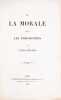
Édition originale de la thèse du philosophe républicain. Le "païen mystique" recherche dans les traditions religieuses, légendes et législations des Anciens, les prémisses d'une morale populaire et sociale antérieure à la philosophie. Il soutient avec talent l'opinion selon laquelle les mythes ne sont que des symboles créés dans un âge lointain pour envelopper idées morales et dogmes philosophiques, avant d'être interprétés comme des faits réels et d'être développés sous une forme historique.Rousseurs.
DE LA MORALE AVANT LES PHILOSOPHES (THESE)
Typographie de Firmin Didot Frères, Paris. 1860. In-8. Broché. Etat d'usage, Tâchée, Dos satisfaisant, Rousseurs. 290 pages. Papier muet encollé sur le dos, le consolidant. Etiquette de code sur la couverture. Quelques tampons de bibliothèque.. . . . Classification Dewey : 180-Philosophie antique, médiévale, orientale
Thèse prés. à la Faculté des Lettres de Paris. Classification Dewey : 180-Philosophie antique, médiévale, orientale
HERMES TRISMEGITE . Traduction complète prédédée d' une étude sur l' origine des livres hermétiques.
1983 Couverture souple 1983 P , Trédaniel , 1983 , in8 broché ,CXI - 302 pp . Marges légèrement jaunies , quelques surlignages au crayon . Langue: Français
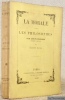
La morale avant les philosophes. Deuxième édition.
,Paris, Charpentier, Libraire-éditeur 1863, 356 pp., 1 vol. in 12 relié cartonnage, dos lisse avec pièce de titre.
La morale avant les philosophes. Deuxième édition.
Paris, Charpentier 1863, 185x120mm, 356pages, broché. Bon état.
Pour un paiement via PayPal, veuillez nous en faire la demande et nous vous enverrons une facture PayPal
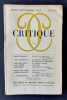
MENARD (René). ROUDAUT (Jean). BECARUD (Jean). ASTRE (Georges-Albert). KEIM (Jean). FRITZ (Kurt von). ROBINET (André). STAROBINSKI (Jean).
Reference : 48333
Critique. Revue générale des publications françaises et étrangères. N°135-136, août-septembre 1958.
Paris. Directeur : Georges Bataille. Un volume 22,6x14,2cm broché de 150 pages. Bon état.
Tous nos livres sont visibles sur notre site : https://www.livrepoesie.com/
MENARD (René). SCHNEIDER (Pierre). JUIN (Hubert). CHASTEL (André). NIEL (André). BROËNS (Maurice). PIEL (Jean).
Reference : 48325
Critique. Revue générale des publications françaises et étrangères. N°114, novembre 1956.
Paris. Directeur : Georges Bataille. Un volume 22,6x14,2cm broché de 90 pages. Bon état.
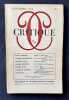
Tous nos livres sont visibles sur notre site : https://www.livrepoesie.com/
Esperanza de Israel
Hiperión 1987 572 pages in8. 1987. Broché. 572 pages. Cet essai de Gabriel Albiac lauréat du Prix National de l'Essai en 1988 analyse les origines marranes (juifs convertis de force) de la pensée de Baruch Spinoza. Il explore le contexte historique des conversions forcées en Espagne et au Portugal l'émergence des hétérodoxies juives dans la communauté séfarade d'Amsterdam au XVIIe siècle et la manière dont cette expérience marrane a cristallisé la pensée 'anormale' de Spinoza
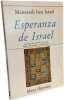
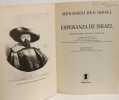
Bon état couverture un peu jaunie intérieur propre
Espérance d'Israël.
P., Vrin, 1979, 1 vol. br. 206 pp. +table,
Annotation et soulignements au crayon et au bic dûs au philosophe Jean Brun, de la bibliothèque de qui le livre provient.
Mencius : Contexts and Interpretations
Honolulu, University of Hawai'i Press 2002 Livre en anglais. In-8 reliure éd. sous jaquette 22,5 cm sur 15,5. VI-328 pages. Jaquette en très bon état. Très bon état d’occasion.
Sommaire, notes. Très bon état d’occasion
Treatise on Right and Wrong.
London, Kegan Paul, Trench, Trubner & Co., 1934. 8vo. Orig. full cloth with orig. dust jacket. Few traces of use and dust jacket with some soiling. X,277 pp.

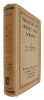
First edition.
De charlataneria eruditorum declammationes duae.
Lipsae - Leipzig, Apud Jo. Frid. Gleditsch & Filium 1715, 155x95mm, 7 Bl., 154Seiten, Pappband.
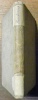
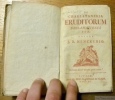
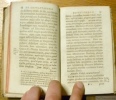
3 Bl., Pour un paiement via PayPal, veuillez nous en faire la demande et nous vous enverrons une facture PayPal
QUAND PLUS RIEN NE VA DE SOI - APPRENDRE A VIVRE AVEC L'INCERTITUDE
ROBERT LAFFONT. 1979. In-8. Broché. Etat d'usage, Couv. convenable, Dos plié, Intérieur frais. 258 Pages. . . . Classification Dewey : 100-PHILOSOPHIE ET DISCIPLINES CONNEXES
Classification Dewey : 100-PHILOSOPHIE ET DISCIPLINES CONNEXES
54 millions d'individus sans appartenance - L'obstacle invisible du septennat - Essai de psychopolitique
Robert Laffont. 1983. In-8. Broché. Etat d'usage, Couv. légèrement passée, Dos plié, Intérieur acceptable. 224 pages. Nombreux passages soulignés et annotés au feutre noir dans le texte. Annotation au crayon de papier en page de gardE.. . . . Classification Dewey : 190-Philosophie occidentale moderne
Classification Dewey : 190-Philosophie occidentale moderne
ANTHROPOLOGIE DIFFERENTIELLE - VERS UNE ANTROPOLOGIE SOCIOPSYCHANALYTIQUE 1 -COLLECTION PETITE BIBLIOTHEQUE N°208
PAYOT. 1972. In-12. Broché. Bon état, Couv. convenable, Dos satisfaisant, Intérieur frais. 417 Pages - Quelques illustrations dans le texte en noir et blanc - quelques annotations au crayon sans conséquences pour la lecture. . . . Classification Dewey : 100-PHILOSOPHIE ET DISCIPLINES CONNEXES
Classification Dewey : 100-PHILOSOPHIE ET DISCIPLINES CONNEXES
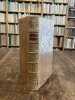
Phédon. Entretiens de Socrate avec ses disciples sur l'Immortalité de l'Ame. Précédé de la vie de ce célèbre philosophe.
Par Moses Mendelsohn, traduit de l'allemand sur la sixième édition par L. Haiussmann, 1 vol. in-8 reliure de l'époque pleine basane racinée, fers de prix du Petit Séminaire de Brive au premier plat, Charles Heideloff, Paris, 1830, 332 pp.
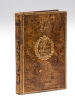
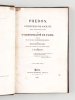
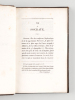
Intéressant exemplaire, portant les fers de prix du "Petit Séminaire de Brive", mention "Prix de Dissertation" 1842 au crayon en garde, pour cette nouvelle traduction française de l'une des oeuvres majeures du philosophe juif de l'Aufklärung berlinoise, Moses Mendelsohn (1729-1786). Dans sa Correspondance, Grimm évoquait l'ouvrage en ces termes : "M. Mosès s'est permis de mettre dans la bouche de son Socrate beaucoup d'arguments et de raisonnements tirés de la philosophie moderne en faveur du système de l'immortalité de l'âme. Ce Socrate, au lieu d'être le maître de Criton et des autres philosophes d'Athènes, n'est qu'un élève de Leibniz, de Wolff et de Mosès". Etat très satisfaisant (petits frott. en reliure, petites mouill. et qq. rouss., bon état par ailleurs).
Jérusalem
Les Presses d'Aujourd'hui Les Presses d'Aujourd'hui, 1982. In-8 broché, 208 pages. Préface d'Emmanuel Lévinas. Bon état. Peu courant
Toutes les expéditions sont faites en suivi au-dessus de 25 euros. Expédition quotidienne pour les envois simples, suivis, recommandés ou Colissimo.
Jérusalem ou Pouvoir religieux et judaïsme
Les Presses d'Aujourd'hui 1982 206 pages collection l'arbre double. 0x2x1cm. 1982. Broché. 206 pages.


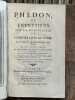
Phédon, ou Entretiens sur la spiritualité et l'immortalité de l'âme. Par M. Mosès Mendels-Sohn, Juif à Berlin. Traduit de l'allemand par M. Junker, de l'Académie des Belles-Lettres de Gottingen.
A Paris, chez Saillant et à Bayeux, chez Lepelley, 1772. In-8 de 1 frontispice gravé, (4)-XXIV-342-(2) pp., veau marbré glacé, dos lisse orné, pièce de titre en maroquin rouge (reliure de l'époque).
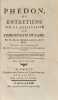
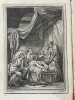
Première édition française donnée par Junker. Gravure de Ménil d'après Monet en frontispice.Traduit deux fois en français en 1772, d'abord par un pasteur huguenot à Berlin (Abel Burja sous le titre : Phédon ou Dialogues Socratiques sur l'Immortalité de l'Ame), ensuite par G.-A. Junker, un Allemand installé à Paris qui s'était déjà signalé par plusieurs traductions de l'allemand l'anglais, il le fut rapidement aussi en hollandais, italien, suédois, polonais, russe et hongrois. Le 1er juillet 1772, la Correspondance littéraire de Grimm en prit acte : « traduit depuis peu le Phédon, ou Entretiens sur la spiritualité et l'immortalité de l'âme, non de Platon mais de Mosès Mendelshon [sic], juif, à Berlin. M. Mosès jouit d'une grande réputation en Allemagne. C'est un célèbre métaphysicien et son Phédon a fait quelque sensation à Paris, quoique la philosophie dominante ne soit pas dans ce goût-là. M. Mosès s'est permis de mettre dans la bouche de son Socrate beaucoup d'arguments et de raisonnements tirés de la philosophie moderne en faveur du système de l'immortalité de l'âme. Ce Socrate au lieu d'être le maître de Criton et des autres philosophes d'Athènes, n'est qu'un élève de Leibnitz, de Wolff et de Mosès » (P. H. Meyer, Le rayonnement de Moïse Mendelssohn hors d'Allemagne).Très bon exemplaire. Cohen - De Ricci, 386 ; Szajkowski, Franco-Judaïca, 1625.
Phédon, ou Entretiens sur la Spiritualité et l'Immortalité de l'Ame. Par. M. Mosès Mendels-Sohn, Juif à Berlin. Traduit de l'Allemand par (Georg Adam Junker).
Paris, Saillant 1772. 8°: 2 n.n. Bl., XXIV S., 342 S., 1 Bl. Privileg. Mit gestochenem Frontispiz. Interimsbroschur der Zeit mit Marmorpapierbezügen.
Goedeke IV/I, 488, 8 - Graesse IV, 485. - Erste französische Ausgabe, 4 Jahre nach der deutschen Originalausgabe jedoch noch vor der ersten englischen Uebersetzung erschienen. - Mit einer Einführung des Uebersetzers. Unbeschnittenes, sehr breitrandiges Exemplar. Ecken zu Beginn und gegen Ende etwas eselsohrig. Kleiner Papierverlust am Rücken.
Phédon, ou Entretiens sur la Spiritualité et L'Immortalité de L'Ame. Traduit de L'Allemand, Par M. Junker.
A Paris, Saillant, 1772. Cont. full mottled calf. Back worn as the golddecoration is nearly gone. Engraved frontisp. XXIV,342,(2) pp. A few lvs. slightly browned, otherwise internally fine.
Scarce first French edition.
Phédon ou entretiens sur l'immortalité de l'âme
Editions Alcuin Editions Alciun, 2000. In-8 broché de 195 pages. Bon état
Toutes les expéditions sont faites en suivi au-dessus de 25 euros. Expédition quotidienne pour les envois simples, suivis, recommandés ou Colissimo.
PHÉDON, ou Entretiens sur la Spiritualité et l'Immortalité de l'Ame, par M. Mosès Mendels-Sohn, Juif à Berlin.
Traduit de l'Allemand par M. Junker, de l'Académie des Belles-Lettres de Gaettingen. Orné d'un frontispice d'après Monet et gravé par Ménil. Paris, chez Saillant, Libraire & Bayeux, chez Lepelley, 1772. In-8 (22,5x14cm) dans une brochure de carton rigide dans l'attente de reliure, restauration au dos et ouvrage non ébarbé. (4)-XXIV-342-2pp.
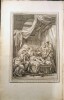
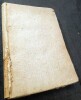
[Édition originale française ornée d'un beau frontispice d'après Monet, gravé par Ménil. Précédé d'une vie de Socrate, un essai composé en trois dialogues à la manière du «Phédon» de Platon, à partir de la correspondance de Mendels-Son avec son ami Thomas Abbt. Ouvrage à relier et bon état intérieur avec toutes les marges.
Phédon, ou entretiens sur la spiritualité et l'immortalité de l'âme. Traduit de l'allemand par M. Junker.
Paris et Bayeux Saillant et Lepelley 1772 1 vol. Relié in-8, veau fauve écaille, dos à nerfs, pièce de titre de maroquin rouge, caissons ornés de fleurons et dentelle dorés avec double filet en encadrement, coupes filetées, coiffes guillochées, tranches rouges, XXIV + 342 + (2) pp. Edition originale française ornée d'un beau frontispice d'après Monet, gravé par Ménil. Précédé d'une vie de Socrate, cet essai est composé en trois dialogues, à la manière du "Phédon" de Platon, à partir de la correspondance de Mendelssohn avec son ami Thomas Abbt. Infime galerie de ver au dos en pied, sinon très bon exemplaire en reliure d'époque avec ex-libris gravé Cazenove.