 Write to the booksellers
-
Type
Autograph (15)
Book (51223)
Magazine (288)
Manuscript (2)
Maps (1)
New book (1)
Old papers (1)
Photographs (1)
-
Latest
Last 24h (22)
Last 3 days (19)
Last month (731)
Last week (481)
-
Language
Dutch (6)
English (43)
Finnish (1)
French (51403)
German (19)
Greek (5)
Italian (20)
Japanese (2)
Latin (20)
Polish (1)
Portuguese (3)
Spanish (7)
Swedish (2)
-
Century
16th (60)
17th (198)
18th (1330)
19th (3655)
20th (22139)
21st (3779)
-
Countries
Belgium (6718)
Brazil (24)
Canada (6)
China (2)
Côte d'Ivoire (69)
Denmark (1046)
France (38746)
Germany (3)
Greece (3)
Netherlands (269)
Switzerland (4646)
-
Syndicate
ALAC (6)
CLAM (37)
CNE (6)
ILAB (20311)
NVVA (998)
SLACES (907)
SLAM (17731)
SNCAO (41)
Linguistic lapses with especial reference to the perception of linguistic sounds. Dissertation.
No place, Reprinted from the Archives of Philosophy, Psychology and Scientic Methods no year, 260x175mm, 110pages, paperback.
Pour un paiement via PayPal, veuillez nous en faire la demande et nous vous enverrons une facture PayPal
Grundtankernes System. En udførligere Fremstilling af Logiken. 3 Dele. (1. Ontologien. 2. Metafysiken. 3. Den Subjektive Logik).
Christiania, Osk. Knobelauchs Forlag, 1882-87. Indbundet i et nogenlunde samtidigt hldrbd. med rygforgyldning. Stålstukket portræt af forfatteren. (8),XXI,169,(1),300,384 pp. Den tredie del er indbundet forrest.
ENSEIGNEMENT ET RELIGION, ETUDES PHILOSOPHIQUES
Félix Alcan. 1907. In-8. Broché. Etat d'usage, Couv. légèrement passée, Dos abîmé, Intérieur acceptable. 237 pages. Etiquette de code sur le dos. Tampons et annotations de bibliothèque sur le 1er plat et en page de titre. Rousseurs sur les plats. Quelques annotations au crayon dans le texte.. . . . Classification Dewey : 100-PHILOSOPHIE ET DISCIPLINES CONNEXES
'Bibliothèque de Philosophie contemporaine'. La pédagogie de l'école normale en 1902. L'enseignement d'état et la pensée religieuse. Philosophie religieuse de Locke... Classification Dewey : 100-PHILOSOPHIE ET DISCIPLINES CONNEXES
La philosophie de Hobbes.
,Paris, Félix Alcan Bibliothèque de philosophie contemporaine 1893, 221 pp., 1 vol. in 12 br. gravure 'Léviathan' in fronispice.
Lécole mystique de Lyon 1776-1847. Le grand Ampère - Ballanche - Cl.-Julien Bredin - Victor de Laprade - Blanc Saint Bonnet - Paul Chenavard. Préface de M. Edouard Herriot
1935 Paris, Alcan, 1935, in 8, broché, XI-306 pages
...................... Photos sur demande ...................


Phone number : 04 77 32 63 69
Galliae Delphinatusque panegyricus, VI. ID. DECEM. M.D.LVIII. Dictus Coram Illustrissimo Protopraeside Delphinatus. A.R.P.F. Claudio LYONNARD, Philosophiae Professore, & Licentiate Theologo, in Collegio Gratianopolit. FF. Praedicatorum.
Gratianopoli, Ex Typis Iacobi Petit Typographi, 1661, 1 volume in-18 de 135x80 mm environ, (3) ff., (6) ff. (titre, epistre), 40 pages, (3) ff., reliure signée en parchemin crème, titres en long en caractères gothiques rouges et noirs, papier fragile avec bordures fendillées, sinon bon état.
Merci de nous contacter à l'avance si vous souhaitez consulter une référence au sein de notre librairie.
LES TROIS GENIES DE LA CHAIRE BOSSUET, BOURDALOUE, MASSILLON OU LEURS OEUVRES ORATOIRES EN TABLEAUX SYNOPTIQUES
IMPRIMERIE DU PATRONAGE SAINT-PIERRE. 1896. In-Folio. Relié plein cuir. Etat d'usage, Coins frottés, Dos frotté, Rousseurs. XIX + 665 pages - dos à nerfs - fleurons auteur et titre dorés sur le dos - épidermures sur les plats - 3 PHOTOS DISPONIBLES. . . . Classification Dewey : 210-Philosophie et théorie
Année liturgique. Sujets divers. La Très Sainte Vierge. Panégyriques de quelques saints. Classification Dewey : 210-Philosophie et théorie
LA PHENOMENOLOGIE
Paris, QUE SAIS-JE?, 1956, in-12 broché, 126 pp. Quelques notes au crayon en marge, couverture en bon état, intérieur en bon état.
Nombreux titres disponibles en Philosophie.
La Condition Postmoderne. Rapport sur le savoir. - [PRESENTATION-COPY]
(Paris), Minuet, (1979). [Recte: Les Ateliers de Normandie, 1988]. 8vo. Original wrappers. A bit of minor soiling to wrappers, otherwise very fine. Apart from some underlinings to the first few pages, internally very nice and clean. 109, (3) pp. Author's presentation-inscription ""pour Jen,/ avec ironie/ et myopathie/ J-F Lyotard/ Sharlony [?]/ Janvier 1991"".
![La Condition Postmoderne. Rapport sur le savoir. - [PRESENTATION-COPY]. "LYOTARD, JEAN-FRANCOIS.](https://static.livre-rare-book.com/pictures/LLX/48962_1_thumb.jpg)
![La Condition Postmoderne. Rapport sur le savoir. - [PRESENTATION-COPY]. "LYOTARD, JEAN-FRANCOIS.](https://static.livre-rare-book.com/pictures/LLX/48962_2_thumb.jpg)
![La Condition Postmoderne. Rapport sur le savoir. - [PRESENTATION-COPY]. "LYOTARD, JEAN-FRANCOIS.](https://static.livre-rare-book.com/pictures/LLX/48962_3_thumb.jpg)
Lovely presentation-copy of a later issue of the groundbreaking work that introduced the term ""post-modernism"" and fundamentally altered the interpretation and course of (post-)modern philosophy. With this book, Lyotard set the agenda for the discussion of the postmodern, which began in the 1980'ies. Lyotard's main point is that modern society has become postmodern because man no longer believes that scientific and technological progress will lead to freedom, prosperity, and enlightenment for all. For postmodern man, doubt is the dominating factor. The term ""postmodernism"" was previously only used by art critics, but with ""The Postmodern Condition"", Lyotard introduced it in philosophy, with the following quotation: ""Simplifying to the extreme, I define postmodern as incredulity towards metanarratives"", altering our comprehension of this most recent period of philosophy. ""The term ""postmodern"" came into the philosophical lexicon with the publication of Jean-François Lyotard's ""La Condition Postmoderne"" in 1979 (English: ""The Postmodern Condition: A Report on Knowledge"", 1984), where he employs Wittgenstein's model of language games (see Wittgenstein 1953) and concepts taken from speech act theory to account for what he calls a transformation of the game rules for science, art, and literature since the end of the nineteenth century. He describes his text as a combination of two very different language games, that of the philosopher and that of the expert. Where the expert knows what he knows and what he doesn't know, the philosopher knows neither, but poses questions. In light of this ambiguity, Lyotard states that his portrayal of the state of knowledge ""makes no claims to being original or even true,"" and that his hypotheses ""should not be accorded predictive value in relation to reality, but strategic value in relation to the questions raised"" (Lyotard 1984, 7). The book, then, is as much an experiment in the combination of language games as it is an objective ""report.""On Lyotard's account, the computer age has transformed knowledge into information, that is, coded messages within a system of transmission and communication. Analysis of this knowledge calls for a pragmatics of communication insofar as the phrasing of messages, their transmission and reception, must follow rules in order to be accepted by those who judge them. However, as Lyotard points out, the position of judge or legislator is also a position within a language game, and this raises the question of legitimation. As he insists, ""there is a strict interlinkage between the kind of language called science and the kind called ethics and politics"" (Lyotard 1984, 8), and this interlinkage constitutes the cultural perspective of the West. Science is therefore tightly interwoven with government and administration, especially in the information age, where enormous amounts of capital and large installations are needed for research."" (SEP).
Der Widerstreit. Übersetzt von Joseph Vogl. Mit einer Bibliographie zum Gesamtwerk Lyotards von Reinhold Clausjürgens.
München, Wilhelm Fink Verlag. 1987. 8°. 333 S., Originalleinwand mit Schutzumschlag.
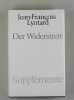
Erste deutsche Ausgabe. - Mit handschriftlichem Besitzvermerk auf dem fliegenden Vorsatz.
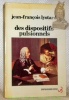
Des dispositifs pulsionnels.
Paris, Christian Bourgois 1980, 205x135mm, II - 307pages, broché.
Pour un paiement via PayPal, veuillez nous en faire la demande et nous vous enverrons une facture PayPal
Des dispositifs pulsionnels,
U.G.E., 10/18, 1973, 318 pp., poche, légères traces d'usage, tranches brunies, couverture partiellement brunie, état très correct.
LA CONDITION POSTMODERNE
Format moyen, couverture souple. 109 pages. Bon état. Une expédition par Mondial Relay vous sera proposée 2022 les éditions de minuit
La Confession d'Augustin. Frontispice et travaux photographiques de François Rouan.
Paris Galilée, coll. "Incises" 1998 1 vol. broché in-8, broché, couverture à rabats grenat, non coupé, 120 pp., 5 pages de fac similé in fine. Édition originale. Un des 106 exemplaires de luxe numérotés comportant une sérigraphie aquarellée et signée par François Rouan, et parmi ceux-ci l'un des 8 exemplaires d'artiste justifié "E.A. 2/8". Prière d'insérer conservé. En excellente condition.
L'enthousiasme : la critique kantienne de l'histoire
Galilée, "La philosophie en effet", 1986, 114 pp., broché, couverture légèrement jaunie,bon état.
Les transformateurs
in-8 broché jauni par endroits de 156 pages +16 de hors-textes peuvent subsister des traces de passages soulignés éditions Galilée
L'inhumain. Causeries sur le temps.
P., Galilée, 1991. In-8 br., couverture rempliée, 219 pp., ex-libris manuscrit.
Qq annotations au crayon de bois, bonne cond. par ailleurs. - Frais de port : -France 5,7 € -U.E. 8 € -Monde (z B : 12 €) (z C : 22 €)
L’inhumain. Causeries sur le temps. Collection Débats.
Paris, Editions Galilée 1988, 240x150mm, 219pages, broché. Bon état.
Pour un paiement via PayPal, veuillez nous en faire la demande et nous vous enverrons une facture PayPal
Misère de la philosophie. Collection Incises.
Paris, Editions Galilée 2000, 240x155mm, 306pages, broché. Couverture à rabats. Bel exemplaire.
Pour un paiement via PayPal, veuillez nous en faire la demande et nous vous enverrons une facture PayPal
Pérégrinations : loi, forme, événement
Galilée, Débats, 1990, 134 pp., broché, couverture très légèrement empoussiérée, bon état.
Que peindre ? Adami-Arakawa-Buren.
Aux éditions de la Différence, 1987. Deux volumes in-4 br. sous emboîtage éditeur illustré. Coll. " La vue du texte ". Vol. 1 : texte de J.-F. Lyotard. Vol. 2 : oeuvres d'Adami, Arakawa et D. Buren. Reproductions principalement en couleurs. E.O. Bel envoi autographe de Jean-François Lyotard.
Jean-François Lyotard. Cahier de l'Arc, N° 64.
Paris, L'Arc, 1976. 18 x 23, 88 pp., broché, très bon état.
L'Arc, revue trimestrielle.
Au juste Conversations
Christian Bourgois Editeur 1979, in-8 broché, couverture illustrée à rabats, 191 p. (très bon exemplaire ; épusié dans la collection) Première édition du recueil de ces discussions à bâtons rompus autour de la vision philosophique de Lyotard et de son regard sur la justice.

