Write to the booksellers
-
Type
Autograph (15)
Book (50918)
Magazine (288)
Manuscript (2)
Maps (1)
New book (1)
Old papers (1)
Photographs (1)
-
Latest
Last 24h (28)
Last 3 days (24)
Last month (1169)
Last week (39)
-
Language
Dutch (6)
English (43)
Finnish (1)
French (51097)
German (19)
Greek (5)
Italian (20)
Japanese (2)
Latin (21)
Polish (1)
Portuguese (3)
Spanish (7)
Swedish (2)
-
Century
16th (61)
17th (194)
18th (1293)
19th (3614)
20th (22004)
21st (3742)
-
Countries
Belgium (6718)
Brazil (24)
Canada (6)
China (2)
Côte d'Ivoire (69)
Denmark (1046)
France (38688)
Germany (3)
Greece (3)
Netherlands (269)
Switzerland (4399)
-
Syndicate
ALAC (6)
CLAM (37)
CNE (6)
ILAB (19989)
NVVA (998)
SLACES (907)
SLAM (17656)
SNCAO (41)
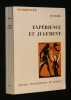
Erfahrung und Urteil, Untersuchungen zur Genealogie der Logik
Hamburg, 1948. 8vo. Original half cloth. Ex-libris pasted on to verso of front-board. A nice and clean copy. XXV, (1), 478 pp.

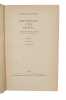
Fourth edition. Edmund Husserl is famous for his contributions to modern phenomenology. This groundbreaking work was the first of Husserl’s posthumous works devoted to the genealogy of logic.""In his investigations into the origin of the predicative judgement presented in EXPERIENCE and JUDGEMENT, Edmund Husserl makes an important distinction between objective self-evidence and the self-evidence of judgement. Husserl uses the distinction as a basis upon which to establish the further distinction of the prepredicative level of experience from the predicative level of experience."" (Snyder Lee R., ""The concept of evidence in Edmund Husserl's genealogy of logic"", Philosophy and Phenomenological Research 41, (1981). p[p]. 547)
Erste Philosophie (1923/24). Erster Teil: Kritische Ideengeschichte / Zweiter Teil: Theorie der Phänomenologischen Reduktion. Zus. 2 Bde
Den Haag, Martinus Nijhoff, 1956 - 59, in-8vo, XXXIV + 468 s. / XLIII +592 s., Original-Broschüre.

(SLACES, NVVA)
Phone number : 41 (0)26 3223808
"Expérience et jugement; recherche en vue d'une généalogie de la logique. Collection : Epiméthée."
Paris, Presses Universitaires de France (PUF), 1991. 15 x 22, 497 pp., broché, bon état (quelques annotations en début de volume).
Traduit de l'allemand par Denise Souche-Dagues.
Expérience et jugement (recherches en vue d'une généalogie de la logique)
Presses Universitaires de France Epiméthée Broché 1970 In-12 (13.5 x 18 cm), broché, 497 pages, traduit de l'allemand par D. Souche ; pliures au dos, quelques traces aux plats, par ailleurs intérieur très frais, bon état général. Livraison a domicile (La Poste) ou en Mondial Relay sur simple demande.

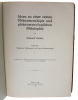
Formale und transzendentale Logik. Versuch einer Kritik der logischen Vernunft. Sonderabdruck aus: ""Jahrbuch für Philosophie und phänomenologische Forschung"", Bd. X. Herausgegeben von E. Husserl, Freiburg I. Br. - [THE FINAL CONCEPTION OF LOGIC]
Halle, Niemeyer, 1929. 4to. Orig. full cloth w. gilt leather title-label to spine. A bit of minor brownspotting and sunning to front board"" back board also a bit brownspotted. The two last leaves with a crease to lower margin, otherwise internally very nice and clean. XI, (1), 298 pp.
First edition of Husserl's seminal work, which contains his philosophy of logic and mathematics. This important work entitled ""Formal and Transcendental Logic"" with the sub-title ""An Attempted Critique of the Logic Reason"" provides us with Husserl's final conception of logic. Though now famous as the father of phenomenology, Husserl was initially a student of mathematics, and in his two first works ""Über den Begriff der Zahl"" and ""Philosophie der Aritmetik"", his early philosophy is developed on the basis of mathematics with the aim to provide a sound foundation for mathematics by combining it with philosophy and psychology. His main work from 1900-1901, Logische Untersuchungen"", probably one of the two most important and influential philosophical works of the 20th century, Husserl establishes a philosophy that asks the question of the essence of the matter of perception as opposed to the form of perception, as well as the meaning of the difference between formal or pure and material laws, truths and determinations, -all based on his strong interest in the relationship between the formalities of arithmetic and of logic.However, it is in his ""Formal and Transcendental Logic"" that Husserl most thoroughly introduces us to the formal character of logic and formulates his final conception of it. According to Husserl, logic is formal, because it is nothing more than the development of pure reason, and pure reason is a formal concept. As such, logic for Husserl becomes the self-interpretation of pure reason (die Selbstauslegung der reinen Vernunft) which is, again, a formal activity. Husserl also determines that there are two formal ways of conceiving logic, one being a tool for judging sentences true or false, and another, which includes knowledge.And so, this work not only provides us with a genetic-phenomenological investigation of philosophy and of the basis of logic, but it also provides us with an insight into the entire inner systematic structure of late Husserlian thought.
Husserliana - band III : Ideen zu einer reinen Phänomenologie und phänomenologischen Philosophie - 1.Allgemeine Einführung in die reine Phänomenologie (neue auf Grund der handschriftlichen Zusätze des verfassers erweiterte Auflage - herausgeg. Und eingel. Von W.Biemel)
Haag, Nijhoff 1950 xvi + 483pp., in the series "Husserliana E. Husserl Gesammelte Werke" volume III-1, softcover (vague trace of removed label at lower end of spine), 25cm., small stamp, text is clean and bright, F18739
Ideen zu einer reinen Phänomenologie und phänomenologischen Philosophie. Erstes Buch (alles). Allegemeine Einführung in die reine Phänomenologie. Sonderdruck aus: ""Jahrbuch für Philosophie und phänomenologische Forschung"", Bd. I herausgegeben von E. H... - [FOUNDING CONSTITUTIVE PHENOMENOLOGY - INTRODUCING ""EPOCHÉ""]
Halle, Max Niemeyer, 1913. 4to. Orig. printed wrappers, uncut. Some wear to extremities of wrappers, capitals a bit worn, and spine a bit soiled, but intact, solid, and no loss of lettering. Old owner's name crossed out at tope of front wrapper. Internally very nice and clean. VIII, 323, (1) pp.
The scarce first edition, off-print, of Husserl's second main work, his seminal ""Ideas"", which constitutes the founding text of Constitutive Phenomenology and the work, in which Husserl introduces his groundbreaking notion of ""epoché"". It was due to this work that he was able to secure himself the position as Professor in Freiburg (from 1916-1928).Although the work is called ""Ideen I"", there is no doubt as to its status as a separate work. Husserl did not publish his Ideen II and III in his lifetime, and they were only published posthumously, both in 1952. They have had none of the impact that the ""Ideen I"" had, and they are considered to be works in their own right too, although much less interesting.When Husserl published his ""Logical Investigations"" in 1900-1901, he changed the face of philosophy and founded the new philosophy of the 20th century: Phenomenology. In the Logical Investigations, Husserl began by attacking Psychologism and then went on to introduce his new philosophical method, which only then saw the light of day, and which only becomes fully developed later on. In 1900-01 he asks the question of the essence of the matter of perception as opposed to the form of perception. In his ""Ideen"", he extends his scope to include philosophy of the natural sciences, and he reflects thoroughly on the method of transcendental phenomenological epohé and reduction. He thus takes a new turn on conscious life and the pre-given status of it. This can no longer be accepted as something that exists in the world as the final guarantee for the world and the positive sciences of it. We must distinguish between the act of consciousness and the phenomena at which it is directed, in order to study the very structure of consciousness. All assumptions about the existence of the external world must be suspended, in order to achieve knowledge of the essences. It is this procedure that Husserl calls ""epoché"", and the constitutive phenomenology, which is founded in this work, is something that comes to characterize the rest of Husserl's works.Husserl is now famous as the father of phenomenology, and he decisively influenced the likes of Heidegger, Sartre, Carnap, Merleau-Ponty, Levinas, Ricoeur, Derrida etc. etc.
Ideen zu einer reinen Phänomenologie und phänomenologischen Philosophie. Erstes Buch (alles). Allegemeine Einführung in die reine Phänomenologie. Sonderdruck aus: ""Jahrbuch für Philosophie und phänomenologische Forschung"", Bd. I herausgegeben von E. H... - [FOUNDING CONSTITUTIVE PHENOMENOLOGY - INTRODUCING EPOCHÉ]
Halle, Max Niemeyer, 1913 + 1923. Ideen: 4to. Orig. full brown cloth w. gilt spine. Professionally rebacked preserving almost all of the original back. A bit of repaired wera to capitals and hinges. Marginal notes and underlinings throughout, all in pencil, otherwise nice and clean. VIII, 323, (1) pp. Sachregister: 4to. Unbound, no wrappers. Uncut. A bit of brownspotting. 60 pp.(2),


The scarce first edition, off-print, of Husserl's second main work, his seminal ""Ideas"", which constitutes the founding text of Constitutive Phenomenology and the work, in which Husserl introduces his groundbreaking notion of ""epoché"". It was due to this work that he was able to secure himself the position as Professor in Freiburg (from 1916-1928). Also present is the first edition of the rarely seen subject index to the ""Ideen"" by Gerda Walther.Although the work is called ""Ideen I"", there is no doubt as to its status as a separate work. Husserl did not publish his Ideen II and III in his lifetime, and they were only published posthumously, both in 1952. They have had none of the impact that the ""Ideen I"" had, and they are considered to be works in their own right too, although much less interesting.When Husserl published his ""Logical Investigations"" in 1900-1901, he changed the face of philosophy and founded the new philosophy of the 20th century: Phenomenology. In the Logical Investigations, Husserl began by attacking Psychologism and then went on to introduce his new philosophical method, which only then saw the light of day, and which only becomes fully developed later on. In 1900-01 he asks the question of the essence of the matter of perception as opposed to the form of perception. In his ""Ideen"", he extends his scope to include philosophy of the natural sciences, and he reflects thoroughly on the method of transcendental phenomenological epohé and reduction. He thus takes a new turn on conscious life and the pre-given status of it. This can no longer be accepted as something that exists in the world as the final guarantee for the world and the positive sciences of it. We must distinguish between the act of consciousness and the phenomena at which it is directed, in order to study the very structure of consciousness. All assumptions about the existence of the external world must be suspended, in order to achieve knowledge of the essences. It is this procedure that Husserl calls ""epoché"", and the constitutive phenomenology, which is founded in this work, is something that comes to characterize the rest of Husserl's works.Husserl is now famous as the father of phenomenology, and he decisively influenced the likes of Heidegger, Sartre, Carnap, Merleau-Ponty, Levinas, Ricoeur, Derrida etc. etc.
Ideen zu einer reinen Phänomenologie und phänomenologischen Philosophie. Erstes Buch (alles). Allegemeine Einführung in die reine Phänomenologie. Sonderdruck aus: ""Jahrbuch für Philosophie und phänomenologische Forschung"", Bd. I herausgegeben von E. H... - [FOUNDING CONSTITUTIVE PHENOMENOLOGY - INTRODUCING EPOCHÉ]
Halle, Max Niemeyer, 1913 + 1923. Ideen: 4to. Orig. full brown cloth w. gilt spine. Professionally rebacked preserving almost all of the original back. Wear to capitals, corners, and hinges. End-papers renewed. Internally very nice and clean. VIII, 323, (1) pp. Sachregister: 4to. Reddish simple cloth boards. Internally nice and clean. 60 pp.
The scarce first edition, off-print, of Husserl's second main work, his seminal ""Ideas"", which constitutes the founding text of Constitutive Phenomenology and the work, in which Husserl introduces his groundbreaking notion of ""epoché"". It was due to this work that he was able to secure himself the position as Professor in Freiburg (from 1916-1928). Also present is the first edition of the rarely seen subject index to the ""Ideen"" by Gerda Walther.Although the work is called ""Ideen I"", there is no doubt as to its status as a separate work. Husserl did not publish his Ideen II and III in his lifetime, and they were only published posthumously, both in 1952. They have had none of the impact that the ""Ideen I"" had, and they are considered to be works in their own right too, although much less interesting.When Husserl published his ""Logical Investigations"" in 1900-1901, he changed the face of philosophy and founded the new philosophy of the 20th century: Phenomenology. In the Logical Investigations, Husserl began by attacking Psychologism and then went on to introduce his new philosophical method, which only then saw the light of day, and which only becomes fully developed later on. In 1900-01 he asks the question of the essence of the matter of perception as opposed to the form of perception. In his ""Ideen"", he extends his scope to include philosophy of the natural sciences, and he reflects thoroughly on the method of transcendental phenomenological epohé and reduction. He thus takes a new turn on conscious life and the pre-given status of it. This can no longer be accepted as something that exists in the world as the final guarantee for the world and the positive sciences of it. We must distinguish between the act of consciousness and the phenomena at which it is directed, in order to study the very structure of consciousness. All assumptions about the existence of the external world must be suspended, in order to achieve knowledge of the essences. It is this procedure that Husserl calls ""epoché"", and the constitutive phenomenology, which is founded in this work, is something that comes to characterize the rest of Husserl's works.Husserl is now famous as the father of phenomenology, and he decisively influenced the likes of Heidegger, Sartre, Carnap, Merleau-Ponty, Levinas, Ricoeur, Derrida etc. etc.
Ideen zu einer reinen Phänomenologie und phänomenologischen Philosophie. Erstes Buch (alles). Allegemeine Einführung in die reine Phänomenologie. Sonderdruck aus: ""Jahrbuch für Philosophie und phänomenologische Forschung"", Bd. I herausgegeben von E. H... - [FOUNDING CONSTITUTIVE PHENOMENOLOGY - INTRODUCING EPOCHÉ]
Halle, Max Niemeyer, 1913. 4to. Contemporary or a bit later blue half cloth with a gilt red leather title-label to spine. Remains of glue to edges of the inside of boards (from a protective cover that has not left marks anywhere else). Old owner's signatures to title-page, one erased. Some light pencil-annotations. A nice and clean copy. VIII, 323, (1) pp.
The scarce first edition, off-print, of Husserl's second main work, his seminal ""Ideas"", which constitutes the founding text of Constitutive Phenomenology and the work, in which Husserl introduces his groundbreaking notion of ""epoché"". It was due to this work that he was able to secure himself the position as Professor in Freiburg (from 1916-1928).Although the work is called ""Ideen I"", there is no doubt as to its status as a separate work. Husserl did not publish his Ideen II and III in his lifetime, and they were only published posthumously, both in 1952. They have had none of the impact that the ""Ideen I"" had, and they are considered to be works in their own right too, although much less interesting.When Husserl published his ""Logical Investigations"" in 1900-1901, he changed the face of philosophy and founded the new philosophy of the 20th century: Phenomenology. In the Logical Investigations, Husserl began by attacking Psychologism and then went on to introduce his new philosophical method, which only then saw the light of day, and which only becomes fully developed later on. In 1900-01 he asks the question of the essence of the matter of perception as opposed to the form of perception. In his ""Ideen"", he extends his scope to include philosophy of the natural sciences, and he reflects thoroughly on the method of transcendental phenomenological epohé and reduction. He thus takes a new turn on conscious life and the pre-given status of it. This can no longer be accepted as something that exists in the world as the final guarantee for the world and the positive sciences of it. We must distinguish between the act of consciousness and the phenomena at which it is directed, in order to study the very structure of consciousness. All assumptions about the existence of the external world must be suspended, in order to achieve knowledge of the essences. It is this procedure that Husserl calls ""epoché"", and the constitutive phenomenology, which is founded in this work, is something that comes to characterize the rest of Husserl's works.Husserl is now famous as the father of phenomenology, and he decisively influenced the likes of Heidegger, Sartre, Carnap, Merleau-Ponty, Levinas, Ricoeur, Derrida etc. etc.
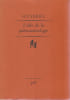
Idées directrices pour une phénoménologie,
Gallimard, Tel, 2005, 567 pp., broché, traces d'usage, passages signalés au crayon, état correct.
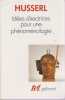
Idées directricves pour une phénoménologie. Traduit de l’allemand par Paul Ricoeur.
Gallimard, 1950. Fort in-8°, broché.
[15459]
LA CRISE DE L'HUMANITE EUROPEENNE ET LA PHILOSOPHIE
Paris, AUBIER MONTAIGNE, 1977, in-12 broché, 172 pp. Bilingue. Traduction Paul Ricoeur. Quelques notes au crayon en marge, couverture en bon état, intérieur en bon état.
Nombreux titres disponibles en Philosophie.
"La crise de l'humanité européenne et la philosophie - ""La philosophie en poche"""
Aubier Montaigne. 1977. In-12. Broché. Etat d'usage, Couv. convenable, Dos satisfaisant, Papier jauni. 172 pages. Nombreux passages soulignés au feutre noir dans le texte. Annotation au crayon de papier en page de faux titre.. . . . Classification Dewey : 190-Philosophie occidentale moderne
Edition bilingue, trad. de Paul Ricoeur. Préface du Dr S. Strasser, avec en postface un essai de J.-M. Guirao. Classification Dewey : 190-Philosophie occidentale moderne
La crise de l'humanité européenne et la philosophie.
Paris Republications Paulet n° 2 1971 1 vol. broché plaquette in-8, brochée, p. 225-258. Très bon état.
La crise de l'humanité européenne et la philosophie. Collection : Philosophie de l'esprit.
Paris, Aubier, 1987. 13 x 22, 160 pp., broché, bon état (quelques rares soulignages).
"Livre en français accompagné du texte allemand en regard; traduction de Paul Ricoeur; préface du Dr. S. Stasser, avec en postface unessai de J.-M. Guirao, contribution à la constitution d'une grammaire de Husserl."
"La crise des sciences européennes et la phénoménologie transcendantale - Collection "" Tel n°151 ""."
Gallimard. 1999. In-8. Broché. Etat d'usage, Couv. convenable, Dos plié, Intérieur frais. 589 pages - étiquette collée sur le 1er plat et sur le dos.. . . . Classification Dewey : 100-PHILOSOPHIE ET DISCIPLINES CONNEXES
"Collection "" Tel n°151 "" - traduit de l'allemand et préfacé par Gérard Granel. Classification Dewey : 100-PHILOSOPHIE ET DISCIPLINES CONNEXES"
La crise des sciences européennes et la phénoménologie transcendantale. Traduit de l’allemand et préfacé par Gérard Granel. Collection Tel.
Paris, Gallimard 2008, 190x125mm, IX - 589pages, broché. Exemplaire à l'état de neuf.
Pour un paiement via PayPal, veuillez nous en faire la demande et nous vous enverrons une facture PayPal
LA TERRE NE SE MEUT PAS
Format moyen, couverture souple. 93 pages. Bon état. Une expédition par Mondial Relay vous sera proposée 1989 les éditions de minuit
La terre ne se meut pas
Editions de Minuit Paris, Les Éditions de Minuit, Collection Philosophie, 1989. In-8 broché (22 x 13,5 cm) de 93 pages. Traces de scotch ancien au verso de la couverture, sinon Bon état
Toutes les expéditions sont faites en suivi au-dessus de 25 euros. Expédition quotidienne pour les envois simples, suivis, recommandés ou Colissimo.
"La terre ne se meut pas - Collection "" Philosophie ""."
Les éditions de minuit. 1989. In-8. Broché. Etat d'usage, Couv. légèrement passée, Dos satisfaisant, Papier jauni. 93 pages - légères rousseurs et salissures sur les plats.. . . . Classification Dewey : 100-PHILOSOPHIE ET DISCIPLINES CONNEXES
"Collection "" Philosophie "" - Traduit de l'allemand par D.Franck, D.Pradelle et J.F.Lavigne. Classification Dewey : 100-PHILOSOPHIE ET DISCIPLINES CONNEXES"
LECONS POUR UNE PHENOMENOLOGIE DE LA CONSCIENCE INTIME DU TEMPS
Paris, PUF, Epiméthée, 1964, in-8 broché, 205 pp. Quelques notes au crayon en marge, couverture en bon état, intérieur en très bon état.
Nombreux titres disponibles en Philosophie.
Leçons pour une phénomélogie de la conscience intime du temps
Paris Presses Universitaires De France - P.U.F 1964 Petiit In-8 exemplaire partiellement non coupé , traduit de l4allemand par Henri Dussort , préface de Gérard Granel Ex- Libris Manuscrit d'une étudiante en Khâgne
Bon Couverture souple
Leçons pour une phénoménologie de la conscience intime du temps.
PUF, Epiméthée ,1983, broché, couverture orange à rabats, 15x21 cm, 205 pages.