 Write to the booksellers
-
Type
Autograph (15)
Book (51060)
Magazine (288)
Manuscript (2)
Maps (1)
New book (1)
Old papers (1)
Photographs (1)
-
Latest
Last 24h (92)
Last 3 days (21)
Last month (1269)
Last week (38)
-
Language
Dutch (6)
English (43)
Finnish (1)
French (51239)
German (19)
Greek (5)
Italian (20)
Japanese (2)
Latin (21)
Polish (1)
Portuguese (3)
Spanish (7)
Swedish (2)
-
Century
16th (62)
17th (194)
18th (1296)
19th (3636)
20th (22089)
21st (3743)
-
Countries
Belgium (6731)
Brazil (24)
Canada (6)
China (2)
Côte d'Ivoire (66)
Denmark (1045)
France (38818)
Germany (3)
Greece (3)
Netherlands (268)
Switzerland (4403)
-
Syndicate
ALAC (6)
CLAM (37)
CNE (6)
ILAB (20098)
NVVA (998)
SLACES (907)
SLAM (17764)
SNCAO (41)
Ludwig Feuerbach et la fin de la philosophie classique allemande
P., éditions sociales, 1946, agrafé, 53 p.p., 21.5 x 13.5 x 0.5 cm, une petite tache sur la quatrième de couverture.
Ludwig Feuerbach et la fin de la philosophie classique allemande
1946 Moscou, Editions en langues étrangères, 1946, 13 x 20 cm, 74 pp, couverture souple, en bon état,
.
Ludwig Feuerbach et la fin de la philosophie classique allemande
Paris, Editions Sociales 1976 1 in -8 Broché 92[p.p]
bien conservé, pages jaunies et reliure un peu abîmé Disponibilité sous réserve de vente en boutique, prix valable, frais de port en plus, La Poste ou Mondial Relay
Ludwig Feuerbach et la fin de la philosophie classique allemande,
Editions sociales, "Classiques du marxisme", 1970, 91 p., poche, couverture légèrement défraîchie, passages signalés au crayon, état correct.
Ludwig Feurbach et la fin de la philosophie classique allemande
Editions Sociales. 1947. In-8. Broché. Bon état, Couv. convenable, Dos satisfaisant, Intérieur frais. 47 pages. Ex-libris au crayon sur la page de titre.. . . . Classification Dewey : 190-Philosophie occidentale moderne
Classification Dewey : 190-Philosophie occidentale moderne
M. E. Duhring bouleverse la science (anti-Duhring) - Tome 1 - Philosophie.
Paris, Alfred Costes, "Oeuvres complètes de Fr. Engels", 1931 1 volume In-8° couronne (12 x 18,8cm) Broché. 1 feuillet, XXXIV + 226p, 1 feuillet. Petites rousseurs sur la couverture; papier uniformément jauni; en majeure partie non coupé.
1er tome seul (sur 3), soit la partie "Philosophie" complète, de la traduction intégrale, par BRACKE (pseudonyme d'Alexandre-Marie Desrousseaux, 1861-1955), de l' "Anti-Durhing" publié en 1877-1878 (série d'articles dans le "Vorwaerts", journal du parti social-démocrate) et en 1878 en volume, par le philosophe allemand Friedrich ENGELS, théoricien du socialisme (1820-1895); avertissement du traducteur ("aucun livre n'a autant contribué à faire connaître véritablement et à répandre les bases de la conception matérialiste de l'histoire et de la méthode marxiste") et préfaces de l'auteur aux 1ère (1878), 2è (1885) et 3è (1894) éditions.
Oeuvres complètes de Friedrich Engels: Anti-Dühring. M. E. Düring bouleverse la science,
Editions Sociales, 1956, 512 p., broché, couverture un peu défraîchie, trace de pli sur le dos, passages signalés au crayon, état correct.
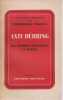
Socialisme utopique et socialisme scientifique,
Editions sociales, Classiques du marxisme, 1963, 104 pp., broché, tranches brunies, traces d'usage, dos un peu abîmé, état correct.
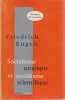
Socialisme utopique et socialisme scientifique.
Editions du parti communiste français, collection Les éléments du communisme, 1944. Plaquette in-8 brochée sur agrafes, couverture imprimée, très légèrement insolée.
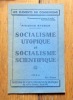
Socialisme utopique et socialisme scientifique. Traduction de Paul Lafargue.
P., Bureau d'Editions, 1936, in 8° broché, 80 pages.
PHOTOS sur DEMANDE. ...................... Photos sur demande ...................


Phone number : 04 77 32 63 69
Þróun jafnaðarstefnunnar draumsýn verður að vísindum [i.e. Icelandic ""The development of social policy: a dream becomes a science""] - [FIRST ICELANDIC ""SOCIALISM""]
Akureyri, Jafnaðarmannafélag [i.e. Icelandic: ""the Socialist association""] Akureyrar, 1928 8vo. (130 x 192 mm). Uncut in the original printed red wrappers with a bit of wear to edges and a newer, simple paper spine. A couple of notes in light pencil, otherwise clean and fresh. 79 pp.
![Þróun jafnaðarstefnunnar draumsýn verður að vísindum [i.e. Icelandic ""The development of social policy: a dream becomes a science""] - [FIRST ...](https://static.livre-rare-book.com/pictures/LLX/63371_1_thumb.jpg)
![Þróun jafnaðarstefnunnar draumsýn verður að vísindum [i.e. Icelandic ""The development of social policy: a dream becomes a science""] - [FIRST ...](https://static.livre-rare-book.com/pictures/LLX/63371_2_thumb.jpg)
![Þróun jafnaðarstefnunnar draumsýn verður að vísindum [i.e. Icelandic ""The development of social policy: a dream becomes a science""] - [FIRST ...](https://static.livre-rare-book.com/pictures/LLX/63371_3_thumb.jpg)
Exceedingly scarce first edition of the first Icelandic translation of Engels' impactful work Socialism: Utopian and Scientific, referred to by Hunt as ""the Bible of global communism"" (2009: 3). With this influential pamphlet, Engels set out to make the definitive introduction to scientific socialism. Basing it on the three chapters from his book Herrn Eugen Dühring's Umwälzung der Wissenschaft (1878) – also known as Anti-Dühring – he here wished to reproduce the most topical excerpt from the theoretical section of the book, that of strictly scientific socialism. Engels put them together himself and asked Paul Lafargue (1842-1911), Karls Marx' son-in-law, to translate the work into French and add some extra remarks. Anti-Dühring had been serialized in a German newspaper between 1877 and 1878 as a polemical response to the works of Eugen Dühring (1833-1921) – a philosophy lecturer at the University of Berlin, whose brand of socialism was making significant inroads into German social democracy. He criticized Marx and Engel's centralism and economic determinism, while proposing a gradualist political programme (Hunt 2009: 295). Engels' response ""went beyond the usual Marx-Engels invective into a broader definition and defence 'of the dialectical method and the communist world outlook' [...]. All of Engel's great gifts as a propagandist and popularizer were on display as he countered the allure of Dühring with a pacey, engaging and comprehensible explanation of the science of Marxism"" (Hunt 2009: 296). The reception of the pamphlet was a success: Engels ""proudly described it making a 'regular revolution' and 'tremendous impression' in France."" (2009: 300) As the French translation proved to be extremely popular and gained a widespread audience, Engels considered it important to translate it into other languages as well, turning it into a veritable propaganda pamphlet. Indeed, the work became extremely popular and was translated into numerous languages, exercising profound influence upon the theory of socialism throughout Europe.OCLC locates merely two copies in libraries worldwide, both being in Denmark. References and further reading: Gissurarson, Hannes Hólmsteinn. (2021). Communism in Iceland, 1918–1998. Reykjavik: Social Science Research Institute at the University of Iceland. (tilføjes 63244) The Frock-Coated Communist: The Revolutionary Life of Friedrich Engels. London: Allen Lane.Guðmundsson, Steinþór. (1928). Fr. Engels. Þróun jafnaðarstefnunnar. Rjettur: Tímarit um þjóðfelags- og menningarmál , 13. árg. 1928, 1. hefti, pp. 125.26. https://timarit.is/page/4089270#page/n122/mode/2up
L'IDEOLOGIE ALLEMANDE : PREMIERE PARTIE, FEUERBACH - CLASSIQUES DU MARXISME. PRECEDEE DES THESES SUR FEUERBACH.
SOCIALES. 1974. In-12. Broché. Etat d'usage, Couv. convenable, Dos frotté, Intérieur acceptable. 143 pages. Quelques annotations au crayon à papier sans réelle conséquence sur la lecture.. . . . Classification Dewey : 100-PHILOSOPHIE ET DISCIPLINES CONNEXES
INTRODUCTION DE JACQUES MILHAU. TRADUCTION DE RENEE CARTELLE ET GILBERT BADIA. Classification Dewey : 100-PHILOSOPHIE ET DISCIPLINES CONNEXES
Friedrich Engels Profile. Eine Auslesen aus seinen Werken und Briefen.
Wuppertal-Barmen, Peter Hammer, 1970 14 x 21, 412 pp., broché, bon état
Herausgegeben von HIRSCH Helmut, mit einem Geleitwort von Johannes RAU
La pensée, revue du rationalisme moderne (arts, sciences, philosophie), nouvelle série, N° 25, juillet-août 1949.
Paris, La Pensée, 1949. 19 x 28, 160 pp., broché, bon état.
L'idéologie allemande première partie : "feuerbach"
1968 Paris, Editions Sociales, 1968, In douze,154 pp, poche, bon état,
traduction de R .Cartelle et M.Badia.
La pensée, revue du rationalisme moderne (arts, sciences, philosophie), nouvelle série, N° 26, septembre-octobre 1949.
Paris, La Pensée, 1949. 19 x 28, 160 pp., broché, bon état.
M.E. Duhring bouleverse la science (anti-Duhring). Traduit par Bracke (A.-M. Desrousseaux).
Alfred Costes, éditeur, 1949-1955. 3 volumes, in-12, brochés.
[15756]
M. E. Duhring boulverse la science (Anti-Duhring). Traduit par Bracke (A. -M. Desrousseaux). Tome II : ECONOMIE POLITIQUE.
P., Costes, 1932, in 12 relié demi-basane noire à coins, amateur, dos lisse, étiquette rouge, plat supérieur de couverture conservée, 197 pages ; papier terni ; frottis.
...................... Photos sur demande ...................
Phone number : 04 77 32 63 69
Socialisme utopique et socialisme scientifique. Traduction francaise par Paul Lafargue. - [THE INTRODUCTION TO SCIENTIFIC SOCIALISM]
Paris, 1880. 8vo. Original printed green wrappers. Spine worn and to small nicks to back wrapper. A (vague) fold down the middle. Overall in excellent condition. 35 pp.
![Socialisme utopique et socialisme scientifique. Traduction francaise par Paul Lafargue. - [THE INTRODUCTION TO SCIENTIFIC SOCIALISM]. "ENGELS, ...](https://static.livre-rare-book.com/pictures/LLX/60262_1_thumb.jpg)
![Socialisme utopique et socialisme scientifique. Traduction francaise par Paul Lafargue. - [THE INTRODUCTION TO SCIENTIFIC SOCIALISM]. "ENGELS, ...](https://static.livre-rare-book.com/pictures/LLX/60262_2_thumb.jpg)
![Socialisme utopique et socialisme scientifique. Traduction francaise par Paul Lafargue. - [THE INTRODUCTION TO SCIENTIFIC SOCIALISM]. "ENGELS, ...](https://static.livre-rare-book.com/pictures/LLX/60262_3_thumb.jpg)
The rare first edition thus, being the scarce separate printing from Revue Socialiste, in excellent original condition, of Engel's highly popular Utopian Socialism and Scientific Socialism. With this influential pamphlet, Engels set out to make the definitive introduction to scientific socialism. Basing it on the three chapters from his book ""Herr Dühring's Revolution in Science"", he here wished to reproduce the most topical excerpt from the theoretical section of the book, that of strictly scientific socialism. Engels put them together himself and asked Paul Lafargue, Karls Marx' son-in-law, to translate the work into French and add some extra remarks. ""I put them together for my friend Paul Lafargue for translation into French and added a few extra remarks. The French translation revised by me appeared first in the Revue socialiste and then independently under the title: Socialisme utopique et socialisme scientifique, Paris, 1880."" (Engels, from the preface to the German translation, 1882). The French translation proved to be extremely popular and gained a widespread audience. So much so that Engels considered it important to translate it into other languages as well, turning it into a veritable propaganda pamphlet. ""The surprising success of the Lafargue translation in the Frenchspeaking countries and especially in France itself forced me to consider the question whether a separate German edition of these three chapters would not likewise be of value. Then the editors of the Zurich Sozialdemokrat informed me that a demand was generally being raised within the German Social-Democratic Party for the publication of new propaganda pamphlets, and they asked me whether I would not apply those three chapters to this purpose. I was naturally in agreement with that and put my work at their disposal. It was, however, not originally written for immediate popular propaganda. How could what was in the first place a purely scientific work be suitable for that, What changes in form and content were required?"" (Engels, from the preface to the German translation, 1882). From the original manuscript of the work, we know that Marx too was involved in the coming-to-be of this original pamphlet. The last page of the manuscript contains a postscript in Marx's handwriting: ""Dear Lafargue, here is the fruit of my consultation (of yesterday evening) with Engels. Polish the phrases, leaving the gist intact."" The three-page introduction to the work, which is written by Lafargue and signed P.L. at the end, is important in itself, as it gives an introduction to the history of Marx and Engels as the founders of socialism, culminating with the present pamphlet that epitomizes scientific socialism. Paul Lafargue (1841-1911), Karl Marx's son-in-law, was a leading member of the French socialist movement and played an important rôle in the development of the Spanish socialist movement. A close friend of Friedrich Engels in his later years, he wrote and spoke from a fairly orthodox Marxist perspective on a wide-range of topics including women's rights, anthropology, ethnology, reformism, Millerandism, and economics. The work became extremely popular and was translated into numerous languages, exercising profound influence upon the theory of socialism throughout Europe. ""At the request of my friend, Paul Lafargue, now representative of Lille in the French Chamber of Deputies, I arranged three chapters of this book as a pamphlet, which he translated and published in 1880, under the title: ""Socialisme utopique et Socialisme scientifique"". From this French text, a Polish and a Spanish edition were prepared. In 1883, our German friends brought out the pamphlet in the original language. Italian, Russian, Danish, Dutch, and Roumanian translations, based upon the German text, have since been published. Thus, the present English edition, this little book circulates in 10 languages. I am not aware that any other Socialist work, not even our Communist Manifesto of 1848, or Marx's Capital, has been so often translated. In Germany, it has had four editions of about 20,000 copies in all. (Englas in the preface to the English translation from 1892).
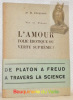
Vie et Pensée. L’Amour folie érotique ou vertu suprême ?
Neuchâtel, La Baconnière 1942, 193x140mm, 55pages, broché. Couverture à rabats. Bandeau d’annonce conservé. Très bel exemplaire.
Pour un paiement via PayPal, veuillez nous en faire la demande et nous vous enverrons une facture PayPal
Cahiers Internationaux de Symbolisme n°12 : Le Mythe, par Garaudy - L'instant ou la connivence de la nostalgie et de l'utopie, par Cl. Lejeune ...
IMP. DIEU-BRICHART J.. 1966. In-12. Broché. Très bon état, Couv. légèrement passée, Dos satisfaisant, Intérieur frais. 123 pages.. . . . Classification Dewey : 190-Philosophie occidentale moderne
Classification Dewey : 190-Philosophie occidentale moderne
Cahiers Internationaux de Symbolisme n°7 : Cybernétique et Oecuménisme. Tradition et Symbôle. Biologie Moléculaire et Information.
IMP. DIEU-BRICHART J.. 1965. In-12. Broché. Bon état, Couv. convenable, Dos satisfaisant, Intérieur frais. 96 pages. Quelques figures dans le texte.. . . . Classification Dewey : 190-Philosophie occidentale moderne
Classification Dewey : 190-Philosophie occidentale moderne
Cahiers Internationaux de Symbolisme n°8 : Beaudelaire et l'oxymoron. Les gnoses, structures et symboles archétypes. L'Utopie comme symbole ...
IMP. DIEU-BRICHART J.. 1965. In-12. Broché. Très bon état, Couv. convenable, Dos satisfaisant, Intérieur frais. 116 pages. Quelques partitions et figures dans le texte.. . . . Classification Dewey : 190-Philosophie occidentale moderne
Classification Dewey : 190-Philosophie occidentale moderne
Umgrenzte Leere. Zur Praxis einer politisch-theologischen Ästhetik im Anschluss an Peter Weiss Romantrilogie “Die Ästhetik des Widerstands”.Religion - Geschichte - Gesellschaft Fundamentaltheologische Studien Bd.9.
Münster, LIT Verlag 1998, 240x160mm, 467Seiten, Verlegereinband. Exemplar wie neu.
Pour un paiement via PayPal, veuillez nous en faire la demande et nous vous enverrons une facture PayPal
Sur l’intentionnalité et ses modes
Coll. «Epiméthée», Presses universitaires de France (PUF), 1re édition, 2006, 339 p. Broché, 15 x 21,8 cm.
Bon état.

