 Write to the booksellers
49 books for « tibullus »Edit
-
Century
16th (1)
18th (7)
19th (3)
20th (1)
-
Topics
Books from the xviiith (3)
Early printed books (1)
Greek (27)
Latin (32)
Literature (3)
Poetry (2)
Rome (2)
Teaching (1)
Various (1)
-
Countries
Belgium (3)
Denmark (3)
France (10)
Germany (1)
Greece (1)
Netherlands (28)
Switzerland (3)
-
Syndicate
CLAM (1)
ILAB (9)
SLAM (4)
Albii Tibulli Equitis Rom. Quae exstant, ad fidem veterum membranarum sedulo castigata. Accedunt notae, cum Variar. Lectionum libello, & terni Indices; quorum primus omnes voces Tibullianas complectitur.
Amsterdam (Amstelaedami), Ex Officina Wetsteniana, 1708.
4to. (XX, including frontispiece),476,(73 index),(1 blank) p., 9 full page engravings. Calf. 23.5 cm (Ref: STCN ppn 186442033; Schweiger 2,1093; Graesse 6/2,157; Ebert 22968; Brunet 5,856) (Details: Back gilt and with 5 raised bands. Red shield in the second compartment. Edges dyed red. Marbled endpapers. Frontispiece engraved after a design of Joseph Mulder, by Willem (de) Broen, who is also the engraver of the 9 plates. The frontispiece shows left a shepherdess, probably Delia, Tibullus first love, and the subject of book I; she leans on a fountain, holding a staff; she reaches out towards a shepherd at the left, in the distance 3 nude women (the three Graces) dancing with 3 putti; a ploughing farmer in background, sheep in foreground. Title printed in red and black. Engraved printer's mark on the title, with Wetstein's motto: 'Terar dum prosim'. Commentary in 2 columns below the text. P. 409/441 contain the 'libellus Variarum Lectionum' on, p. 442/466 the 'notae' of Nicolaas Heinsius, p. 467/476 observations by Janus Dousa) (Condition: Binding somewhat scuffed. Head & tail of the spine chafed. Paper yellowing) (Note: Latin love elegy is more or less an original Roman creation. It is a literary form of which almost every feature is derived from Greek models, but it has no analogue in Greek literature. These elegies, 'clearly Greek in inspiration, are all concerned with love, and it is predominantly as a medium for love poetry that the elegy was developed during the first century B.C. (...) What might be called the classic type of love-elegy, the cycle of short poems centred upon the poet's relationship with a single mistress, appears to have originated with Cornelius Gallus: his 'Lycoris' (...) was the prototype of Tibullus' Delia, Propertius' Cynthia, Ovid's Corinna, and Lygdamus' Neaera'. (OCD 2nd ed. p. 379) This edition of Tibullus of 1708 contains what is now called the 'Corpus Tibullianum'. Of this corpus, consisting of 4 books, only the first two belong to the Latin poet and elegist Tibullus, 55-19 B.C., who was probably a Roman knight. The first book deals with the poet's unhappy love for a mistress, Delia, a married woman, probably of a low social status, and for a boy named Marathus. The poetic attributes of these lovers are largely conventional, but they may really have existed. Book two, which is believed to be incomplete, celebrates in 3 elegies a new courtesan, Nemesis, probably also ficticious. There is also an elegy on the blessings of peace, and the impression of a rustic festival. The third and fourth book are by the hands of other poets. Book three contains six smooth but wooden elegies by a much inferior poet, who calls himself Lygdamus. The 4th book of the Tibullus collection consists of elegies of a very different quality, and opens with 211 hexameters on the achievements of Tibullus' patron M. Valerius Messalla Corvinus, the 'Panegyricus Messallae'. Incorporated in the 4th books are also a number of short elegies, written with a unique frankness by the 'docta puella' Sulpicia, a contemporary of Tibullus. This edition was produced by the Dutch scholar/soldier Joan van Broekhuizen (Janus Broukhusius), 1649-1707, who during an adventurous life pursued his classical studies and poetry at leisure. His editions of Propertius (1702) and Tibullus laid the foundation for his reputation as a classical scholar. He was admired as a latinist, for his taste and for his erudition. (NNBW 4,309/12) As a neolatin poet he is known as the 'Propertius of Holland'. (Sandys 2,329)) (Collation: *-2*4, 3*2; A-3Y4, 3Z2 (leaf 3Z2 verso blank)) (Photographs on request)
The complete poems of Tibullus. An en face bilingual edition. Albius Tibullus, Lygdamus, and Sulpicia. Translated by Rodney G. Dennis and Michael C.J. Putnam. With an introduction by Julia Haig Gaisser.
Berkeley etc., University of California Press, 2012.
X,159 p. Paperback. 23 cm
Albii Tibulli Carmina quae exstant omnia. Ex recensione F. Wunderlichii cum notis G. Heyne.
Torino, Augustae Taurinorum, Ex typis Viduae Pomba et Filiorum, 1821.
2 volumes: 293,(98 index); 421 p., engraved portrait of Tibullus. Contemporary hardback 25.5 cm (Red gilt shields on the backs; some wear to the extremes)
Tibullus, a commentary (by) Michael C.J. Putnam.
Norman, University of Oklahoma Press, 1973
210 p. Cloth. 19.5 cm (Introduction, Latin text and commentary. Including dustjacket)
Tibullus, a commentary (by) Michael C.J. Putnam.
Norman, University of Oklahoma Press, n.d.
210 p. Paperback. 19 cm (Introduction, Latin text and commentary)
The elegies of Albius Tibullus. The corpus Tibullianum edited with introduction and notes on books I, II and IV,2-14 by Kirby Flower Smith.
Darmstadt, Wissenschaftliche Buchgesellschaft, 1971.
542 p. Paperback. 19 cm (Reprint edition 1941) (On the inside of the frontcover some pencil, and 2 small paper clippings)
Tibullus: Elegies. Introduction, text, translation and notes (by) Guy Lee. Third edition. (Including Book 3, text and translation) Revised in collaboration with Robert Maltby.
Liverpool, Francis Cairns, 1995.
XXII,168 p. Paperback. 21.5 cm (Text, translation, textual & explanatory notes)
Haec mihi fingebam. Tibullus and his world.
Leiden, Brill, 1978.
15,275 p. Cl. 24 cm (Cincinnati Class. Studies NS 3) (Stain at right edge of the frontcover; small review stamp on frontcover)
Powerplay in Tibullus. Reading Elegies Book One.
Cambridge, CUP, 1998.
XII,328 p. Hardbound. 22.5 cm (Including dustjacket)
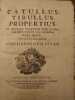
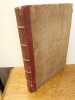
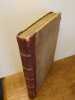
Catullus, Tibullus, Propertius, ad optimorium exemplarium fidem recensiti, cum MSS. codicum variis lectionibus margini appositis. Ad Celsisssimum Aurelianensium Ducem.
Lutetiae Parisiorum, Typis Antonii Urbani Coustelier, 1723. 25,5 x 18,5 cm, xj-312 pp. et 1 ff. Relié demi chagrin, dos à nerfs muet. reliure usée mais encore solide, coins très émoussés, intérieur en bon état.

C. Valerius Catullus, Pristino nitori restitutus, & ad optima Exemplaria emendatus. Cum Fragmentis C. Gallo inscriptis
1754 Lutetiae Parisiorum (Paris), typis Josephi Barbou, 1754, 3 parties en 1 volume in-12 à pagination continue de (2)XVI-344 pp., très belle reliure de l'époque, de plein maroquin rouge, dos lisse orné de fers dorés à la grotesque, pièces de titre de maroquin vert, encadrement de triple-filets dorés sur les plats, très bel exemplaire
Charmante édition latine de ce recueil d'oeuvres des trois plus importants poètes latins, lyriques et élégiaques, du premier siècle avant Jésus-Christ. Caius Valerius Catullus (84-55 Avant J.-C.), Albius Tibullus (54-19 Avant J.-C.), et Sextus Propertius (50-15 avant J.-C.), que l'on doit à l'humaniste Girolamo Avanzi. La première édition de ces oeuvres par Nicolas Lenglet Dufresnoy (1674-1755) a paru en 1742 chez le même éditeur.
Catullus, Tibullus et Propertius, Pristino nitori restituti, & ad optima Exemplaria emendati. Accedunt. Fragmenta "Cornelio Gallo" inscripta. Editio nova correctior.
Parisiis, Typis Fratrum Barbou, 1792. In-12 (156 x 90 mm), frontispice gravé, XX-364 pp., (1) f. blanc, 2 planches gravées, 3 vignettes gravées, reliure veau marbrée, dos lisse orné de fleurons dorés, triple filet doré sur plats, roulettes dorées sur coupes et à l'intérieur des plats, tranches dorées, 1 trou de vers sur mors, coins et coupes frottés, intérieur très bien, inscription au stylo à plume partiellement raturée sur page de faux-titre, bel exemplaire.

Catullus, Tibullus et Propertius, Pristino nitori restituti, & ad optima Exemplaria emendati. Accedunt Fragmenta Cornelio Gallo inscripta. Editio Nova Correctior.
Parisis, Fratrum Barbou, 1792 ; 1 volume in-12°, plein veau marbré de l' époque, triple filet doré en encadrement des plats, dos lisse orné de petits fers dorés, titre doré sur étiquette de maroquin rouge, roulette sur les coupes, tranches dorées; XXpp.,364pp.; infime perte de cuir à la coiffe supérieure, coins supérieurs très légèrement émousssés.Bel exemplaire pratiquement sans piqûres.
Illustré de 3 gravures hors texte non signées et de 3 vignettes en en-tête ( dont 1 d'après Eisen). ( GrF)
Carmina ex recensione C. Lachmanni passim mutata explicuit L. DISSENIUS.
Göttingen, Dieterich, 1835.
2 vols. in 1: CXCII,128;477 p. H.calf 21 cm (Backs gilt, and with 4 raised bands, and 2 black shields; foxed)
Carmina ex recensione C. Lachmanni passim mutata explicuit L. DISSENIUS.
Göttingen, Dieterich, 1835.
2 vols. in 1: CXCII,128;477 p. H.cl. 21 cm
Albii Tibulli quae supersunt Omnia Opera, varietate lectionum novis commentariis, excursibus imitationibus gallicis, vita auctoris et indice absolutissimo instruxit Philipp. Amat. de Golbéry.
Paris, Elegius Lemaire, 1826.
CXVI,580,(4) p. Half green morocco 24 cm (Back ruled gilt, cover somewhat worn at the extremes)
Gedichte. Lateinisch und Deutsch von R. HELM. 4. Auflage.
Darmstadt, WB, 1979.
VI,147 p. Cl. 25 cm
Gedichte. Lateinisch und Deutsch von R. HELM. 7. unveränderte Aufl.
Bln., Ak. Verlag, 1988.
VI,147 p. Cl. 24 cm
Carmina libri tres. Cum libro quarto Sulpiciae et aliorum C.G. HEYNii editio quarta. Nunc aucta notis et observationibus E.C.F. WUNDERLICHii. Accedit index verborum. Supplementum edidit L. Dissenius. (Partes tres in uno volumine).
Hildesheim etc., Olms, 1975.
3 vols. in 1: 80,274;492;8,63 p. Cl. 18 cm (Repr. ed. Lpz. 1817/19)
Carmina libri tres. Cum libro quarto Sulpiciae et aliorum C.G. HEYNii editio quarta. Nunc aucta notis et observationibus E.C.F. WUNDERLICHii. Accedit index verborum. Supplementum edidit L. Dissenius. (Partes tres in uno volumine).
Hildesheim etc., Olms, 1975.
3 vols. in 1: 80,274;492;8,63 p. Cl. 18 cm (Repr. ed. Lpz. 1817/19)
Elegiae cum carminibus pseudotibullianis. Edidit E. HILLER. Accedit Index Verborum.
Lpz., Tauchnitz, 1911.
XXIV,105 p. H.cl. 20 cm (Cover slightly worn)
ANTHOLOGIE AUS DEN ELEGIKERN DER RÖMER. 2. Heft: Tibull. Erklärt von C. JACOBY. 2. verbesserte Aufl.
Lpz., Tbn., 1894.
IV,65 p. Cl. 22 cm (TbGLS) (Rebound)
Elegieën, en andere gedichten uit het Corpus Tibullianum. Vertaald, ingeleid en van aantekeningen voorzien door J. NAGELKERKEN.
Baarn, Ambo, (1994).
137 p. Cloth 22 cm (OiN Suppl. 104; includingdustjacket; name on front flyleaf)

