 Write to the booksellers
33 books for « stirner »Edit
-
Century
19th (1)
20th (14)
21st (1)
-
Countries
Belgium (1)
France (29)
Netherlands (1)
Switzerland (2)
-
Syndicate
ILAB (17)
NVVA (1)
SLAM (17)
Der Einzige und sein Eigenthum. (Privat-Ausgabe. Veranstaltet von John Henry Mackay). (Leipzig, Offizin von W. Drugulin, 1911). - (Bound with:) STIRNER, M. (PSEUD. OF J.C. SCHMIDT). Das unwahre Prinzip unserer Erziehung oder der Humanismus and Realismus.
(Leipzig, Spamersche Buchdruckerei, 1911). (2), 354, (6) pp.; (2), 25 pp. 4to. Grey and blue-brown marbled paper over boards, raised bands with label and gilt lettering, the compartments with a floral decoration, the original covers preserved, gilt lettered scroll to front cover reading 'Plus est en Moi.' The first work is number 116 of 980 copies printed, the second work is number 61 of 980 copies printed. Both are printed on especially prepared Van Gelder-Zonen paper with the name of John Henry Mackay as watermark. The first work is signed by John Henry Mackay on the annotated leaf bound in at the end. The orginal covers are Japanese 'Pergamentpapier'; the idea to have the books bound was abandoned 'da es unmöglich ist, hier den Geschmack des einzelnen auch nur annähernd zu treffen.' The last 6 pages of the first work contain the 'Inhalt', a leaf with the title and at the bottom the text: Beilage zu Exemplar Nr. 116, followed by the annotated leaf which is dated Charlottenburg bei Berlin, 1. Juli 1911 and signed by John Henry Mackay. In the first work Stirner proceeds from Hegelianism to its almost complete inversion in a doctrine that denied all absolutes and all institutions, and based itself solely on the 'ownness' of the human individual. His is the ideal of the man who realizes himself in conflict with the collectivity and other individuals. Striner holds the individual to be the focal point and center of the world and asserted that the feelings and thinking of the individual determine the whole scale of social values and that there is nothing objective outside the individual, or the ego. Since the individual who creates the world through his imagination and will is the only reality, the world belongs to the individual: the world becomes his possession.The ressemblance between Nietzsche and Stirner is striking and indeed Nietzsche regarded Stirner as one of the unrecognized seminal minds of the nineteenth century. With the growing vogue for Nietzsche at the end of the century Stirner's work witnessed a popular revival. But Stirners greatest influence was exerted upon anarchism, many years after his death. It is still a classic of libertarian thought in which the uniqueness of the individual is stressed.Max Stirner, born as Johann Caspar Schmidt, was born in 1806 in Bayreuth and died in 1856 in Berlin. He was one of the most prominent left-wing Hegelians in Berlin and he contributed, together with Karl Marx and other young bourgeois radicals, to the Rheinische Zeitung, the journal of the advanced wing of the industrial and banking circles in the Rhineland. The present work is his major and most celebrated work which made a strong impression on the German intelligentsia and which was widely read and reviewed. The work was published in 1844 (although the title-page on all first editions reads 1845) and it forced Marx and Engles to write extensive refutations of Stirner's ideas in their Die deutsche Ideologie.John Henry Mackay, the Scots born German poet, was the chief instrument in the revival of Stirnerism. He met Stirner's name very early in his career while reading Lange's History of Materialism, and was moved to read Stirner's book. Mackay was so impressed that he devoted part of his life to the rediscovery and rehabilitation of the lost and forgotten genius. His biography of Stirner appeared in Berlin in 1898 and it is a tribute to his thoroughness that since its publication not one important fact about Stirner has been discovered by anybody.


(NVVA, )
Phone number : 31 20 698 13 75
Le faux principe de notre éducation - L'Anticritique.
AUBIER MONTAIGNE - Bibliothèque Sociale Bilingue In-8°, broché, couverture souple sobre vert tabac, 182 pages, l'exemplaire est en très bon état.
Rare Exemplaire, EDITION BILINGUE FRANCAIS-ALLEMAND . Marx Stirner est aussi bien célèbre qu'inconnu, par un livre, souvent relu, mais souvent incompris: l'unique et sa propriété, une uvre à la fois éblouissante et énigmatique. Ce volume-ci éclaire la pensée de Max Stirner en offrant enfin au public deux opuscules qui encadrent, dans le temps, l' uvre principale. Le premier, Le Faux Principe de notre éducation ou l'humanisme et le réalisme (1842), outre sa grande valeur intrinsèque, révèle les soubassements de L'Unique et sa propriété (1844). Le second, L'Anticritique, ou les critiques de Stirner (1845), répond particulièrement aux attaques de Ludwig Feuerbach et des disciples de Bruno Bauer; il manifeste et garantit la cohérence et l'unité de la pensée de Max Stirner. Encore faut-il souligner l'actualité du premier des deux opuscules. Max Stirner y pose le dilemme auquel nous sommes encore affrontés : développe-t-on consciencieusement notre capacité de devenir des créateurs ou ne nous traite-t-on qu'en créatures juste bonnes à être dressées ? Bon Etat Franco de port France jusqu'à 29 euros iclus. PAYPAL immédiat. MONDIAL RELAY pour : FRANCE, Portugal, Pologne, Espagne, Allemagne, Autriche, Pays Bas, Luxembourg, Italie, Belgique. Toutes les étapes sont accompagnées. Achat, estimations et listages (Papiers, Archives, monographies, arts et métiers, sciences humaines et bibliophilie) France / Suisse (sur rdv).
le Faux Principe de Notre Education ou l'Humanisme et le Réalisme. L'Anticritique (Critique de Stirner).
Paris. Aubier Montaigne. 1974. In-8. Br. Edition Bilingue. 182 p. Bon état. Couverture défraichie et frottée.
LUNIQUE ET SA PROPRIÉTÉ. Et autres écrits. Traduits par Pierre Gallissaire et André Sauge.
LAge dHomme, éd. 1994. Grand in-8° br. 437 pp.
Bon état. Exemplaire de Jean-Jacques Pauvert comportant son cachet d'ex-libris.
L'unique et sa propriété
Stock plus 1978 455 pages in12. 1978. broché. 455 pages.
Bon état légères taches sur couverture
L'UNIQUE ET SA PROPRIETE ET AUTRES ECRITS
Editions l'Age d'Homme 1999 3x22x16cm. 1999. Broché.

Très Bon Etat de conservation intérieur propre bonne tenue
L'unique et sa propriété
1960 Paris, Jean-Jacques Pauvert , 1960, In huit ,333 pp, broché, couverture illustrée d'après un dessin de Max Ernst
traduction du Docteur Reclaire.
Le faux principe de notre éducation ou l'humanisme et le réalisme - L'anticritique (critiques de Stirner) - édition bilingue - Collection bibliothèque sociale .
Aubier Montaigne. 1974. In-8. Broché. Bon état, Couv. convenable, Dos satisfaisant, Intérieur frais. 182 pages - édition bilingue, texte en allemand avec la traduction française en regard.. . . . Classification Dewey : 300-SCIENCES SOCIALES
Collection bibliothèque sociale - Edition bilingue - traduction, introduction et notes par Henri Arvon. Classification Dewey : 300-SCIENCES SOCIALES
GOURMONT (Remy de) - LEAUTAUD (Paul) - LOUYS (Pierre) - MAGRE (Maurice) - RACHILDE - STIRNER (Max) - WELLS (Herbert George) - VERHAEREN (Emile) -
Reference : 40302
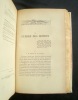
Le Mercure de France : octobre-décembre 1899 -
Paris : Société du Mercure de France, 1899 - un fort volume in-8 (15,5x23,2cm) demi vélin souple à coins, avec pièces de titre, d'année et de tomaison (reliure de l'époque), 864 pages - Papier uniformément jauni sinon exemplaire en bon état - Au sommaire de ces trois numéros : Rémy de Gourmont : Le Songe d'une femme, Un soir dans un musée ; Rachilde : La Peste de Florence ; Pierre Louys : Préface aux Mimes des Courtisanes ; Max Stirner : Ma puissance ; H.-G. Wells : La Guerre des mondes (I à XIII) ; Emile Verhaeren : Le Pèlerin; Maurice Magre : Les Amants -
Créé en 1890 et animé par Alfred Vallette, Le Mercure de France s'est imposé rapidement comme la revue de nouvelles générations d'écrivains réunis autour de Rémy de Gourmont : Rachilde, Henri de Régnier, Marcel Schwob, Emile Verhaeren, Pierre Louys, Léon Bloy, Paul Léautaud, André Gide, Alfred Jarry, Guillaume Apollinaire... Tous nos livres sont visibles sur notre site : https://www.livrepoesie.com/
Max Stirner ou la première confrontation entre Karl Marx et la pensée anti-autoritaire. Recueil de texte publié sous la direction de D. Dettmeijer.
Lausanne, L’Age d’Homme 1979, 270x210mm, 270pages, broché.

illustré, Pour un paiement via PayPal, veuillez nous en faire la demande et nous vous enverrons une facture PayPal
Oeuvres Complètes. L'unique et sa propriété et autres écrits.
L'Age d'Homme.1972.In-8,couv.souple à rabats.437 p.BE.
Oeuvres complètes - L'unique et sa propriété et autres écrits
Collection "Germanica" L'Age d'Homme (1972) - Un volume in-8 broché de 440 pages - Traduit par P. Gallissaire et A. Sauge - Très bon état
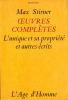
L'unique et sa propriété [Unknown Binding]
Couverture différente .Broché bon état.Contenu propre . Dos insolé . Coins cornés . 1972. 436 pages . PHOTOS SUR DEMANDE
Merci de nous contacter à l'avance si vous souhaitez consulter une référence dans notre boutique à Authon-du-Perche.
"L'unique et sa propriété; un chef d'oeuvre immortel de philosophie."
Paris, Editions S.L.I.M., 1948. 14 x 19, 403 pp., broché, très bon état.
"Traduction de Henri Lasvignes; préface de E. Armand; avant-propos de F. Planche."
Oeuvres complètes. L'unique et sa propriété, traduit par P. Gallissaire, et autres écrits, traduit par A. Sauge. Collection Germanica.
Lausanne, L’Age d’Homme 1972, 210x140mm, 437pages, broché. Couverture à rabats. Bel exemplaire.
Pour un paiement via PayPal, veuillez nous en faire la demande et nous vous enverrons une facture PayPal
L Unique et sa propriété
1922 Stock 1922 in-12 broché, 449 pages, photos sur demande / pictures on request. Odeur de grenier
"L'unique et sa propriété - ""La petite vermillon"" n°126"
La table ronde. 2006. In-12. Broché. Etat d'usage, Couv. convenable, Dos satisfaisant, Papier jauni. 411 pages - une illustration en noir et blanc en frontispice.. . . . Classification Dewey : 830-Littératures des langues germaniques
Trad. et postface de Henri Lasvignes. Présentation de Cécile Guérard. Classification Dewey : 830-Littératures des langues germaniques
"Oeuvres complètes - L'unique et sa propriété et autres écrits - Collection ""Germanica""."
L'age d'homme. 1972. In-8. Broché. Bon état, Couv. convenable, Dos plié, Intérieur frais. 437 pages - couverture contrepliée.. . . . Classification Dewey : 100-PHILOSOPHIE ET DISCIPLINES CONNEXES
"Collection ""Germanica"" - traduit par P.Gallissaire ('unique et sa propriété) - traduit par A.Sauge (autres écrits). Classification Dewey : 100-PHILOSOPHIE ET DISCIPLINES CONNEXES"
L'unique et sa propriété
Jean-Jacques Pauvert. 1960. In-8. Broché. Etat d'usage, Couv. légèrement passée, Dos plié, Intérieur acceptable. 333 pages. Mors très légèrement fendus en coiffes.. . . . Classification Dewey : 830-Littératures des langues germaniques
Trad. du Docteur Reclaire. Classification Dewey : 830-Littératures des langues germaniques
L’Unique et sa propriété
Editions Labor 2006, broché, 516pp; collection quartier libre - très bon état
Der Einzige und sein Eigentum
Druck und Verlag von Philipp Reclam. Non daté. In-24. Relié toilé. Etat d'usage, Couv. légèrement passée, Dos satisfaisant, Papier jauni. 429 pages. Livre en allemand. Caractères gothiques. Traces de mouillures sur les plats.. . . . Classification Dewey : 430-Langues germaniques. Allemand
Classification Dewey : 430-Langues germaniques. Allemand
L’UNIQUE ET SA PROPRIÉTÉ
Quartier libre, éditions Labor, Paris 2006
Un volume épais in-12°, reliure semi rigide éditeur, 1er plat de couleur jaune illustré d’un poing sur lequel est juché une petite silhouette au bras levé. 513 pages + une Table des matières. TRES BON ÉTAT [50456]
De l'éducation : le faux principe de notre éducation - Les Lois de l'école
Max Stirner, De l'éducation : le faux principe de notre éducation - Les Lois de l'école / Gunther Freitag - Jean Barrué : En lisant l'unique, Spartacus, cahiers mensuels, René Lefeuvre, février-mars 1974, 13,5 cm X 18,7 cm, 104 pp, couverture souple illustrée.
Plats salis, bords frottés. Très bon état par ailleurs. Intérieur frais.
L'unique et sa propriété et autre écrits
L'Age d'Homme. 1994. In-8. Broché. Etat d'usage, Couv. convenable, Dos satisfaisant, Intérieur acceptable. 437 pages. Plats contrepliés en un rabat. Léger accroc sur le 2e plat.. . . . Classification Dewey : 830-Littératures des langues germaniques
Trad. par Pierre Gallissaire et André Sauge. Classification Dewey : 830-Littératures des langues germaniques

