 Write to the booksellers
6 books for « say horace »Edit
-
Century
18th (1)
19th (2)
20th (2)
-
Topics
Author’s sending (1)
Economics (1)
Economics (1)
Gas (1)
Modern illustrated book (1)
North america (1)
Poetry (1)
Tea (1)
-
Countries
Belgium (1)
Denmark (2)
France (3)
-
Syndicate
ILAB (3)
SLAM (1)
Histoire des relations commerciales entre la France et le Bresil. - [FIRST EDITION WITH AN EXCEPTIONAL PRESENTATION INSCRIPTION]
Paris, Guillaumin, 1839. 8vo. In contemporary half calf with gilt lettering and ornamentation to spine. With author's presentation inscription to half title: ""de la part d. l'auteur / á son ami M. Philip Taylor / H. S."" (i.e. English: ""From the author to his friend Mr. Philip Taylor, H. S. (i.e. Horace Say)). A few scratches to spine and internally with light occassional brownspotting, but overall a nice and clean copy. 333, (3) + 5 plates of which 2 are folded.
![Histoire des relations commerciales entre la France et le Bresil. - [FIRST EDITION WITH AN EXCEPTIONAL PRESENTATION INSCRIPTION]. "SAY, HORACE.](https://static.livre-rare-book.com/pictures/LLX/62435_3_thumb.jpg)
![Histoire des relations commerciales entre la France et le Bresil. - [FIRST EDITION WITH AN EXCEPTIONAL PRESENTATION INSCRIPTION]. "SAY, HORACE.](https://static.livre-rare-book.com/pictures/LLX/62435_4_thumb.jpg)
Uncommon first edition – with author’s presentation inscription to English industrialist Philip Taylor - of Say’s seminal work in which he analyzes Brazil not just descriptively but analytically, treating it as a case study for how free trade, open markets and liberal institutions can foster economic development and growtH. This embodies the classical liberal belief in progress through commerce - linking Enlightenment ideals to the economic realities of the 19th century. In the present work Say reflects and extends the liberal economic philosophy of his father famous Jean-Baptiste Say, celebrated for ""Say’s Law"" and his advocacy of free markets. While Jean-Baptiste laid the theoretical foundation for classical economics in France, his son Horace applied these ideas to real-world contexts - analyzing Brazil as a proving ground for liberal trade principles. The work bridges theory and practice showing how the younger Say carried forward and globalized his father’s economic legacy. Say identifies Brazil as a model for future French colonial economics - not in terms of conquest but through integration into global trade networks. This early liberal vision contrasts sharply with later exploitative imperial models and shows how economists like Say envisioned colonialism as an economic partnership shaped by industrial and technological exchange. He anticipates the country's economic take-off and presents it as a promising model for France’s emerging colonial ambitions, especially in the tropics. The book is deeply informed by the liberal economic thought of the time and offers a fine insight into the global economic thinking of 19th-century France. The present copy was given by Say to Philip Taylor (1786–1870), an English industrialist and engineer. He was a pivotal figure in Franco-British industrial exchange during the 19th century. A Protestant like Say, Taylor settled in Marseille, where he played a crucial role in advancing industrial technologies, especially in the sugar refining sector. His connection with the Say family was not only personal but also professional - he collaborated closely with Horace Say’s uncle, founder of the Say sugar refinery (later Béghin-Say), to introduce British-designed machinery into French industry. The friendship between Say and Taylor reflects a broader internatioanl network of liberal thinkers, industrialists and reformers who were shaping the global economy during the first half of the 19th century. This dedication documents a personal and ideological alliance at the heart of early industrial globalization linking two pivotal figures at the intersection of theory and industry. Kress III, C.4986 Not in Einaudi or Mattioli.

Histoire des relations commerciales entre la France et le Brésil, et considérations générales sur les monnaies, les changes, les banques et le commerce extérieur.
Paris, Guillaumin, 1839. In-8 de 333 pp, (1) f. avis au relieur, (1) f. prospectus de l'ouvrage ; demi-maroquin rouge, dos à nerfs, tranches marbrées (reliure signée de Lortic).
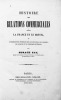
Edition originale. L'illustration se compose de 3 planches gravées d'après les dessins de J. Blumenthal (carte de la baie de Rio de Janeiro, (carte de Bahia et de la baie de Todos Os Santos, (plan de Pernambouc), d'un tableau synoptique dépliant du cours des changes et des marchandises à Rio de Janeiro de 1808 à 1839, et d'une carte dépliante du Brésil rehaussée en couleurs. Intéressant aperçu de l'histoire et de l'économie du Brésil, de ses liens avec la France, avec une attention particulière sur le rôle joué par l'esclavage et la nécessité de son abolition. On trouve en fin d'ouvrage des tableaux d'importation du café, cacao, bois d'ébénisterie, cuirs et cornes. Horace Say fut un des plus importants économistes français du XIXe siècle. Après des études à Genève, il entra dans la maison de commerce de Delaroche-Delessert et partit en 1813 aux États-Unis puis au Brésil pendant plusieurs années. De retour en France, il fonda à Paris en 1818 une maison de commission pour l’Amérique du Sud. En qualité de président de la Chambre de Commerce, il dirigea une enquête sur l’industrie de Paris entre 1848 et 1851. Son rapport obtint en 1853 le grand prix de statistiques décerné par l’Académie des Sciences. Exemplaire enrichi d'un envoi autographe signé de l'auteur à Natalis Rondot. Les deux dernières lettres du nom ont été coupées à la reliure. Économiste, historien de l'art et industriel français de la soie, Natalis Rondot fut notamment délégué par la chambre de commerce de Reims afin de représenter la France en Chine lors d'une mission extraordinaire pour négocier des traités de commerce de 1843 à 1846. Au cours de ce voyage, Natalis Rondot s'intéressa aux cultures chinoise, japonaise et indochinoise, à leur travail de la soie et apprit le chinois. A son retour, il contribua de façon déterminante à l'essor de l'industrie de la soie à Lyon dans les années 1850. Nommé par la Chambre de commerce en 1856, il fut le fondateur du musée d'Art et d'Industrie de Lyon, futur musée historique des Tissus, qu'il inaugura en 1864. Cet ouvrage propose un remarquable tableau de l’économie brésilienne au temps des empereurs et de l’avenir qu’elle offrait au monde. Horace Émile Say ou Horace Say, né à Noisy-le-Sec le 11 mars 1794 et mort le 25 juillet 1860, est un négociant et un économiste français connu surtout pour être le fils de Jean-Baptiste Say et le père de Léon Say. Biographie d'Horace Say Bel exemplaire dans une reliure signée. Borba de Moraes, 779 : an excellent work. — Garraux, 275. — Sabin, 77353.

"SAY, HORACE. - THE INVENTION OF THE STEREOMETER (GAS PYCHNOMETER).
Reference : 44128
(1797)
Description d'un Instrument propre à measurer le volume des corps, sans les plonger dans aucun liquide.
(Paris, Chez Fuchs, Guillaume, An VI (1797)). Without wrappers. In: ""Annales de Chimie et de Physique, Par MM. Gay-Lussac et Arago."" , tome 23, Cahier 1. Pp. 1-112 (entire issue offered). Say's paper: pp. 1-27 a. 1 folded plate depicting the stereometer.
First appearance of Say's description of his invention of the Gas Pychnometer, which he himself called Stereometer. It is a simple apparatus for determining the density and volume of solids without water. - Darmstaedter 1797 Say.
CHAPELLES ARDENTES
1921 broché (paperback) grand in-octavo, dos (spine) muet crème très légèrement défraîchi (faded), première de couverture illustrée (front cover illustrated), non rogné (edges no smooth) en partie (partly) non coupé (uncut), tirage limité tiré à 522 exemplaires - 1 des exemplaires sur papier vergé d'arches (522 copies were printed) abondamment illustré (plentifully illustrated), orné de 43 illustrations originales gravées sur Bois (engraving-wood) par Morin-Jean, sans pagination (105 pages), 1921 Paris La Belle Edition Editeur,
bon état intérieur (inside - very good condition), édition originale (first printing).
Chapelles Ardentes, décorés de 43 bois taillés par Morin-Jean.
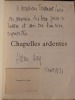
Paris, à la Belle édition, 1921. In-8 carré broché. ss pagination, 56 feuillets. Illustrations in et hors texte en noir et blanc. Tirage limité à 522 exemplaires, celui étant un des 500 sur vergé d'Arches, numéro 25. Bel envoi de l'auteur en page de faux titre avec sa carte. Couverture défraichie, intérieur frais.
Traite d´économique politique ou simple expostion de la manière dont se forment, se distribuent et se consomment les richesse. Sixième édition entièrement revue par l´auteur, et publiée sur les manuscrits qu´il a laissés, par Horace Say, son fils.
Paris, Guillaumin Libraire, 1841, (sixième édition), in-8°, vii + 640 pp, 19th century green half-morocco, marbled boards and endpapers, gilt supralibro on frontcover (Stuttaford Collection), some foxing at first 35 pages but a nice/good copy. First posthumous edition published by the son Horace, the first edition was from 1803.

