 Write to the booksellers
20 books for « polybius »Edit
-
Century
16th (1)
17th (2)
18th (3)
19th (2)
-
Topics
English (1)
Greek (9)
History (2)
Latin (10)
Maigret (1)
Military arts (2)
-
Countries
Belgium (2)
Denmark (6)
France (1)
Netherlands (10)
Switzerland (1)
-
Syndicate
ILAB (8)
NVVA (1)
SLACES (1)
SLAM (1)
EK TÔN POLUBIOU TOU MEGALOPOLITOU EKLOGAI PERI PRESBEIÔN. Ex libris Polybii Megalopolitani Selecta de legationibus; et alia quae sequenti pagina indicantur: (Fragmenta Ex Historiis Quae Non Extant: Dionysii Halicarnassei: Diodori Siculi: Appiani Alexandrini. Dionys. Cassii Nicaei De Legationibus. Dionys. Lib. LXXIX. Et LXXX. imperfectus. Emendationes In Polybium impressum Basileae per Ioannem Hervagium Anno M.D.XXIX) Nunc primum in lucem edita. Ex bibliotheca Fulvii Ursini.
Antwerpen (Antverpiae), Ex officina Christophori Plantini, 1582.
4to. 2 parts in 1: (VIII),447,(1 blank);182 p. Calf 23 cm. 'Editio princeps' (Ref: Not in STCV; Hoffmann 3,270; Schweiger 1,272; Speeckaert/Sorgeloos no. 386; Voet, Plantin Press, 2081; Graesse 5,395: 'un jugement très honorable est porté sur cette éd. et sur le man. dont Ursin s'est servi, par Schweighaeuser'; Dibdin 2,351, note; Sandys, 'A history of classical scholarship' 1,405) (Details: Back with 5 raised bands, its compartments gilt with double fillet, and a starry ornament. Double fillet gilt borders on the boards. Edges marbled. Woodcut printer's device on title, motto 'Constantia et Labore'. The first part, p. 1-294, contains the Greek text of Polybius' 'Selecta de legationibus'; p. 295-447 contain the 'Selecta de legationibus' of Dionysius Halicarnassensis, Diodorus Siculus, Appianus and Dio Cassius. The first 148 pages of the second part contain the 'Fulvi Ursini notae in Polybium'; followed by 34 pages with Ursinus' 'emendationes in Polybium', taken from the Basle edition of Johannes Hervagius of 1529) (Condition: Binding worn. Back rubbed. Head & tail of the spine chafed. Boards scratched. Small surface damage on the lower board. Hinges cracking, but strong. Corners bumped. Small tear in the front flyleaf) (Note: The Greek author Polybius, ca. 200 - 118 B.C., born at Megalopolis, is the historian of the rise of Rome to world power. After the lost battle at Pydna in 168, where Greece lost its independence, young Polybius was, among 1000 other eminent Achaeans, deported to Rome, and held hostage there. In Rome he became a member of the circle of the Roman magistrate Scipio Aemilianus, whom he accompanied on his campaigns through Spain and Africa. There he developed a warm admiration for the Romans. Of Polybius' 'Histories', consisting of 42 books, only the first 5 books are extant, the rest is lost, except excerpts, the so-called Constantinean Excerpts, or Selecta, which survived. 'His original purpose was to narrate the history of the 53 years (220-168), from the Hannibalic War to Pydna, which left Rome mistress of the world' (OCD 2nd ed. p. 853). He did so from a Roman point of view. Later in life he extented his work to the year 120. Polybius aim was didactic, he wanted to inform the statesman and to teach 'the general reader how to face disaster' (OCD). He narrated and analysed political and military events to bring out their causes. The rise of Rome to her deserved and destined supremacy over the civilized world was according to him the work of Destiny. He was the last Greek historian who may claim high rank. Polybius was widely read in Byzantine times, and after his 'rediscovery' in the West, the Florentine statesman Macchiavelli used him as a political thinker. He was edited and analysed by great philologists like Poliziano and Casaubon. The Constantinean Excerpts, of which the 'Selecta de Legationibus', or 'Excerpta de Legationibus' (On diplomacy) form part, were compiled when the Byzantine emperor Constantine VII Porphyrogenitus, 913-959, ordered the creation of a kind of encyclopaedias of History, Agriculture and Medicine. They were to contain excerpts from the most important ancient texts, most of which are now lost. This trend of excerpting and anthologizing was ulitmately responsible for the fragmentary form in which the text of Polybius has come down us, or to put it more mildly, thanks to the excerptors much of Polybius has been preserved. The encyclopaedia of History consisted of numerous extracts from the works of the leading Greek historians, then extant in Constantinople, beginning with Herodotus and ending with Theophylactus. It was organized under 53 headings, of which only 6 survive: 'De virtutibus et vitiis' (On virtues and vices), 'De sententiis' (On Aphorisms), 'De insidiis' (On ambushes), 'De stratagematis' (On stratagems), 'De legationibus gentium ad Romanos' (On foreign embassies to Rome), and 'De legationibus Romanorum ad Gentes' (On Roman embassies abroad). The most important of the Constantinean excerpts are those of Polybius. They preserved virtually all the surviving text that we have of the books 20-39 of Polybius. The 'editio princeps' of the excerpts of Polybius was published in Antwerp in 1582 by the Italian humanist scholar Fulvius Ursinus (1529-1600). At the beginning of the preface to the edition Fulvius Ursinus tells us that he received some years before from his friend Antonius Augustinus, archbishop of Tarragona, a manuscript with 'Polybii quaedam fragmenta', collected by 'Iohanne quodam Constantinopolitano', in order to correct and publish it. (Leaf pi2 recto) Ursinus became the librarian of 3 cardinals, and was a great collector of manuscripts and books. Sandys says of him that he 'was the centre of classical and antiquarian interest in Rome, and there was hardly any edition of a Latin author published in his time to which he did not contribute readings from his store of MSS'. (Sandys 2,153) The great German scholar Schweighaeuser, who published in 1795 his epoch-making edition of Polybius, had a high opinion of this work of Ursinus. It is of the highest importance and usefulness. Ursinus restored many corrupt places, and gave us the true Polybius, he said. (Schweighaeuser's Polybius, 1789-1795, volume I, p. XIII). According to Voet the edition of these exerpts, notwithstanding its importance, was not really a success: in 1642 as yet 407 copies remained unsold) (Collation: pi4, A-Z4, a-z4, Aa-Kk4 (leaf Kk4 verso blank); A-Z4 (leaf Z4 blank)) (Photographs on request)
Les Cinq premiers Livres des Histoires de Polybe Megalopolitein, avec trois Parcelles du VI. Une du VII, une du VIII & une du XVI. Autrefois traduits et mis en lumière par Louïs Maigret, & derechef revuz, corrigez & renduz plus entiers par lui sur l'exemplaire grec..
Lyon, par Jean de Tournes 1558 [Continuation of title: "Auxquels de nouveau sont ajoutees les subsequentes Parcelles des livres IX. X. XI. XII. XIII. XIIII. XV. XVII. Toutes traduites par lui sur l'exemplaire grec. Ensemble le dessein du camp des Rommeins extrait de la description de Polybe"], [12] + 335 + [17] pp., title page decorated with a woodcut frame (depicting allegorical figures, and with a portrait of Polybius), one engraved folding plate out-of-text (plan of the Roman camp), engraved printer's mark (with the motto "Son art en Dieu") on last page, woodcut initials & bands & tailpieces, handwritten ex-libris on title "GvHamme 1636", in-folio (33x22cm.), firm and solid modern hardcover binding, spine in brown leather with gilt title, text and interior are clean and bright except for few old underlinings in text, [Rare 16th century edition, containing the French translation of the first 5 books of "Histories" by the Greek historian Polybius of Megalopolis, together with some fragments of some other books. It gives a detailed analysis of the political and military events at the time of the rise of Rome (3rd and 2nd cy. BC)], weight: 1.1kg., G121050
Des Polybius Kriegsgeschichte in fünf Büchern, übersetzt von F.W. benicken. Mit erläuternden Anmerkungen und zwanzig bildlichen Darstellungen in Steindruck.
Weimar, Landes=Industrie=Comptoir, 1820. Contemp. hcalf. Gilt spine. Titlelabel with gilt lettering. Spine somewhat worn and spine-ends taped. Stamps on title-page. XX,642,(2) pp. and 20 folded lithographed plates. Scattered brownspots.
Historias. Volumen II-IV: Libro II-IV. Texto revisado y traducido por A. DIAZ TEJERA.
Madrid, Consejo Superior de Investigaciones Científicas, 1986 - 1995.
3 volumes: XVIII,(2x114),11;X,(2x179),16;XXX,131;14 p. Cloth. 22 cm (Alma Mater, Colección Hispánica de autores griegos y latinos)
Historias. Volumen I/2: Libro I (Caps. 32-88). Texto revisado y traducido por Alberto Díaz Tejara.
Madrid, Consejo Superior de Investigaciones Científicas, 1982.
(190) p. Cloth. 22 cm (Greek text with parallel Spanish translation)
Historiae. Editionem a Ludovico Dindorfio curatam retractavit et instrumentum criticum addidit Theodorus Büttner-Wobst. Vol. IV: libri XX-XXXIX, fragmenta.
Leipzig, B.G. Teubner, 1904.
LVI,552 p. Half cloth. 17.5 cm (BT) (Cover worn at the extremes. Head & tail of the spine chafed. Back faded. Front flyleaf removed. Stamp on the verso of the title. Interior ok)
Historiae. Editionem a Ludovico Dindorfio curatam retractavit et instrumentum criticum addidit Theodorus Büttner-Wobst. Vol. V: Appendix, Indices et Historiarum conspectum continens.
Leipzig, B.G. Teubner, 1904.
251 p. Hardbound. 17.5 cm (BT) (Small piece of sellotape at the head of the spine. Head of the spine chafed. Stamp on the verso of the title. Interior ok)
Polybii Historiarum liber XXX quoad fieri potuit restitutus.
Kampen, J.H. Kok, 1919.
(VIII),100 p. Wrappers. 25 cm (Dissertation, University of Amsterdam) (Ownership's inscription of the author's daughter on the title page. Cover slightly worn)
Polybios.
Darmstadt, Wissenschaftliche Buchgesellschaft, 1982.
XX,448 p. Cloth 20 cm (Wege der Forschung 347) (Occasional pencil underlinings. Frontcover slightly spotted)
Polybios. Lebens- und Weltanschauung aus dem 2. vorchristlichen Jahrh.
Lpz., Dieterich, 1927.
VIII,79 p. Cl. 22 cm (Das Erbe der Alten)
Polybios. Polibio tradotto per Ludovico Domenichi et nuovamente da lui riveduto & corretto, con due fragmenti ne iquali si ragiona delle republiche & della grandezza di Romani. BOUND with - Angebunden: IDEM: Vndici libri di Polibio nuouamente trouati.
In Vinegia Apresso Gabriel Giolito de Ferrari, M D X LVI / In Vinegia : Appresso Gabriel Giolito de Ferrari e fratelli, M D LIII, 1546 / 1553, in-8vo, 191 p. (+ 1 devise gravé sur bois de l’imprimeur) + 9 leaves (Tavola), / 325 p. (+ 1 = Errori) + 4 leaves, vellum binding over boards (17th c.). / Alter Prgt., fleckig, Rücken unten etwas lädiert.
2 volumes bound in 1 together (etc.). Venedig, G. Giolito de Ferrari, 1546. (14,5:10 cm). Mit 2 Druckermarken. 291 num., 9 nn. Bll. - Angebunden: Ders. Undici libri nuovamente trovati, et tradotti per Ludovici Domenichi. Ebda. 1553. Mit Druckermarke. 325 S., 4 Bll. EDIT 16, CNCE 26050 u. CNCE 27063; Adams P. 1812 (I). Image disp.

(SLACES, NVVA)
Phone number : 41 (0)26 3223808
Om Grundlæggelsen af Romernes Verdensherredømme efter de tre første Bøger af Polybios's historiske Værk. Oversat af O.A. Hovgaard.
København, Schønberg, 1890-93. Samtidigt hshirtbd. Håndskreven titeletiket på ryg. Aksel E. Christensens eksemplar. (8),430 pp.
(Historiske Kildeskrifter).
Geschichte des Polyb, mit den Auslegungen und Anmerkungen des Ritters Herrn von Folard...worinne derselbe die Kriegskunst nach allen ihren Theilen nebst seinen Lehrgebäude von der Kolonne deutlich und gründlich abgehandelt...Vermehret mit den vortrefl...
Wien, Prag und Triest, Trattnern, 1759-60. 4to. Bound in 7 contemp. uniform hcalf. Gilt spines. Tome-and titlelabels with gilt lettering. A paperlabel pasted on upper part of spines. Small tear to two top of spines. Stamps on title-pages. Engraved portrait as frontispiece, Engraved titlevignettes, fine engraved vignettes in the text and 146 engraved plates (mainly double-page and folded, all called for in the plate-index) and 3 folded engraved maps. Some rather faint, mainly marginal, scattered brownspots.
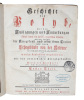
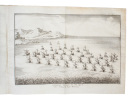
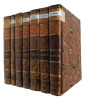
Graesse V,396 - Rumpf:237.
Histoire de Polybe, nouvellement traduit du Grec par Vincent Thuillier. Avec un Commentaire ou Corps de Science Militaire, enrichi de Notes critiques et historiques.... et représentées en Figures. Par M. de Folard. 7 Vols. (incl. Supplement by Folard).
Amsterdam, Aux Depens de la Compagnie, 1729-30. + Supplement: Amsterdam, Chatelain et Fils, 1753. 4to. Bound in 4 uniform contemp. full calf. Raised bands. Blindtooling to compartments. Titlelabels with lettering. Broad gilt border on covers. With the monogram of King Frederik V in gold on red background on all covers. Light wear to spine-ends on the first volume. Spines slightly rubbed. Stamp on title-pages. Engraved frontispiece to Suppl.vol., 131 engraved plates, mostly folding (of which 2 are supplied in Zerox-copy), 3 folded engraved maps, many large engraved vignettes. Internally clean and fine.
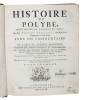
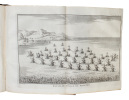
This second French edition is here supplied with a 7th volume, first published to the edition of 1753. - Brunet IV, 791 - Graesse V,396-97.
Geschichte des Polyb, mit den Auslegungen und Anmerkungen des Ritters Herrn von Folard... worinne derselbe die Kriegskunst nach allen ihren Theilen nebst seinen Lehrgebäude von der Kolonne deutlich und gründlich abgehandelt...Vermehret mit den vortref...
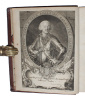
Wien, Prag und Triest, Trattnern, 1759-60. 4to. Bound in 6 contemp. fine uniform full calf, richly blindtooled covers, Cambridge-style bindings. Raised bands. Richly gilt compartments. Tome-and titlelabels with gilt lettering. Some spineends with a little wear and one torn. S Stamps on title-pages. Engraved portrait as frontispiece, Engraved titlevignettes, fine engraved vignettes in the text and 145 (of 146 - one in xerox-copy) engraved plates (mainly double-page and folded). The 3 engraved maps missing. Internally clean and fine, printed on good paper. All 6 volumes have exceptionally fine endpapers with handcoloured flowers.
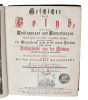
Graesse V,396 - Rumpf:237.
Polybiu Tu Lykorta Megalopolitu Historion ta sozomena (Greek). Polybii Lycortae F. Megalopolitani Historiarum libri qui supersunt. Isaacus Casaubonus ex antiquis libris emendavit, Latine vertit, Commentariis illustravit. Aineiu Taktikon te kai Poliork...
(Franckfurt am Main), Daniel & Dauid. Aubriorum, 1619. Folio. Contemp. full vellum. Some miscolouring to covers. Ms title on spine. Title-page printed red/black with printers wooccut device.(60),1080,(32),151 pp. Light yellowing to the first leaves. A few scattered brownspots. Greek and Latin Text.
Second Casaubon edition. Brunet IV:789, Graesse V:394, Dibdin II, p. 350: ""A most excellent edition"" the merits of which have been long known to the literary world. The preface, in the opinion of the late Dr. Joseph Warton, ""is one of the finest ever written... ""
Polybii Lycortae F. Megalopolitani Historiarum, libri qui supersunt. En 2 TOMES
JANSSONII Johannis. 1670. In-12. Relié plein cuir. Bon état, Couv. convenable, Dos à nerfs, Intérieur frais. 908 + 1816 pages. Bandeaux, lettrines et culs-de-lampe. Relié plein cuir marron. Pièce de titre bordeaux. Titre et caissons dorés sur le dos à 5 nerfs. Tranches marbrées. Mors fendus. Coins frottés. Texte sur 2 colonnes, avec le texte grec en regard du texte latin. Coiffes légèrement usées.. . . . Classification Dewey : 470-Langues italiques. Latin
Interprete Isaaco Casaubono. Accurante Jacobo Gronovio. Classification Dewey : 470-Langues italiques. Latin

POLYBE - ( POLYBIUS - POLYBIOS ) - Jean Charles FOLARD - Le Comte de CHABOT :
Reference : 30757
Abrégé des Commentaires de M. de Folard, sur l'Histoire de Polybe. Par M*** (le comte de Chabot) Mestre de Camp de Cavalerie. En 3 volumes.
" Paris, Veuve Gandouin, Giffart, David l'Aîné, Jombert, Durand, 1754, 3 vols in-4°, 27 x 21 cm, (vol. I) (4) nn pp + x pp + (2)(approbation) + xlviii pp + 421 pp + (3)nn pp (errata) + 51 engraved plates, some folding or double-page ; (vol.II) (4) nn pp + ix + 477 pp (error 469) + (1)(bl) + (2)(errata) + 22 engraved plates ; (vol.III) (4) nn pp + vii pp + 384 pp + (3)(avis au relieur) + (1)(bl) + (2)(errata) + 40 engr. pl. (complete). Bound in uniform contemporary half-leather, smooth spine with red title- and green vol. label, matching marbled boards, some joints a bit weak, those of vol. III nearly completely split, nothwithstanding a very nice uncut and complete copy of the abridged version of Folard's ""Commentaries on the History of Polybe"" on the arts of war and defense, three volumes finely illustrated with in all 113 engraved plates including four maps and one plan of Cremona, the others representing battle orders and antique weaponry, defences and military artefacts. With a general index of three volumes. This abridged version contains the famous ""Traité de la colonne"" , and the ""Traité de l'attaque et de la défense des places des Anciens"". Barbier I/39e; Quérard II/110, III/148 et VII/254. Jean Charles de Folard, 1669 - 1752, soldier and military author, inventor of the column formation."

