 Write to the booksellers
67 books for « plinius minor »Edit
-
Language
French (66)
Latin (1)
-
Topics
English (2)
Greek (57)
Latin (58)
Wilde oscar (1)
-
Countries
Belgium (1)
France (1)
Netherlands (65)
Caii Plinii Caecilii Secundi Opera quae supersunt omnia. Ad fidem optimarum editionum diligenter expressa. (Liber I-X: ex recensione Cortii et Longolii. Panegyricus Nervae Trajano Augusto dictus, ex editione T. Hearne)
Glasgow (Glasguae), In aedibus academicis excudebant Robertus et Andreas Foulis, Academiae typographi, 1751.
12mo. 3 volumes in 2: (IV),1-275,(1 blank); (IV),277-633(1 blank),(23 p. index),(1 blank) p. Vellum 13 cm (Ref: Gaskell no. 208+ (p. 163), and especially no. 208 (p. 419); ESTC Citation No. T190303; Schweiger 2,807: 'Sehr saubrer Abdruck des Textes der Briefe nach Corte und Longolius und des Panegyricus nach Th. Hearne'; Graesse 5,346; Ebert 17358; cf. Dibdin 2,331 & 332; cf. Moss 2,495) (Details: 2 thongs laced through the joints. Short title in ink on the back) (Condition: Vellum slightly soiled and scratched. Some foxing. Paper yellowing) (Note: The Roman civilian administrator Gaius Plinius Caecilius Secundus, 61-112 A.D, published 9 books of literary letters, consisting of short essays, character sketches and sensible observations. The letters paint the high society of the young Roman empire. The tenth book contains Pliny's correspondence with the emperor Trajan. Pliny is famous for his description of the eruption of the Vesuvius on the 24th of August in 79 A.D. He was a nephew of the encyclopedist Pliny the Elder, who died, observing the eruption from afar, overcome by poisonous fumes. Pliny the Younger held under Trajanus a number of magistracies. In 111 or 112 he became governor of Bithynia. From here he was in constant correspondence with the Emperor. His letters, which were conceived of as artistic productions, are more or less epistolary essays. In the late antiquity and later in the Renaissance the literary letter had a widespread influence. The Scottish printers Robert and Andrew Foulis chose for this edition of Pliny's 247 letters the best available text at the time. It was produced by the German classical scholar Gottlieb Cortius, or Kortte, 1698-1731, who made his name producing editions of Latin authors, and whose works were provided with very extensive commentaries, in the manner of the Dutch scholar Petrus Burmannus. His very critical and elaborate Plinus Minor edition was published in Amsterdam in 1734. Cortius died before he could finish the job. Most publishing work was done by a pupil of his, the young German philologist Paul Daniel Longolius, 1704-1779. He added also emendations of his own. Longolius published 3 ancient authors in an exemplary manner, these Letters of Pliny the Younger, and also Diogenes Laertius (1739), and Gellius (1741). (ADB 19,156/7) His Plinius edition is called by Ernesti the editio optima (Ernesti/Fabricius Bibliotheca Latina, 2,416) For the Panegyricus Foulis used the edition of Pliny the Younger which was produced by the English scholar Thomas Hearne, 1678-1735, and which dates from 1703 (Oxford). It is called by Dibdin a 'very respectable edition'. Thousands of panegyrics must have been delivered in antiquity. Only a few of them survive. A panegyric is an elaborate eulogy, a formal set-piece oration in praise of an emperors or a high dignitary and was an integral part of the ceremony of politics in the Roman empire. The most influential panegyric speech was delivered in 100 A.D. by Plinius Minor before Trajan and the Senate in Rome, in which he thanks the emperor for his election to the consulship. It served as a model of rhetoricians in late antiquity. 'It went on to teach many Renaissance and Baroque ceremonial orators how to address supreme political authorities in public speeches. (The Classical Tradition, Cambr. Mass. 2010, p. 745). His most famous imitator in the Renaissance was Erasmus. By the 18th century the panegyric was treated with suspicion, for it easily slid from a showpiece of praise to mindless flattery. 'For Enlightenment critics panegyrics were not to be seen as part of a vital political culture; rather, they were a sure index of the constriction of personal liberty and the inevitable bankruptcy of language under autocracy'. (The Classical Tradition, Cambr. Mass., 2010, p. 684) In the 35 years between 1742 and 1776 the learned Foulis brothers, who were University Printers to the University of Glasgow, produced ca. 590 titles. Circa 100 of them are Greek or Latin editions. The Foulises printed textbooks for the University, but also works of learning, and general literature. From their presses have come some of the finest specimens of accurate and elegant printing that was produced in the eighteenth century. They once hung up the sheets of an Horace edition (1744) which was being printed, in the college of Glasgow, and offered a reward to those who could discover an inaccuracy. It seems that this Pliny edition was originally planned in two volumes. On the verso of the titles of volume 1 and 2 one reads: 'Epistolarum libri sex priores' and 'Epistolarum libri quatuor posteriores. Panegyricus Nervae Trajano Augusto dictus'. However, at the bottom of page 503, the first page of the Panegyricus, is printed 'Vol. III'. It was probably intended later on that the Panegyricus should comprise the third volume, 'but no copy has been seen with a separately-bound vol. III, nor one with a Vol. III title page'. (Gaskell p. 164) The Panegyricus is, instead of a title, preceded by 2 leaves which only announce the Panegyricus, and donot have an imprint. The Foulises produced in this same year also a quarto edition of the Letters of Pliny. (Gaskell 207)) (Collation: Vol. 1: pi2, A-L12; M6. Vol. 2: pi2, N-X12, Y6 (minus blank leaf Y6); pi2 (leaf pi1 half-title, pi2 volume title), Z-2D12, 2E6, 2F12 (leaf 2F12 verso blank)) (Photographs on request)
Lettere di Plinio il Giovane, tradotte in lingua Italiana e dedicate all'Illustriss., ed Eccellentiss. Signore D. Alessandro Albani, nipote di nostro Signore Clemente XI, Pontefice Ottimo Massimo, dal Canonico Gio. Antonio Tedeschi e tra gli Arcadi Orticolo Eleo.
Roma, Della Stamperia di Gio. Maria Salvioni, nella Sapienza, 1717.
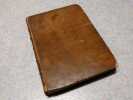
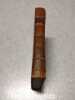
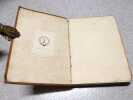
4to. (XXXV),(1 blank); 441,(1 errori),(2 blank) p. Calf 24 cm (Ref: Schweiger 2,816; Moss 2,502, quotes Nicola Francesco Haym ('Biblioteca Italiana o sia notizia de libri rari nella lingua italiana', Venice/Milan, 1741, p. 157): 'La traduzione, e l'impressione sono ambi bellissime'; Ebert 17379; Graesse 3,351) (Details: Back with 5 raised bands, and a gilt red morocco shield in the second compartment. Title printed in red and black. Woodcut initials. Excellent quality paper) (Condition: Binding scuffed. Boards scratches and spotted. Corners bumped. Foot of the spine slightly damaged. Front joint partly split. Bookplate and small label on the front pastedown. Front hinge cracking, but strong. First two leaves foxed. Faint name on the title) (Note: The Roman civilian administrator Gaius Plinius Caecilius Secundus, 61-112 A.D, published 10 books of literary letters, consisting of short essays, character sketches and sensible observations. The letters paint the high society of the young Roman empire. The ninth book contains Pliny's correspondence with the emperor Trajan. Pliny is famous for his description of the eruption of the Vesuvius on the 24th of August in 79 A.D. He was a nephew of the encyclopedist Pliny the Elder, who died, observing the eruption from afar, overcome by poisonous fumes. Pliny the Younger held under Trajanus a number of magistracies. In 111 /112 he became governor of Bithynia. From here he was in constant correspondence with the Emperor. His letters, which were conceived of as artistic productions, are more or less epistolary essays. In the late antiquity and later in the Renaissance the literary letter had a widespread influence. Not much is known about the Canon Giovanni Antonio Tedeschi, or Johannes Antonius Tedeschi, who produced this first complete Italian translation of the correspondence of Pliny Minor. He also published a translation of the letters of Symmachus (1724). He died in 1727. We found one Giovanni Antonio Tedeschi, who was dean (archiprete) of the family Borghese, in whose palace he died in 1727, and who was buried in S. Lucia della Tinta. (Claudio De Dominicis, 'Carlo De Dominicis, architetto del settecento romano', Roma 2006, p. 73) This must be our Tedeschi, for he dedicated his Symmachus translation to Marcantonio Borghese. Tedeschi was a member of the Italian literary academy/society 'Accademia degli Arcadi' or 'Accademia dell'Arcadia'. In 'Prose degli Arcadi, tomo terzo', Roma 1718, p. CV, he is described as 'Orticolo Eleo. Il Canonico Gio. Antonio Tedeschi da Pesaro'. 'Orticolo Eleo' being his 'nome arcadico', i.e. his pen name or pseudonym. So the phrase 'e tra gli Arcadi Orticolo Eleo', probably means 'and among the Arcadi his name is 'Orticolo Eleo''. Might this pen name refer to a 'olive grove'? A problem is that there is in this same period a namesake who was a sculptor/stonemason) (Provenance: On the title the name of 'Harriet Taylor'. This is Harriet Taylor Upton, 1853 - 1945, who was an American political activist and author. Taylor 'Upton is best remembered as a leading Ohio state and national figure in the struggle for women's right to vote and as the first woman to become a vice chairman of the Republican National Committee'. Harriet Taylor married in 1884 the attorney George W. Upton. She 'was a key organizer and the first president of the Suffrage Association of Warren. She was also a member of the National Woman Suffrage Association (NWSA) from 1890. In 1891, Upton hosted a conclave of women seeking equal rights with men, Ohio Women in Convention, in her home. (...) Harriet Upton was inducted into the Ohio Women's Hall of Fame in 1981, in the category of Government and Military Service. In early 2010, Upton was proposed by the Ohio Historical Society as a finalist in a statewide vote for inclusion in Statuary Hall at the United States Capitol'. She probably wrote her name before 1884. (See Harriet's lemma in Wikipedia) On the French title in pencil: 'J.W. Tellegen' On the front pastedown the bookplate of 'Thomas Conolly', depicting a round garter, with the motto: 'En Dieu Est Tout'; in the center a cubit arm, the hand is grasping an annulet. Someone wrote once in pencil beneath the plate: 'One time Speaker in the Irish House of Commons'. This is not correct. This Speaker was William Conolly, of humble descent, who was the first of his line, and in his time the wealthiest and the most powerful politician in Ireland. He died childless in 1729. Thomas Conolly, 1738-1803, was a son of his nephew William James Conolly. Thomas inherited the estate of his father William James when he was still a minor. 'Thomas Conolly was the quintessential Irish gentleman, a keen huntsman and a fine horseman, as well as a politician and landowner. Regarded as the wealthiest commoner in the kingdom: he actually spent much of his career in debt because of large debts he inherited from his father. Conolly sat in the Irish parliament for forty years where he prided himself on his often imagined independence'. (See for this interesting family: (www)castletown.ie) (Collation: pi4, b-c4, d6 (leaf d6 verso blank); A-3H4, 3I6 (leaf 3I6 blank)) (Photographs on request)
Honderd jaar geestelijk leven in den Romeinschen keizertijd.
Leiden, v.Doesburgh, 1922.
555 p. Cl. (OiN 304, Plinius minor: transl. of 'nagenoeg de hele correspondentie'; a chapter on Seneca, Lucianus, Dio Chrysostomus, Sophists etc.)(Fronthinge cracking; partly foxed. Tip of the lower corner of the last half of the book-block faintly waterstained)
Plinius Minor. Plini Caecili Secundi Epistolarum Libri Novem. Epistolarum ad Traianum liber. Panegyricus
Recensuit Mauritius Schuster, editionem tertiam curavit Rudolphus Hanslik, Editio stereotypa editions tertiae (MCMLVII), 1 vol. in-8 reliure demi-chagrin à coins rouges, couvertures et dos conservés, Bibliotheca scriptorum graecorum et romanorum Teubneriana, In aedibus B.G. Teubneris [ Teubner ], Stutgardiae et Lipsiae, 1992, XXX-490 pp.
![Plinius Minor. Plini Caecili Secundi Epistolarum Libri Novem. Epistolarum ad Traianum liber. Panegyricus. PLINIUS MINOR ; [PLINE LE JEUNE ]](https://static.livre-rare-book.com/pictures/CDL/68144_thumb.jpg)
![Plinius Minor. Plini Caecili Secundi Epistolarum Libri Novem. Epistolarum ad Traianum liber. Panegyricus. PLINIUS MINOR ; [PLINE LE JEUNE ]](https://static.livre-rare-book.com/pictures/CDL/68144_2_thumb.jpg)
![Plinius Minor. Plini Caecili Secundi Epistolarum Libri Novem. Epistolarum ad Traianum liber. Panegyricus. PLINIUS MINOR ; [PLINE LE JEUNE ]](https://static.livre-rare-book.com/pictures/CDL/68144_3_thumb.jpg)
Bon exemplaire bien relié (petite brunissure en dos, ex-libris en garde)
C. Plinii Caecilii Secundi Epistolarum libri X. Notis integris Is. Casauboni, Jani Gruteri, H. Stephani, Augusti Buchneri, Casp. Barthii, Joh. Fred. Gronovii, Selectissimisque Joh. Mariae Catanaei, Ritterhusii & aliorum, insertis suo loco integris commentariis Francisci Balduini, J.C. Cunradi Ritterhusii, J.C. & Gerh. Joh. Vossii in 'Relationem' seu consultationem 'Plinii', & ad hanc 'Rescriptum Trajani' Imper. de 'Christianis', illustrati & accurate recensiti a Johanne Veenhusio, Brem.
Leiden, Rotterdam (Lugd. Batav. Roterodami), Ex Officina Hackiana, 1669.
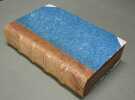
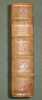
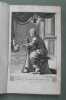
8vo. (LII),818,(23 index),(1 blank) p., frontispiece. 19th century half calf. 19.5 cm 'We shall have reason to congratulate ourselves on the acquisition of so elegant and desirable an edition' (Ref: STCN ppn 840239440; Schweiger 2,809; Brunet 4,722: 'bonne édition'; Fabricius/Ernesti 2,415, among the 'meliores editiones'; Dibdin 2,331: 'is one of the scarcest and most valuable of the octavo Variorum classics'; Moss 2,494/95: 'the text of Pliny is correct, and the select notes of Veenhyseen (sic) do great credit to his learning and judgment'; Ebert 17351: 'eine der bessern Augaben cum notis varior.' Graesse 5,347/48) (Details: Back ruled gilt, and with 4 raised bands. The frontispiece, engraved by G. Wingendorp, depicts Plinius at his desk, in front of him 2 quills and an inkpot. Woodcut printer's mark on the title, depicting a soaring eagle, motto 'Movendo'. Dibdin adds: 'and whether we consider the elegance of its typography, the accuracy of the text, or perspicuity of the notes, we shall have equal reason to congratulate ourselves on the acquisition of so elegant and desirable an edition'. Winckelmann used this 1669 edition of Pliny when he visited the Laurentine Villa (Ep. II,17) of Pliny) (Condition: Binding slightly scuffed. Seven small wormholes at the foot of the spine. New endpapers. Ownership entry on the title. Some foxing) (Note: The Roman civilian administrator Gaius Plinius Caecilius Secundus, 61-112 A.D, published 10 books of literary letters, consisting of short essays, character sketches and sensible observations. The letters paint the high society of the young Roman empire. The ninth book contains Pliny's correspondence with the emperor Trajan. Pliny is famous for his description of the eruption of the Vesuvius on the 24th of August in 79 A.D. He was a nephew of the encyclopedist Pliny the Elder, who died, observing the eruption from afar, overcome by poisonous fumes. Pliny the Younger held under Trajanus a number of magistracies. In 111 or 112 he became governor of Bithynia. From here he was in constant correspondence with the Emperor. His letters, which were conceived of as artistic productions, are more or less epistolary essays. In the late antiquity and later in the Renaissance the literary letter had a widespread influence. The German classical scholar Johannes Veenhusius of Bremen, 1643-1675, published the 'Epistulae' with the complete commentaries of Casaubon, Gruterus, Henri Estienne, Buchnerus, Barthius, Johannes Fredericus Gronovius, and with select notes of Cattaneo, Ritterhusius, and himself. The emendations of Gronovius are published here for the first time. Added are Henri Estienne's 'Praefatio' and Conrad Lycosthenes' 'Vita Plinii', Boxhornius' essay on Pliny's alleged Christianity, and the notes of Balduinus, Ritterhusius and the Vossii. For his text of the 'Epistulae', Veenhusius generally follows Estienne/Cattaneo, even when he reports in the footnotes the notes and the comments of other scholars who disagree with or correct the text he is printing. To confirm Pliny's authorship of book 10, he reprints at the beginning of that book the dedicatory letter of Giovanni Maria Cattaneo, who published an edition of Pliny's letters in 1506, to Ambrogio del Maino. In his own dedication to the officials of the city of Bremen, Veenhusius speaks of the difficult task of an editor. But he affirms that Pliny is an author worthy of their sponsorship; many of his letters deal with Roman law, which would be useful to compare with common law, and many contain learned observations about antiquity and politics, which are not only useful but also necessary to know. ('Catalogus Translationum Et Commentariorum: Mediaeval and Renaissance Latin translations and commentaries, annotated lists and guides'. Volume IX, editors V. Brown,J. Hankins,R. A. Kasterp, Washington, 2011, p. 94) Not much is known about Veenhusius, he is not to be found in ADB and NNBW. At the beginning of the 'dedicatio' to this edition he calls himself Johannes Veenhusen, and Bremen his 'Patria'. In 1671 he produced for the Leiden publisher Hackius another 'Variorum' edition, now of Statius.) (Provenance: On the title 'Bibliotheca vallis Sti Lamberti, 1749'. We found on the internet one book with exactly this same provenance: ((crlv))((org))/bibliographie-des-voyages/1203. The Cistercian abbey Val St. Lambert was situated in Seraing, Southwest of the Belgian city of Liège. It was founded in 1202 and closed down in 1796. Nowadays it is a crystal glass factory. (See Wikipedia 'Val-Saint-Lambert'). On the front flyleaf the name of the Dutch specialist of Roman law 'J.W. Tellegen'. On the front pastedown a small label of 'Libreria dello Studente, Add.: Paolo Franchini, Firenze') (Collation: *-3*8, 4*2; A-3G8 (leaf 3G5 verso blank; minus leaf 3G6, 7 & 8) (Photographs on request)
Caji Plinii Caecilii Secundi Panegyricus, cum notis integris Francisci Jureti, Joannis Livineji, Justi Lipsii, Petri Fabri, Conradi Rittershusii, Jani Gruteri, Christiani Gotlibi Schwarzii, et selectis aliorum, curante Joanne Arntzenio, qui & suas adnotationes adjecit. Accedit Joannis Masson Vita Plinii, editio tertia auctior.
Amsterdam (Amstelaedami), Apud Janssonio Waesbergios, 1738.
4to. (XXIV including frontispiece),XCII,(4 index); 469,(57 index) p. Half vellum 25 cm (Ref: STCN ppn 186699948; Schweiger 2,812/3; Dibdin 2,335; Moss 2,495/6; Fabricius/Ernesti 2,423; Graesse 5,349: 'Bonne édition'; Ebert 17374) (Details: Early 20th century binding. Brown gilt morocco shield on the back. Title in red & black. Engraved printer's mark on the title, depicting a mole, flanked by a seating Hermes and Athena; the motto is: 'vulgo caeca vocor, video sed acutius ipso', 'By the crowd I am called blind; but I see better than itself'. The frontispiece is bound after the title, it is engraved by W. Jongman; on it we see on orator (Plinius) standing on a kind of pedestal; he is pronouncing his eulogy in the Senate in front of a statue of the emperor Trajanus; the senate is listening, and someone enters with a laurel wreath for the orator in his hand) (Condition: paper browning and browned) (Note: In 100 A.D. The Roman civilian administrator Gaius Plinius Caecilius Secundus, or Pliny the Younger (61-112 A.D) was elected 'consul electus'. On the occasion of his entry on the position of consul Pliny pronounced in the Senate an eulogy to thank the emperor. This specimen of his eloquence survived, and is known as the 'Panegyricus'. In his speech he elaborated on all the admirable actions and good qualities of the emperor Trajanus. Pliny published also 9 books of literary letters, consisting of short essays, character sketches and sensible observations. The letters paint the high society of the young Roman empire. The tenth book contains Pliny's correspondence with the emperor Trajan. Pliny is famous for his description of the eruption of the Vesuvius on the 24th of August in 79 A.D. He was a nephew of the encyclopedist Pliny the Elder, who died, observing the eruption from afar, overcome by poisonous fumes. Pliny the Younger held under Trajanus a number of magistracies. In 111 or 112 he became governor of Bithynia. From here he was in constant correspondence with the Emperor. The Dutch scholar Johannes Arntzenius, 1702 - 1759, had experience with Panegyrics and late Latin. In 1733 he already had edited the Roman eulogist Aurelius Victor. Later in life, in 1753, he produced an edition of another Panegyricus, that of the late antique author Pacatus Drepanius. Arntzenius was professor of Eloquentia and Historia of the University at Franeker since 1743. (NNBW 1 179/80) (Provenance: Name on front flyleaf: 'J.W. Tellegen') (Collation: *-3*4 (first gathering: *1, *4 frontispiece, then *2 & *3, i.e. leaf pi1 of the STCN copy, the frontispiece, has been bound in our copy immediately after the title, leaf *1); 2*-3*4; (a) - (m)4; chi1, A-3V4 (minus blank leaf 3V4)) (Photographs on request)
Plinius. Vesuvii Incendium. (Übersetzung Wilhelm Junk)
(Darmstadt, H. Hohmann, 1924)
16 p. Plain wrappers. 25 cm (Cover somewhat worn. Paper yellowing. The leaves are kept together by a decorative brown tie) (Colophon at the end: 'Gedruckt von H. Hohmann in Darmstadt in einer Auflage von 300 Exemplaren, gewidmet den Teilnehmern an der Jubiläums-Feier der Weimarer Bibliophilen-Gesellschaft, die am 25. Mai 1924 zu Darmstadt stattfand, von der Vereinigung "Berliner Bibliophilen-Abende". Dieses Exemplar trägt die Nummer 180') (Contains the Latin text with parallel German translation of both letters of Pliny to Tacitus, on the eruption of the Vesuvius, and the death of his uncle. The translator, the antiquarian bookseller Wilhelm Junk, ends the short preface with: 'Meine Uebersetzung will das Verständnis erleichtern und erhebt keinen Anspruch auf philologische Akribie'. The translator is the famous antiquarian bookseller and publisher in the field of natural sciences Wilhelm Junk, born in Prague in 1866. 'Antiquariat Junk' in Berlin became from 1899 the leading bookdealer in works on natural history in Europe. In Berlin he was for a long time committee member of the 'Berliner Bibliophilen Abende'. Junk also edited and published several scientific reference works. A Jewish refugee, he moved his shop to The Hague in 1934. It took 2 ships to transport his stock. One year later he sold his shop to Rudolph Schierenberg, who kept the name 'Antiquariaat Junk'. The firm, now led by Allard, the son of Schierenberg, still exists in Amsterdam and still specializes in natural history. Junk kept in 1935 the publishing branch, which was called 'Uitgeverij Dr. W. Junk'. During a raid by the Nazi's in 1942 part of his stock was burned. On December 3, 1942, Wilhelm Junk and his wife, Elli Silbermann, born 1875, killed themselves, the moment the Gestapo stood at their door)
Plinius der Jüngere. Briefe. Lateinisch und Deutsch von Helmut Kasten
Berlin, Akademie Verlag, 1982.
XX,691,(3) p. Cloth 24.5 cm (Schriften und Quellen der Alten Welt)
Ausgewählte Briefe des jüngeren Plinius. Erklärt von Anton Kreuser. Mit einer Tafel: Grundriss einer römischen Villa.
Leipzig, B.G. Teubner, 1894.
142 p. Boards. 21 cm (TbGLS, Griechische und Lateinische Schriftsteller, Ausgaben mit Anmerkungen; only edition) (Rebound. Some pencil)
Plinius, Epistolae. A critical edition by Selatie Edgar Stout, emeritus professor of Latin, Indiana University.
Bloomington, Indiana University Press, 1962.
399 p. Wrappers. 23.5 cm (Cover plasticized)
Plinius Mladsí. Dopisy. (Preface and translation Ladislav Vidman)
Praha, Svoboda, 1988.
387 p. Cloth 2.5 cm (Anticka Knihovna; 'Dopisy' means in Czech 'letters') (Including dustjacket)
Caii Plinii Caecillii Secundi Opera, Tomus II (Liber tertius-Liber sextus). Des Plinius Caecilius Secundus Werke, übersetzt von J.A. Schäfer. Zweyter Band (Drittes Buch-Sechstes Buch).
Wien, Triest, Geistinger, 1825.
413,(1 errata) p. Contemporary boards 21 cm (Latin text with facing German translation) (Binding scuffed)
Caii Plinii Caecillii Secundi Opera, Tomus IV (Liber X). Des Plinius Caecilius Secundus Werke, übersetzt von Johann Adam Schäfer. Vierter Band (Zehntes Buch).
Wien, Triest, Geistinger, 1825.
308,(1 errata) p. Contemporary boards 21 cm (Latin text with facing German translation) (Binding scuffed)
79 - Ein Brief des jüngeren Plinius.
Frankfurt, Suhrkamp, 1979.
173 p., illustrations. Paperback 20 cm (Collagebrief)
C. Iulius Quadratus Bassus, Klient des jüngeren Plinius und General Tranjans.
München, Verlag der Bayerischen Akademie der Wissenschaften, 1934.
86,(1) p. Wrappers 23 cm (SBAW) (Outer edges of the frontcover damaged)
Caii Plinii Caecilii Secundi Epistolarum libros decem, cum notis selectis Jo. Mariae Catanaei, Jac. Schegkii, Jac. Sirmondi, Is. Casauboni, Henrici Stephani, Conradi Rittershusii, Cl. Minois, Casparis Barthii, Aug. Buchneri, Jo. Schefferi, Jo. Frid. Gronovii, Christophori Cellarii aliorumque, recensuerunt suisque animadversionibus illustrarunt Gottlieb Cortius et Paullus Daniel Longolius, qui etiam universum opus indicibus locupletissimis instruxit.
Amsterdam (Amstelaedami), Apud Janssonio-Waesbergios, 1734.
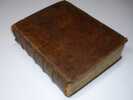
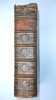
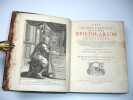
4to. Frontispiece, (LII),92,(4);846,(119),(1 blank) p. Contemporary mottled calf 26 cm (Ref: STCN ppn 186700156; Schweiger 2,809/10; Brunet 4,722: 'bonne édition'; Dibdin 2,332; Graesse 5,343; Ebert 17356; Fabricius/Ernesti 2,416) (Details: Back with 5 raised bands, and panelled in gilt with floral motives. Frontispiece, it depicts Pliny writing a letter. Title in red & black. Engraved printer's mark on title; a mole, with the motto: 'Vulgo caeca vocor. Video sed acutius ipso') (Condition: Binding rather worn and scratched. Head & tail of the spine damaged. Back rubbed, shield in the second compartment gone. Corners bumped. Endpapers chipping and loosening. Right margin of the frontispiece chipped. Title soiled and with a small hole and a small tear in the outer margin. Small tear in the outer margin of the first 5 leaves. Outer margin of last 6 leaves chipping. Some foxing) (Note: The Roman civilian administrator Gaius Plinius Caecilius Secundus, 61-112 A.D, published 9 books of literary letters, consisting of short essays, character sketches and sensible observations. The letters paint the high society of the young Roman empire. The tenth book contains Pliny's correspondence with the emperor Trajan. Pliny is famous for his description of the eruption of the Vesuvius in 79 A.D. The German classical scholar Gotlieb Cortius, or Kortte, 1698-1731, made his name producing editions of Latin authors, whose works were provided with very extensive commentaries, in the manner of the Dutch scholar Petrus Burmannus, to whom this edition is actually dedicated. Dibdin admires the work of Cortius: 'this', he says, 'is a very critical and elaborate edition, calculated for those who wish to enter minutely into all the niceties of grammatical construction and historical illustration'. Ernesti says that this is a work 'quae est sane luculenta, et ut nunc est, optima editio'. Cortius died before he could finish the job. Most remaining work was done by a pupil of Cortius, the young German philologist Paul Daniel Longolius, 1704-1779, from 1735 Rector of the Gymnasium in Hof (Saale). He published 3 ancient authors in an exemplary manner, the Letters of Pliny the Younger, and the works of Diogenes Laertius (1739) and Gellius (1741). (ADB 19,156/7) The edition of the letters and the commentary is preceded by a 70 pages long biography of Pliny by J. Masson, which was first published in Amsterdam in 1709) (Collation: pi1, *4 (minus *4), 2*-7*4 (minus 7*4); (a)-(m)4; A-5O4, a-p4 (leaf p4 verso blank)) (Photographs on request) (Heavy book, may require extra shipping costs)
Caii Plinii Caecilii Secundi Epistolarum libros decem, cum notis selectis Jo. Mariae Catanaei, Jac. Schegkii, Jac. Sirmondi, Is. Casauboni, Henrici Stephani, Conradi Rittershusii, Cl. Minois, Casparis Barthii, Aug. Buchneri, Jo. Schefferi, Jo. Frid. Gronovii, Christophori Cellarii aliorumque, recensuerunt suisque animadversionibus illustrarunt Gottlieb Cortius et Paullus Daniel Longolius, qui etiam universum opus indicibus locupletissimis instruxit.
Amsterdam (Amstelaedami), Apud Janssonio-Waesbergios, 1734.
4to. Frontispiece, (LII),92,(4);846,(119),(1 blank) p. Vellum 26.5 cm (Ref: STCN ppn 186700156; Schweiger 2,809/10; Brunet 4,722: 'bonne édition'; Dibdin 2,332; Graesse 5,343; Fabricius/Ernesti 2,416: 'optima editio') (Details: Back with 5 raised bands. Short title in the second compartment. Blind tooled boards. The engraved frontispiece depicts a pensive Pliny busy writing a letter. Title printed in red & black. The engraved printer's mark on the title shows a mole, flanked by Athena and Hermes; the motto reads: 'Vulgo caeca vocor. Video sed acutius ipso') (Condition: Nice copy. Vellum very slightly soiled. Vellum at the outer edge of the upper board very slightly damaged) (Note: The Roman civilian administrator Gaius Plinius Caecilius Secundus, 61-112 A.D, published 9 books of literary letters, consisting of short essays, character sketches and sensible observations. The letters paint the high society of the young Roman empire. The tenth book contains Pliny's correspondence with the emperor Trajan. Pliny is famous for his description of the eruption of the Vesuvius in 79 A.D. The German classical scholar Gotlieb Cortius, or Kortte, 1698-1731, made his name producing editions of Latin authors, whose works were provided with very extensive commentaries, 'cum notis Variorum', in the manner of the Dutch scholar Petrus Burmannus, to whom this edition is actually dedicated. Such commentaries are 'Fundgruben' for the classical scholar. The students should bear in mind that the outdated commentaries were the work of scholars who knew their latin far beter than they do. Dibdin shows admiration for the work of Cortius. 'This' he says 'is a very critical and elaborate edition, calculated for those who wish to enter minutely into all the niceties of grammatical construction and historical illustration'. Ernesti says that this is a work 'quae est sane luculenta, et ut nunc est, optima editio'. Cortius died before he could finish the job. Most work was done by a pupil of Cortius, the young German philologist Paul Daniel Longolius, 1704-1779, from 1735 Rector of the Gymnasium in Hof (Saale). He published 3 ancient authors in an exemplary manner, the Letters of Pliny the Younger, Diogenes Laertius (1739), and Gellius (1741). (ADB 19,156/7) The edition of the letters and its commentary is preceded by a 70 pages long biography of Pliny by J. Masson, which was first published in Amsterdam in 1709. (Schweiger 2,818)) (Collation: pi1, *4 (minus leaf *4), 2*-7*4 (leaf 7*4 blank); (a)-(m)4; A-5O4, a-p4 (leaf p4 verso blank)) (Photographs on request) (Heavy book, may require extra shipping costs)
Selected letters of Pliny. Edited (with introduction & notes) by G.B. Allen.
Oxford, Clarendon Press, 1957.
147,(2) p. Cloth 19 cm (Introduction, text & notes)
Select letters of Pliny the Younger. Latin text, with English notes edited by A.J. Church & W.J. Brodribb. New edition.
London, Longmans, Green, 1897.
XV,276 p. Cloth 20 cm (Front flyleaf removed; occasional pencil; slightly foxed)
Plinio el Joven. Panegyrico de Trajano. Traduccion, introduccion y notas por Alvaro D'Ors.
Madrid, Instituto de Estudios Politicos, 1955.
LIII,93,(1) p., 2 plates. Stiff wrappers 22.5 cm (Cover plasticized)
C. Plinii Caecilii Secundi Epistolae. Mit kritisch berichtigem Text, erläutert von Moritz Döring, Conrector am Gymnasium zu Freyberg.
Freyberg, Verlag von J.G. Engelhardt, 1843.
2 volumes: XXIV,324;421 p. Half calf 21.5 cm (Backs gilt and with 4 raised bands. Marbled endpapers. Binding worn at the extremes, some foxing)
The letters of the Younger Pliny. Translated by J.B. FIRTH.
Ldn., N.Y., Walter Scott, n.d. (1910 - 1916).
2 vols: 26,259; 285 p. Cloth 17 cm (Name cut from front flyleaf)
Selections from Pliny's letters. M.B. Fisher & M.R. Griffin.
Cambridge etc., CUP, 1987.
72 p. Stiff wrappers 21.5 cm (Cambridge Latin Texts) (Text and notes)
Pliny. A selection of his letters. Translated by Clarence Greig.
Cambridge etc., CUP, 1978.
IX,83 p. Paperback 22 cm (Translations from Greek and Roman Authors)
Epistolarum libri decem et Panegyricus, cum Variorum adnotationibus quibus suas addidit E. Gros.
Paris (Parisiis), Excudit C.L.F. Panckoucke, 1834 - 1836.
2 volumes: XII,288; 288 p. Calf 23 cm (Bindings worn and scuffed. Corners bumped, head & tail of the spine chafed)

