 Write to the booksellers
31 books for « phaedrus »Edit
-
Language
French (28)
Latin (3)
-
Century
18th (4)
19th (2)
20th (2)
-
Topics
Aesop (1)
Books from the xviiith (1)
Fables (1)
Greek (13)
Latin (16)
Literature (2)
-
Countries
Belgium (1)
Denmark (1)
France (9)
Greece (2)
Netherlands (17)
Switzerland (1)
-
Syndicate
ILAB (8)
SLAM (4)
Phaedri, Aug. liberti, Fabularum Aesopiarum libri V. Cum integris commentariis Marq. Gudii, Conr. Rittershusii, Nic. Rigaltii, Is. Neveleti, Nic. Heinsii, Joan. Schefferi, Jo. Lud. Praschii, & excerptis aliorum. Curante Petro Burmanno.
The Hague (Hagae-Comitum), Apud Henricum Scheurleer, 1718.
8vo. 2 parts in 1: (LXII),398;258,(70 index) p., including frontispiece. Vellum 19.5 cm (Ref: STCN ppn 189725249; Schweiger 2,735; Dibdin 2,280; Moss 2,394; Graesse 5,253; Ebert 16595) (Details: 6 thongs laced through both joints. Borders of the boards tooled in blind with double fillet, and with gilt floral ornaments at the corners of blind tooled rectangles. Title in red & black. Printer's device on the title, which depicts a flying Hermes; with an appropriate motto: 'Voor konst en koopmanschap'. Frontispiece designed by P. Tiedeman and executed by J. Mulder, depicting Phaedrus with pen on paper while listening to his Muse; in the background Aesopus surrounded by fable animals) (Condition: Vellum soiled. Back spotted. All 4 ties gone. Front hinge cracking, but still strong. A few gatherings are slightly loosening. The paper of the frontispiece is yellowing) (Note: The Roman poet Phaedrus, 15 B.C. - ca. 50 A.D., occupies in the history of the fable a very important role. He was a slave of Thracian descent, and became a freedman (libertus) of the first Roman emperor Augustus. He composed 5 books (probably incomplete) of verse fables. His beast-tales are adaptions of the fables of the Greek poet and archfabulist Aesopus, or Aisopos (6th century B.C), and inventions of his own. Phaedrus prides himself to have elevated the fable into an independent genre of literature. Sometimes he satirizes contemporary conditions, and he is always fond of emphasizing the moral of the story. 'The presentation is, in general, animated and marked by a brevity of which Phaedrus is rightly proud, but which sometimes leads to obscurity' (OCD 2nd ed. p. 809). Nevertheless, his style is clear, pure and simple, this in contrast to the swollen rhetoric of his time. He was widely read in the Middle Ages. During the 17th & 18th he was also very much en vogue. Schweiger lists hundreds of editions. Very popular among scholars and students were the Dutch 'Variorum' editions of Phaedrus. This kind of editions offered a 'textus receptus' which was widely accepted, and was accompanied with the commentary and the annotations of various specialists, taken or excerpted from earlier useful, normative or renewing editions. Editions like these, 'cum notis Variorum', were useful, but never broke new ground. This 'Variorum edition' was produced by the leading scholar Petrus Burmannus, 1668-1741. He was professor of Latin at the University of Utrecht from 1696, and at Leiden from 1715. As an editor he was an industrious manufacturer of 'Variorum' Editions, confining himself to the Latin classics. He edited besides Phaedrus, Horace, Claudian, Ovid, Lucan, and the Poetae Latini Minores, Petronius, Quintilian, Suetonius. (Sandys 2 p. 343/5). Moss declares that this edition of Phaedrus by Burmannus 'is held in considerable estimation'. Moss's high opinion may be correct, and the motto on the title, 'for art and trade' may also speak of great expectations, nevertheless it was not the success the publisher Scheurleer hoped for. We compared this 1718 edition with copies of the edition of 1728, brought on the market by the wellknown Leyden based firm of Samuel Luchtmans, and must conclude that Luchtmans must have bought the remainder of unsold copies of the edition of 1718 from Scheurleer, removed the original title, and added only a new title-page dated 1728. The books are identical, except for the title-page) (Collation: pi1, *8 (minus leaf *8), 2*-3*8, 4*6, chi1; A- 2B8 (leaf 2B8 blank); a-v8, x4) (Photographs on request)
Phaedri, Aug. liberti, Fabularum Aesopiarum libri V. Cum integris commentariis Marq. Gudii, Conr. Rittershusii, Nic. Rigaltii, Is. Neveleti, Nic. Heinsii, Joan. Schefferi, Jo. Lud. Praschii, & excerptis aliorum curante Petro Burmanno.
Leiden (Lugduni in Batavis), Apud Samuelem Luchtmans, 1728.
8vo. 2 parts in 1: (LXII),398;258,(70 index) p., including frontispiece. Calf 21 cm (Ref: STCN 296744565; Schweiger 2,736; cf. Dibdin 2,280; cf. Moss 2,394; Graesse 5,253; Brunet 4,588; Ebert 16595) (Details: Back with 5 raised bands. Morocco letterpiece, once red, in the second compartment. Floral gilt ornaments in the other compartments. Marbled endpapers. Title in red & black. Woodcut ornament on the title. Frontispiece designed by P. Tiedeman and executed by J. Mulder, depicting Phaedrus with pen on paper while he listens to his Muse; in the background Aesopus surrounded by fable animals) (Condition: Back scuffed. Corners bumped) (Note: The Roman poet Phaedrus, 15 B.C. - ca. 50 A.D., occupies in the history of the fable a very important role. He was a slave of Thracian descent, and became a freedman (libertus) of the first Roman emperor Augustus. He composed 5 books (probably incomplete) of verse fables. His beast-tales are adaptions of the fables of the Greek poet and archfabulist Aesopus, or Aisopos (6th century B.C), and inventions of his own. Phaedrus prides himself to have elevated the fable into an independent genre of literature. Sometimes he satirizes contemporary conditions, and he is always fond of emphasizing the moral of the story. 'The presentation is, in general, animated and marked by a brevity of which Phaedrus is rightly proud, but which sometimes leads to obscurity'. (OCD 2nd ed. p. 809) Nevertheless, his style is clear, pure and simple, this in contrast to the swollen rhetoric of his time. He was widely read in the Middle Ages. During the 17th & 18th he was also very much en vogue. Schweiger lists hundreds of editions. Very popular among scholars and students were the Dutch 'Variorum editions' of Phaedrus. This kind of editions offered a 'textus receptus' which was widely accepted, and was accompanied with the commentary and the annotations of various specialists, taken, or excerpted from earlier useful, normative or renewing editions. Editions like these, 'cum notis Variorum', were useful, but never broke new ground. This 'Variorum edition' was produced by the leading scholar Petrus Burmannus, 1668-1741. He was professor of Latin at the University of Utrecht from 1696, and at Leiden from 1715. As an editor he was an industrious manufacturer of 'Variorum editions', confining himself to the Latin classics. He edited besides Phaedrus, Horace, Claudian, Ovid, Lucan, and the Poetae Latini Minores, Petronius, Quintilian, Suetonius. (Sandys 2 p. 343/5) Didbin and Moss do not mention this 'Variorum edition' of 1728. They mention only the Burmannus editions of 1698 and 1718. Schweiger had a sharper eye, for he observes about this edition of 1728: 'Bloss neuer Titel zur Ausgabe von 1718'. This 1728 edition is indeed exactly the same as the edition of 1718. We compared both editions, and must conclude that Luchtmans must have bought the unsold copies of the edition of 1718 from the publisher Scheurleer in The Hague, removed the original title, added only a new title-page dated 1728, and brought them to the market for the second time) (Collation: pi1, *8 (minus leaf *8), 2-3*8, 4*6, (5*)1; A-2B8 (minus blank leaf 2B8); a-v8, x4) (Photographs on request)
Ezopische Fabelen van Fedrus, gevryden slaef des Keizers Augustus. In Nederduitsch Dicht vertaelt en met Aanmerkingen verrykt door D. van Hoogstraten.
The Hague ('s Gravenhage), By Gerard Block, 1739.
8vo (XLVIII),259,(1 blank),37,(1 blank) p. Vellum. 15.5 cm (Ref: STCN ppn 303260319; Geerebaert 125,2,a; cf. OiN p. 290) (Details: 5 thongs laced through the joints. Title in red & black. Woodcut floral ornament on the title. Woodcut initials) (Condition: Binding age-tanned and slightly spotted. Small name label on the front pastedown. 1 name and 1 small stamp on the front flyleaf. Paper slightly yellowing. Endpapers foxed) (Note: David van Hoogstraten (1658-1724) was conrector of the 'Schola Latina' at Amsterdam from 1694 till 1722. He wrote Dutch and neolatin poetry, and is well known for his lexicon 'Nieuw woordenboek der Nederlantsche en Latynsche tale' (1704, 1719, 1736). He published editions and translations of Nepos, Terentius and Phaedrus. (NNBW 831-833) This is the second edition of Van Hoogstraten's translation of the fables of Phaedrus. The first edition, which was published in 1703 in Amsterdam by François Halma, was a more ambitious project than this modest and cheaper version. It was in quarto and had engraved plates. One year earlier, in 1701, Halma had already produced Van Hoogstraten's scholarly Latin edition of Phaedrus, with ample commentary, which was specially made for prince Johan Willem Friso, 1687-1711, Prince of Orange (1702-1711) and 'stadhouder' of Friesland and Groningen. In the preface to the second edition of this translation the publisher Block tells the reader that this cheaper edition is primarily intended for young readers. He advises all family men to have their children read and reread this book. Van Hoogstraten dedicates his translation to the younger sister of Johan Willem Friso, princess Maria Amalia, 1689-1771, who was only 13 years old when it was first published. Van Hoogstraten was influential in the field of Dutch language studies in the 18th century with his work: 'Aenmerkingen over de geslachten der zelfstandige naemwoorden' (1700). It was his opinion that the Dutch language equalled the Greek, and that it surpassed the Latin (having no articles)) (Provenance: The name label is of one 'Herman Spaan'. On the flyleaf a small stamp: 'Ex libris A. Kerckhoffs'. This might be the Dutch linguist and cryptographer Auguste Kerckhoffs, 1835-1903, who was professor of languages at the 'École des Hautes Études Commerciales' in Paris in the late 19th century. (See for this interesting man Wikpedia 'Auguste Kerckhoffs' and also 'Kerckhoffs's principle'. On the flyleaf also the name of 'H.J.' or 'H.I. van Reenen') (Collation: *-3*8, A-S8 (leaf R2 verso and S8 verso blank)) (Photographs on request)
PHAEDRUS [PHAEDRI] & ROMULUS (SCHWABE J.G.S. & GAIL J.B., eds.)
Reference : K71925
(1826)
Phaedri Fabularum Aesopiarum libri quinque. Accedunt Romuli Fabularum Aesopiarum libri quatuor [2 volumes]
Parisiis, Lemaire 1826 [full title: Phaedri Fabularum Aesopiarum libri quinque, quales omni parte illustratos publicavit Joann. Gottlob. Sam. Schwabe. Accedunt Romuli Fabularum Aesopiarum libri quatuor quibus novas Phaedri fabellas cum notulis variorum et suis subjunxit Joann. Bapt. Gail], complete in 2 volumes: xviii,573 + 652pp. + engravings (ills.) out-of-text + 1 folding map, 22cm., in the series "Bibliotheca classica latina sive collectio auctorum classicorum latinorum cum notis et indicibus", cart.cover (marbled plates, spine in cloth), some foxing, stamp, good condition, [introduction and text in Latin], K71925
Phaedri Augusti Caesaris liberti fabularum aesopiarum libri quinque ; Notis perpetuis illustrati, & cum integris Aliorum Observationibus In lucem editi à JOHANNE LAURENTIO JC.
Amstelodami, apud Johannem Janssonium à Waesberge & Viduam Elizei Weyerstraet, 1667, 1 volume in-12 de 185x105x40 mm environ, 1f.blanc, titre-frontispice gravé par Hagens, 31 ff.-462-1f.b.-titre-102 ff. (Index)-3 ff.blancs, un ex-libris gravé sur le premier contreplat et un autre sur l'avant dernier feuillet blanc, reliure muette en parchemin crème ancien, tranches mouchetées de rouge et brun. Ouvrage illustré de 1 frontispice de Hagens et 103 vignettes dans le texte.Quelques auréoles sur le parchemin, rares petites rousseurs, bon état. Première édition illustrée hollandaise, complète des 275 à 281 mais les vignettes ont été tachées d'encre car licencieuses.
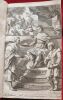
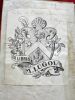
Phèdre (en latin Caius Iulius Phaedrus ou Phaeder), né vers 14 av. J.-C. et mort vers 50 apr. J.-C., est un fabuliste latin d'origine thrace, affranchi de l'empereur. À peu près le tiers de son uvre est repris dÉsope dont il adapte les fables ; les deux autres tiers sont issus de son imagination. Tout comme son prédécesseur, Phèdre raconte des histoires danimaux, mais il met en scène aussi des personnages humains et parmi ceux-ci Ésope. Au total, il composera 5 livres de fables. Merci de nous contacter à l'avance si vous souhaitez consulter une référence au sein de notre librairie.
[Excudebat Ambrosius Firminus Didot, Firminis Didot Fratres [ Ambroise Firmin Didot, Firmin Didot Frères ]] - PHAEDRUS ; (BERGER DE XIVREY, Jules)
Reference : 37107
(1830)
Phaedri Aug. Liberti Fabularum Aesopiarum Libros Quatuor. Ex Codice olim Pithoeano, deinde Peletteriano, nunc in bibliotheca Lud. Lepeletier de Rosanbo ... cum prolegomenis, annotatione, indice, edidit Julius Berger de Xivrey.
1 vol. in-8 reliure demi-chagrin brun, Excudebat Ambrosius Firminus Didot, Firminis Didot Fratres [ Ambroise Firmin Didot, Firmin Didot Frères ], Paris, 1830, 266 pp.
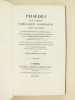
Bon état (petite mouill. marginale en marge des premiers ff., bel état par ailleurs) pour cet exemplaire très agréablement relié.
De fabelwereld. Samengesteld en ingeleid door H.C. KOOL.
Amst., Arbeiderspers, 1960.
191 p., ills. Hardbound. (Incl. dustjacket; also translations of fables of De la Fontaine, Gellert et alii; not in OiN)
Cornelii Nepotis Vitae excellentium imperatorum. Editio nova, ex optimis exemplaribus emendata et schematibus illustrata. (Bound with:) Phaedri Augusti Liberti Fabularum Aesopiarum libri quinque, quibus accedunt fabulae novae ex codice Perottino. Editio nova, ex optimis exemplaribus emendata et schematibus illustrata.
Paris, H. Delloye, Henriot, 1837 - 1838.
2 vols. in 1: (II),136;(II),172 p., richly illustrated. Half dark green morocco 24 cm (Back gilt, endpapers marbled; numerous nice engravings of the early 19th century French School, e.g. Jean Gabriel Caquet (1749-1802), Louis Français (1814-1897), Karl Gigardet (1813-1871), Adrien Godefroy (1777-1865), Eugène Guillaumot (1813-1869), Jean Lous Joseph Lacoste (1809-1866), Pierre Eugène Lacoste (1818-1908), Eugène Laville (1814-1869), Louis Charles Auguste Steinheil (1812-1843), Louis Joseph Trimolet (1812-1843), Émile Wattier (1800-1868). This book is obviously a coproduction of the Parisian printers Delloye and Henriot, for the paper, layout and the illustrators of both books are the same) (Cover slightly worn at the extremes; paper slightly foxed)
Fables. Texte établi et trad. par A. BRENOT.
Paris, Les Belles Lettres, 1961.
Wrs. 20 cm (Budé)
Fabels. Vert. en ingel. door M. MOONEN.
Antwerpen, Ned. Boekhandel, 1951.
X,76 p. Pocket. 18 cm (OiN 290; Klassieke Galerij)
Fabulae Aesopiae. Recognovit et praefatus est L. MÜLLER.
Lpz., Tbn., 1869.
XIV,66 p. Brds. (BT)(Cover scuffed; name on title)
Aesopische fabels. Opnieuw in verzen verteld (door) J. VAN NIEUWENHUIZEN. Met gravures van J. van Vianen.
Den Haag, van Hoeve 1964.
195 p.; ills. Cl. 21 cm (OiN 290; includ. dustjacket)
Ausgewählte Fabeln. Erkl. von F.E. RASCHIG. 3. Aufl.
Bln., Wdm., 1871.
XI,85 p. Wrs. (WmS)(Back rep. with paper)
Fabulae Aesopiae. Recensuit J.S. SPEYER.
Groningen, Wolters, nd.
15,84 p. Boards. 19 cm (Rebound; some pencil; cover a bit soiled)
Fabulae Aesopiae. Recensuit J.S. Speyer.
Groningen, J.B. Wolters, nd.
XV,84 p. Cloth. 20.5 cm
Fabulae Aesopiae. Recensuit J.S. Speyer.
Groningen, J.B. Wolters, nd.
XV,84 p. Boards. 19 cm (Rebound; some pencil; cover a bit soiled)
Fabeln. Lateinisch-deutsch. Herausgegeben und übersetzt von Eberhard Oberg.
Darmstadt Wissenschaftliche Buchgesellschaft. 1996. Klein-8°. 272 S. Originalleinwand mit Schutzumschlag.
Lizenzausgabe der Artemis-Ausgabe: "Sammlung Tusculum. Wissenschaftliche Beratung: Karl Bayer, Manfred Fuhrmann, Fritz Graf, Erik Hornung, Rainer Nickel." - Blindgeprägtes Exlibris auf Vorsatz.

Phaedri... Fabulae. Ad manuscriptos codices et optimam quamque editionem emendavit Steph.-And. Philippe. Accesserunt notae ad calcem.
Lutetiae parisiorum, Joan. August. Grange 1748 In-12, demi-velin blanc post., dos lisse, pièce de titre rouge, tranches dorées. XLVIII- 305 pp. Titre et 12 figures dans le texte gravés d'après Durand par Fessard et Sornique, bandeaux, lettrines et culs-de-lampe. Rel. lég. ternie. Intérieur très frais un feuillet entaché d’humidité. Bon exemplaire.
Edition établie par Philippe de Prétot (1710-1787). Les notes sont en grande partie du P. Noël-Étienne Sanadon. Bon état d’occasion Livres anciens
Les Fables de Phèdre, affranchi d'Auguste, traduits en français.
Avignon, veuve Seguin, 1799. 1 vol. in-18, basane marbrée, dos lisse orné de fleurons dorés, pièce de titre en basane fauve, roulette dorée sur les coupes, tranches rouges. Reliure de l'époque. Petit trou au plat inf, coins émoussés. Bon exemplaire. x-213 pp.
Edition bilingue, destiné à l'enseignement de la langue latine, avec une aide chiffrée pour comprendre la syntaxe.

Augusti Caesaris Liberti. Fabulae Brevibus illustratae adnotationibus. Ad usum Regiarum Scvholarum.
Augustae Taurinorum, 1779. Small 8vo. Cont. full limp vellum. Title page and inside of front board soiled. 2 pages with notes in text. Occationally brownspotted. 8, 135, (1) pp.
PHAEDRUS, Von Fr Fr. RUCKERT, O. SCHONBERGER
Reference : RO40169837
(1987)
ISBN : 3150011442
LIBER FABULARUM, FABELBUCH, LATEINISCH/DEUTSCH
Philipp Reclam jun.. 1987. In-16. Broché. Etat d'usage, 1er plat abîmé, Dos satisfaisant, Intérieur frais. 240 pages. Texte en latin et en allemand en regard. Etiquette de code sur le 1er plat. Tampons et annotations de bibliothèque sur le 1er plat et en page de titre. Quelques annotations dans le texte.. . . . Classification Dewey : 870-Littératures des langues italiques. Littérature latine
'Universal-Bibliothek'. Übersetzt von Freidrich Fr. Rückert und Otto Schönberger, Herausg. und erläutert von Otto Schönberger. Classification Dewey : 870-Littératures des langues italiques. Littérature latine

