 Write to the booksellers
167 books for « ovidius »Edit
-
Language
English (1)
French (164)
German (1)
Latin (1)
-
Century
16th (1)
17th (9)
18th (12)
19th (5)
20th (17)
-
Countries
Belgium (12)
Denmark (11)
France (34)
Germany (1)
Italy (1)
Netherlands (96)
Switzerland (12)
-
Syndicate
CLAM (2)
ILAB (33)
NVVA (4)
SLACES (4)
SLAM (13)
Topics
- Books from the xviith (2)
- Early printed books (1)
- Elzevier (1)
- English (2)
- Engraving (books about) (1)
- Gold (1)
- Gravelot (1)
- Greece (2)
- Greek (88)
- History (1)
- Illustrated books (1)
- Latin (101)
- Latin greek (2)
- Literature (12)
- Mythology (3)
- Paris (1)
- Pérrichon (1)
- Philosophy (1)
- Picasso (1)
- Poetry (2)
- Reliure (2)
- Roman literature (1)
- Translation (1)
- Various (1)
- Vellum (1)
Die fasten - BAND I text und übersetzung & II kommentar - wissenschaftliche kommentare zu lateinischen und griechischen schriftstellern
Carl Winter / Universitätsverlag 1957 in8. 1957. Broché. 2 volume(s).
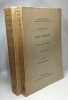
couvertures défraîchies bords frottés un peu fendu au niveau des charnières annotations en haut des faux titre et des pages titre intérieurs propre rares et lègères annotations au crayon à papier sur le tome I une étiquette collée dans le dernier plat intérieur sur chaque volume
Tristia - herausgegeben übersetzt und erklärt von Georg Luck - BAND II: Kommentar - Lieferung 1
Carl winter 1968 in8. 1968. Broché.
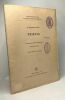
tampons sur le premier plat bords très frottés intérieur propre couverture défraîchie
P. OVIDII NASONIS poetae Sulmonensis Opera quae vocantur Amatoria, cum doctorum virorum commentarijs partim hucusque etiam alibi editis, partim iam primùm adiectis. His accesserunt Iacobi Micylli annotationes longe doctissimae. [...] Eiusdem Iacobi Micyll
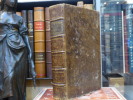
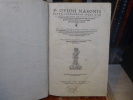
Per Ioannem Heruagium Basilae 1549 P. OVIDII NASONIS poetae Sulmonensis Opera quae vocantur Amatoria, cum doctorum virorum commentarijs partim hucusque etiam alibi editis, partim iam primùm adiectis. His accesserunt Iacobi Micylli annotationes longe doctissimae. [...] Eiusdem Iacobi Micylli locorum aliquot ex Ouidiana Metamorphosi Retractatio. Cum locuplete rerum & verborum in hisce omnibus memorabilium indice.- Relié à la suite:P. OVIDII NASONIS metamorphosens libri quindecim cum commentariis raphaelis regis. Adiectis etiam Annotationibus Iacobi Micylli nunc primum in lucem editis, cum locupletifsimo praeterae in haec omnia indice. Basilae, Per Ioannem Heruagium, 1543.2 ouvrages reliés en 1 volume in-folio ( 365 X 230 mm ) de ( 16 )- 528-( 32 ) pages et ( 28 )-355-( 2 ) pages, pleine basane fauve racinée, dos à nerfs orné de fleurons et palettes dorés, pièce de titre de maroquin bronze ( Reliure du début du XIXe siècle ). Belle marque d'imprimeur au verso du dernier feuillet, bel exemplaire.
De kunst der vrijage. (Nederlandsche bewerking J. Meihuizen)
Amsterdam, Strengholt, 1941.
167 p. Half cloth. 25 cm (OiN 275; prose translation of Ars Amandi) (Charming illustrations by the Dutch artist and book illustrator Frans (Franciscus Alphonsus Maria Cornelis) Lammers (1911-1966). In the weekly magazine 'Nieuwsblad voor den Boekhandel', 109e Jaargang, no. 42, 22 October 1942, we read in a review of this illustrated edition, written by the important Dutch book historian and expert on typography G.W. Ovink (1912/1984: 'Ovidius: Kunst der vrijage (Strengholt). Een buitengewoon dankbare opgave: de luchtige poëzie van Ovidius, die zoo onnavolgbaar het oude Rome op het hoogtepunt van zijn bloei en het begin van de decadentie weergeeft, te illustreeren. Strengholt heeft hiervoor F. Lammers aan het werk gezet, een handig en bekwaam teekenaar (...) Het is verheugend dat deze kunstenaar, wiens werk reeds op ander gebied bekend was, hier de kans kreeg om een dergelijk onderwerp, dat hem ligt, te behandelen in de bandversiering en illustraties. Hij koos een bruinen linnen rug met een rood etiket in grondopdruk met (te magere) nette Romeinsche kapitalen, en een losse vakverdeeling met een hartje in lauwertak, braaf en stijf. De platten daarentegen zijn 'in wit papier, met den titel in zuivere letters en een aardige teekening van een verliefd paar (te laag) daaronder. De derde stijlwisseling komt in de titelpagina, die in Bodoni werd uitgevoerd, terwijl de tekst daarna uit de nobele, inderdaad Romeinsche ,,Weiss"-letter is gezet. Een rare combinatie. De marges zijn zeer ruim gehouden, 'daarin vonden de onderkoppen (Weiss cursief) een plaats, een goede oplossing. Lammers vulde een aantal volle pagina's met benijdenswaardig vlotte penteekeningen, nu en dan op het ,,galante" af, doch nog zeer onschuldig. Zij lijken ons echter te schetsmatig en anecdotisch om bij dit in dubbelen zin klassieke werk geheel te bevredigen. Illustraties daarvoor moeten zeker luchtig zijn, maar daarom nog niet vluchtig. En de Romeinsche jongemannen waren niet allen boerenpummels zooals Lammers die teekent. Door de vlotte prentjes, de stopper-teekeningen in rood, de roode initialen en de ruime opmaak is het een aantrekkelijk boek geworden, doch iets te luchtig van toon en tegelijk te veel in de richting van het pompeuze ,,prachtwerk". Een kleiner formaat, dat meer tot een telkens ter hand nemen inviteert, voorts - zoo mogelijk - een wat gladder papier, en een delicatere typografie zouden meer in de lijn van dezen tekst gelegen hebben'. (facsimile.ub.rug.nl/cdm/ref/collection/tijdschrift/id/149/))
De kunst der vrijage. Twintig eeuwen oude, maar niet verouderde liefdeswenken. (Nederlandsche bewerking J. Meihuizen)
Amsterdam, Strengholt, 1941.
167 p., illstrations. Half cloth. 25 cm (OiN 275; translation of Ars Amandi; including a slightly worn dustjacket. Charming illustrations by the artist and book illustrator Frans Lammers. In the weekly magazine 'Nieuwsblad voor den Boekhandel', 109e Jaargang, no. 42, 22 October 1942, we read in a review of this edition, written by the important Dutch book historian and expert on typography G.W. Ovink (1912/1984: 'Ovidius: Kunst der vrijage (Strengholt). Een buitengewoon dankbare opgave: de luchtige poëzie van Ovidius, die zoo onnavolgbaar het oude Rome op het hoogtepunt van zijn bloei en het begin van de decadentie weergeeft, te illustreeren. Strengholt heeft hiervoor F. Lammers aan het werk gezet, een handig en bekwaam teekenaar, (...). Het is verheugend dat deze kunstenaar, wiens werk reeds op ander gebied bekend was, hier de kans kreeg om een dergelijk onderwerp, dat hem ligt, te behandelen in de bandversiering en illustraties. Hij koos een bruinen linnen rug met een rood etiket in grondopdruk met (te magere) nette Romeinsche kapitalen, en een losse vakverdeeling met een hartje in lauwertak, braaf en stijf. De platten daarentegen zijn 'in wit papier, met den titel in zuivere letters en een aardige teekening van een verliefd paar (te laag) daaronder. De derde stijlwisseling komt in de titelpagina, die in Bodoni werd uitgevoerd, terwijl de tekst daarna uit de nobele, inderdaad Romeinsche ,,Weiss"-letter is gezet. Een rare combinatie. De marges zijn zeer ruim gehouden, 'daarin vonden de onderkoppen (Weiss cursief) een plaats, een goede oplossing. Lammers vulde een aantal volle pagina's met benijdenswaardig vlotte penteekeningen, nu en dan op het ,,galante" af, doch nog zeer onschuldig. Zij lijken ons echter te schetsmatig en anecdotisch om bij dit in dubbelen zin klassieke werk geheel te bevredigen. Illustraties daarvoor moeten zeker luchtig zijn, maar daarom nog niet vluchtig. En de Romeinsche jongemannen waren niet allen boerenpummels zooals Lammers die teekent. Door de vlotte prentjes, de stopper-teekeningen in rood, de roode initialen en de ruime opmaak is het een aantrekkelijk boek geworden, doch iets te luchtig van toon en tegelijk te veel in de richting van het pompeuze ,,prachtwerk". Een kleiner formaat, dat meer tot een telkens ter hand nemen inviteert, voorts - zoo mogelijk - een wat gladder papier, en een delicatere typografie zouden meer in de lijn van dezen tekst gelegen hebben'. (facsimile.ub.rug.nl/cdm/ref/collection/tijdschrift/id/149/)
Uitwerking van de eindexamensyllabus Latijn 1990.
Amst., Meulenhoff, 1989.
182 p.; ills. Pb. 23 cm (Without the volume of 28 p. with 'Antwoorden')
Uitwerking van de eindexamensyllabus Latijn 1990.
Amsterdam, Meulenhoff, 1989.
182 p.; illustrations. Paperback. 23 cm (Without the volume of 28 p. with 'Antwoorden')
Alle de werken van Publ. Ovidius Naso. Het derde deel: bestaande in Klaag-brieven, Brieven uit Pontus, Almanak, Vloek tegen Ibis, Nooteboom, Troost-dicht aan Livia, 't Blanketsel. In de Nederlandse taale overgebracht door Abraham Valentyn. Met verklaaringen, en uitleggingen verrijkt door Lud. Smids M.D.
Amsterdam (t'Amsteldam), By Pieter Mortier, Boekverkooper, 1701.
4to. (VIII),334,(40 index) p., frontispiece; 26 engraved plates. Vellum. 29 cm (Ref: STCN ppn 843242159; Schweiger 2,685; Geerebaert 122,26,b; OiN 273) (Details: Large paper copy. Third volume of 3 only. Back with seven raised bands. Boards blind stamped. The frontispiece, made by J. Goeree and J. van Vianen, depicts Ovid in despair being sent into exile by the emperor Augustus. Engraved plates of gods & goddesses and the like in the translation of the Fasti.) (Condition: Vellum age-toned, soiled & spotted. Paper partly yellowing. 3rd and last volume only) (Note: This third volume of a set of three contains a Dutch prose translation of part of the works of the Roman poet Ovid, 43 B.C. - 17 A.D. It contains a translation of the 'Tristia', 'Epistulae ex Ponto', 'Fasti', 'Ibis', 'Nux', 'Consolatio ad Liviam Elegiae', 'Medicamina Faciei Femineae'. Ovidius 'is perhaps the most consistently influential and popular writer of the classical tradition. His central position is suggested by the many surviving manuscripts of his works and their early publication in printed editions. (...) Most would agree that it is his Metamorphoses that has had the greatest influence, but his other major poems, the Heroides, Tristia, Fasti, and particularly his racier works, the Amores, Ars amatoria, and Remedia amoris, have played their part in maintaining his reputation as a writer of enduring importance and appeal.' (The Classical Tradition, Cambr. Mass. 2010, p. 667) The huge number of editions and translations suggests that Ovid's appeal lies also beyond the bounderies of the scholarly world. The editor and annotator of this work, Ludolf Smids, confesses in the preface of the first volume that he thinks that his readers probably know little Latin. In the preface of the 2nd volume (the Metamorphoses), he is more precise about his public. There he states that everyone has read this 'weergaloos Konstwerk' (inimitable work of art) thoroughly. Painters, sculptors, and engravers draw on this famous source for inspiration. 'Want wie (buiten de Letterkundige) beroemd sich niet de Metamorphosis door en door geleesen te hebben, aangesien sy is de rijke schatkamer en het volgepropte wapenhuys van Schilders, Beeldhouwers en Graveerders, die niet ontkennen hunne Ifigeniaas, Medeaas, Nioben, Altheën, en andere wonderstukken, deselve ontleend te hebben'. In the preface to this last volume Smids declares once more that he did not publish the translation and did not write his annotations for scholars and the like, but for painters, sculptors, engravers and draughtsmen, and for young students (jonge Leerlingen van Taalen en Weetenschappen). The dates of the translator Abraham Valentijn are unknown. He was living in the Dutch town of Dordrecht, at least from 1666, where he first was praeceptor (teacher of classical languages) of the local 'Schola Latina', and later Conrector. His Ovid translation was first published in Leiden 1678, and was reprinted twice. He also published a prose translation of Juvenal, which had some success, for it was reprinted several times. (Van der Aa 19,24) More is known about the editor and annotator of this translation, Ludolf Smids, 1649-1720. He came to Leiden, where he became Doctor of Medicine in 1673. He went to live in Amsterdam, where he spent more time on the study of history, antiquities, poetry and numismatics than as medical practioner. He wrote plays, poetry, and several books on numismatics. He also translated the 'Mostellaria' of Plautus into Dutch. (Van der Aa, 17/2, 760) (Provenance: On the front pastedown in ink: 'J.H. Verheijen'. This is the Dutch painter and draughtsman Jan Hendrik Verheijen, 1778-1846. See his Wikipedia article) (Collation: pi2 (including frontispiece), *2, A - Z4, Aa - Zz4, Aaa4 (leaf Aaa4 blank) (26 plates at page 146, 154, 157, 160, 164, 177, 179, 181, 198, 215, 220, 223, 227, 241, 243, 261, 262, 264, 268, 278, 281, 283, 285, 296, 305 & 307) (Photographs on request)
Gedaanteverwisselingen van P.Ovidius Naso en derzelver verklaring door Abt Banier. Vercierd met CXL. Prentverbeeldingen, zeer keurig naar de Tekeningen van Eisen, Gravelot, Moreau, en anderen, in het Koper gebragt, door de beroemde Kunstgraveerders Le Mire, Longueil, &c. (Two volumes).
" Amsterdam, D.J. Changuion en G. Warnars, 1779, 2 vols in-4°, 28 x 21,5 cm, engraved frontispiece, two coloured title-page with engraved vignette + (10) + 279 pp + 80 copper engraved plates h.t. ; two coloured title page with engr. vign. + 308 pp +(10) pp + 61 copp. engr. plates (includ. endplate). Contemporary half leather with richly decorated smooth back with double labels in green and red leather. Very handsome copy. Attractive 18th century illustrated translation in Dutch of the Metamorphoses of Ovidius. The two volumes comprise a total of 141 full-page engravings by the most famous contemporary illustrators like Boucher, Eisen, Gravelot, Leprince, Monnet, Moreau, Parizeau et Saint-Gois. The illustrations in this work were originally used for a French edition (by de Prault, Paris, 1767-1771) of which Cohen (pp. 769-772) says; ''Superbe ouvrage...c'est un des plus galamment illustrés de tout le siècle''. See also; Exhibition catalogue, The Hague, Museum Meermanno Westranium, 1980, Ovidius herschapen, item 44."
SANDRART, Joachim von ( 1606 - 1688 ) - Karel van MANDER - OVIDIUS ::
Reference : 58329
"L ' Academia Todesca della Architectura, Scultura & Pictura : Oder Teutsche Academie der Edlen Bau-Bild- und Mahlerey-Künste. . [Supplement] Lebens Lauf und Kunst-Werke ....Herrn Joachims von Sandrart. (= Vol. I) ; Der Teutschen Academie Zweyter und Letzter Haupt-Theil.....durch J. von Sandrart auf Stockau (= Vol. II). (Bound at the end of Vol.II ) Ovidii Metamorphosis..aus dem Niederlaendischen Carls von Mander...der Sandrartischen Academie einverleibet. ."
" Nürnberg, Johann-Philip Miltenberger, 1675 (= vol. 1) : Nürnberg, Christian Sigismund Froberger für Jacob von Sandrart und Michael und Johann Friedrich Endtern, Frankfurt, 1679 . Ovidius/von Mander, Nürnberg; Froberger 1679 (= vol 2). 2 vols in-folio, (47,5 x 25 cm). Uniformly bound in contemporary blindtooled pigskin. Very fine copy, bindings with minimal traces of use, interior mostly stainless, only sporadic spots at a few pages. Copy of the Gotha ducal library, with small cancelation stamp :''Duplum/Bibli Duc/Goth''. Modern printed ex-libris on the first paste down ''Friedrich Schoene''.. Notoriously difficult to collate because of the complicated publication history and the intricate system of plate-numbering we collated our copy against the copy in the Mark Millard collection at the National Gallery of Art in Washington (Vol. III North European Books, item 111). [1] Text-leaves. Missing in our copy is only one leaf; in Vol.1 part 2 ; pp.(1) the separate title page. The privilege leaf pp (IX-X) in Vol 1 has been misbound and placed in Vol. 2 Part 2. For completeness sake we briefly list here the leaves present in our copy but lacking in the Millard copy. [1] Vol. 2 Halftitle ; [2] Vol.2 Part 2 ; halftitle (2) pp ; [3] Ovidius Carl von Mander ; (2)pp + 174 pp +(4)(table) (this part not present in the Millard). [2] Plates.. Our copy lacks 1 plate in Vol 2 : folding map of Rome.All the other (261/262) plates are present. Rare and beatifully preserved copy of this capital publication in the history of Western art. Complete with the often lacking German translation of the Karel van Mander work on Ovidius."
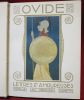
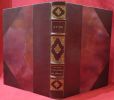
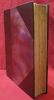
Lettres d'Amoureuses. Les Héroïdes. Traduction de G. Miroux. Illustrations de Manuel Orazi gravées sur bois par Perrichon.
Paris, Editions René Kieffer, 1919 (achevé d'imprimer 1914), 1 volume in-4 de 285x215 mm environ, demi maroquin à coins bordeaux, dos à nerfs portan titres dorés, orné de caissons à riches motifs dorés, tranche de tête dorée, couvertures et dos conservés, feuillets non rognés. Illustrations de Manuel Orazi gravées sur bois par Perrichon. Exemplaire du tirage de tête N° 11 : un des 20 exemplaires sur Japon à la forme avec une suite sur Chine, deux suites sur Japon, et un dessin original de l'illustrateur, numérotés de 1 à 20. Quelques rousseurs, sinon bon état.
Ovide, en latin Publius Ovidius Naso, né en 43 av. J.-C. à Sulmone (en italien Sulmona) dans le centre de l'Italie et mort en 17 ou 18 ap. J.-C., en exil à Tomis (l'actuelle Constan a en Roumanie), est un poète latin qui vécut durant la période qui vit la naissance de l'Empire romain. Ses uvres les plus connues sont L'Art d'aimer et les Métamorphoses. Merci de nous contacter à l'avance si vous souhaitez consulter une référence au sein de notre librairie.
Publii Ovidii Nasonis Metamorphoseon libri XV. Expurgati, & explanati. Cum appendice de Diis, & Heroibus Poeticis. Auctore Josepho Juvencio e Societate Jesu.
Venice (Venetiis), Apud Nicolaum Pezzana, 1715.
12mo. (VI),640,(13 index),(1 blank). Calf 15.5 cm 'Kind of prize copy?' (Ref: Not in Schweiger, though he mentions other editions; cf. Graesse 5,76; cf. Ebert 15445) (Details: Back gilt and with 4 raised bands. Woodcut ornament on the title. On the lower part of the pages, below Ovid's text, Juvencius notes in Latin) (Condition: Binding scuffed, corners bumped. Head and tail of the spine damaged. Prize inscription on front flyleaf. Paper somewhat foxed and yellowing. Name and old ink inscription on the flyleaf at the end) (Note: The Roman poet Ovidius, 43 B.C. - 17 A.D, 'is perhaps the most consistently influential and popular writer of the classical tradition (...) Most would agree that it is his Metamorphoses that has had the greatest influence, but his other major poems, the Heroides, Tristia, Fasti, and particularly his racier works, the Amores, Ars amatoria, and Remedia amoris, have played their part in maintaining his reputation as a writer of enduring importance and appeal'. (The Classical Tradition, Cambr. Mass. 2010, p. 667) Ovid was widely read in antiquity, and remained to be read at the Carolingian court in the Middle Ages. The 12th/13th centuries are even called the 'aetas Ovidiana', for Ovid's love elegy was one of the mainsprings of the phaenomenon of courtly love and its literary expression. His 'Ars amatoria' and the 'Remedia' became even part of the school curriculum. Ovid became also the favourite poet of the Renaissance. Especially his 'Metamorphoses' were a source of inspriration for Boccaccio, Dante, Petrarca, Chaucer, Shakespeare, Milton, and in modern times Kafka, T.S. Eliot, Freud, et many others. This school edition of Metamorphoses of the Roman poet Ovid is the work of the French Jesuit scholar, poet and paedagogue Joseph de Jouvancy, or Jouvency, in Latin Josephus Juvencius, 1643-1719. Jouvancy entered the Society of Jesus when he was sixteen, 'and after completing his studies he taught grammar at the college at Compiègne, and rhetoric at Caen and the College of La Flèche. He made his profession in the latter place in 1677 and was afterwards appointed professor at the Lycee Louis-le-Grand in Paris. In 1699 he was called by his superiors to Rome to continue the history of the Society of Jesus begun by Niccolo Orlandini, and was engaged on this work until his death. (...) Jouvancy edited a large number of school editions of Latin authors, including Terence, Horace, Juvenal, Persius, Martial, the Metamorphoses of Ovid and the philosophical writings of Cicero, such as De Officiis, Cato Major and Laelius'. The texts were revised and purged for school use, and supplied with footnotes in Latin. 'These expurgated editions were frequently reissued well into the 19th century, both in France and other countries'. (Source for Jouvancy Wikipedia) This Ovid edition was rather popular. Dozens of editions were published in Europe in the 18th and the first half of the 19th century) (Provenance: Piemontese provenance. The manuscript prize is for 'Carolus Philippus Testa' of the 'Schola Clarascensis', and is awarded to him in 1717 by 'Magistro Joê Boucher Tullensi'. Most probably a prize for one Carlo Filippo Testa of a school in the Italian city Cherasco (Clarescum) in Piemonte, and donated by a magister named Johannes Boucher from Toul. The Piemontese origin seems to be confirmed by the inscription on the verso of the flyleaf at the end. It is in Italian, and is to thank 'mio caro amico' 'Chiera, Pietro da Mondovi' who was a 'compagno in grammatica'. We found a Pietro Chiera from the Piemontese city Modovi who taught Latin grammar at a Piemontese school from 1851 till 1854. At the end the name 'Rovere, Gio Battista da Magliano, 1863.' Who this Italian from the Tuscan city Magliano was, we could not find out) (Collation: A-2D12, 2E6 (Leaf E6 verso blank))
Proeve eener navolging van Ovidius Gedaantverwisselingen, door W. BILDERDIJK.
Amsterdam, By P. den Hengst en Zoon, 1829.
VIII,207 p. Contemporary boards 23 cm (OiN 277; Cover worn & chafed; both hinges strengthened with a strip of white cloth; name on title)
P. Ovidius Naso. Vol. II: Metamorphoses. Ex iterata R. MERKELii recognovit cum emendationis summario.
Lpz., Tbn., 1909.
XLVI,329 p. Cl. 17 cm (BT)
P. Ovidius Naso. Vol. II: Metamorphoses. Ex iterata R. MERKELii recognitione. Cum emendationis summario.
Lpz., Tbn., 1912.
XLVI,329 p. Cloth. 17 cm (BT) (Sl. worn)
P. Ovidius Naso. Vol. III: Tristia. Ibis. Ex ponto libri. Fasti. Ex iterata R. MERKELii recognitione.
Leipzig, Teubner, 1897.
XXXXI,355 p. Half cloth. 17 cm (BT)(Rebound)
P. Ovidius Naso. Vol. III: Tristia. Ibis. Ex ponto libri. Fasti. Ex iterata R. MERKELii recognitione.
Lpz., Tbn., 1914.
XXXXI,355 p. Cl. (BT)
De godenschildering in Ovidius' metamorphosen.
Nijmegen, Drukkerij Gebr. Janssen, 1946.
XII,192 p. Stiff wrappers. 24 cm (Dissertation University Nijmegen)
Over een middeleeuws-franse prozabewerking van Ovidius' 'Ars Amatoria'.
Amst., NHUM, 1956.
38 p. Wrs. (Med. KNAW)
Ovid: a poet on the margins.
London etc., Bloomsbury, 2016.
(XIV),104 p. Paperback. 21.5 cm (Introduction to Ovidius)
P. Ovidii Nasonis Opera omnia, in tres tomos divisa, cum integris notis Nicolai Heinsii D.F., lectissimisque Variorum notis. Quibus non pauca, ad suos quaeque antiquitatis fontes diligenti comparatione reducta, accesserunt, studio Borchardi Cnippingii. (Volumen 1)
Amsterdam (Amstelodami), Ex typographia Blauiana, Sumptibus Societatis, 1683.
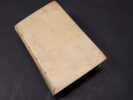
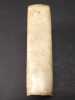
8vo. (XVI),832,(14 index),(2 blank) p., One portrait of Ovid. Vellum. 20 cm (Volume 1 of 3) (Ref: STCN ppn 852573480; Schweiger 2,631: 'Bloss Wiederholung der Ausgabe von 1670'; Brunet 4/272: 'Cette édition est belle, et les notes en sont plus et mieux choisies'; Dibdin 2,267/8: 'Yet (of the Variorum editions) that of 1683 is perhaps the general favourite'; Graesse 5,70; Ebert 15368; Rahir 2784, 'Annexes de la Collection Elzevirienne') (Details: Volume 1 of 3 only. One engraved portrait of Ovid. Engraved frontispiece, depicting the Judgment of Paris; in the foreground Amor and a peacock, in the background Troy. This volume contains the Latin text with extensive commentary of the 'Heroides' (p. 1/308), 'Amores' (p. 309/510), 'Ars Amatoria' (p. 511/680), 'Remedia Amoris' (p. 681/738), the fragment 'Medicamina Faciei' (p. 738/748), 'Halieuticon' (p. 749/760), 'Consolatio ad Liviam' (p. 761/793), and 'Nux' (p. 793/806); at the end have been printed 3 verse epistles, each written in the person of a legendary woman to her absent lover, forged by the Italian humanist and impersonator of Ovid, Angelo Sabino, or Angelus Sabinus, floruit 1460/1480. The 3 hoax poems were for a long time attributed to Aulus Sabinus, a friend of Ovidius) (Condition: Binding age-tanned. Upper corner of back cover damaged. This is volume 1 of 3 only) (Note: The Roman poet Ovid, 43 B.C. - 17 A.D, 'is perhaps the most consistently influential and popular writer of the classical tradition. His central position is suggested by the many surviving manuscripts of his works and their early publication in printed editions. (...) Most would agree that it is his Metamorphoses that has had the greatest influence, but his other major poems, the Heroides, Tristia, Fasti, and particularly his racier works, the Amores, Ars amatoria, and Remedia amoris, have played their part in maintaining his reputation as a writer of enduring importance and appeal'. (The Classical Tradition, Cambr. Mass. 2010, p. 667) Ovid was widely read in antiquity, and remained to be read at the Carolingian court in the Middle Ages. Ovid became also the favourite poet of the Renaissance. Boccaccio and Petrarca were influenced by him. Shakespeare was inspired more by Ovid than by Vergil. (Neue Pauly 9,110/119) The huge number of editions and translations suggests that Ovid's appeal lies also beyond the bounderies of the scholarly and literary world. A new age (1658-1837) dawns in the textual history of Ovid's poems with the work of the famous Dutch scholar, neolatin poet and diplomat, Nicolaas Heinsius, 1620-1681, 'who, after 345 year, remains the central figure in any account of the editing of Ovid. No modern editor will fail to mention his name in the preface as the 'sospitator Ovidii; no 'apparatus criticus', will fail to cite his numerous contributions to the improvement of the text'. (P.E. Knox (ed.), 'A companion to Ovid', Chichester 2013, online version) Heinsius' editions of Ovid offer texts that are based on an extensive first hand knowledge of the manuscripts, and that are supplemented with a full textual commentary which records and discusses 'variae lectiones', and notes alterations of the vulgate text. (Sandys 2,323/6) Our edition of 1683 is a reissue an an edition of 1670, published in Leiden. It is a so-called 'Variorum' edition. Such an edition generally offers a 'textus receptus' which is widely accepted, accompanied with the commentary and the annotations of various specialists, taken, or excerpted from earlier useful, normative or renewing editions. Editions like these were useful, but never broke new ground. This Variorum edition was produced by the Dutch classical scholar of German descent Bochardus Cnippingius, 1623/24-1674. At the age of 23 or 24 he was appointed Rector of the Schola Latina at Culemborg. He gave up this position and moved to Leiden to teach classics at the local 'Schola Latina', later he became Conrector. Cnippingius' edition was the main source for the Ovid translation of the English poet John Dryden. (J.A. van der Welle, 'Dryden and Holland', Groningen 1962, p. 122/24)) (Collation: *8, A-3G8 (leaf 3G8 blank)) (Photographs available on request)

