 Write to the booksellers
388 books for « newton e t »Edit
-
Type
Book (382)
Magazine (1)
Music sheets (3)
Old papers (1)
Posters (1)
-
Latest
Last month (19)
Last week (1)
-
Language
English (4)
French (381)
Russian (3)
-
Century
17th (1)
18th (27)
19th (20)
20th (153)
21st (35)
-
Countries
Belgium (30)
Canada (5)
China (1)
Côte d'Ivoire (9)
Denmark (30)
France (278)
Germany (3)
Switzerland (28)
United Kingdom (1)
United States of America (3)
-
Syndicate
ALAC (4)
CLAM (5)
CLAQ (3)
ILAB (175)
NVVA (2)
SLACES (2)
SLAM (128)
Topics
- Aesthetics (2)
- Africa (2)
- Animals (1)
- Archaeology (2)
- Architecture (5)
- Arithmetic (3)
- Arouet (4)
- Asia - orient (2)
- Astronomy (6)
- Autographs (2)
- Aviation (2)
- Bacon francis (4)
- Barber (2)
- Bestiary (1)
- Bible (1)
- Buffon (2)
- Children’s books (6)
- Christmas (1)
- Comic strip (2)
- Curiosa (3)
- Detective novels (4)
- Drama (2)
- Drawings (2)
- Early printed books (3)
- Earth (2)
- Education (3)
- Education - morals (1)
- England (2)
- English (9)
- Engraving (books about) (2)
- Entomology (3)
- Environment (1)
- Epigraphy (3)
- Ethic (3)
- Ethnography (2)
- Ethnology (3)
- Fashion (5)
- Fine arts (10)
- First edition (3)
- Flora (2)
- Flowers (2)
- Freemasonry (4)
- Geography (3)
- Guide books (2)
- Helvética (2)
- History (10)
- Industrial arts & crafts - fine arts (8)
- Isaac (32)
- Jazz (2)
- Joyce james (3)
- Kaufmann (11)
- Law (2)
- Leibniz (2)
- Literature (9)
- Lithographs (1)
- Mathematics (12)
- Navy (3)
- Newton (281)
- Newton helmut (8)
- Oceania (9)
- Optics (1)
- Ornithology (2)
- Palaeontology (3)
- Periodicals (2)
- Philosophy (3)
- Photography (33)
- Physics (15)
- Quebec (3)
- Religions (5)
- Review (3)
- Ruth (1)
- School (1)
- Sciences (16)
- Sciences & technique (1)
- Sciences pc (1)
- Scores (3)
- Sculpture (6)
- Shapes & colours (4)
- Songs (2)
- Tea (8)
- Theory (2)
- Translation (3)
- Travel (3)
- United kingdom (2)
- Versailles (2)
- Voltaire (7)
- War (3)
- Youth (2)
- Zoology (1)
Astronomiae Physicae & Geometricae Elementa. - [WITH THE FIRST PRINTING OF NEWTON'S ""LUNAE THEORIA"" AND THE FIRST UNVEILING OF NEWTON'S CALSSICAL SCHOLIA]
Oxoniae (Oxford), E Theatro Sheldoniano, 1702. Folio. Contemporary full calf, raised bands, rectangular blindtooled frames and central panel ""mirror"" on covers, Cambridge-style binding. leather at joints cracked, but cords intact so that covers not loose. Corners a bit bumped. Light wear to spine ends. Spine a bit rubbed. Pastedowns and flyleaves with browning. Title-page with large engraved vignette (Sheldon Theater). (12),494,(2) pp. With numerous textdiagrams. Very light browning to titlepage and a few marginal brownspots to last leaf, a fine clean copy, printed on good paper with wide margins.On the verso of the title-page is pasted the book plate of Sir William Baird of Newbaith. He habitually pasted his armorial bookplate on the verso of the title-pages of the books in his large and fine library.
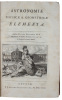
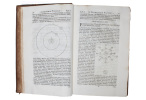

First edition of the first text book of astronomy based on Newtonian principles. Apart from its importance in the remodeling of astronomy in conformity with physical theory, the work is of the utmost importance as a source book - it contains the FIRST PRINTING OF NEWTON'S PAPER ON LUNAR THEORY (""Lunae Theoria Newtoniana"", pp. 332-336) as well as the FIRST EXPOSITION OF NEWTON'S CLASSICAL SCHOLIA, which Newton himself considered an important part of his philosophy.Gregory, a Scottish mathematician, who taught at Edinburgh and Oxford, was one of Newton's closest friends and associates. Newton thought highly of his work and communicated for insertion it in his Lunar Theory. He also permitted Gregory to use the material of that which is known as his ""Classical Scholia"", which are incorporated into Gregory's preface. ""Newtonian scholars have long been aware of a set of draft Scholia to Propositions IV to IX of Book III of the ""Principia"". These were composed in the 1690's, as part of an unimplemented plan for a second edition of the work. Since they describe supposed anticipation of Newton's doctrines in the thought of Greco-Roman antiquity, they have been known as the 'classical' Scholia..... Newton's thoughts on these matters were not, however, kept completely concealed. HE PERMITTED DAVID GREGORY TO USE THE MATERIAL EXTENSIVELY in a long historical preface to his ""Astronomiae Physicae & Geometricae Elementa"" (1702), IF WITHOUT ATTRIBUTION. (It was also available to Maclaurin for his much later work)."" (McGuire & Rattansi in ""Newton and the Pipes of Pan"", 1966).""It was the first textbook composed on gravitational principles, and remodeling astronomy in conformity with physical theory. Newton thought highly of it, and communicated for insertion in it (p. 332)) his 'lunar theory', long the guide of practical astronomers in determining the Moon's motions. The discussion in the preface, in which the doctrine of gravitation was brought into credit on the score of its antiquity, likewise emanated from Newton."" (DNB).""His thick folio text on foundations of astronomy, Astronomiae...elementa (1702) is a well-documented but unimaginative attempt to graft the gravitational synthesis propounded in the first book and especially the third book of Newton's Principia onto the findings of traditional astronomy. While respected as a source book it is now chiefly remembered for the remarks by Newton on the prisca sapientia of the ancients and their ""knowledge"" of the inverse-square law of universal gravitation and for the Latin version of Newton's short paper on lunar theory which it reproduces."" (DSB).Babson No. 71. - Houzeau & Lancaster 9240.

"LEIBNITZ, GOTTFRIED WILHELM., JOHANN BERNOULLI, JACOB BERNOULLI & ISAAC NEWTON - SOLVING THE BRACHISTOCHRONE PROBLEM.
Reference : 45644
(1697)
Communicatio suae pariter, duarumque alienarum ad edendum sibi a Dn. Jo. Bernoulli, deinde a Dn Marchione Hospitalio communicatarum solutionum problematici curvae..descensus a Dn. Jo. Bernpulli....propositi solutione... (Leibniz). + Curvatura Radii in...
Leipzig, Grosse & Gleditsch, 1697. 4to. No wrappers. In: ""Acta Eruditorum Anno MDCXCVII"", No V, May-issue. Pp. 193-240 (entire issue offered). With titlepage to the volume 1697. Leibniz: pp. 201-205. Johann Bernoulli: pp. 206-211. Jacob Bernoulli: pp. 211-214. Newton: pp. 223-224. As usual, some leaves with browning.
First appearance of the famous issue of Acta Eruditorum in which the 4 solutions by the 4 most eminent mathematicians at the time, were printed together. There were in all 5 solutions to the posed problem, and Newton's solution was first printed in the Philosophical Transactions (January 1697) and reprinted here. The solution proposed by L'Hopital, not printed here, was not published until 1988.The brachistochrone problem was posed by Johann Bernoulli in Acta Eruditorum in June 1696. He introduced the problem as follows: ""I, Johann Bernoulli, address the most brilliant mathematicians in the world. Nothing is more attractive to intelligent people than an honest, challenging problem, whose possible solution will bestow fame and remain as a lasting monument. Following the example set by Pascal, Fermat, etc., I hope to gain the gratitude of the whole scientific community by placing before the finest mathematicians of our time a problem which will test their methods and the strength of their intellect. If someone communicates to me the solution of the proposed problem, I shall publicly declare him worthy of praise."" Johann Bernoulli and Leibniz deliberately tempted Newton with this problem. It is not surprising, given the dispute over the calculus, that Johann Bernoulli had included these words in his challenge:- ....""there are fewer who are likely to solve our excellent problems, aye, fewer even among the very mathematicians who boast that [they]... have wonderfully extended its bounds by means of the golden theorems which (they thought) were known to no one, but which in fact had long previously been published by others.""According to Newton's biographer Conduitt, he solved the problem in an evening after returning home from the Royal Mint. Newton: ... ""in the midst of the hurry of the great recoinage, did not come home till four (in the afternoon) from the Tower very much tired, but did not sleep till he had solved it, which was by four in the morning.""Newton send his solution to his friend Charles Montague and Montague published anonymously in the Transactions. Newton's solution, presented here in the Acta, is also anonymous. The episode did not please Newton, as he later wrote: ""I do not love to be dunned [pestered] and teased by foreigners about mathematical things ..."" After the competition Johann Bernoulli said "".... my elder brother made up the fourth of these (after Leibniz, himself and Newton), that the three great nations, Germany, England and France, each one of their own to unite with myself in such a beautiful search, all finding the same truth.""Struik (Edt.) ""A Source Book in Mathematics, 1200-1800, pp. 391 ff.
La Methode des Fluxions, et des Suites Infinies Par le Chevalier Newton. (Translated by G. Louis Le Clerc, ount de Buffon). - [THE CALCULUS - THE INFINITESIMAL METHOD]
Paris, De Bure, 1740. 4to. Contemporary half calf, raised bands, richly gilt spine and and red speckled edges. Leather title-label to spine. Corners neatly repaired. Title in red/black. (2), III-XXX, (2) Errata, 148 pp., many diagrams. The ""Preface"" and the first 18 leaves of the text with a foxing to lower margin and right corners. The ""Preface"" is an historical account of Newton's method ""la sublime méthode"", written by Buffon. Without the leaf ""Extrait des Registres"".
The influential first French edition of Newton's important work, which constitutes the most extensive description of the mathematical method he used in his famous ""Principia"", the method of infinitesimals, which was already written about 1671, but not published until 1736, i.e. posthumously, with the title ""Method of Fluxions and Infinite Series..."". In this work ""Newton stated clearly the fundamental problem of the calculus: the relation of quantities being given, to find the relation of the fluxions of these, and conversely. In conformity with this problem and the new notation, Newton then gave examples of his method....In this book Newton introduced his characteristic notation and conceptions. He regarded his variable quantities as generated by the continuous motion of points, lines and planes, rather than as aggregates of infinitesimal elements, the view which had appeared in ""De analysi""...The rate of generation Newton called a ""fluxion"", designating it by means of a letter with a dot over it, a ""pricked letter"", the quantity generates he called a ""fluent"".( Boyer, The History of the Calculus.).Colson (in his preface to the first edition from 1736) says: ""I gladly embraced the opportunity that was put into my hands, of publishing this posthumous work, because I found it had been composed with that view and design. And that my own Country-men might first enjoy the benefit of this publication, I resolved upon giving it an English translation, with some additional remarks of my own, I thought it highly injurious to the memory and reputation of the real Author, as well as invidious to the glory of our own Nation, that so curious and useful a piece should be any longer suppress'd and confined to a few private hands, which ought to be communicated to all the learned World for general Instruction.It was through the French translations of his works that Newton came to play the seminal role as the most important of mathematicians that he did in France, and particularly the years around 1740, when the present work appeared in French for the first time were seminal to the scientific development in France, where the likes of Voltaire had only just made the nation acquinted with the work of the great mathematician. Gray No 236. Babson No 173.
Astronomie physique ou principes généraux de la nature, appliqués au mécanisme astronomique et comparés aux principes de la philosophie de M. Newton.
Paris, Jombert, 1740.
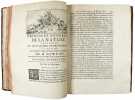
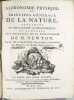
Première édition. Un ouvrage important dans l'histoire de l'introduction des théories de Newton en France. Il a été publié la même année que les "Institutions de physique" d'Emilie du Chatelet. En exposant la physique de Newton, Gamaches tente de concilier ces théories avec les tourbillons de Descartes. Etienne Simon de Gamaches (1672-1756) chanoine de Sainte-Croix de la Bretonnerie, était aussi un astronome membre de l'Académie des Sciences. Illustré par 22 planches hors-texte dépliantes et 10 vignettes et culs de lampe, gravés sur cuivre par Cochin. Petits manques aux coiffes. Bel exemplaire, frais. /// In-4 de (8), XLVIII, 362, (14) pp., 22 planches h.-t. Veau marbré, dos à nerfs orné, tranches rouges. (Reliure de l'époque.) //// First edition. An important book in the history of the introduction of Newton's theories in France. It was published the same year as the "Institutions de physique" of Emilie du Chatelet. "Gamaches gives here nine dissertations on the nature and laws of movement, the principles of the philosophy of Newton, the theory of planets, etc., and a clarification of relative movement and Newtonian attraction." Babson, A descriptive catalogue of the works of Sir Isaac Newton.

Optice: sive de Reflexionibus, Refractionibus, Inflexionibus & Coloribus Lucis, Libri tres. Latine reddidit Samuel Clarke, S.T.P. Editio Secunda, auctior.
London, Impensis Gul. & Joh. Innys, 1719 (colophon: Londini: Ex Officina Gulielmi Bowyer, 1718). 8vo. Contemp. full calf. Corners, fronthinge and spineends professionally repaired. Inner hinges reinforced. Gilt lineborders on back. Titlelabel in red leather with gilt lettering. Old owners name stamped on titlepage (small).Instead of htitle is bound ""Catalogus Librorum prostantium apud Gul. & Joh. Innys"" (1 leaf), the Cataloque is furthermore bound at end, but with a different typography. (2),XI,(1),415 pp. and 12 folded engraved plates. Very light brownning to a few margins. Printed on good paper, in general fine and clean internally.
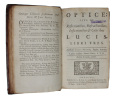
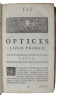
Scarce second Latin edition of Newton's ""Optics: or a Treatise of the Reflections, Refractions, Inflections, and Colours of Light. London 1704."", one of the great books in the history of science. ""Newton's Optics did for Light what his Principia had done for Gravitation, namely, placed it on a scientific basis."" (E.W. Brown). The translation was brought to light ""At the request of Newton, Dr. Samuel Clarke prepared a Latin edition of his Optics which appeared 1706, and he was generously presented by Sir Isaac with GBP 500, or GBP 100 for each of his five children, as a token of the appreciation and gratitude of the author. DeMoivre is said to have secured and taken charge of this translation, and to have spared neither time nor trouble in the task. Newton met him every evening at a coffe-house, and when they have finished their work he took De Moivre home with him to spend the evening in philosophical conversation.""(Brewster in his ""Newton"", 1855"").""In the accumulation of optical phenomena from his first paper (the short memoir in Philosophical Transaction, 1672) until the above book (the Optics,..) 33 years later, Newton had gathered explanations to many problems. The rainbow is fully explained and also ""Newton's rings"", produced by pressing the flat side of a plano-convex glass against a double convex lens of long focal lenght, producing rings of alternating brightness and darkness"" his explanation was not valid, as he did not know optical interference. He speculated on the double refraction of Icelandic spar...."" (Dibner in Heralds of Science No 148) - G.J. Gray No 180.
SUMO Helmut Newton, Celebrating 20 Years of Sumo. Auteur:
, Taschen Gmbh , 2025 Gebonden, in originele cellofaan verpakking, 464 pages, 43,4 x 31,9 x 11,1 cm . ISBN 9783836578196.
A tribute to one of the 20th century's most influential, intriguing and controversial photographers. SUMO established new standards for the art monograph genre, and secured a prominent place in photo-book history. This new edition, carefully revised by June Newton, is the fulfillment of an ambition conceived some years ago by Helmut Newton. He would surely be pleased that, a decade on from its first publication, SUMO now in a format that allows for a more democratic distribution?will reach the widest possible audience. However, proud owners of the new edition won?t wrestle with their copy of SUMO. It comes with a unique stand for displaying the book at home. SUMO was a titanic book in every respect: it broke records for weight, dimensions, and resale price. Helmut Newton (1920?2004) always demonstrated a healthy disdain for easy or predictable solutions. SUMO?a bold and unprecedented publishing venture?was an irresistible project. The idea of a spectacular compendium of images, a book with the dimensions of a private exhibition, reproduced to exceptional page size and to state-of-the-art origination and printing standards, emerged from an open, exploratory dialogue between photographer and publisher. With the physically commanding SUMO weighing in?boxed and shrink-wrapped?at 35.4 kilos, Newton created a landmark book that stood head and shoulders above anything previously attempted, both in terms of conceptual extravagance and technical specifications. Published in an edition of 10,000 signed and numbered copies, SUMO sold out soon after publication and quickly multiplied its value. This worldwide publishing sensation now features in numerous important collections around the world, including New York?s Museum of Modern Art. Legendary SUMO copy number one, autographed by over 100 of the book's featured celebrities, also broke the record for the most expensive book published in the 20th century,
Elemens de la philosophie de NEUTON mis à la portée de tout le monde -- EDITION ORIGINALE -- BON EXEMPLAIRE
Amsterdam, Ledet, 1738, un volume in 8 relié en plein veau glacé, dos orné de fers dorés, tranches rouges (reliure de l'époque), (habiles restaurations aux mors), 1 portrait de NEWTON, 1 portrait de VOLTAIRE, (1), 399pp., (1pp.), 6 planches hors texte, 1 tableau dépliant, nombreuses figures dans le texte
---- EDITION ORIGINALE ---- BON EXEMPLAIRE ---- "Voltaire' importance for the history of science lies particularly in his having composed a famous popularization of Newton, Eléments de la philosophie de Newton (1738), while collaborating with his companion and mistress, Emilie, Marquise Du Châtelet, on her translation of the Principia into french...". (DSB XIV pp. 83 et suivantes) ---- BABSON N° 120 : "From 1725 to 1728, Voltaire lived in exile in England and became a fervent admirer of the Newtonian philosophy which he introduced into France . He may have met Newton... In 1736, while a refugee in Holland, he sent the first chapters of his "Elémens" to the Amsterdam publisher, Ledet, but departed without supplying the rest of the manuscript. Finally 25 chapters were printed, with the additional phrase on the title "Mis à la portée de tout le monde". The text is preceded by a poem and dedication to Voltaire's mistress, the brilliant Marquise du Châtelet, who collaborated with him in the study of Newton" ---- Gray N° 39**7236/ARB5
Trois savants illustres : N. KOPERNIK, J. KEPLER, I. NEWTON. Leur vie et leurs oeuvres -- EDITION ORIGINALE (1883)
P., Librairie centrale des publications populaires, 1883, un volume in 8 relié en demi-basane rouge, dos orné de filets dorés (reliure de l'époque), (dos légèrement frotté), (2), 2pp., 341pp., 11 planches
---- EDITION ORIGINALE ---- Les époques de l'astronomie - Histoire sommaire de l'astronomie - Nicolas Kopernik : enfance et jeunesse, Kopernik devenu homme, luttes de Kopernik, travaux astronomiques, sur les révolutions des orbes célestes, les trois systèmes du mondes, derniers moments de Kopernik - Jean Képler : enfance et jeunesse, persécutions, exode, ses paralipomènes, astronomie nouvelle ou physique céleste, réforme du calendrier, les harmonies, les lois de Képler, étude sur les comètes, l'année terrible de Képler, épitome astronomiae Copernicum in septem libris conscripta, deuxième exode de Képler, Dernière phase de la vie de Képler - Isaac Newton : Enfance, adolescence, premières découvertes, la gravitation universelle, le calcul infinitésimal, la lumière, expériences sur la lumière, couleurs des corps, couleurs composées, l'arc-en-ciel, lames minces, phénomène des plaques épaisses, théories optiques, publication de l'optique, gravitation universelle, les contemporains de Newton, philosophie de Newton, liste des ouvrages de Newton - etc**6323/K4
Demonstration de Loix du Choc des Corps. (Piece qui a remporté le Prix de L'Academie Royale des Sciences, Proposé pour l'année mil sept cens vingt-quatre, selon Fonadation faite...).
Paris, Caude Jombert, 1724. 4to. Nice recent marbled boards in old style with titlelabel on frontcover. 24 pp. and one folded engraved plate. A few weak brownspots to margins. Otherwise fine and clean.
First edition of this extremely scarce work by the famous mathematician, solving an important problem in dynamics and extending Newton's work.""Despite the invention by Leibniz and Newton of the Calculus, the problem of mechanics of impact or percussion remained of centarl interest. The Royal Academy of Sciencesin Paris biannually qwarded a prize for the most outstanding paper"" in 1724 and 1726 the prizes were for papers on percussion. Colin Maclaurin, professor of mathematics at the University of Aberdeen, was awarded the prize in 1724 (forthe paper offered) over John Bernoulli...He expressed thet the interaction of forces on ciolliding bodies are equal in magnitude but opposed in direction (newton's third law) and used the physical construct of an elastic spring between the contact points in order to obtain changes in velocity during compression and restitution phases of collisions...""(W.J. Stronge in ""Impact Mechanics"").The Scottish mathematician Colin MacLaurin (1698-1746) is best known for developing and extending Newton's work in calculus, geometry and gravitation"" his 2-volume work ""Treatise of Fluxions"" (1742) was the first systematic exposition of Newton's methods. It is well known that MacLaurin was awarded prizes by the Royal Academy of Sciences, Paris, for his earlier work on the collision of bodies (the work offered here) and the tides (1740).
Élémens de la philosophie de Neuton, mis à la portée de tout le monde
Amsterdam, Jacques Desbordes, 1738, in-8, [2]-399-[1] pp. 9 pl, , Édition originale, à l'adresse de Jacques Desbordes. Elle est illustrée d'un portrait de Voltaire, d'un portrait allégorique de Newton, 6 planches gravées, un tableau dépliant et de nombreuses vignettes dans le texte ainsi que de jolis bandeaux et culs-de-lampe. Dans ses Élémens, dédicacés à la Marquise du Châtelet, qui partage avec Voltaire la gloire d'avoir introduit, en France, les idées scientifiques et philosophiques de Newton et à qui l'on doit la première édition française des Principia, Voltaire présente Newton comme le découvreur du vrai système du monde et le destructeur des erreurs du cartésianisme. Il s'engage personnellement pour la propagation de newtonisme, dont il fit la découverte pendant son exil en Angleterre entre 1725-1728 : pour Voltaire, l'empirisme de Newton, sa méthode expérimentale et son refus de tout dogme symbolise la victoire des Lumières sur la métaphysique chrétienne (Voir Norman). Manques et épidermures, pâles mouillures, quelques rousseurs et taches. Norman 2165 ; DSB XIV, pages 82-85; Babson, 120. Couverture rigide
Bon [2]-399-[1] pp. 9 pl
Helmut Newton BABY SUMO + Bookstand by Philippe Starck.
, Taschen, 2020 Hardcover, 35.8 x 50 cm, 9,80 kg (21.56 lb), 464 pages, with bookstand and pedestal, 74 cm (29.2 in.) (height of book on stand). English/DE/FR / Edition of 10,000 copies **new in original packaging unopened! Very Fine! ISBN 9783836582216.
Created on the occasion of Helmut Newton's 100th birthday and TASCHEN's 40th anniversary, we present BABY SUMO, the ultimate collectible! Published in a limited edition of 10,000 numbered copies, it is precisely half the size of the famous 1999 original. BABY SUMO comes with a stainless-steel bookstand designed by Philippe Starck, including a pedestal and a booklet documenting the making of this legendary publication. Collector's edition of 10,000 numbered copies with a bookstand by Philippe Starck
At the piano-Ivor Newton: The world of an Accompanist [Hardcover] Ivor Newton
RELIE BON ETAT SOUS JAQUETTE. ANGLAIS. 309 PAGES. 555GR. PHOTOS SUR DEMANDE. At the piano. Ivor Newton: The world of an accompanist , Newton, I. Hamish Hamilton, Relié, 1966
Merci de nous contacter à l'avance si vous souhaitez consulter une référence dans notre boutique à Authon-du-Perche.
Elémens (éléments) de la philosophie de Neuton (Newton), donnés par Mr. de Voltaire. Nouvelle édition
1738 Londres (Paris), sans nom d'éditeur, (Prault), 1738, in-8 de 1 portrait gravé de Voltaire en frontispice-(4) pp. (faux-titre et titre avec vignette gravée par Duflos)-(2) pp. d'avertissement des libraires-XVI pp. (pour les Eclaircissements nécessaires)-(4) pp. (pour la table des chapitres)- 326 pp. (paginé 3 à 328), (cf. Bengesco,Tome II, p. 29)-(12) pp. de table des matières, (sans page d'errata, ni le portrait de Newton), reliure de l'époque, de plein veau brun, dos à nerfs orné de fers dorés, pièce de titre de maroquin rouge, bon exemplaire.


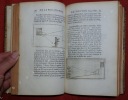
2e édition, celle-ci donnée par Voltaire lui-même, après que l'ouvrage ait été imprimé une 1re fois à Amsterdam la même année, par Desbordes sous les auspices de Ledet. Cette édition revue par l'auteur est augmentée d'un 26e chapitre sur les flux et reflux. Elle est illustrée de 6 planches gravées hors-texte, de nombreuses figures gravées sur cuivre dans le texte, et d'un tableau dépliant. Cet ouvrage essentiel, introduisit véritablement la pensée de Newton en France. Voltaire découvre Newton lors de son séjour en Angleterre entre 1727 et 1729. A Cirey, où il installe un laboratoire, il se consacre à la physique et y rédige cet ouvrage. L'édition originale, publiée par Ledet en association avec Jacques Desbordes, fut imprimée sans l’autorisation de l’auteur qui avait décidé d’abandonner le projet suite au rejet de privilège en janvier 1738 et après maintes tracasseries. L'ouvrage avait paru avant que Voltaire eût envoyé la fin du 23e chap. et le 24e, dont le texte, fut rédigé par un mathématicien resté anonyme. (Bengesco, 1570, Tome II, p. 29).
Elémens (élèments) de la philosophie de Neuton (Newton), donnés par Mr. de Voltaire. Nouvelle édition
1738 Londres (Paris), sans nom d'éditeur, (Prault), 1738, in-8 de (4) pp. (faux-titre et titre avec vignette gravée par Duflos)-XVI pp. (pour les Eclaircissements nécessaires)-(4) pp. (pour la table des chapitres)-(2) pp. d'avertissement des libraires - 326 pp. (paginé 3 à 328), (cf. Bengesco,Tome II, p. 29)-(12) pp. de table des matières, et 1 p. d'errata, portrait gravé de Voltaire, et portrait gravé de Newton par J. Dupin, reliure de l'époque, de plein veau fauve marbré, dos à nerfs orné de fers dorés, pièce de titre de maroquin fauve, ex libris manuscrit à l'encre brune en haut de la page de titre, quelques restaurations, bon exemplaire.

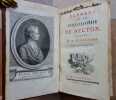
2e édition, celle-ci donnée par Voltaire lui-même, après que l'ouvrage ait été imprimé une 1re fois à Amsterdam la même année, par Desbordes sous les auspices de Ledet. Cette édition revue par l'auteur est augmentée d'un 26e chapitre sur les flux et reflux. Elle est illustrée de 6 planches gravées hors-texte, de nombreuses figures gravées sur cuivre dans le texte, et d'un tableau dépliant. Cet ouvrage essentiel, introduisit véritablement la pensée de Newton en France. Voltaire découvre Newton lors de son séjour en Angleterre entre 1727 et 1729. A Cirey, où il installe un laboratoire, il se consacre à la physique et y rédige cet ouvrage. L'édition originale, publiée par Ledet en association avec Jacques Desbordes, fut imprimée sans l’autorisation de l’auteur qui avait décidé d’abandonner le projet suite au rejet de privilège en janvier 1738 et après maintes tracasseries. L'ouvrage avait paru avant que Voltaire eût envoyé la fin du 23e chap. et le 24e, dont le texte, fut rédigé par un mathématicien resté anonyme. (Bengesco, 1570, Tome II, p. 29).
NUITS BLANCHES
Paris Filipacchi 1978 in 8 (27x20) 1 volume reliure toilée noire de l'éditeur sous jaquette illustrée en couleurs, 152 pages, avec de nombreuses photographies en couleurs et noir et blanc par Helmut Newton, cachet ex-libris. Bon exemplaire ( Photographies sur demande / We can send pictures of this book on simple request )
Bon Jaquette en très bon état Reliure d'origine
Art Styles of the Papuan Gulf
Newton, Douglas: Art Styles of the Papuan Gulf. New York: The Museum of Primative Art, 1961. Inscribed, 'Signed at the request of the Smithsons. Douglas Newton. by god.' 100 pages, with over 200 illustrations in black & white. Hard cover. 28.5 x 22.5cms. Douglas Newton was Curator of the Museum of Primative Art, New York. In this book he surveys the artistic achievements of the people of southern New Guinea.
Douglas Newton was Curator of the Museum of Primative Art, New York. In this book he surveys the artistic achievements of the people of southern New Guinea.
"CLAIRAUT, ALEXIS-CLAUDE. - CORRECTING NEWTON'S INVERSE SQUARE LAW.
Reference : 53475
(1746)
De L'orbite de la Lune dans le Systeme de M. Newton.
(Paris, L'Imprimerie Royale, 1746). 4to. Without wrappers. In ""Histoire de L'Academie Royale des Sciences. Année MDCCXLIII. Avec les Memoires de Mathematiques & de Physique, pour la même Année."" Pp. 17-32 and 3 folded engraved plates.
First printing of this controverial paper. ""In 1743 Clairaut read before the Academy a Paper entitled ""L’orbite de la lune dans le systeme de M. Newton,"" Newton was not fully aware of the movement of the moon’s apogee, and therefore the problem had to be reexamined in greater detail. However, Clairaut - and d’Alembert, and Euler, who were also working on this question - found only half of the observed movement in their calculations. It was then that Clairaut suggested completing Newton’s law of attraction by adding a term inversely proportional to the fourth power of the distance. This correction of the law elicited a spirited reaction from Buffon, who opposed this modification with metaphysical considerations on the simplicity of the laws of nature. Clairaut, more positive and more a pure mathematician, wanted to stick to calculations and observations. The controversy that arose between these two academicians appears in the Mémoires of the Academy for 1745 (published long afterward)."" (DSB).
Mrs. Newton.
Cologne, Taschen, 2004, gd. In-4, cartonnage éd., jaquette photo coul. éd., 256 pp., nb. Photos en coul. et en noir de l'auteur et de son mari Helmut Newton, Superbe livre des deux grands photographes June et Helmut Newton. Ce livre est une biographie "photographique" des lieux de vie, des amis et de la famille de l'auteur. En anglais, in english. Très bon état
LA CHRONOLOGIE DES ANCIENS ROYAUMES CORRIGÉE à laquelle on a joint une Chronique abrégée, qui contient ce qui s'est passé anciennement en Europe, jusqu'à la conquête de la Perse par Alexandre le Grand.
1728 Paris, Martin, Coignard, Guerin, Montalant, 1728. In-quarto (190 X 246 mm) veau fauve brun, dos cinq nerfs, caissons dorés ornés aux petits fers, pièce de titre maroquin grenat, large frise dorée en queue, tranches rouges (reliure de l'époque) ; (20) ff. de titre, préface, catalogue des oeuvres de Newton et avertissement de l'éditeur anglais, 416 pages, (2) ff. de table, approbation, privilège et errata. Ex-libris tampon encre bleue en queue du feuillet de titre : «De Cayrol », répété sur le premier feuillet blanc, avec sa signature autographe.
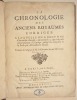
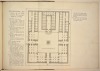
PREMIÈRE ÉDITION FRANCAISE de cette histoire des premières grandes civilisations, à savoir celles des Grecs, Egyptiens, Assyriens, Babyloniens, Mèdes et Perses. L'édition originale, posthume, a été publiée à Londres la même année, et traduite de l'anglais en français par François Granet et Marthan. COMPLET des TROIS PLANCHES dépliantes gravées sur cuivre, représentant des plans du Temple de Salomon. Composé par Isaac NEWTON (1643-1727) pour son propre délassement, ce système chronologique a été publié à son insu par un certain Abbé Conti, à qui Newton en avait confié une copie. Il se trouva ainsi obligé, contre son intention, d'en donner une édition plus fidèle, mais il ne put que la préparer, la mort le surprenant avant sa publication. Pierre Daunou (1761-1740) a donné dans la "Biographie Universelle" de Michaud une longue note érudite à propos de cet ouvrage, note qu'il conclut en ces termes : «En perdant sa base astronomique, le système chronologique de Newton ne repose plus que sur des considérations relatives à l'histoire, à la durée des générations et des règles, aux progrès des sociétés, des arts et de l'idolâtrie. Quelques graves que soient ces observations, et quelque incertitude qu'elles puissent répandre sur la chronologie vulgaire, elles ne suffisent point assurément pour en établir une nouvelle. Mais ce système est un très grand fait dans l'histoire de la science chronologique ; et il sert au moins à confirmer ce qu'à dit Varron, que l'âge historique ne commence qu'à la première olympiade » (Tome XXX, pages 397 à 400). Exemplaire de Louis-Nicolas-Jean-Joachim de CAYROL (1775-1859), député de 1820 à 1822, commissaire des guerres sous la Révolution, puis commissaire ordonnateur et sous-intendant militaire. Grand bibliophile, il fut l'ami de Gérard de Nerval. BEL EXEMPLAIRE, conservé dans sa reliure de l'époque. NICE COPY. PICTURES AND MORE DETAILS ON REQUEST.
Elemens de la philosophie de Neuton, mis à la portée de tout le monde
Amsterdam, Étienne Ledet & compagnie, 1738, in-8, [4]-XII-[2]-410-[6] pp.8 pl, Veau marbré havane, filet à froid en encadrement sur les plats, dos à nerfs orné de caissons dorés, tranches rouges, Édition originale de ce traité. Il est illustré de 8 planches hors-texte (dont un tableau des couleurs et des tons de la musique) et de nombreuses vignettes dans le texte ainsi que de jolis bandeaux et culs-de-lampe. Dans ses Élémens dédiés à la Marquise du Châtelet, qui partage avec Voltaire la gloire d'avoir introduit, en France, les idées scientifiques et philosophiques de Newton et à qui l'on doit la première édition française des Principia, Voltaire présente Newton comme le découvreur du vrai système du monde et le destructeur des erreurs du cartésianisme. Il s'engage personnellement pour la propagation de newtonisme, dont il fit la découverte pendant son exil en Angleterre entre 1725-1728 : pour Voltaire, l'empirisme de Newton, sa méthode expérimentale et son refus de tout dogme symbolise la victoire des Lumières sur la métaphysique chrétienne (Voir Norman). Complet du chapitre additionnel Du flux et reflux, l'Avertissement des libraires et des Éclaircissemens nécéssaires donnés par l'auteur pour servir de préface. Déchirure avec atteinte au f. R2 (sans dommage pour la lecture), petits manques et épidermures, restaurations à la reliure, dos gauchi, sans le portrait de Voltaire. Bel état intérieur. Norman, 2165 ; DSB XIV, pages 82-85; Babson, 120 Couverture rigide
Bon [4]-XII-[2]-410-[6] pp.8 pl.
?La Méthode des fluxions et des suites infinies
?Paris, Debure?, 1740, in-4, XXX-[2]-148-[2] pp, Veau havane marbrée, dos à nerfs orné de caissons dorés, pièce de titre rouge, tranches rouges, Édition originale de la traduction française par Buffon dont le nom n'est mentionné que dans les Extraits des registres de l'Académie royale des sciences, in fine. Elle est traduite sur la traduction anglaise de John Colson parue en 1736 (sans son commentaire), elle-même traduite sur l'édition originale en latin de Newton qui ne fut jamais publiée. Elle est illustrée de figures en noir dans le texte. Dans sa longue préface, il explique vouloir donner un "Newton clair, plus traitable, & à la portée du commun des géomètres", donne une courte notice historique des mathématiques pré-newtoniennes, critique sévèrement ses rivaux, notamment lorsqu'il évoque la controverse avec Liebniz et expose la méthode de calcul de Newton. Dans cet ouvrage le célèbre physicien anglais expose sa méthode de calcul infinitésimal dans sa première partie, lui donne une notation propre et propose ses applications dans la seconde. Bien que cet ouvrage fut relativement confidentiel lors de sa rédaction et sa première circulation via manuscrits, il est aujourd'hui reconnu comme fondamental dans l'histoire des mathématiques. Petits manques et épidermures, quelques taches. Complet de son errata. Gray, 236; Babson, 173. Couverture rigide
Bon XXX-[2]-148-[2] pp.
?Arithmetica universalis ; sive de Compositione et Resolutione arithmetica cum commentario Johannis Castillionei
?Amsterdam, Marc-Michel Rey, 1761, , 2 vol. in-4 : [6]-XVIII-310-[1] pp. 32 pl. + [4]-288-[2]-134-[1] pp. 5 pl, Demi-chagrin noir, filets dorés sur les plats, dos à nefs orné de caissons dorés, tranches marbrées, Édition commentée par Giovanni di Castillione qui fut lui-même éditeur d'ouvrages de Newton. Elle comporte également au second volume l'Additamentum vel de Solutione et constructione Aequationum, &c. d'Halley et 9 petits traités de Colson, Moivre, Halley (2), Folkes, Campbell, Baermanno, Kaestner et Boscovich. Elle est illustrée de 37 planches hors-texte. L'Arithmétique de Newton est le texte qui établit la réputation du physicien anglais. Elle contient ses cours d'algèbre professés à Cambridge entre 1673 et 1683. Newton parvint à déterminer des valeurs approchées des racines numériques et établit les fondements de la théorie des fonctions de ces racines. Babson, 205; Gray 281. Petits frottements et épidermures, rousseurs, petits manques angulaires sans atteinte à 4 pl. et restaurations angulaires sans atteinte à 9 pl. du 1er vol. Ex-libris René Mariaux. Couverture rigide
Bon 2 vol. in-4 :
Autoportrait
Robert Laffont 2004, in/8 broché, 300 pages, photographies en noir et blanc. Traduit de l'anglais par Anatole Muchnik.
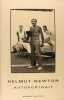
"Né Helmut Neustaedter dans une famille de la bonne bourgeoisie juive de Berlin, Helmut Newton est d'abord un enfant gâté qui se moque des études et ne s'intéresse qu'au sexe – pour lequel il manifeste un intérêt précoce. Quand, à l'âge de douze ans, on lui offre sa première caméra, c'est le coup de foudre pour un art qui fera de lui une célébrité mondiale. Sa vie fut mouvementée mais toujours tournée vers un seul but : devenir photographe. Fuyant l'Allemagne en 1938, il se retrouvera gigolo à Singapour, puis prisonnier et enfin soldat en Australie, où sa carrière artistique, intimement associée à l'image du magazine Vogue, prendra son envol après la guerre... On reconnaît entre mille autres une photographie de Helmut Newton. Son vocabulaire artistique si singulier a fait de lui l'inventeur d'un style. Un style dont il nous livre ici les clefs. Sulfureuse et provocatrice, l'œuvre de Newton restitue la beauté, l'humour, l'érotisme et parfois même la violence qu'il observe dans les univers qu'il fréquente : la mode, le luxe, l'argent, la célébrité."
Helmut Newton's illustrated. Pictures from an exhibition n° 2
S.l., éd. Schirmer-Mosel, 1987, Premier tirage, cartonnage souple, in-folio (39 x 30 cm), agrafé, papier fort, 28 pp., ill. par 32 photos en noir, Premier tirage de cet album de 32 photos noir et blanc principalement de nus féminins avec une maquette de Jane Newton alias Alice Springs. Pas courant Très bon état
Autoportrait
Paris, Robert Laffont, 2004, 15,5 x 24, 304 pages cousues sous couverture souple illustrée. Traduit de l'anglais (Etats-unis) par Anatole Muchnik. Photographies noir & blanc. "Il fut l'un des plus audacieux photographes du vingtième siècle, sans doute le seul à avoir connu un destin de star. Né Helmut Neustaedter dans une famille de la bonne bourgeoisie juive de Berlin, Helmut Newton est d'abord un enfant gâté qui se moque des études et ne s'intéresse qu'au … Il fut l'un des plus audacieux photographes du vingtième siècle, sans doute le seul à avoir connu un destin de star. Né Helmut Neustaedter dans une famille de la bonne bourgeoisie juive de Berlin, Helmut Newton est d'abord un enfant gâté qui se moque des études et ne s'intéresse qu'au sexe - pour lequel il manifeste un intérêt précoce. Quand, à l'âge de douze ans, on lui offre sa première caméra, c'est le coup de foudre pour un art qui fera de lui une célébrité mondiale. Sa vie fut mouvementée mais toujours tournée vers un seul but : devenir photographe. Fuyant l'Allemagne en 1938, il se retrouvera gigolo à Singapour, puis prisonnier et enfin soldat en Australie, où sa carrière artistique, intimement associée à l'image du magazine Vogue, prendra son envol après la guerre... On reconnaît entre mille autres une photographie de Helmut Newton. Son vocabulaire artistique si singulier a fait de lui l'inventeur d'un style. Un style dont il nous livre ici les clefs. Ce livre, richement illustré de photos de la collection d'Helmut Newton, est plus qu'un récit de souvenirs. C'est un véritable autoportrait, celui de l'artiste en éternel jeune chien."
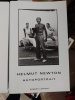

Choc angulaire en pied de dos & première de couverture.

