 Write to the booksellers
9 books for « michaelis johann davi... »Edit
Fragen an eine Gesellschaft Gelehrter Männer, die auf Befehl Ihro Majestät des Königes von Dännemark nach Arabien reisen. - [THE HANDBOOK OF NIEBUHR'S ARABIA-EXPEDITION]
Frankfurt am Mayn, Garbe, 1762. 8vo. Very nice contemporary full mottled calf with five raised bands to richly gilt spine. Titlelabel with gilt lettering. A bit of wear to spine, causing slight loss of leather and a neat restoration to lower compartment. A paperlabel pasted on top of spine. Small loss of leather to back board. A stamp on title-page (Holstein=Holsteinborg). (70), 397 pp., 4 folded tables, paginated 391-97. Internally clean, some quires printed on thick paper.
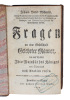
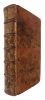
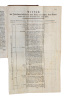
The rare first edition of the founding work of Niebuhr's Arabia-expedition, which would gain world-wide fame and establish the scientific description of the Arabian peninsula. The present work consists in 100 questions, the answers to which constitute the purpose of the Royal Danish Arabia Expedition. In fact, the present work is the handbook of Niebuhr's travel to Arabia Felix, as its author is the spiritual father of it. The work is extraordinary in many ways, and it not only served as the basis for the Arabia-expedition, it also constitutes a forerunner of modern bible science that would begin to emerge a few decades later. Johann Davis Michaelis (1717-19) was a theologian and orientalist, whose fame today rests upon the present work and upon the fact that he was responsible for the first scientific expedition to Arabia Felix, namely that of Niebuhr. In 1753, he had come up with the idea for the the Royal Danish Arabia Expedition (1761-1767) and had gotten the Danish minister Bernstoff to agree to it. In 1760, when the expedition was becoming a reality, Michaelis recommended Niebuhr as a participant, and he outlined the entire purpose of the trip - namaly the list of 100 questions that he prepared and published for the members of the expedition, in order for them to answer in the course of the voyage. For all intents and purposes, Michaelis was the spiritual father of the Arabia-expedition. As a theologian and an orientalist, many of Michaelis' questions have root in the Bible. But unlike many other theolgians of the time, Michaelis sought to shed light over biblical themes through sources outside of the Bible - especially from the Middle East, not least Arabia. In this regard, his 100 Questions also came to be a precursor to the emergence of modern bible science.Although the expedition would have never taken place had it not been for Michaelis and his 100 questions - many of which are also purely naturalistic - he could not quite have foreseen the scientific outcome of the expedition. He had not foreseen that Niebuhr would become the founder of the scientific description of the Arabian peninsula and that Niebuhr's notes would become the basis for the first decipherment of Mesopotamian and Persian cuneiform. On the contrary, he was probably quite disappointed that his questions were not all answered as thoroughly as the had anticipated. Adding to that, Niebuhr's answer to the questions ""only"" takes up six pages in the preface to ""Description of Arabia"", although the text itself contains many detailed explanations and answers to Michaelis' questions.

Abhandlung von der syrischen Sprache und ihrem Gebrauch. nebst dem ersten Theil.
Göttingen, Johann Albrecht Barmeier, 1768. 8vo. 2 volumes bound in one modest marbled paper covered cardboard binding. Wear to extremities, internally fine and clean. 112 118 pp.
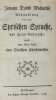
First edition of Michaelis work on the Syriac language. Johann Davis Michaelis (1717-19) was a theologian and orientalist, whose fame today rests upon the present work and upon the fact that he was responsible for the first scientific expedition to Arabia Felix, namely that of Niebuhr. As a theologian and an orientalist, many of Michaelis' questions have root in the Bible. But unlike many other theolgians of the time, Michaelis sought to shed light over biblical themes through sources outside of the Bible - especially from the Middle East, not least Arabia.
Syntagma Commentationum (pars prima - pars secunda) [2 parts]
Goettingae [Göttingen], Apud viduam Abrami Vandenhoeckii [Vandenhoeck] 1759-1767 2 parts in 1 physical volume, [2],236 + [2],293 pp., 22cm., contemporary full vellum binding (intact, with contemporary handwritten title on spine), paper somewhat browned (text always well readable though), text in Latin, with tipped-in heraldic ex-libris from Alfred Ollivant D.D. and from "Eccl. Cath. Landaven: Liber Familie Sancti Teiliavi", good condition, [Johann David Michaelis, 1717-1791, was a German (Prussian) biblical scholar with an emphasis on Hebrew matters, professor at the University of Göttingen (1745-1791). This work includes 23 articles, a.o.: Commentatio de battologia ad Matth. VI-7, Paralipomena contra polygamiam, Secunda contra polygamiam paralipomena, Lex Mosaica Deut. XXII,6.7 ex historia naturali et moribus Aegyptiorum illustrata, etc.], R108152
Spicilegium Geographiae Hebraeorum Exterea Post Bochartum. 2 vols.
Gottingen, Vandenhoeck, 1769-1780. 4to. Bound in two uneven half calf bindings. Bindings with wear. Ex-libris pasted on to verso of front boards and previous owner's names to front free end-papers. Title-page in vol. 1 with repair in lower outer corner, not affecting text. Brownspotted throughout. XVI, 308 pp. (2), 218 pp.
First edition of this important work which became highly influential in seventeenth-century Biblical exegesi. Johann Davis Michaelis (1717-19) was a theologian and orientalist, whose fame today rests upon the present work and upon the fact that he was responsible for the first scientific expedition to Arabia Felix, namely that of Niebuhr.
[Chez S. J. Baalde, Chez J. van Schoonhoven & Comp] - MICHAELIS, Johann David
Reference : 59261
(1774)
Recueil de questions, proposées à un société de savants, qui par ordre de Sa Majesté Danoise font le Voyage de l'Arabie
1 vol. in-4 reliure arabisante milieu XXe siècle plein chagrin vert, dos à 4 nerfs orné, plats ornés de dorures dans le type islamique, Chez S. J. Baalde, A Amsterdam, Chez J. van Schoonhoven & Comp., Utrecht, 1774, 2 ff., XLIV-256 pp., 8 ff. (Essai de Tables chronologiques), 38 pp. (Extrait de la Description de l'Arabie par Niebuhr).
Important manque de texte au douzième feuillet (pp. XIX-XX de la préface), bel exemplaire par ailleurs (ancien ex-libris d'un collège anglais avec son cachet d'annulation, qq. rouss.). Prix en l'état pour cette première édition française. L'ouvrage complète le récit de Niebuhr intitulé "Description de l'Arabie", publié chez la même année chez le même éditeur. Grand savant hébraïsant et orientaliste, Johann Michaelis (1717-1791) fut l'inspirateur de la grande expédition danoise en Arabie (1761-1767) dirigée par Carsten Niebuhr et Peter Forsskal.
Dissertation qui a remporté le prix proposé par l'Académie royale des sciences et belles lettres de Prusse, sur l'influence réciproque du langage sur les opinions, et des opinions sur le langage : avec les pièces qui ont concouru
Berlin, Chez Haude et Spener, 1760, in-4 (23x18cm), basane (19ème), dos à nerfs muet, doubles filets aux plats, armoiries au centre, ex-libris en page de garde. Frottements, coins usés, petit début de fente, rousseurs. De la bibliothèque de Joaquin Gomez de la Cortina, marquis de Morante, avec ses armes aux plats et ex-libris. Joaquin Gomez de la Cortina fut l’un des plus grands bibliophiles espagnols du 19ème siècle, il meurt écrasé par ses livres.
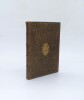
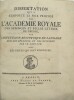
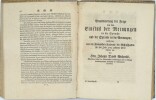
L'ouvrage réunit un précis du concours par Mérian, deux dissertations en français (la dissertation primée et un discours sur la question posée par l'Académie), puis leur traduction allemande en deux parties. En 1759, l'Académie royale des sciences et belles-lettres de Prusse lance un concours sur une question devenue célèbre : dans quelle mesure les opinions d'un peuple influencent sa langue, et réciproquement. Le prix est attribué à Johann David Michaelis (1717-1791), professeur à Göttingen, pour son mémoire en allemand ; l'Académie publie un recueil réunissant ce texte primé, un résumé français de Mérian, et les pièces concurrentes non retenues. L'ouvrage s'inscrit dans le grand débat du siècle sur le rapport entre langage et pensée (Condillac, Rousseau, Maupertuis) et popularise en Allemagne la notion de « génie de la langue ». Traduit intégralement en anglais en 1771 (la traduction française complète du texte allemand de Michaelis ne paraîtra séparément qu'en 1762, à Brême), il est aujourd'hui considéré comme un texte fondateur de la réflexion sur le relativisme linguistique, annonçant les débats ultérieurs de Herder et Humboldt. M3-Et1
Mosaisches Recht. 1,-6 Theil (alles).
Frankfurt am Main. Johann Gottlieb Garbe, 1770-75. 8vo. Bound in 2 fine contemp. full vellum. handwritten titles on spines. Clean and fine.
First edition of this hugely influential exposition and commentary to the laws of the ""Pentateuch"" and Moses.
Abhandlung von der Syrischen Sprache, und ihrem Gebrauch: nebst dem ersten Theil einer Syrischen Chrestomathie.
Wittwe Vandenhoeck Göttingen 1772 2 parties reliées en 1 volume in-12 ( 180 X 110 mm ) de 112 et 118 pages, cartonnage de papier granité , dos lisse janséniste. Reliure frottée, bon exemplaire.
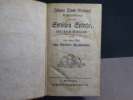
[JUDAÏCA] L'Esprit des loix mosaïques
Frères Labottière | Bordeaux 1785 | 12.5 x 19.5 cm | Relié
Édition originale de cette adaptation française très abrégée du Mosaisches Recht de Johann David Michaelis, publiée à Bordeaux en 1785 sous le nom de M. Senger. In-4 ; xij pp., 2 ff. n. ch. d'avertissement et de table, 270 pp., un f. n. ch. de privilège. Reliure en pleine basane fauve écaille de l'époque, dos lisse orné de caissons richement décorés de fleurons dorés, pièce de titre de basane vert sombre, roulettes dorées sur les coiffes, triple filet doré encadrant les plats, gardes et contreplats de papier à la cuve, tranches mouchetées. Restaurations au dos et aux mors, agréable état intérieur. Publié à Francfort-sur-le-Main chez Johann Gottlieb Garbe en six parties successives de 1770 à 1775, le Mosaisches Recht constitue l'une des entreprises majeures de Johann David Michaelis (1717-1791), orientaliste, hébraïsant et professeur à Göttingen. Le présent volume n'en retient qu'une fraction, réorganisée et condensée pour le public français par celui qui se présente sur la page de titre sous le nom de M. Senger, dont l'identité n'a pu être établie. * Michaelis entreprend d'examiner la législation attribuée à Moïse en recherchant moins son commentaire théologique que les raisons historiques de ses prescriptions. Sa méthode doit beaucoup à Montesquieu : les lois sont rapportées au climat, au territoire, aux usages, à l'économie et à l'organisation sociale du peuple pour lequel elles furent établies. Appliqué au Pentateuque, le principe de L'Esprit des lois transforme ainsi un corpus sacré en objet d'enquête historique et politique, dont il s'agit de restituer la rationalité dans les circonstances particulières de l'ancien Israël. La transformation française du texte prend un relief singulier dès ses premières pages. Le volume s'ouvre en effet sur une dédicace « À la Nation Juive », formule dont la présence dans un ouvrage imprimé à Bordeaux en 1785 ne pouvait être tout à fait indifférente. La ville abritait alors une importante communauté séfarade d'origine espagnole et portugaise, fortement implantée dans le négoce et organisée sous la désignation de « Nation Juive Portugaise ». Rien ne permet d'affirmer que la dédicace lui était expressément destinée ; sa formulation rencontrait néanmoins à Bordeaux une réalité sociale et institutionnelle immédiate. Elle produit surtout un contraste remarquable avec les positions prises quelques années auparavant par Michaelis lui-même. Lorsque Christian Wilhelm von Dohm publie en 1781 son Über die bürgerliche Verbesserung der Juden, plaidoyer en faveur d'une amélioration de la condition civile des Juifs, Michaelis lui répond l'année suivante par une longue critique. S'il avait consacré une part considérable de son uvre à la langue, à l'histoire et aux institutions hébraïques, le savant de Göttingen demeurait hostile à plusieurs des conséquences politiques que Dohm tirait des principes de tolérance des Lumières. Entre l'original allemand et cette édition bordelaise s'opère ainsi plus qu'une simple réduction. Nourrie de Montesquieu, l'analyse historique des lois de Moïse par Michaelis se trouve condensée, traduite et placée sous une adresse « À la Nation Juive » dans l'un des principaux centres du judaïsme séfarade français. Cette première adaptation française conserve ainsi la trace d'un déplacement intellectuel particulièrement révélateur, de Göttingen au Bordeaux des Lumières. - Photographies et détails sur www.Edition-Originale.com -


