 Write to the booksellers
9 books for « john first »Edit
-
Century
18th (2)
19th (2)
-
Topics
Chemistry (2)
Fox (1)
Holland (1)
Orchestra (3)
Tea (2)
Travel (1)
-
Countries
Belgium (1)
Denmark (2)
France (6)
-
Syndicate
ILAB (8)
SLAM (6)
DISQUE VINYLE 33T 12 SUPER HITS VOL56. CONFIDENCES POUR CONFIDENCES / JE T'AI AIME / I'VE SEEN THAT FACE BEFORE / QUELQUES MOTS POUR ANNA / PRESENTS ARMS / MADEMOISELLE CHANG / ROSES DE PICARDIE / MONA LISA / FIDELE / KIDS IN AMERICA .....
LES TRETEAUX. non daté. In-12. Broché. Bon état, Couv. convenable, Dos satisfaisant, Intérieur frais. Photode M. LAGUENS sur la couverture.. . . . Classification : 410-33 Tours

Classification : 410-33 Tours


DISQUE VINYLE 33T MEDITERANEENNE, LET'S DANCE, TWISTER MA PEINE, MORNIN', D'AMOUR OU D'AMITIE, LOVE IS A STRA?GER, ADIOS AMOR, BEAT IT, MADAME, TOO SHY, SAVE YOUR LOVE, EVERY BREATH YOU TAKE.
LES TRETEAUX INTERNATIONAL. non daté. In-12. Broché. Bon état, Couv. convenable, Dos satisfaisant, Intérieur frais. Pochette en couleurs, plusieurs petit textes encadré dans un meme carré dérrière la pochette.. . . . Classification : 410-33 Tours
Disque n° 6516 Classification : 410-33 Tours
DISQUE VINYLE 33T CHACUN FAIT C'QUI LUI PLAIT, COUP DE FOLIE, HENRI PORTE DES LILAS, LET'S GROOVE, WORDY RAPPINGHOOD, TOUT POUR LA MUSIQUE, ON MY OWN, IL EST LIBRE MAX, ARTHUR'S THEME, LE SAMPA, LA DANSE DES PETITS CHATS, DALLAS VILLE MIRAGE......
LES TRETEAUX INTERNATIONAL. non daté. In-12. Broché. Bon état, Couv. convenable, Dos satisfaisant, Intérieur frais. Pochette en couleurs, 13 super Hits.. . . . Classification : 410-33 Tours
Disque n° 6496 Classification : 410-33 Tours
disque vinyle 33t - Hit télé parade enfants
Les tréteaux international. Non daté. In-12. Broché. Bon état, Couv. convenable, Dos satisfaisant, Intérieur frais. disque vinyle 33t - pochette en couleurs - étiquette sur le 2eme plat. . . . Classification : 410-33 Tours
6495 // Ulysse - Capitaine Flam - Maya l'abeille - Spiderman - Les peaux rouges heureux - L'île aux enfants -... Classification : 410-33 Tours
SHEFFIELD John , first Duke of Buckingham and Normandy - George Vertue (engraver) after Sir Godfrey Kneller :
Reference : 34321
Portrait engraving of John Sheffield. ''His Grace John Duke of Buckingham''.
0. S.l. 1722., original dated engraved portrait of John Sheffield, 222 x 155 mm, with engraved caption and coat of arms underneath, mounted on a large thick 19th century paper leaf. (see NPG D20436)..
"DRAPER, (JOHN) WILLIAM. - THE FIRST DAGUERREOTYPE PORTRAIT.
Reference : 46912
(1840)
On the Process of Daguerreotype, and its application to taking Portraits from the Life.
London, Richard and John Taylor, 1840. Contemp. hcalf. A nic to spine at upper hinge. Hinges weakening (not loose). Gilt lettering to spine ""Philosophical Magazine"" - Vol.XVII. In: ""The London, Edinburgh, and Dublin Philosophical Magazine and Journal of Science. Conducted by David Brewster et al."". Vol. XVII. A stamp to titlepage and a few other pages. Entire volume offered. VIII,552 pp. Draper'spaper: pp. 217-225.
First printing of the famous paper in which Draper relates how he was able to made the first photographic portrait on a daguerreotype plate, giving an ennormously long exposure. The subject of the portrait, Draper's assistant, powdered his face with flour and sat in front of the camera for a half hour facing the sunlight.Draper stated that it is possible to make portraits in full sunlight, using mirrors as light reflectors. ""But in the reflected sunshine, the eye cannot support the effulgence of the rays. It is therefore necessary to pass them through some blue medium, which shall abstract from them their heat and take away their offensive brilliancy. Ihave used for this purpose blue glass, and also ammoniaco-sulphate of copper, contained in a large trough of plate glass, the interstice being about an inch thick."" (p. 217 in the paper offerd).""Draper first achieved wide celebrity for his pioneering work in photography. As early as 1837, while still in Virginia, he had followed the example of Wedgwood and Davy in making temporary copies of objects by the action of light on sensitized surfaces. When the details of Daguerre’s process for fixing camera images were published in various New York newspapers on 20 September 1839, Draper was ready for the greatest remaining challenge, to take a photographic portrait. A New York mechanic, Alexander S. Wolcott, apparently won the race by 7 October. But if Draper knew of this, he persisted in his own experiments and succeeded in taking a portrait not later than December 1839. His communication to the Philosophical Magazine, dated 31 March 1840, was the first report received in Europe of any photographer’s success in portraiture. The superb likeness of his sister Dorothy Catharine, taken not later than July 1840, with an exposure of sixty-five seconds, seems to be the oldest surviving photographic portrait.""(DSB).The volume contains also Michael Faraday's importent letter to Gay-Lussac on induction in the first English version. ""On Magneto-electric induction."", pp. 281-89 a. pp.356-366. (Originally published in French in ""Annales de Chimie et Physique"" in 1832.
"DALTON, JOHN. - THE FIRST PAPER ON MODERN ATOMIC THEORY - GERMAN EDITION.
Reference : 43629
(1808)
Ueber die Absorption der Gasarten durch Wasser und andere tropfbare Flüssigkeiten. Frei bearbeitet von Gilbert. Mit einigen Zusätzen.
(Halle, Rengerschen Buchhandlung, 1808). Without wrappers as published in ""Annalen der Physik. Herausgegeben von Ludwig Wilhelm Gilbert"", Bd. 28, Viertes Stück. The entire issue offered (=Heft 4). Titlepage to vol. 28 (small stamps on verso). Pp. 377-496 a. 3 engraved plates. Dalton's paper: pp. 397-416 a. 1 engraved plate showing apparatus.
First appearence i German of Dalton's epoch-making paper in which is contained THE FIRST CLEAR STATEMENT OF MODERN ATOMIC THEORY and having the FIRST LIST OF ATOMIC WEIGHTS ""Verhältniss der Gewichte der kleinsten Theilschen von gasförmigen und andern Körpern."" (Table of the relative weights of the ultimate particles of gaseous and other bodies). The paper offered is a free translation of Dalton's paper ""On the Absorption of Gases by Water and Other Liquids"", published 1805 in ""Memoirs of the Literary and Philosophical Society of Manchester"".""The paper was read to the Manchester Philosophical Society by Dalton in 1803 and printed in 1805. The appended table in this paper is the first list of atomic weights. Dalton, in this publication, took the law which William henry had recently enunciated (that the amount of of gas absorbed by a liquid is proportional to the pressure) and extended it to apply to mixtures of gases, using his own law of partial pressures."" (Leicester & Klicktein ""A Source Book in Chemistry"", p. 258).Parkinson ""Breakthroughs"", 1803 C.- Smyth No. 38.
CANDID REFLECTIONS ON THE REPORT (AS PUBLISHED BY AUTHORITY) OF THE GENERAL-OFFICERS Appointed by his MAJESTY'S Warrant of the First of November last, to enquire into the CAUSES of the FAILURE of the late expedition to the coasts of FRANCE. In a LETTER to a FRIEND in the Country.------Non, fi quid turbida Roma Elevet, accedas, examenve improbum in illa.
London, printed for S. Hooper and A. Morley at Gay's Head, near Beaufort-Building, MDCCLVIII [1758]. 1758 1 vol in-8° (197 x 125 mm) de: 26 pp. (rogné court en marge inférieure avec petite petite atteinte texte). Broché, couverture de papier ancien muette.
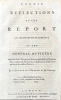
Rare édition originale de ce rapport sur le raid britannique avorté sur Rochefort, au début de la guerre de sept ans (1756-1763). Le présent mémoire relate les détails de cette vaine tentative. En 1756, le nouveau leader de la Chambre des communes, William Pitt, dit lancien (1708-1778) , fonde le concept de « Naval Descents », qui prévoit des débarquements de troupes sur la côte française. En septembre 1757, le général John Mordaunt (1697-1780), responsable de lentrainement des troupes anglaises, a pour ordres dattaquer et prendre le port de Rochefort, le grand arsenal français en Charente. La flotte est commandée par Sir Edward Hawke et Sir Charles Knowles. Lexpédition comporte 31 vaisseaux de guerre, 49 bâtiments de transports pour véhiculer 10 bataillons. Mordaunt est assez dubitatif sur cette idée et craint que les renseignements disponibles (qui datent de 1754) ne soient obsolètes. Cependant, le projet est poussé à William Pitt et Mordaunt ne peut quobéir. La flotte part dAngleterre le 6 septembre 1757 et capture lÎle-d'Aix le 21 septembre. Cependant, comme craint, la défense de Rochefort est plus élaborée et des bancs de sable rendent nécessaire un débarquement par barque sur les 2 derniers kilomètres. Devant ces difficultés, Mordaunt et ses collégues décident dannuler lattaque le 25 septembre. Cependant, le 28 septembre, un deuxième conseil de guerre décide de tenter un débarquement de nuit sur les forts gardant lembouchure de la Charente, Mordaunt devant diriger personnellement les premiers assauts. Malheureusement, un fort vent empêche ce plan daboutir et Hawke décide de rentrer en Angleterre. Mordaunt na dautre choix que de rembarquer. Furieux de léchec de cette expédition, William Pitt, avec lappui du roi George II, forme une commission denquête afin de trouver des responsables. Cette commission conclut que lexpédition aurait dû être menée à son terme et que les défenses de Rochefort nétaient en aucun cas imprenables. En conséquence, Mordaunt, est jugé en cour martiale en décembre 1757. Acquitté de laccusation de désobéissance, il est néanmoins relevé de son commandement et Pitt lancera une autre tentative lannée suivante : le 3 septembre 1758, une flotte d'une centaine de navires avec à son bord Édouard de Grande-Bretagne (1739-1767), débarque à Saint-Briac sur Mer 10 000 hommes commandés par le général Bligh, avec lobjectif d'attaquer Saint-Malo. Mais un vent de noroît les prive du soutien de leur flotte, qui doit se réfugier à l'abri de la pointe de la presque-Isle de Saint-Cast, et le 11 septembre, la fameuse « Bataille de St Cast » laisse sur le terrain quelque 2 000 morts britanniques et environ 740 prisonniers ! Bel exemplaire, frais.
Observations sur le Commerce des États Américains, par le Lord Sheffield.
Rouen, Imprimerie de la Dame Besogne, 1789. 1789 1 vol. in-4° (300 x 228 mm) of: vi, (7)-228 p., 16 tables as follows: I-II 1 folding l. each, III: 5 pp. and 2 fold. ll., IV-VII: 1 folding l. each, VIII: 1 l., IX: 24 p., X: 1 fold. l., XI: 1 l., XII-XVI: 1 p. each, pp. [231]-238. Original plain boards, uncut.
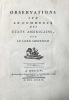
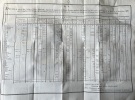
Une comparaison statistique détaillée entre les importations et les exportations de la Grande-Bretagne et des États-Unis entre 1700 et 1783. Holroyd a continuellement révisé et élargi son texte à travers un certain nombre d'éditions anglaises. Il mentionne l'importance croissante du commerce avec les Antilles et le Canada, notamment Terre-Neuve et la Nouvelle-Écosse, leurs pêcheries, leur bois d'uvre et leur construction navale. Les tableaux comparent les exportations et importations du commerce entre les États-Unis et dautres pays. Cette première traduction de l'anglais fut de Rumare, magistrat de Rouen. La traduction ultérieure de Mirabeau ne comprenait pas les tableaux statistiques. Sabin 32638 mentionne une édition de Londres et une édition de Rouen de 237 p. Howes (Hartley) H604 note que l'ouvrage « a souligné avec mépris la position impuissante du commerce américain et a ainsi influencé l'élaboration de la politique commerciale de l'Angleterre de 1783 à 1789, si préjudiciable au commerce et aux intérêts maritimes américains qu'elle a grandement contribué à la formation d'un LUnion fédérale est mieux à même que les États fédérés séparés de riposter contre la puissance maritime britannique. Provenance : bibliothèque privée au dos, ex-libris d'Alberto Parreño. 1 vol. in-4° of: vi, (7)-228 p., 16 tables as follows: I-II 1 folding l. each, III: 5 pp. and 2 fold. ll., IV-VII: 1 folding l. each, VIII: 1 l., IX: 24 p., X: 1 fold. l., XI: 1 l., XII-XVI: 1 p. each, pp. [231]-238. Original plain boards, uncut. First French edition. A detailed statistical comparison between the imports and exports of Great Britain and the United States between 1700 to 1783. Holroyd continually revised and enlarged his text through a number of English editions. He mentions the growing importance of trade with the West Indies and Canada, especially Newfoundland and Nova Scotia, their fisheries, lumber, and shipbuilding. The tables compare the export and import of trade between the United States and other countries. This first translation from the English was by de Rumare, a magistrate of Rouen. Mirabeaus later translation did not include the statistical tables. Sabin 32638 mentions a London and a Rouen edition of 237 p. Howes (Hartley) H604 notes the work Pointed out superciliously the helpless position of American commerce, and thus influenced the shaping of Englands trade policy from 1783 to 1789, so detrimental to American commerce and shipping interests as to contribute greatly to the formation of a Federal union, better able, than were the separate federated states, to retaliate against British maritime might. Provenance: remnants of private library numbers on spine, bookplate of Alberto Parreño.

