 Write to the booksellers
12 books for « isocrates »Edit
-
Language
French (11)
Greek (1)
-
Century
17th (1)
19th (1)
20th (1)
-
Topics
Greek (7)
Latin (6)
-
Countries
Belgium (2)
France (3)
Netherlands (7)
-
Syndicate
ILAB (1)
SLAM (1)
The orations of Lysias and Isocrates, translated from the Greek; with some account of their lives; and a discourse on the history, manners, and character of the Greeks, from the conclusion of the Peloponnesian war, to the battle of Chaeronea, by John Gillies, LL.D.
London, Edinburgh, Printed for J. Murray, and J. Bell, 1778.
4to. (XXXVI),CXXXV,(1 blank),498,(1 errata)(1 blank) p.; a portrait of Lysias & of Isocrates. Calf 28 cm (Ref: ESTC Citation No. T106138; Hoffmann 2,490 & 2,575: 'eine gute Übersetzung'; Ebert 10628 & 12573; Moss 2,119: 'faithful and masterly'; Brunet 3,1258: 'Traduction fidèle, et comme telle fort estimée; Graesse 4,315; Ebert 12573; Dict. of British Classicists 2,370/2) (Details: Back ruled gilt and with 5 raised bands. Red morocco shield with gold lettering in the second compartment. Small and fading gilt coat of arms on the boards, within a surrounding banner, on which: 'The Society of writers to the Signet'. (This is a society of Scottish lawyers) Wide margins. Both engravings were made 'ex marmore antiquo in Museo Capitolino'. Edges dyed red) (Condition: Binding scuffed & scratched. Extremities chafed, corners bumped. Joints split but strong. Front hinge cracking. Some insignificant foxing. Old ink inscription on the title reading: 'The Society of Clerks to the Signet') (Note: The speeches of the Athenian orators Lysias (c. 459-380 B.C.) and Isocrates (436-338 B.C.) are of great importance for the understanding of the great political issues of the 4th century. Their speeches provide us with a most valuable insight in, and commentary on the social and political events in Athens. 'Taken separately, their writings are imperfect; when combined, they afford a system of information equally extensive and satisfactory'. (Preface p. pi3 recto). The English translation of 18 speeches of Lysias and 6 of Isocrates by the Scottish classical scholar and ancient historian John Gillies, 1747-1836, is mentioned one of his major contributions to classical scholarship. 'In the long preliminary discourse on the history and private lives and manners of the Greeks during the period 404 to 338 B.C., Gillies specifically adopted Isocrates as his source, partly no doubt because it suited his own strongly monarchist views to do so'. (DBC 2,371) During the conference 'Revolutions and Classics' of the UCL, held in 2016, where scholars examined the manner in which classical texts have been deployed in societies undergoing rapid and radical social change, it was argued by the young independent scholar Sebastian Robins, that it was Gillies' intention to make available to his contemporaries classical texts that he believed bore immediately on the most pressing political questions of the day: the American Revolutionary War, a war which had just begun. This armed conflict between Great Britain and its 13 North American colonies raged from 1775 till 1783, during which the colonies declared in July 1776 independence as the United States of America. The authority of the two Athenian orators, Robins says, overrules and rectifies that of the contemporary Athenian orator Demosthenes, and that of the late antique historian/philosopher Plutarch and others 'on the basis of which some of the most ingenious eighteenth-century writers had raised flattering accounts of Greek virtue and glory. Their speeches, moreover, contain compelling evidence of the violence, prejudice, and corruption of the ancient Greeks and of the shortcomings of ancient republican institutions. Champions of the nascent American republic on both sides of the Atlantic, Gillies declares', ought, on the authority of the speeches he translates, to reassess their faith in the relationship between democracy and virtue, which he assumed, underpinned the Congressional declarion (of 1776). Gillies is best known for his 'History of Ancient Greece' (1786), the first substantial complete survey in English of the whole Greek history to the time of August. It became popular, and was quickly translated into German and French) (Provenance: Stamp of the Scottish 'Society of the writers to the Signet' on the boards) (Collation: pi4, A-C4, D2, a-3r4; B-3R4, 3S2 (portrait after leaf L1 and T3) (Photographs on request) (Heavy book, may require extra shipping costs)
Isocrates' Trapeziticus. Vertaald en toegelicht.
Utrecht, Nijmegen, Dekker & v.d. Vegt, 1933.
255 p. Wrs. 24 cm (Diss.)(Used, cover shabby)
Plutarchi Chaeronensis peri PAIDÔN AGÔGÊS, seu De puerorum educatione libellus. Analysi grammatica, interpretatione simplici ad textum graecum & paraphrasi perspicua ad modum Iohannis Minellii, illustratus studio M. Christiani Iunckeri, Dresd. Ill. Gymnas. Sax. Henneb. quod Schleusingae est, Conr. (Bound with:) Isocratis Attici rhetoris Orationes tres. I. ad Demonicum. II. ad Nicoclem. III. quae inscribitur Nicocles. Analysi grammatica, interpretatione simplici ad textum graecum & paraphrasi perspicua ad modum Iohannis Minellii, illustratae studio M. Christiani Iunckeri, Dresd. Ill. Gymnas. Sax. Henneb. quod Schleusingae est, Conr.
Leipzig (Lipsiae), Apud Maurit. Georg. Weidmannum, 1719.
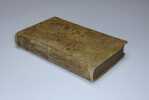
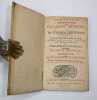
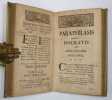
8vo. Two parts in 1 volume: (XIV),381,(3, stocklist) p. Vellum 17 cm (Ref: VD18 10402462; Ad 1: Hoffmann 3,185; Ad 2: Hoffmann 2,478) (Details: Two title-pages, both printed in red & black. On the left pages, printed in two columns, the Greek text and a parallel literal word for word translation into Latin; on the right page a polished translation, on the lower half of the right pages notes in Latin) (Condition: Vellum soiled and spotted. Paper foxed and browning) (Note: The Greek philosopher, historian and educator Plutarchus of Chaeroneia was born before 50 A.D. and died after A.D. 120. He is our most important witness of the spiritual climate of the first and second century A.D. He wrote numerous short treatises of popular moral philosophy, which go under the general name of Moralia. They include debating themes, works in the form of question and answer, and serious discussions of philosophical topics. 'It is no exaggeration to say that Renaissance and early modern Europe discovered Greece and Rome through Plutarch's eyes'. (The Classical Tradition, Cambr. Mass., 2010, p. 748) The treatise 'de puerorum educatione' is the first treatise of the 'Moralia' (No. 1, 1a-14c). Since Wyttenbach's 'Moralia' edition (1795-1810, Animadvers. I, 29-156) it is generally assumed, on stylistic and grammatical grounds, that this treatise cannot have been written by Plutarchus. Therefore it is very remarkable that a not genuine essay has such a strong influence on European intellectual and cultural life. 'The essay, however, is interesting in itself, since it reflect in many ways the educational conditions of its time. Frankly recognizing the difference in natural endowments, the author insists on the great benefits which inevitably come from training. Physical training is of course required, and military training is held to be most important for preparing men to win in battle. A knowledge of philosophy is the final goal of education'. (Plutarch, 'Moralia', with English translation by F.C. Babbitt, LCL 197, p. 3) In the first half of the 18th century alone German scholars published editions in 1705, 1719, 1738, 1744, 1745, 1749, 1750. In 1738 and 1754 German translations appeared. There was evidently much demand for Plutarchus' treatise on the education of children in Germany in the 18th century. The German historian and schoolmaster Christian Juncker, born 1668, became Conrector in 1695 of the 'Hennebergisches Gymnasium Schleusingen'. In 1713 he was appointed Rector of the Gymnasium of Altenburg, where he died in 1714. Juncker produced for the Leipzig publisher Weidmann a whole series of Latin school editions in the same manner as this Plutarch/ Isocrates edition, of Sallustius, Terentius, Florus, Horatius, Vergilius & Suetonius. Weidmann reissued them for decades. They were made in the manner of the popular 'Latin made easy method' of the Dutch schoolmaster Johannes Minellius. The Greek ones, first published in 1704, Juncker made as a next step for schoolboys who had already mastered the Greek of the New Testament. (p. *2 verso) ) (Provenance: On front flyleaf in ink 'Weidlich 1793') (Collation: *8 (minus leaf *8); A - 2A-8) (Photographs on request)
Isocrates' Trapeziticus vertaald en toegelicht
Utrecht, Dekker & Van de Vegt 1933 viii + 255pp.+ 3pp.theses, Academisch proefschrift (ter verkrijging van den graad van doctor in de Letteren en Wijsbegeerte aan de Rijksuniversiteit te Utrecht 1933), 24cm.
Isocratis ad Demonicum paraenesis.
1666 br. (papier de reliure d'attente) (usagé, coins émoussés) pet. in-8, 38pp., Lyon Antoine Molin 1666
Texte grec et latin de ce classique de l'enseignement à l'usage des écoliers de la classe de Rhétorique. Ex-libris d'un certain Pierre Fodell et mention vengeresse "La Sœur Depine est une anesse" !
[Sumtibus C.E. Kollmanni [ Kollmann ]] - ISOCRATES ; BENSELER, Gustav Eduard
Reference : 37237
(1832)
Isocratis Areopagiticus [ Areopagitikos ]
Cum priorum editorum annotationibus edidit suasque notas adiecit Gustavus Eduardus Benseler, 1 vol. in-8 reliure demi-veau marron, Sumtibus C.E. Kollmanni [ Kollmann ], Lipsiae [ Leipzig ], 1832, xxiv-458 pp. et 1 f.
![Isocratis Areopagiticus [ Areopagitikos ]. ISOCRATES ; BENSELER, Gustav Eduard](https://static.livre-rare-book.com/pictures/CDL/37237_thumb.jpg)
![Isocratis Areopagiticus [ Areopagitikos ]. ISOCRATES ; BENSELER, Gustav Eduard](https://static.livre-rare-book.com/pictures/CDL/37237_2_thumb.jpg)
![Isocratis Areopagiticus [ Areopagitikos ]. ISOCRATES ; BENSELER, Gustav Eduard](https://static.livre-rare-book.com/pictures/CDL/37237_3_thumb.jpg)
Texte en grec, commentaires et notes en latin. Exemplaire enrichi de la signature autographe de Boissonnade (Jean François Boissonade de Fontarabie, professeur de littérature grecque à la Faculté des Lettres de Paris) à l'encre rouge, apposée en page de titre (ex-libris manuscrit). Etat satisfaisant (rel. frottée avec accrocs en coiffes).
Orationes. Vol. I. Recognovit praefatus est indicem nominum addidit G.E. BENSELER. Editio altera curante F. BLASS.
Leipzig, Teubner, 1902.
LVIII,241 p. Cloth. 17 cm (BT, Bibliotheca Teubneriana) (Rebound, name on title)
Ausgewählte Reden. Für den Schulgebrauch erklärt von Otto Schneider. Erstes Bändchen (An Demonikos, Euagoras, Areopagitikos). 3. Auflage besorgt von Max Schneider.
Leipzig, B.G. Teubner, 1888.
VIII,142 p. Half cloth. 22 cm (TbGLS, Griechische und Lateinische Schriftsteller, Ausgaben mit Anmerkungen, last edition) (Rebound. Some pencil)
Philippe et lettres à Philippe, à Alexandre et à Antipatros. Texte et trad., avec une intr. et des notes (par) G. MATHIEU.
Paris, De Boccard, 1924.
V,169 p. Wrs. 25 cm (Cover sl. worn; back sl. dam.)
Philippe et lettres à Philippe, à Alexandre et à Antipatros. Texte et traduction, avec introduction et des notes (par) G. MATHIEU.
Paris, De Boccard, 1924.
169 p. Wrs. 25 cm (Rebacked)
PANEGURICOS
Non précisé. Non daté. In-8. Broché. Etat passable, Couv. convenable, Dos satisfaisant, Déchirures. 188 pages. Texte en grec ancien et notes en allemand. Couverture cartonnée non d'origine, avec titre annoté sur le dos. Quelques pages abîmées et détachées. Pages de titre et 2 premières pages manquantes.. . . . Classification Dewey : 480-Langues helléniques. Grec
Classification Dewey : 480-Langues helléniques. Grec


ISOCRATES- Johannes LONICER ( secondary author ) - Maximus TYRIUS - Johann Froben ( secondary author ) :
Reference : 44165
Contemporary collection of two titles bound in one volume. [1] Isocratis Atheniensis, oratoris & philosophi clarissimi, orationes. Eiusdem vita, ex Plutarcho, philostrato , & dionysio halicarnaseo. Joanne Ionicero interprete. [2] Sermones e Graeca in Latinum linguam versi cosmo paccio interprete.
[1] Basel, Andreas Cratander, 1529, in-folio, 305 x 199 mm, (24)nn pp + 117 leaves (= 118, error twice leaf number 116) + (20)nn pp (index) (complete, contains a last leaf not mentionned in the USTC collation). With contemporary finely executed rubrication in red, green , yellow and some blue. Title within woodcut historiated architectural border (signed HF), another historiated border on a1-recto by Hans Holbein. [2] Basel, Johann Froben, 1519, in-folio, pp 170 (= 174, a4-verso, b1, b2-recto , wrongly numbered or uncounted) + (2)nn pp (operis novissima) (complete). Title within woodcut historiated architectural border (signed AH = Ambrosius Holbein), 2 further woodcut historiated architectural borders, pp. a3-recto , pp b1-recto and several large initial letters ( 45 x 45 mm), of which three coloured. This copy also with contemporary finely executed rubrication and underlinings. Bound in somewhat later mottled calf, raised spine with gilt decorations and title label. Spine with restorations, joints cracked again but binding technically sound and with not many obtrusive signs of wear . Both works were rubricated by the same, first (?) owner, most probably J.Boerii, Archdyacon Z Contsen[ ] (?). His name on both title pages in the same (most probably his own) handwriting. In the second book also some marginal notes in the same hand. A John Boerius, archdeacon, is mentionned in connection with Durham cathedral around 1515. But we cannot interpret the addition Z Contsen[ ]. There are no other provenance indications apart from a small thumnail printed ex-libris of ''MN'' with the devise '' cy est mon amy le moins fol'', tipped-in on the first paste down. Nicely preserved collection of two Basle postincunables pertaining to ancient Greek philosophy and literature. Both works are extensively rubricated and colored. USTC N° 667214 and USTC N° 673353..

