 Write to the booksellers
74 books for « hasan »Edit
-
Latest
Last month (1)
Last week (1)
-
Language
English (1)
French (47)
Russian (28)
-
Century
19th (4)
20th (19)
21st (6)
-
Countries
Belgium (4)
China (1)
Denmark (4)
France (33)
Switzerland (6)
United States of America (28)
-
Syndicate
CLAM (1)
ILAB (18)
SLAM (13)
Topics
- Ampelography - wines (1)
- Arabic (1)
- Arabic literature (1)
- Archaeology (1)
- Architecture (4)
- Asia - orient (2)
- China (2)
- China (7)
- Dance & ballet (1)
- Dedication (1)
- Early printed books (1)
- Ethiopia (1)
- Geography (7)
- Gill (1)
- Guittoneau ben (1)
- History (6)
- Iran - persia (7)
- Iraq (6)
- Islam muslim (8)
- Israel (2)
- Linguistics (2)
- Literature (6)
- Manchuria (1)
- Manuscripts (7)
- Morocco (1)
- Neurology (1)
- Pacific (1)
- Poetry (1)
- Policy (1)
- Sciences (3)
- Slavery (1)
- Sudan (1)
- Syria (6)
- Translation (3)
- Wine (1)
- Writing - calligraphy (1)
- Zoology (6)
"SHAKESPEARE, WILLIAM. [Translated by:] ÖRIKAGASIZADE HASAN SIRRI.
Reference : 60040
(1884)
Venedik Taciri [Turkish, i.e. ""The merchant of Venice""] - [THE FIRST WORK BY SHAKESPEARE, TRANSLATED DIRECTLY FROM ENGLISH, TO BE PUBLISHED IN TURKEY]
Istanbul, Matbaa-i Ebuzziya, 1301 [1884]. 8vo (180 x 120 mm). Uncut, unopened. Unbound without wrappers as issued. Turkish in Arabic script. 11 loose stapled gatherings, as issued. Extremities with soiling and first leaf missing lower 5 mm, far from affecting text. Last leaf detached. Internally clean. A good copy of a very fragile publication. 176 pp.
![Venedik Taciri [Turkish, i.e. ""The merchant of Venice""] - [THE FIRST WORK BY SHAKESPEARE, TRANSLATED DIRECTLY FROM ENGLISH, TO BE PUBLISHED IN ...](https://static.livre-rare-book.com/pictures/LLX/60040_1_thumb.jpg)
![Venedik Taciri [Turkish, i.e. ""The merchant of Venice""] - [THE FIRST WORK BY SHAKESPEARE, TRANSLATED DIRECTLY FROM ENGLISH, TO BE PUBLISHED IN ...](https://static.livre-rare-book.com/pictures/LLX/60040_2_thumb.jpg)
Extremely rare first Turkish translation Shakespeare's The Merchant of Venice - The first work by Shakespeare, translated directly from English, to be published in Turkey, one of the very first translations of any English literature into Turkish. As Ottoman power was waning, some sultans developed a passion for Shakespeare. Sultan Abdülhamid II, who ruled about 34 years and earned fame as a despot, was a theatre buff with an intense interest in Shakespeare's tragedies and comedies. It was rumored in the late 19th century that when The Merchant of Venice was presented at the special exclusive palace theatre in ?stanbul, and Shylock began to sharpen his knife to take his revenge, the Sultan became apprehensive, actually so scared that he ran out screaming and caused the play to come to an abrupt end. The Sultan later reportedly said: ""Abandon such frightening scenes"" instead, present performances that will make us laugh"". ""The young translator, while adhering to the original, added the translator's notes to explain to the Turkish reader certain cultural features of the text [8, p. 43]. The translator himself remarked that, despite having a good command of the English language due to the specifics of Shakespeare's style, he sometimes needed to refer to French translations of the work to clarify certain points. Some translation tricks that Hasan Sirri resorted to at the time were interesting and justified. In most Shakespearean replicas with the word Jew he replaced the name of the hero - Shylock, probably in order to bypass possible conflicting moments [8, p. 45]. After all, Hasan Sirri himself occupied the position of a civil servant at the time of the translation and, given the national diversity of the Ottoman state at that time, his decision to ""avoid sharp corners"" was correct. Reading the translation of Hasan Sirri, it is also interesting to observe its accuracy in relation to the Turkish cultural heritage"" (Prushkovska1, TURKISH TRANSLATIONS OF SHAKESPEARE'S WORKS) Kitabhane-i Ebüzziya was a series published by the Turkish publisher Ebüzziya Mehmet Tevfik Bey in order to present classical and contemporary literature to a wider Turkish speaking audience.

"SHAKESPEARE, WILLIAM. [Translated by:] ÖRIKAGASIZADE HASAN SIRRI.
Reference : 59728
(1908)
Hamlet. - [FIRST OTTOMAN-TURKISH TRANSLATION OF HAMLET]
Cairo, Kütübhane-i Içtihad, 1908. 8vo. In recent full calf with four raised bands. With blind-stamped ornamentation to boards in old Ottoman style. Very light occassional brownspotting, last few leaves a bit frayed, but no loss of text. Otherwise a fine copy. 243 pp
![Hamlet. - [FIRST OTTOMAN-TURKISH TRANSLATION OF HAMLET]. "SHAKESPEARE, WILLIAM. [Translated by:] ÖRIKAGASIZADE HASAN SIRRI.](https://static.livre-rare-book.com/pictures/LLX/59728_1_thumb.jpg)
![Hamlet. - [FIRST OTTOMAN-TURKISH TRANSLATION OF HAMLET]. "SHAKESPEARE, WILLIAM. [Translated by:] ÖRIKAGASIZADE HASAN SIRRI.](https://static.livre-rare-book.com/pictures/LLX/59728_2_thumb.jpg)
![Hamlet. - [FIRST OTTOMAN-TURKISH TRANSLATION OF HAMLET]. "SHAKESPEARE, WILLIAM. [Translated by:] ÖRIKAGASIZADE HASAN SIRRI.](https://static.livre-rare-book.com/pictures/LLX/59728_3_thumb.jpg)
The very rare first complete Ottoman-Turkish translation of Shakespeare’s Hamlet. ""Although Hamlet was performed in Greek in 1842 and in Armenian in 1866 (Silahtaroglu 1989: 7), according to Savas Arslan, ""the first complete translation of Hamlet was made from the French by Abdullah Cevdet and published in Cairo"" (Arslan 2008: 159). Between 1908 and 1910, Abdullah Cevdet produced a large oeuvre of translations, including four translations of Shakespeare's tragedies: Hamlet, Macbeth, Julius Caesar, and Romeo and Juliet to Ottoman Turkish. ""A Certain Abdullah Cevdet, a doctor of medicine, a polemist, a printer, was also known as a Shakespeare idolator as he always found a way of mentioning Shakespeare in all his talks and in all his writings. Abdullah Cevdet translated and published in his own printing house first in Cairo and then in Istanbul five of Shakespeare's play, beginning with Hamlet in 1908 and ending the series with Anthony and Cleopatra in 1921"" (Turhan, Vahit. Shakespeare in Turkish). Although Hamlet was published the same year as The Second Constitutional Era Abdülhamid II seemed to be even less tolerant of the dissemination of Hamlet, Macbeth, and Julius Caesar, all being about unjust rulers who were executed. The performances of these plays were subject to strict censorship in Ottoman dominated countries and they were banned from most of them. (Paker 1986: 91), which is most likely the reason for why Abdullah Cevdet was able to publish the translations of these plays only after 1908, though he had finished translating Hamlet in 1902. ""It is necessary to note here that the initial literary import of Hamlet into the Ottoman literary system has been framed within the broader narrative of Hamidian absolutism. For instance, Ýnci Enginün points out that various attempts to perform Hamlet were turned down by Abdülhamid II in his bid to root out any attempt which would debilitate the absolute monarchy. Along similar lines, Sevda Ayluçtarhan highlights that Abdullah Cevdet’s 1908 translation of Hamlet was a ""critical text"" produced by a prominent culture-planner of the time in opposition to Abdülhamid II’s absolutist regime. Ayluçtarhan further points out that Cevdet’s Hamlet was motivated by his perception of the “parallels between Hamlet’s step-father and Abdulhamid II, who had been brought to the throne (1876) on the condition that he would promulgate the Constitution (Kanun-i Esasi) but did not really keep his promise.Cevdet’s translation was introduced to the Turkish audience at a time when the discourse of westernization was prevalent. The translation coincided with the announcement of a Constitutional Revolution that led to the dethronement of Abdülhamit II and ultimately to the promotion of western-inspired reforms. Since Cevdet was one of the ardent supporters of an Ottoman Renaissance through westernization, his translation has been framed as a symbol of the western canon within the Turkish context. For instance, Demirkol regards Cevdet’s translation as an object of culture-planning which was sought to promote westernization. In the same vein, Paker suggests that Cevdet’s Hamlet plays a ""stimulating if not revolutionary role in the intellectual re-awakening of the Ottoman political and cultural milieu""."" (Durmus, Discourses on Hamlet’s Journey in Turkey).
Religious Architecture of Islam. Volume I: Asia and Australia
, Brepols, 2021 Hardback, 488 pages, Size:220 x 280 mm, Illustrations:300 col., Language: English. ISBN 9782503589350.
Summary The Religious Architecture of Islam is a wide-ranging multi-author study of the architectural traditions associated with the religion of Islam across the globe. A total of 59 essays by 48 authors are presented across two volumes, Volume 1: Asia and Australia and Volume 2: Africa, Europe, and the Americas. Essays address major themes across historical and contemporary periods of Islam and provide more focused studies of developments unique to specific regions and historical periods. The essays cover Islamic religious architecture broadly defined, including mosques, madrasas, saints' shrines, and funerary architecture. The Religious Architecture of Islam both provides an introduction to the history of Islamic architecture and reflects the most recent scholarship within the field. TABLE OF CONTENTS Hasan-Uddin Khan and Kathryn Blair Moore - Introduction Background Themes Heba Mostafa - Locating the Sacred in Early Islamic Architecture Nezar AlSayyad and ?pek Türeli - The Mosque in the Urban Context D. Fairchild Ruggles - Gardens as Places of Piety and Faith Imdat As - Complex Patterns and Three-Dimensional Geometry in Islamic Religious Architecture Matthew Saba and Michael A. Toler - Archives and Archival Documents in the Study of Islamic Religious Architecture West and Central Asia Abeer Hussam Eddin Allahham - The Holy Mosque of Mecca Akel Ismail Kahera - The Mosque of the Prophet at Medina Kathryn Blair Moore - The Dome of the Rock through the Centuries Mattia Guidetti - The Great Mosque of Damascus through the Medieval Period Mattia Guidetti - Early Islam and Byzantine Churches Melanie Michailidis - Early Mosques in Iran and Central Asia Matthew Saba - Funerary Architecture in Iraq under the Abbasids and their Successors, 750-1250 Megan Boomer and Robert Ousterhout - Muslims, Byzantines, and Western Christians on the Haram al-Sharif Stephennie Mulder - Mosques under the Ayyubids Stephennie Mulder - Shrines in the Central Islamic Lands Melanie Michailidis - Shrines and Mausolea in Iran and Central Asia Sheila Blair - The Ilkhanids and their Successors Bernard O'Kane - Religious Architecture of Central Asia under the Timurids and their Successors Farshid Emami - Religious Architecture of Safavid Iran Oya Pancaro?lu - Islamic Architecture in Medieval Anatolia, 1150-1450 Zeynep Yürekli - Three Sufi Shrines under the Ottomans Ali Uzay Peker - Seljuk and Ottoman Mosques Imdat As - Kocatepe: The Unbuilt State Mosque of Turkey James Steele - Regionalist Expressions of the Mosque in the Arabian Peninsula and Middle East South and East Asia Alka Patel - The Sultanates in South Asia, 700-1690 Laura E. Parodi - Mughal Religious Architecture Kamil Khan Mumtaz - Badshahi Masjid, Lahore Kamil Khan Mumtaz - The Architecture of Sufi Shrines in Pakistan Imran bin Tajudeen - Pre-Islamic and Vernacular Elements in the Southeast Asian Mosques of Nusantara Nancy S. Steinhardt - The Mosque in China Hasan-Uddin Khan - The Great Mosque of Xi'an (Qing Zhen Si) Australia Tammy Gaber - New Australian Mosques
HIKMET (Nazim) ; GÜREH (Hasan, pseud. de Sabahattin Eyüboglu, trad.) ; TZARA (Tristan, pseud. de Samuel Rosenstock)
Reference : 1253
Poèmes de Nazim Hikmet, prix international de la paix, traduit du turc
Paris : Les éditeurs français réunis, 1951. « TU N'EST LOTI QU'UN CHARLATAN »

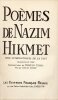
In-12° (185 x 120 mm), xii pp. - [1] f. - 181 pp. - [1] f., demi-basane brune, dos lisse, (reliure de l'époque). Premier recueil en traduction française de poèmes de Nazim Hikmet, comprenant 44 pièces, poèmes et fragments, dont le poème « Le cinquième jour d'une grève de la faim », composé directement en français, et « Pierre Loti », paru pour la première fois en 1924 ; Hikmet, s'engageant dans un débat qui déchirait l'intelligentsia littéraire turque, y prenait position contre l'orientalisme de Pierre Loti : « Et même et surtout toi Pierre Loti, Toi chez qui s'est blotti. Le pou du typhus. Qu'on nous inocula. A travers nos toiles cirées. Tu es plus éloigné de nous, Plus éloigné que l'officier français ! » (p. 149). La plupart des traductions sont dues à l'essayiste Sabahattin Eyüboglu (sous le pseudonyme de Hasan Güreh), qui signe également la notice biographique. Avec une préface de Tristan Tzara. La littérature turque peina longtemps à s'implanter en France : avant 1950, on dénombrait moins d'une dizaine de traductions de textes turcs. Dans les années qui suivirent la seconde guerre mondiale, cependant, les étudiants et intellectuels turcs établis à Paris entreprirent un vaste de travail de traduction et diffusion des littératures de leur pays. La littérature socialiste, en particulier, suscita l'engouement : Nazim Hikmet, emprisonné 15 ans pour son adhésion au parti communiste, partisan de la poésie comme « le plus sanglant des arts », s'imposa rapidement comme un écrivain clef de l'opposition politique, et suscita l'admiration des ex-surréalistes : Louis Aragon, Tristan Tzara qui fonda le Comité pour la libération de Nazim Hikmet... « Son expérience personnelle recouvre l'expérience d'une bonne part de l'humanité, celle qui, tournée vers un avenir radieux, n'a pas besoin de connaître en détail l'histoire et la géographie de la Turquie pour comprendre à quel point l'asservissement du peuple turc est lié à la faillite d'un système social et d'une civilisation périmés. Tout en exaltant les espoirs du peuple turc, la poésie de Nazim Hikmet embrasse l'expression profondément humaine des aspirations communes à tous les peuples » (Tzara, pp. ix-x). Sont joints 2 coupures de presse concernant l'auteur. Provenance : Ex-libris manuscrit Y. Attias, non-identifié. Bibliographie : Mignon, Laurent. "Nazim Hikmet. Venger Azyadé". In Regards sur la poésie du XXe siècle, vol. 1. Laurent Fels. 2009 ; Muhidine, Timour. "La littérature turque en français : un mariage de raison". Bureau international de l'édition française, mars 2010. Dos insolé, avec petit frottement en pied. Mouillures marginales en tout début d'ouvrage.

Turquie-Europe, une relation ambiguë Basri Elmas, Hasan and Vincent, Jean-Marie
Editions Syllepse broche
Merci de nous contacter à l'avance si vous souhaitez consulter une référence dans notre boutique à Authon-du-Perche.
Ennemie en terre promise : une égyptienne paisible en Israël Hasan S.
Fabert édition de 1989
Merci de nous contacter à l'avance si vous souhaitez consulter une référence dans notre boutique à Authon-du-Perche.
Monumental'naya skul'ptura Sovetskogo Azerbaydzhana. In Russian /Monumental Scu
Short description: In Russian. Novruzova, Jamilya Hasan kyzy. Monumental Sculpture of Soviet Azerbaijan. Baku: Akad. of Sciences of the AzSSR, 1960. You are welcome to reach out to us for a detailed description of the copies currently available. Delivery of this book may take longer than usual including extended processing and pre-shipping time, no expedited shipping is available. Please advise us if you have a set date or a deadline to receive your order.SKU6427148
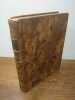
Recueil d'estampes gravées d'après les tableaux du cabinet de Monseigneur le duc de Choiseul. Par les soins du Sr Hasan. [Avec des annotations manuscrites des prix lors de la vente de 1772].
A Paris, chez l'auteur, 1771. 26 x 21,5 cm, titre gravé par Choffard avec dédicace gravée au verso, un portrait du duc de Choiseul, 12 pages de texte gravées et 127 (sur 128) planches gravées numérotées de 1 à 123 (à l'exception de la planche 4 manquante), y compris les figures 44 et 45 gravées sur une seule planche, les 5 planches bis 68, 69, 76, 78 et 101, la planche 74 sur une double page, les figures 93 et 94 sur une seule planche. Les planches sont sous serpente. Des rousseurs sinon bon état des planches. Relié plein veau d'époque, dos à nerfs, pièce de titre, toutes tranches dorées. Reliure usée mais encore solide. Mors partiellement fendus, épidermures, cois émoussés, coiffes arasées. Au centre des plats armoiries dorées du baron de Cartier et de Cartier de Marchienne. Provenance : sur le contreplat ex-libris du Château de Marchienne et ex-libris du bibliophile anglais James Toovey. Avec des annotations manuscrites des prix lors de la vente de 1772. Recueil bien gravée, d'après les tableaux que le duc de Choiseul vendit après sa disgrâce en 1772. Les planches figurent des tableaux de Van de Velde, J. Steen, David Teniers, Rubens, Van Dyck, Le Nain, Hubert Robert...
Les Ombres disparues
2009 Paris, PLON / Feux croisés, 2009 14 x 22,5 cm, 271 pp Neuf car service de presse
Roman traduit du turc par Noémi Cingöz.
Religious Architecture of Islam. Volume II: Africa, Europe, and the Americas
, Brepols, 2022 Hardback, 360 pages, Size:220 x 280 mm, Illustrations:293 col., Language: English. ISBN 9782503589367.
Summary The Religious Architecture of Islam is a wide-ranging multi-author study of the architectural traditions associated with the religion of Islam across the globe. Essays both address major themes across the history of Islamic architecture and provide more focused studies of developments unique to specific regions and historical periods. The essays cover the history of Islamic religious architecture broadly defined, including mosques, madrasas, saints' shrines, and funerary architecture. The Religious Architecture of Islam both provides an introduction to the history of Islamic architecture and reflects the most recent scholarship within the field. TABLE OF CONTENTS AL-ANDALUS AND THE MAGHRIB Glaire D. Anderson ? Early Mosque Architecture in Al-Andalus and the Maghrib Glaire D. Anderson ? Islamic Religious Spaces in Secular Monuments in the West Through the Caliphal Period Susana Calvo Capilla ? The Mosque of Cordoba Juan Carlos Ruiz Souza ? The Mosque of Cordoba and Iberia's Christians Jessica Renee Streit ? Almohad Religious Spaces Susana Calvo Capilla ? The Taifa-period Mosques of Al-Andalus Susana Calvo Capilla ? The Rural and Urban Mosques of Al-Andalus AFRICA AND SICILY Jonathan M. Bloom ? Fatimid Mosques Kristen Streahle ? Religious Spaces in Islamic and Norman Sicily Lara Tohme ? The Ribats of North Africa Mariam Rosser-Owen ? The Almoravid Religious Spaces of Marrakesh and Fez Cynthia Robinson ? The Great Mosque of Tlemcen Hasan-Uddin Khan ? The Mosque of Hassan II, Casablanca Amira K. Bennison ? Madrasas in the Maghrib Amira K. Bennison ? Mosques and Society in the Maghrib Stephennie Mulder ? Mamluk Religious Architecture Nnamdi Elleh ? The Earth Mosques of West Africa Vera-Simone Schulz ? Coral Stone Mosques in East Africa EUROPE Jelena Bogdanovi? ? Religious Landscape in the Balkans in the Fifteenth and Sixteenth Centuries Jelena Bogdanovi? and Vladimir Kuli? ? The ?erefudin White Mosque Nebahat Avc?o?lu ? The Modern and Contemporary Mosque in Europe, Russia, and Turkey Nebahat Avc?o?lu ? Britain's First Mosque: Woking THE AMERICAS Omar Khalidi ? North American Mosques Tammy Gaber ? Canadian Mosques Caroline ?Olivia? Wolf ? Modern and Contemporary Mosques in Latin America Caroline ?Olivia? Wolf ? Argentina's King Fahd Islamic Cultural Center Glossary Index
SUDAN in AFRICA.
Kartoum University Press, 1971, in-8 (240x165mm), 316pp., 4 cartes, broché, couverture en couleurs (bleu et rouge).
Studies presented to the First International Conference sponsored by The Sudan Research Unit 7-12 February 1968 edited with an introduction by Y¥suf Fadl HASAN.
Manto Saadat Hasan Gill Anila Gill Harjeet Singh
Reference : 500105228
(2007)
ISBN : 9782912019745
Viande froide
Bleu autour 2007 18 pages 10 6x0 4x16 2cm. 2007. Broché. 18 volume(s). 18 pages.

Très bon état - L'ouvrage qui n'a jamais été lu peut présenter de légères traces de stockage mais est du reste en très bon état. envoi rapide et soigné dans un emballage adapté depuis France
The Price of Freedom
Penguin Books UK
LIVRE A L’ETAT DE NEUF. EXPEDIE SOUS 3 JOURS OUVRES. NUMERO DE SUIVI COMMUNIQUE AVANT ENVOI, EMBALLAGE RENFORCE. EAN:9780241747223
Gestational Diabetes
NOVA SCIENCE PUBLISHERS INC
LIVRE A L’ETAT DE NEUF. EXPEDIE SOUS 3 JOURS OUVRES. NUMERO DE SUIVI COMMUNIQUE AVANT ENVOI, EMBALLAGE RENFORCE. EAN:9781536183351
Cutaneous Scars
NOVA SCIENCE PUBLISHERS INC
LIVRE A L’ETAT DE NEUF. EXPEDIE SOUS 3 JOURS OUVRES. NUMERO DE SUIVI COMMUNIQUE AVANT ENVOI, EMBALLAGE RENFORCE. EAN:9781536156577
Najstariji Vakufski Dokumenti u Jugoslaviji Na Arapskom Jeziku.
Pristina, 1972. In-8 broché, 356 pp., quelques ill. en noir hors-texte (reprod. photogr., facsimile...), bibliographie, index. Texte en serbe et extrait en arabe.
Petite déchirure en haut du dos, couv. poussiéreuse, bon ex. par ailleurs. - Frais de port : -France 6,8 € -U.E. 9 € -Monde (z B : 14 €) (z C : 24 €)
Erol Atalay memorial.
Izmir, Ege Üniversitesi Basimevi Bornovan 1991. In-8 broché, 205 pp., portrait au front., nb. fig. en n/b. in-t., 49 planches de reprod. photogr. en n/b., 31 contributions multilingue, bibliographie. Qq. notes manuscrites.
Couv. un peu défraîchie, intérieur frais, bon ex. - Frais de port : -France 7,15 € -U.E. 9 € -Monde (z B : 14 €) (z C : 24 €)
Skorostnaya strel'ba po siluetam. In Russian /High-speed shooting on silhouette
Short description: In Russian. Sarychev, Nikolai Grigorievich. High-speed shooting on silhouettes. Moscow: DOSAAF Publishing House, 1974. You are welcome to reach out to us for a detailed description of the copies currently available. Delivery of this book may take longer than usual including extended processing and pre-shipping time, no expedited shipping is available. Please advise us if you have a set date or a deadline to receive your order.SKU7436197
S lyubov'yu k prirode. In Russian /With Love for Nature
Short description: In Russian. Aleshka, Vyacheslav Iosifovich. With Love for Nature. Minsk: Uradzhai, 1977. You are welcome to reach out to us for a detailed description of the copies currently available. Delivery of this book may take longer than usual including extended processing and pre-shipping time, no expedited shipping is available. Please advise us if you have a set date or a deadline to receive your order.SKU7659879
SSSR - Iran. In Russian /USSR-Iran
In Russian. Parvizpur, Badr Hasan. USSR-Iran. Tbilisi: Metsniereba, 1977. All images are for identification of editions only. Several books of the same edition may be available. Please feel free to request photos of available books. SKU7687669
Bibliografiya lingvisticheskoy i metodicheskoy literatury po rodnym i russkomÖ
In Russian. Sukunov, Hasan Habizhevich. Bibliography of linguistic and methodical literature on native and Russian languages in Adyg schools. Nalchik: Elbrus, 1972. Bibliografiya lingvisticheskoy i metodicheskoy literatury po rodnym i russkomu yazyku v adygskikh shkolakh. In Russian/Bibliography of linguistic and methodological literature on native and Russian languages in Adyg schools. All images are for identification of editions only. Several books of the same edition may be available. Please feel free to request photos of available books. SKU7463871
NTR, literatura, geroy. In Russian /STD, Literature, Hero
In Russian. Guliyev, Hasan Mamed oglu. STR, Literature, Hero. Moscow: Znanie, 1977. All images are for identification of editions only. Several books of the same edition may be available. Please feel free to request photos of available books. SKU7669118
Ekspluatatsiya i remont elektrofil'trov. In Russian
In Russian. Aliyev, Hasan Mamed-Ali ogly. Operation and repair of electric filters. Moscow: Energiya, 1976. Ekspluatatsiya i remont elektrofil'trov. In Russian /Operation and repair of electrical filters . All images are for identification of editions only. Several books of the same edition may be available. Please feel free to request photos of available books. SKU7663753
Otchet o komandirovke v Niderlandy. In Russian
In Russian. Rizaev, Ramiz Hasan Quli ogly. Report on mission to the Netherlands. Moscow: 1977. Otchet o komandirovke v Niderlandy. In Russian /Report on mission to the Netherlands . All images are for identification of editions only. Several books of the same edition may be available. Please feel free to request photos of available books. SKU7682663
Rosa Bonheur - Bezield dierschilder
Den Haag, De Mesdag Collectie/Waanders Uitgevers, 2024 Gebonden, 80 pagina's, 17 x 24 cm, talrijke illustraties, NL. *Nieuw. ISBN 9789462625983.
Rosa Bonheur was een 19de-eeuwse kunstenaar van wereldformaat. Ze had een uitgesproken liefde voor dieren en wist ze zowel op doek als papier treffend weer te geven. Bonheur woonde op haar chateau in By, dicht bij het bos van Fontainebleau, en hield daar onder meer paarden, schapen en leeuwen. Ze koesterde haar onafhankelijkheid: ze kon met haar werk ruimschoots voorzien in haar eigen onderhoud en woonde het grootste gedeelte van haar leven samen met een vrouw. Deze rijk geïllustreerde publicatie werpt nieuw licht op hoe Bonheur zich ontwikkelde tot de belangrijkste dierschilder van haar tijd. Ze kon rekenen op internationaal succes ? zo ook in Nederland. Doordat ze letterlijk en figuurlijk zo dicht bij dieren stond, wist Bonheur ze in haar vele studies nauwkeurig en bezield weer te geven. Tentoonstelling: 20 september 2024 t/m 19 januari 2025 De Mesdag Collectie, Den Haag

