 Write to the booksellers
1901 books for « goethe j w »Edit
-
Latest
Last 3 days (7)
Last month (19)
Last week (5)
-
Language
Dutch (1)
French (1888)
German (6)
Russian (7)
-
Century
18th (20)
19th (298)
20th (723)
21st (22)
-
Countries
Belgium (80)
Brazil (1)
Canada (6)
Côte d'Ivoire (3)
Denmark (29)
France (1568)
Germany (8)
Greece (5)
Netherlands (6)
Switzerland (189)
United States of America (7)
-
Syndicate
ALAC (5)
CLAM (12)
CNE (1)
ILAB (1065)
NVVA (31)
SLACES (31)
SLAM (926)
Topics
- Aesop (2)
- Allemand maurice (2)
- Alsace (8)
- Ancien régime (3)
- Autographs (2)
- Billy-goat (2)
- Blaze (5)
- Books from the xviiith (2)
- Botany (3)
- Calbet (12)
- Carlyle (2)
- Carpenter (3)
- Chapront henry (2)
- Children’s books (2)
- Cinema (2)
- Daragnes (9)
- Delacroix eugène (6)
- Drama (3)
- Early printed books (16)
- Essays (4)
- Exhibition (3)
- Faust (22)
- Fine arts (7)
- First edition (34)
- Fox (2)
- Genealogy (4)
- Geography (3)
- German literature (4)
- Germany (3)
- Germany pc (2)
- Goethe johann wolfgang (1836)
- Gold (3)
- Heine henri (2)
- Hetzel (3)
- History (14)
- Icart l. (6)
- Illustrated books (22)
- Illustrated books 19th (3)
- Industrial arts & crafts - fine arts (3)
- Lessing (5)
- Literature (7)
- Littérature 18ème (2)
- Love (3)
- Magazine (2)
- Marold (2)
- Massenet jules (3)
- Memories (10)
- Modern comic (7)
- Modern illustrated book (3)
- Museums (2)
- Music (3)
- Newspapers press (4)
- Nietzsche frédéric (4)
- Philosophy (19)
- Psychology (5)
- Review (3)
- Reviews (2)
- Revolution 1789 (5)
- Schiller (32)
- Sciences (4)
- Scores (5)
- Sculpture (2)
- Shapes & colours (5)
- Tales (8)
- Theatre (62)
- Tragedy (4)
- Version (2)
- Wairy louis-constant alias constant (2)
- Wilde oscar (2)
- Woods & woods’ price lists (3)
- Youth (6)
Faust. Esquisses déssinées par Retsch
Paris, Giard (Imprimerie de Didot), 1830. 635 g In-4 à l'italienne, demi basane brune, [1] f., 8 pp., 26 planches au trait.. Exemplaire ayant conservé sa belle couverture lithographiée par Bichebois aîné (petite déchirure restaurée). Quelques rares petits points de rousseurs ou petites traces d'humidité. . (Catégories : Littérature, )
![Faust. Esquisses déssinées par Retsch. [GOETHE]](https://static.livre-rare-book.com/pictures/CHH/10511_1_thumb.jpg)
![Faust. Esquisses déssinées par Retsch. [GOETHE]](https://static.livre-rare-book.com/pictures/CHH/10511_2_thumb.jpg)
![Faust. Esquisses déssinées par Retsch. [GOETHE]](https://static.livre-rare-book.com/pictures/CHH/10511_3_thumb.jpg)
Faust. Ein Fragment. - [PMM 298 - THE FAUST LEGEND]
Leipzig, Göschen, 1790. Orange cardboard binding (presumably the original!) with gilt title-labet to top of spine. Corners bumped, and wear along hinges and capitals. Overall a very nice and charming copy, tight, and completely unrestored. Some brownspotting throughout, but overall very nice. With the famous engraved frontispiece depicting Faust in his study, by Lips, after Rembrandt (loose) and the tittle-page stating ""Goethe's Schriften. Siebenter Band."", with the large engraved vignette by Lips, picturing Bätely bandaging Jery's hand (different from the ones in the seven other volumes), and the half-title stating ""Faust. Ein Fragment"" with ""Goethe's W. 7. B."" to the foot (repeated on all quires). Old owner's name to verso of frontispiece, otherwise no markings or annotations of any kind.
![Faust. Ein Fragment. - [PMM 298 - THE FAUST LEGEND]. "GOETHE, JOHANN WOLFGANG von.](https://static.livre-rare-book.com/pictures/LLX/63278_1_thumb.jpg)
![Faust. Ein Fragment. - [PMM 298 - THE FAUST LEGEND]. "GOETHE, JOHANN WOLFGANG von.](https://static.livre-rare-book.com/pictures/LLX/63278_2_thumb.jpg)
![Faust. Ein Fragment. - [PMM 298 - THE FAUST LEGEND]. "GOETHE, JOHANN WOLFGANG von.](https://static.livre-rare-book.com/pictures/LLX/63278_3_thumb.jpg)
The scarce first printing, in the corrected variant Hagen So, of one of the peaks of world literature, the main work by the greatest German poet ever, and one of the all-times greatest writers of the world, Johann Wolfgang von Goethe. ""Faust"" was first printed, as it is here, as volume seven of Goethe's Schriften in eight volumes from 1787-1790, and was also published separately, likewise under the title ""Faust. Ein Fragment"". The printing of Faust in the seventh volume of Goethe's works is the original printing after the manuscript of the poet. There are two printings of this volume, between which there is traditionally said to be no precedency, although So has been corrected, which Sm has not. The present copy is Hagen variant So, without the misprints (see Hagen 11:7, So), which can be identified by eg. the lack of the repetition of the three lines in pp. 144-145, which appear in Sm (see Hagen, p. 12). Few other writers have been as influential as Goethe, and his works were an immense source of inspiration to everything from drama and music to science and philosophy. He is generally accepted as one of the most important thinkers within Western culture, and his main work, Faust, is considered one of the most important and influential works of world literature. ""If Goethe may justly be called the last representative of the renaissance ideal of the ""oumo universale"", his ""Faust"" embodies the sum total of his poetical growth."" (Printing and the Mind of Man: 298).""Faust"" is arguably the work for which Goethe is most famous, and this is not without reason. The novel emphasizes the strength of the individual and the right to freely investigate aspects of human and divine character. The novel also fights for man's right to determine his own destiny, and is thus considered the first great literary work in the spirit of modern individualism. Faust is also considered highly relevant to science and scientific thought, as Goethe here offers a holistic and non-analytic approach to these areas. The present volume 7 from 1790 has two vignettes: ""Bätely verbindet dem Jery die Hand"", H. Lips fec."" and ""Faust im Studierzimmer, ein am Fenster erscheinendes magisches Zeichen betrachtend"", H. Lips sc. (nach Rembrandt) (see Hagen 11:7). On the last page is written ""Leipzig, gedruckt bey Christian Friedrich Solbrig"" (see Hagen 11). It also includes the separate texts ""Jery und Bätely"" (pp. 169-224) and ""Scherz, List und Rache"" (pp. 225-320). PMM 298 (being the 1834 ed., not the real first)" Hagen 11,7 - So.
Conversations de Goethe avec Eckermann ( Johann Peter)
Gallimard, 1941. Ment° fictive de seconde édition, fort in octavo, broché, 550 pp., table (1)., index des noms et des sujets (2 coll.) 545-549), ensemble fané, non insolé, de très bonne tenue et état. Traduction de Jean Chuzeville.
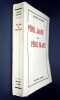
Pour Goethe, Johann Peter Eckermann était à la fois un disciple, un ami intime et le principal confident littéraire de ses dernières années, celui à qui il confie la mission de fixer sa parole et dorganiser son uvre pour la postérité. Né en 1792 près de Hanovre, poète et homme de lettres, Eckermann envoie en 1823 un manuscrit de poèmes à Goethe, qui linvite ensuite à Weimar. Après cette rencontre, et l'amitié qui en découlera, Eckermann vivra près de Goethe à partir de 1824, où il travaillera comme précepteur, accompagnant en 1830 le fils de Goethe en Italie ; en 1838, il devient conseiller grand duc et bibliothécaire. Goethe lui confie la publication de ses uvres posthumes (Nachgelassene Schriften, 1832 1833) et en fait, avec Riemer, lun des principaux éditeurs de lédition complète en 40 volumes (1839 1840). Eckermann résume lui même leur relation comme « celle de lélève au maître, du fils au père, du pauvre en culture au riche en culture », formule qui dit bien ce que Goethe représentait pour lui et, inversement, la confiance exceptionnelle que Goethe lui accordait. Mise à jour du Samedi 27 Juin 2026. Paiement PayPal immédiat, Mondial Relay pour : France, Allemagne, Autriche, Belgique, Espagne, Italie, Portugal, Luxembourg, Pays-Bas, Pologne (Communiquer votre point ou locker si connu). Une participation supplémentaire peut être demandée pour les colis lourds hors France où les envois compris entre 5 et 25 kg sont dégressifs : 2 à 4 kilogrammes - 7.99 / 5 à 10 kg - 15.99 / 15 -25 kg - 25.99. Certaines de nos collections ( Vian, Céline, Camus (...) peuvent être expédiées en Franco de port. Pour linternational hors Europe (Suisse, Canada, Japon, Etats-Unis, les frais dexpéditions peuvent varier selon le poids (mise à jour : 1 juin 2026).
Faust et le second Faust, suivis d'un choix de poésies allemandes traduites par Gérard de Nerval
Paris, Garnier Frères, non daté (1877?). In-12 de 183 x 120 mm, VIII + 448 pages. "Nouvelle édition précédée d'une notice sur Goethe et sur Gérard de Nerval." Relié demi-maroquin marron sombre, dos à 5 nerfs avec la mention "GOETHE - FAUST" frappée or. Plats jaspés, gardes colorées. Mentions au crayon et au stylo sur la page de titre, la seconde apparaissant à demi effacée sur les pages environnantes. Page de papier de soie protégeant la page de titre. Gérard Labrunie (1808-1855), dit Gérard de Nerval, a commencé sa carrière littéraire avec Goethe. À moins de vingt ans, il publie une traduction en français de la première partie du Faust de Goethe, qui sort de presse en novembre 1827. Goethe appréciera la traduction : "Le 3 janvier 1830, l’écrivain allemand avait fait, devant son secrétaire Johann Peter Eckermann, « un grand éloge de la traduction de Gérard [celle de 1828], disant que, quoique en prose pour la meilleure partie, elle était très réussie ». Et Goethe aurait ajouté : « Je n’aime plus lire le Faust en allemand [...] ; mais dans cette traduction française [il s’agit toujours de la traduction de Gérard], tout agit de nouveau avec fraîcheur et vivacité ». Ces propos se trouvent reproduits par Eckermann dans le tome II, publié en 1836, de ses Gespräche mit Goethe, mais restèrent complètement inconnus du public français." (Michel Brix, "Nerval et le mythe de Faust") À la mort de Nerval, le parnassien Théophile Gauthier se fendra d'un commentaire sur les éloges de Goethe au jeune traducteur.
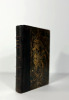
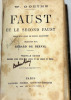
Papier jauni, nombreuses rousseurs à l'intérieur qui ne gênent pas la lecture. Reliure solide, bon état général.
Werther
Les Souffrances du jeune Werther: la célébrité de Goethe es faite et son nom restera longtemps attaché à cet événement littéraire, au premier roman allemand qui franchit véritablement les frontières de l’Allemagne. Précieuse édition française, la première citée par Brunet, des Souffrances du jeune Werther. Goethe, Johann-Wolfgang. Werther, traduction de l’Allemand de Goethe par C. Aubry. Nouvelle Edition, revue et corrigée par le Traducteur. Avec Figures en taille-douce. Paris, de l’Imprimerie de Didot Jeune, 1797. 2 tomes en 2 volumes in-18 de: I/ x, 178 pp., 2 figures hors texte; II/ 209 pp., (6) pp. pour le catalogue de Didot, 2 figures hors texte. Veau granité, roulette dorée à la grecque sur les plats, dos lisses richement ornés, pièces de titre et de tomaison de maroquin rouge, coupes décorées, tranches dorées. Reliure de l’époque. 127 x 78 mm. Précieuse édition française, la première citée par Brunet, des Souffrances du jeune Werther. Quérard, Fr. litt., III, 395 ; Martin & Mylne 77.41 ; Cohen 442. Werther, ce roman dont l'influence fut si grande sur toutes les littératures européennes, parut à Leipzig en 1774 ; la première traduction française est, croyons-nous, celle de George Deyverdun (Maestricht, J.-E. Dufour, 1775 et 1776, 2 vol. in-12), puis vint celle de Seckendorf (Erlangen, 1776, in-8), suivie de près par celle d'Aubry qui, d'après Quérard, serait en grande partie l'œuvre du comte de Schmettau, (Mannheim et Paris, Pissot, 1777, in-8). D'autres traductions furent ensuite publiées par L.-C. de Salse (Basle, J. Decker, 1800, 2 vol. in-8), H. de La Bédoyère (Paris, Colnet, an XII, in-12), Sévelinges (Paris, Demonville, 1804, in-8), Allais (Paris, Dauthereau, 1827, 2 vol. in-32), Pierre Leroux (Paris, Charpentier, 1839, in-12), et Louis Énault (Paris, Hachette, 1855, in-12). En 1774 paraît à Leipzig le premier roman d’un auteur presque inconnu, âgé de 25 ans: Les Souffrances du jeune Werther. Cette œuvre rencontre en Allemagne un succès immédiat. Les revues discutent de la moralité ou de l’immoralité des deux petits volumes, les lecteurs se les arrachent, certains voient dans le destin de Werther un modèle à suivre. La célébrité de Johann Wolfgang Goethe est faite et son nom restera longtemps attaché à cet événement littéraire, au premier roman allemand qui franchit véritablement les frontières de l’Allemagne. Une première traduction française paraît en 1776. Lorsque, trente-deux ans plus tard, le 2 octobre 1808, Napoléon traversant l’Allemagne en conquérant se trouve à Erfurt, il demande à voir Goethe: c’est pour parler avec l’auteur de Werther, un livre qu’il a lu sept fois et qui l’a accompagné lors de sa campagne d’Egypte. «Le Werther est un défi au roman vertueux des Lumières. Mais son discours est avant tout une profession de foi subjectiviste: une quête du sens de la vie par une âme exigeante qui ne se contente plus des modes traditionnels de l’insertion sociale ni des conceptions en vigueur concernant le salut» (Dictionnaire des Œuvres). Les Souffrances du jeune Werther, premier roman de Goethe, connut un succès incroyable dès sa sortie, apportant ainsi du jour au lendemain une notoriété considérable dans toute l'Europe à son auteur. Cela déclencha ce qu'on appela alors la « fièvre werthérienne ». Mme de Staël écrira que «Werther a causé plus de suicides que la plus belle femme du monde...». Goethe lui-même déclara «L'effet de ce petit livre fut grand, monstrueux même... parce qu'il est arrivé au bon moment, mais... le suicide n'est en aucun cas une solution défendue par le livre». Le volume est orné de 4 figures de Berthon gravées par Duplessis-Bertaux. Précieux exemplaire sur papier vélin conservé dans ses élégantes reliures de l’époque aux dos lisses finement ornés.

Goethe's Werke. Vollständige Ausgabe letzter Hand. Unter des durchlauchtigsten deutschen Bundes schützender Privilegien.
55 Bände in 28. Stuttgart und Tübingen, in der J. G. Cotta'schen Buchhandlung (gedruckt bei Cotta in Augsburg), 1828-1835. Kl.-8°. Marmorierte Pappbände der Zeit mit hs. Papier-Rückenschildchen.
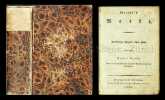
Hagen 23, Ausgabe C2beta, mit Bogennorm "Goethe's Werke". - Ausgabe letzter Hand in der sogenannten Taschen- oder Kleinoktav-Ausgabe auf Druckpapier. "Von Goethe unter Mitwirkung von Göttling, Eckermann und Riemer sorgfältig vorbereitete Ausgabe. Beruht in ihren bereits früher gedruckten Teilen auf den vorwiegend von Göttling, in geringem Masse von Goethe selbst korrigierten Bänden von B bzw. auf den inzwischen erschienenen Eindzeldrucken" (Hagen). Die Bände 1-10 tragen das Erscheinunsjahr 1828 (bei Hagen 1827) "ein wahrscheinlich erst nach 1830 entstandener Neudruck" (Hagen). Die Bände 41-55 mit dem Vortitel "Goethe's nachgelassene Werke. Erster - Fünfzehnter Band". Letzterer enthält die "Inhalts- und Namen-Verzeichnisse über sämmtliche Goethe'schen Werke" von Carl Theodor Musculus und Riemer, sowie die Anzeige für die 55bändige Ausgabe in gross Octav. Die erst 1842 erschienenen Nachtragsbände sind, wie meist, nicht vorhanden. - Teilweise etwas gebräunt, Kanten und Rückenschildchen etwas berieben.

Phone number : 41 (0)44 261 57 50
GOETHE COSMOPOLITE.
Paris, Presses universitaires de France PUF, Revue germanique internationale 12/1999. Revue semestrielle sous la direction de Michel Espagne et Michel Le Rider. Au sommaire : Autour de "Faust" et de "Werther" - Le philosophe, le savant, Goethe intime, Goethe et ses masques - Goethe, les arts et les collections - Goethe et la Romania - Goethe au XXè siècle. In-8 broché de 308 pp. Bon état.
![GOETHE COSMOPOLITE.. [GOETHE] - COLLECTIF](https://static.livre-rare-book.com/pictures/PEN/10585_1_thumb.jpg)
Oeuvres de Goethe (10vol).
A Paris, Librairie L. Hachette et Cie, 1860-1870.

Bel ensemble complet en 10 volumes in-8 (230x150mm) reliés, demi-basane bleue, titres dorés au dos, initiales dorées en queue, tranches jaspées. Vol1(1861,Poésies diverses, Pensées, le Divan oriental-occidental): portrait de Goethe gravé par Goutière en frontispice, titre,(xi),755pp; vol2(1870, Théâtre):488pp; vol3(1860,Théâtre):465pp; vol4(1869,Théâtre):475pp; vol5(1860, Poèmes et Romans):585pp; vol6(1860, Les Années d'apprentissage de Wilhelm Meister):585pp; vol7(1860,Les Années de voyage de Wilhelm Meister):584pp; vol8(1862,Mémoires de Goethe):668pp; vol9(1862, Voyages en Suisse et en Italie par Goethe):504pp; vol10(1863, Mélanges):486pp. Table des noms de personnes qui se rencontrent dans les oeuvres de Goethe, Table alphabétique de toutes les oeuvres contenues dans les 10 volumes in fine du dernier tome, table des matières en fin de chacun des volumes. Traduction effectuée par le professeur de littérature Jacques Porchat (1800-1864) entre 1860 et 1863. Fait suite à l'édition allemande en 30 volumes in-8 (Cotta, Stuttgart et Tubingen, 1850-1851). Le vol premier de cette édition correspond aux 4 premiers de l'édition allemande et résume, selon le traducteur, la vie de l'auteur : ses passions de jeunesse et ses méditations profondes. Les volumes 2,3 et 4 -où s'expriment le génie de l'auteur- comprennent le Théâtre et Faust. La deuxième partie du Faust n'avait, jusqu'alors jamais été traduite intégralement. De même en ce qui concerne le tome 6, Les Années d'apprentissage de Wilhelm Meister -qui correspond au vol 15 allemand-. Le dixième et dernier volume renferme la Campagne de France, les Annales de 1794 à 1822 et plusieurs pièces détachées. Henri Wehrli (professeur de langue et de littérature allemande), Wilhelm Neumann (ancien professeur de théologie à l'université de Berlin) et Hermann Wiener (professeur de littérature grecque à l'Académie de Lausanne) furent de précieux collaborateurs à cette nouvelle traduction. Quant aux travaux scientifiques et à la correspondance, ils devaient faire partie d'un volume à part -non publié-. Rares frottements observés au dos des reliures, des rousseurs éparses, bons exemplaires.
Die Leiden des jungen Werthers. Zweynte ächte Auflage. 2 parts. - [THE MAIN WORK OF THE STURM UND DRANG-ERA. - THE WORLD'S FIRST CULT BOOK]
Strassburg & Hanau, 1775. 8vo. Two parts both in the original blank boards. A number a previous owner's name in near contemporary hand to verso of front boards. Boards with a few stains and internally with light occassional brownspotting, but overall a good unsophisticated copy. 95 pp. pp. 97-192.
![Die Leiden des jungen Werthers. Zweynte ächte Auflage. 2 parts. - [THE MAIN WORK OF THE STURM UND DRANG-ERA. - THE WORLD'S FIRST CULT BOOK]. GOETHE, ...](https://static.livre-rare-book.com/pictures/LLX/62794_1_thumb.jpg)
![Die Leiden des jungen Werthers. Zweynte ächte Auflage. 2 parts. - [THE MAIN WORK OF THE STURM UND DRANG-ERA. - THE WORLD'S FIRST CULT BOOK]. GOETHE, ...](https://static.livre-rare-book.com/pictures/LLX/62794_2_thumb.jpg)
![Die Leiden des jungen Werthers. Zweynte ächte Auflage. 2 parts. - [THE MAIN WORK OF THE STURM UND DRANG-ERA. - THE WORLD'S FIRST CULT BOOK]. GOETHE, ...](https://static.livre-rare-book.com/pictures/LLX/62794_3_thumb.jpg)
Very scarce early edition (D2a) of Goethe's monumental novel-debut, which immediately became a major success and one of the most influential and popular books of the 18th century. The novel caused Goethe almost overnight fame. The style of writing has influenced an entire generation of writers. No other of Goethe's works has been so widely read by his contemporaries, and no other work in general has been of as great importance to the Sturm und Drang-period" the work also caused the so-called ""Lesesucht"" (the important and wide-ranging debate in late 18th century on misreading and on dangerous and harmful literature). The impact it had on not only literature, but on almost all aspects of life at the time, was immense and unheard of. Werther might well be the first cult-figure ever"" -a true ""Werther-Fieber"" broke loose, resulting in a distinct Werther-fashion (yellow trousers, yellow waist-coat, blue coat, high turned-down boots, round felt hat and un-powdered hair, as described by Goethe in the novel), Werther-perfume, Werther-cups etc. Numerous people susceptible to influence actually killed themselves in sympathy with the suffering Werther or overwhelmed by the gulf that separates the outer from the inner world suggested in the novel (the first copycat-suicides of the world, -many of the bodies were found with the book in their hands), and the work incited the romantic urge for revolution"" the work is also said to have been Napoleon's favourite novel, which he carried with him at all times. Goethe himself was very surprised by the impact of the work, and said about it: ""Die Wirkung dieses Büchleins war groß, ja ungeheuer, und vorzüglich deshalb, weil es genau in die rechte Zeit traf."" (Dichtung und Wahrheit). This literary masterpiece may be called the first German novel of world literary class, and it not only seems like a modern work of fiction, it is a work which has irreversibly shaped the feeling of life which is specific to modern man. Hagen 89 (D2a).
Les Souffrances du jeune Werther. Traduction nouvelle orné de trois gravures en taille douce. Les Souffrances du jeune Werther : la célébrité de Goethe est faite et son nom restera longtemps attaché à cet événement littéraire, au premier roman allemand qui franchit véritablement les frontières de l’Allemagne.
Précieuse édition française illustrée des Souffrances du jeune Werther. Paris, de l’Imprimerie de P. Didot l’Aîné, 1809. In-8 de vi pp., (1) f., 234 pp. et 3 planches hors-texte. Maroquin rouge, triple filet doré encadrant les plats, dos à nerfs richement orné, double filet or sur les coupes, roulette intérieure dorée, non rogné. Reliure signée R. Wallis binder. 217 x 134 mm.
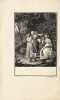
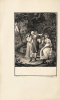
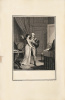
Précieuse édition française des Souffrances du jeune Werther dans une traduction nouvelle donnée par le comte de La Bédoyère. Cohen 442. Werther, ce roman dont l'influence fut si grande sur toutes les littératures européennes, parut à Leipzig en 1774 ; la première traduction française est, croyons-nous, celle de George Deyverdun (Maestricht, J.-E. Dufour, 1775 et 1776, 2 vol. in-12), puis vint celle de Seckendorf (Erlangen, 1776, in-8), suivie de près par celle d'Aubry qui, d'après Quérard, serait en grande partie l'œuvre du comte de Schmettau, (Mannheim et Paris, Pissot, 1777, in-8). D'autres traductions furent ensuite publiées par L.-C. de Salse (Basle, J. Decker, 1800, 2 vol. in-8), H. de La Bédoyère (Paris, Colnet, an XII, in-12), Sévelinges (Paris, Demonville, 1804, in-8), Allais (Paris, Dauthereau, 1827, 2 vol. in-32), Pierre Leroux (Paris, Charpentier, 1839, in-12), et Louis Énault (Paris, Hachette, 1855, in-12). En 1774 paraît à Leipzig le premier roman d’un auteur presque inconnu, âgé de 25 ans : Les Souffrances du jeune Werther. Cette œuvre rencontre en Allemagne un succès immédiat. Les revues discutent de la moralité ou de l’immoralité des deux petits volumes, les lecteurs se les arrachent, certains voient dans le destin de Werther un modèle à suivre. La célébrité de Johann Wolfgang Goethe est faite et son nom restera longtemps attaché à cet événement littéraire, au premier roman allemand qui franchit véritablement les frontières de l’Allemagne. Une première traduction française paraît en 1776. Lorsque, trente-deux ans plus tard, le 2 octobre 1808, Napoléon traversant l’Allemagne en conquérant se trouve à Erfurt, il demande à voir Goethe : c’est pour parler avec l’auteur de Werther, un livre qu’il a lu sept fois et qui l’a accompagné lors de sa campagne d’Egypte. « Le Werther est un défi au roman vertueux des Lumières. Mais son discours est avant tout une profession de foi subjectiviste : une quête du sens de la vie par une âme exigeante qui ne se contente plus des modes traditionnels de l’insertion sociale ni des conceptions en vigueur concernant le salut » (Dictionnaire des Œuvres). Les Souffrances du jeune Werther, premier roman de Goethe, connut un succès incroyable dès sa sortie, apportant ainsi du jour au lendemain une notoriété considérable dans toute l'Europe à son auteur. Cela déclencha ce qu'on appela alors la « fièvre werthérienne ». Mme de Staël écrira que « Werther a causé plus de suicides que la plus belle femme du monde... ». Goethe lui-même déclara « L'effet de ce petit livre fut grand, monstrueux même... parce qu'il est arrivé au bon moment, mais... le suicide n'est en aucun cas une solution défendue par le livre ». Le volume est orné de 3 superbes figures de Moreau gravées par de Ghendt et Simonet. « Existe sur papier vélin, avec les figures avant la lettre » mentionne Cohen, cas du présent exemplaire. Précieux exemplaire sur grand papier vélin, bien complet des 3 figures avant la lettre, conservé à toutes marges car non rogné, relié en maroquin rouge au XIXe siècle par R. Wallis.
Essai sur la métamorphose des plantes. Traduit par Fréderic Soret et suivi de notes historiques. - Versuch über die Metamorphose der Pflanzen...
Stuttgart, Cotta, 1831 ; in-8, demi-veau glacé rose, dos orné de guirlandes dorées et motifs à froid, tranches marbrées. _(Reliure de l’époque.)_ 2 ff., 239 pp., (1 p.)Texte allemand sur les pages de gauche, traduction française en face. ÉDITION ORIGINALE COMPLÈTE en allemand. Elle est augmentée de textes qui ne figurent pas dans la première de 1790 et ÉDITION ORIGINALE de la traduction de F. Soret. Une première traduction par F. de Gingins-Lassaraz avait paru à Genève en 1829. Soret a fait sa traduction en étroite collaboration avec Goethe.Goethe commença à s’intéresser à ce sujet lors d’un voyage en Italie en 1786. Il poursuivait alors l’idée utopique d’une “plante type” (_Urpflanze_) qui lui était venue au jardin botanique de Padoue. “Bien que l’idée de la feuille et de la tige primaires eut été déjà affirmée par F. Wolff dans sa théorie de la génération et bien que le mot “métamorphose” eut déjà été employé par Linné, la conception de Goethe était toute nouvelle : il rompait avec toutes les théories scientifiques du 18e siècle suivant lesquelles la plante est toute entière contenue dans le germe ; il se détachait également de la conception théologique de la nature, en se rapprochant de Kant qu’il ignorait toutefois. La doctrine d’évolution naturaliste de Goethe n’est reliée à aucune théorie, mais elle est une des expressions les plus typiques de la position de Goethe à l’égard de la nature.” _Dict. des Oeuvres Pritzel, 3452 - D.S.B. 5/443 -_Bel exemplaire dans une jolie reliure romantique.
[Ronald Ergo] - Nietzsche, Petrarca, Holderlin, Goethe, Charles Rossie
Reference : 016004
(1984)
Nietzsche, Petrarca, Holderlin, Goethe
Gent 1984 De Prentenier Original Cloth
Langue: néerlandais. Nietzsche, Pétrarque, Hölderlin, Goethe Nietzsche, Ecce homo, À Dieu connu Pétrarque, Sonnet Hölderlin, Les plaintes de Ménon Goethe, Faust 1 gravure signée de Ronald Ergo est une édition du graveur, créée artisanalement à De Schalmei, Jef Tinelstraat 5 à Gand-Oostakker. Papier Bunko-Shi traduction Charles Rossie typographie Ronald Ergo Automne 1984 15 exemplaires Ceci est le numéro 8/15 34 x 46 cm [Cette description peut avoir été traduite par une IA.]
Oeuvres scientifiques analysées et appréciées par E. Faivre -- BEL EXEMPLAIRE
P., Hachette, 1862, un volume in 8 relié en demi-chagrin rouge, dos orné de caissons dorés (reliure de l'époque), (2), 444pp., 4 planches
---- BEL EXEMPLAIRE ---- Vie et relations scientifiques de Goethe (premières études à la faculté de médecine de Strasbourg, relations avec Lavater, Zimmermann, Camper, Blumenbach, Soemmering, Geoffroy Saint-Hilaire, premières études sur la botanique, la géologie, l'anatomie comparée...) - Travaux scientifiques (écrits sur la botanique, essai sur la métamorphose des plantes, anatomie comparée, ostéologie, géologie et minéralogie, optique, traité des couleurs, polémique contre Newton, écrits sur l'arc-en-ciel, études météorologiques...) - La science dans les écrits littéraires et esthétiques de Goethe - Doctrines de Goethe en histoire naturelle (principe d'unité de composition et de l'idée des métamorphoses, conceptions générales sur la nature, jugements de Goethe sur la science et sur les savants contemporains...)**2381/K2/CART1
[Hachette & Cie] - GOETHE, Johann Wolgang von ; ( FAIVRE, Ernest )
Reference : 54348
(1862)
Oeuvres Scientifiques de Goethe. Analysées et appréciées par Ernest Faivre
1 vol. in-8 reliure de l'époque demi-chagrin vert bronze, dos à 4 nerfs orné, Hachette & Cie, Paris, 1862, 444 pp. avec 4 planches hors texte
Bel exemplaire, d'une fraîcheur intérieure tout à fait remarquable. L'ouvrage présente dans une première partie "La vie et les relations scientifiques de Goethe", dans une seconde partie propose ses travaux scientifiques (sur la botanique, l'anatomie comparée et l'ostéologie, la géologie et la minéralogie, l'optique avec le Traité des Couleurs, la polémique contre Newton, ...), dans une troisième partie évoque "la science dans les écrits littéraires et esthétiques de Goethe, puis dans une dernière partie évoque les "Doctrines de Goethe en Histoire naturelle".
Goethe.
Paris Albin Michel, coll. "Cahiers de l'Hermétisme" 1980 1 vol. broché in-8, broché, 263 pp. Textes de Gonthier-Louis Fink, Yvette K. Centeno, Antoinette Fink-Langlois, Rolf Christian Zimmermann, Roger Godard et Goethe. Bon état.
![Goethe.. GOETHE].](https://static.livre-rare-book.com/pictures/VIG/127493_1_thumb.jpg)
Le Romantisme. Wolfgang Goethe. Faust : . Texte français de Gérard de Nerval. Le Second Faust. Texte français de Alexandre Arnoux et R. Rainer Biemel [Unknown Binding] Goethe, Johann Wolfgang von; Arnoux, Alexandre; Biemel, Rainer and Nerval, Gérard de
L. Mazenod impr. Lang, Grandemange Le Romantisme. Wolfgang Goethe. Faust : . Texte français de Gérard de Nerval. Le Second Faust. Texte français de Alexandre Arnoux et R. Rainer Biemel.L. Mazenod 1963 RELIE SOUS TOILE DE EDITEUR EN TRES BON ETAT. ILLUSTRATION ET TEXTE IMPECCABLES. COUVERTURE TRES PROPRE.
Merci de nous contacter à l'avance si vous souhaitez consulter une référence dans notre boutique à Authon-du-Perche.
[DELACROIX] - GOETHE (Johann Wolfgang von Goethe) - Notice de Alfred LEROY - Traduction par Gérard de NERVAL et Henri BLAZE de BURY - Illustrations de DELACROIX
Reference : 49583
(1942)
Faust - Tragédie en 2 parties - Goethe
1942 PARIS, Horizons de France - 1942 - In-8 - Broché - Exemplaire numéroté (n°1308/3000) - Précédé d'une notice par Alfred Leroy - Traduction complète de Gérard De Nerval pour la première partie et par Henri Blaze De Bury pour la deuxième partie - Portrait de l'auteur en frontispice et 17 lithographies par Delacroix - 292 pages - Léger manque en coiffe sinon bon exemplaire, très frais - Réf. 49583
Conformément à nos conditions générales de vente :Les frais de port sont affichés à titre indicatif. Il se peut que nous devions vous contacter pour vous informer du coût de laffranchissement supplémentaire en fonction du poids et du nombre de livres, surtout pour les envois internationaux Cependant vu l'augmentation des tarifs postaux à l'internationale, nous pouvons expédier les ouvrages en point relais MONDIAL RELAY pour les pays suivants : Allemagne, Autriche, Belgique, Espagne, Italie, Luxembourg, Pays-Bas, Pologne, et Portugal. Merci de nous indiquer en retour le point relais choisi ainsi que votre numéro de téléphone mobile & adresse Courriel pour assurer le suivi du colis.N'hésitez pas à nous interroger.In accordance with our general terms and conditions of sale:Shipping costs are displayed for informational purposes only. We may need to contact you to inform you of the additional postage costs depending on the weight and number of books, especially for international shipments.However, given the increase in international postal rates, we can ship books via Mondial Relay to the following countries: Germany, Austria, Belgium, Spain, Italy, Luxembourg, Netherlands, Poland, and Portugal. Please provide us with your chosen Mondial Relay point, as well as your mobile phone number and email address to ensure package tracking.Please feel free to contact us with any questions
Goethe. Faust : 1er cycle, 1re partie et 1er acte de la 2e partie. Texte allemand. Traduction en vers par P. Brégeault de Chastenay [Unknown Binding] Goethe, Johann Wolfgang von and Brégeault de Chastenay, P.
Broché bon état sous papier cristal . Un des exemplaire numéroté sur vélin glacé. Quelques pages non coupées . 1948. 270 pages . Goethe. Faust : 1er cycle, 1re partie et 1er acte de la 2e partie. Texte allemand. Traduction en vers par P. Brégeault de Chastenay
Merci de nous contacter à l'avance si vous souhaitez consulter une référence dans notre boutique à Authon-du-Perche.
Goethe Institut France Minist¿re des affaires trang¿res
Reference : 33841VPSL
ISBN : B0000EHEVL
ëmigrs franºais en Allemagne migrs allemands en France : Une exposition ralise par l'Institut Goethe et le Minist¿re des relations extrieures Paris 1983
Institut Goethe Broch D'occasion tat correct 01/01/1983 171 pages
Poésies de Goethe
Paris Emile Paul Frères 1946 1 in huit broché, sous couverture rempliée illustrée 180 pp,
1/1000 ex. num. tiré sur papier vélin mauve (ex.834) , vignettes , gravées sur bois de Jean Delpech,introduction de Paul Valéry,traduction de M.Betz bon état
goethe Souffrances du jeune werther
Le Livre de Poche 1962 1962. Goethe: Souffrances du jeune Werther/ Le Livre de Poche 1962 . Goethe: Souffrances du jeune Werther/ Le Livre de Poche 1962
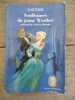
Etat correct
Théâtre de Goethe
Traduction d'Albert Stapfer. Révisée et précédée d'une étude par Théophile Gautier Fils. Joint: GOETHE "Poésies", Paris - Charpentier - 1863 -1 volume in-12 - Traduction par Henri Blaze - 2e édition. Joint: GOETHE "le Faust", Paris - Charpentier - 1866 -1 volume in-12 - Traduction par Henri Blaze - 11e édition. Reliure demi-chagrin vert à coins. Dos à nerfs ornés de fleurons dorés. Tête dorée. Intérieur très propre.
Paris Charpentier 1863 Tome 1: 427 pp.Tome 2: 573 pp.Tome 3: 319 pp. Tome 4: 558 pp. In-12 Reliés 4 volumes Bel ensemble.
Faust et le second Faust de Goethe.
1913 Paris, Crès et Cie, 1913, In-douze, 418 pp, reliure en demi-chagrin marron, dos lisse orné de motifs géométriques dans le style des années "20",reliure signée Seguin d'Angers,tête dorée,
1/1200 ex. Num. Tiré sur Rives, édition avec un portrait et des ornements typographiques dessinés et gravés sur bois par Pierre Eugène Vibert. Coll. "Les Maîtres du Livre" traduction de l'allemand par gérard de Nerval.
LE FAUST de GOETHE. Traduction complète précédée d'un essai sur Goethe. Accompagné de notes et de commentaires et suivie d'une étude sur la mystique du poéme par M. Henri Blaze
Paris Charpentier, Libraire-Editeur 1844 in 12 (18x11,5) 1 volume reliure demi chagrin vert de l'époque, dos lisse orné d'un grand fer doré de style rocaille, tranches peignées, 535 pages, quelques rares rousseurs éparses. Johann Wolfgang von Goethe, 1749-1832. Bel exemplaire ( Photographies sur demande / We can send pictures of this book on simple request )
Bon Couverture rigide
FAUST de GOETHE. Traduction revue et complète, précédée d'un essai sur Goethe par M. Henri Blaze. Édition illustrée par M. Tony Johannot
Paris Michel Lévy Frères, Libraires-Editeurs 1847 grand in 8 (27,5x18,5) 1 volume reliure plein maroquin vert olive, dos à nerfs, couronne dorée au dos en queue, fine dentelle dorée intérieure, filet doré sur les coupes, tranches teintées rouge, portrait gravé de Goethe en frontispice, 373 pages [1], quelques rares rousseurs éparses. Ex-libris J. Sofia Troubetzkoi, Marquesa de Alcanices, Duquesa da Albuquerque de Algeto y de Sesto. Sofia Troubetzkoi, princesse russe, veuve du duc de Morny (demi-frère de l'empereur Napoléon III), épousa en secondes noces en 1868 le duc José Isidro Osorio et Silva-Bazán (Madrid 1825-1909), connu sous le nom de Pepe Osorio, Grand-duc de Sesto, grand aristocrate, homme politique et militaire espagnol. Ce très bel exemplaire à provenance a été relié sans les illustrations de Tony Johannot (9 planches hors-texte sur chine appliqué). Précieux document sur cette alliance aristocratique Hispano-Russe. Bel exemplaire ( Photographies sur demande / We can send pictures of this book on simple request )
Très bon Reliure

