 Write to the booksellers
1769 books for « g andersen »Edit
-
Latest
Last 24h (5)
Last 3 days (35)
Last month (22)
Last week (12)
-
Language
Dutch (1)
English (2)
French (1639)
Russian (127)
-
Century
16th (2)
18th (1)
19th (226)
20th (706)
21st (129)
-
Countries
Belgium (65)
Canada (3)
Denmark (263)
France (1159)
Germany (1)
Switzerland (150)
United States of America (128)
-
Syndicate
ALAC (3)
CLAM (3)
CLAQ (1)
CNE (6)
ILAB (985)
NVVA (8)
SLACES (8)
SLAM (680)
SNCAO (2)
Topics
- Adolescence (2)
- Alexeiff alexandre (2)
- Andersen georges (5)
- Andersen hans christian (1684)
- Archaeology (2)
- Architecture (6)
- Autographs (4)
- Barnyard (2)
- Belperron pierre (4)
- Bertall (4)
- Berty maurice (2)
- Brunelleschi (3)
- Channel channels (2)
- Children’s books (4)
- Children’s books (236)
- Christ (the) (2)
- Christmas (3)
- Comic strip (5)
- Customs (2)
- Denmark (2)
- Dickens charles (3)
- Drawings (2)
- Early printed books (4)
- Economics (2)
- Education (2)
- Entomology (2)
- Esotericism (2)
- Ethic (2)
- Fables (13)
- Fairy tales (11)
- Fantastic (2)
- Feminism (2)
- Fine arts (6)
- First edition (6)
- Genealogy (2)
- History (16)
- Hoffmann (3)
- Illustrated books (6)
- Industrial arts & crafts - fine arts (2)
- Jacob (2)
- Language (34)
- Law (46)
- Lead (1)
- Legends (53)
- Literature (2)
- Magazine (4)
- Manuscripts (2)
- Mermaid (3)
- Miniature (1)
- Modern comic (2)
- Mythology (2)
- Newspapers press (4)
- Perrault charles (29)
- Philosophy (2)
- Photography (2)
- Reading vocabulary (4)
- Review (2)
- Reviews (3)
- River (2)
- Ruth (2)
- Savoir faire (2)
- School (2)
- Sciences (2)
- Scores (3)
- Soldier (1)
- Tales (255)
- Tea (3)
- Testimonies / stories (4)
- Thales (1)
- Theatre (2)
- Topography (5)
- Uriet (5)
- Various (2)
- Vault (1)
- Version (6)
- War (7)
- Youth (67)
ART ET POESIE RUSSES 1900-1930. Textes choisis. Centre Georges Pompidou.
Centre Georges Pompidou Paris 1979 In-4 ( 300 X 210 mm ) de 285 pages, broché sous couverture imprimée rempliée. Illustrations dans et hors-texte. La conception, le choix des textes et les commentaires sont de Troels Andersen et Ksenia Grigorieva. Rédacteurs Olga Makhroff, Stanislas Zadora.Pontus Hulten dans sa préface, signale l'importance des publications concernant l'art et la littérature en Russie et en Union Soviétique pendant les trois premières décennies du XIXe siècle. En Russie, la structure culturelle officielle était sans force réelle et sans racines, et le problème immédiat des jeunes gens révoltés fut beaucoup moins de détruire que de construire. Ce qui fut édifié fut immense.284 noms de Russes et de Français sont évoqués. Très bel exemplaire.

contes d'andersen
Stock Paris 1922 In-12 broché.265 pages.Exemplaire N° 25, un des 75 sur Hollande Van Gelder.Traduction nouvelle d'après le danois par Paul Leyssac.Préface d'Edmond Jaloux.Témoins.Bel exemplaire.

OEUVRES. Tome I.
Gallimard NRF "Bibliothèque De La Pléiade" Paris 1997 In-12 ( 175 X 110 mm ) de CX-1528 pages, pleine basane verte, dos lisse orné de filets dorés, sous rhodoïd et étui illustré. ( Présentation de l'éditeur ). Textes traduits, présentés et annotés par Régis BOYER. Très bel exemplaire.
Jugendleben und Träume eines Italienischen Dichters. - [THE FIRST GERMAN TRANSLATION OF ANDERSEN]
Hamburg, August Campe, 1835. 12mo. Contemporary half calf with richly gilt spine and gilt lines to boards. Spine with wear and some internal brownspotting, otherwise clean and neat. X, 320, (2) pp. Owner's signature to front free end-paper: Julie Carstens 1852.
The very rare first edition of the first German translation of Andersen's first novel, Improvisatoren – the first of Andersen's books to be translated into any foreign language. It is fair to say that no other translation before or after was as important to Andersen as the present. Although not immediately recognizable from the lengthy title, this is in fact the first German translation of Andersen's first novel Improvisatoren, which is considered Andersen's third debut. It appears almost simultaneously with the Danish edition and must have been under preparation at the same time. Improvisatoren is considered one of the most perfect works by Andersen and the work that seriously made him famous, especially in Europe, where he first and foremost came to be known as an eminent author of novels. With his great first novel, Andersen paves the way for the new modern genre of the novel and places himself at the very front of this literary movement. In fact, this novel is perceived to be the first Danish bildungsroman. Improvisatoren also constitutes Andersen's efforts throughout the 30'es to write in a picturesque manner. He is extremely proud to proclaim that due to his novel, his German translator, ""Professor Kruse [...] says that I am the greatest painter and Ørsted says that I should have the brush as well as the pen."" (Letter to Henriette Wulff, March 16, 1835). Andersen is extremely occupied with the novel, in both Danish and German, and focuses greatly upon its reception in both countries. To his extreme joy, Improvisatoren is tremendously well received, and Andersen can hardly believe his success. ""People adore Improvisatoren, everything I say and speak they find terrific, everything I utter an urge for they give me. They ask me what dishes I would like, if I want to drive on trips. You can very well believe that Oehlenschläger at his Prince is not being flattered more than me. It is the first time that I feel the comfort of being a poet."" (Letter to Edvard Collin 5 Juli 1835). Later in the same letter, he asks Collin if he has heard about the German translation and what impressions that is making: ""I long to hear what kind of impression it is making on the Germans."" Before the appearance of the work, Andersen is extremely anxious and extremely occupied with the German translation: ""I so hope it will bring me joy! To hear that it is successful, nothing can be more encouraging, more soothing for my soul and spirit, in that chapter I am very much like my Antonio. You cannot believe how I long to see your translation. It will be ready for the Easter fair, I assume?"" (Letter to Kruse (the translator), April 8, 1835). Later in April 1835, he writes to Henriette Wulff: ""My novel Improvisatoren has now been published in Danish and is being published in German as I write…. Never before has any work by me caught the masses so vividly [...] I am 'on a wave'" but my heart is full of gratitude towards the good God" from him I feel that it is all a gift, a blessing, he has allowed to flow through my soul."" (Letter to Henriette Wulff, April 29, 1835). Before the work even appeared, Andersen had a list of recipients for the German translation. Among these was Adelbert von Chamisso (1781-1838), to whom he wrote in April 1835: ""Here I send you my Italian son"" he speaks the German language, so your family can also understand him. I wish that in the great Germany people will be aware of my book and that I may deserve that awareness. That Kruse is introducing me as an author of novels should be somewhat of a recommendation. [...] For making such an effort of being known outside of little Denmark, I think I cannot be blamed."" According to Möller-Christensen (1993), there was an interaction between the author, his biography and his work – Möller-Christensen calls this interplay ""the golden triangle"" – which resulted in the emergence of a myth early on, influencing and promoting the reception of his work in Germany. Biographical information supported the translated work, and, at the same time, the author consciously made himself available to the media via contacts in the literary world (Möller-Christensen 1991, see also Jørgensen 1996). Indeed, there was, and still is, an “effective synergy between Andersen’s life and work, which continues to influence the dissemination of his works” (Thomsen 2025: 15). Furthermore, the national recognition of Andersen’s work “was fostered by its international circulation rather than the reverse"" (Thomsen 2025: 8). This German translation was the foundation for Andersen's international (and even national) reputation and paved the way for further translations. It was through Andersen’s growing popularity in Germany in the early 1840’s that an interest was ignited in France (Thomsen 2025: 2). The first English translation ""The Improvisatore"" or Life in Italy"" (1845), by Mary Howitt, was based on the German translation (Jørgensen 1996: 18). After the first English translation, Andersen attended a party in England, where he met Charles Dickens, to whom the English translation was already known. According to Paul Binding, some key features in Dickens' David Copperfield (1849-50) can be traced back to Andersen's first novel (Binding 2014). Together with two other novels, (""Only a Fiddler"" and ""O.T."" or, Life in Denmark""), it was part of the late romantic era in Germany, where it was “assessed in light of a contemporary literary discussion […] about the legacy of Romanticism and the new experience of fragmentation associated with modernity.” (Thomsen 2025: 9). It was both criticized for failing “in its romantic project and ended up emphasizing division” and “also praised for not adhering to an exhausted romanticism” (Thomsen 2025: 10). At the same time. in England, the realistic features of Andersen’s writing were highly prioritized. (Thomsen 2025, Jørgensen 1996) Binding, Paul. (2014, 1 January). Reflections after writing – Hans Christian Andersen: European Witness. Museum Odense. https://museumodense.dk/udgivelser/reflections-after-writing-hans-christian-andersen-european-witness/ Jørgensen, Aage (1996). H. C. Andersen i Europas Spejl. zusammenfassung: H. C. Andersen im Spiegel Europas. In Niels Oxenwad (ed.), Andersiana. pp. 5-40. H. C. Andersens Hus, Odense. Möller-Christensen, Ivy York (1993). H. C. Andersens gennembrud i Tyskland. In Johan de Mylius, Aage Jørgensen & Viggo Hjørnager Pedersen (ed.), Andersen og Verden. Indlæg fra den første internationale H. C. Andersen-konference, 25.-31. august 1991. pp. 321-28. H. C. Andersen-Centret, Odense Universitet. Odense Universitetsforlag, Odense. Thomsen, T. B. (2025). Andersen Abroad: Literary Circulation in Nineteenth-Century Europe. Journal of World Literature, 10(2), 193-212. Article 3. https://doi.org/10.1163/24056480-01002003

Ved min Velgører Provst Gutfelds Død. [In: Den Vest-Siællandske Avis eller Slagelse Ugeblad for uden- og inden-landske Historie og Dagens vigtigste Nyheder. Redigeret af Pastor og Ridder Bastholm, Trykt og Forlagt af Peter Magnus. No. 9, 9de Aarg. Løv... - [ANDERSEN'S THIRD PUBLICATION - EXTREMELY RARE]
Slagelse, 1823. 4to. Contemporary turquoise cardboard binding with contemporary handwritten title to spine. The poem is found on column 145. All the issues are numbered continuously throughout: 1676 columns (i.e. 838 pp.). All issues with the same contemporary owner's signature to top of first leaf: ""Neergaard"". An excellent copy.
The extremely rare first printing of the 1823-issues of this slightly obscure newspaper, which contains Hans Christian Andersen's third publication. This exceedingly rare piece of Anderseniana was published, when the master of the fairy tale genre was merely 17 years old, namely in February 1823. Hans Christian Andersen constitutes the greatest Danish author ever to have lived, arguably the greatest author of children's literature in the world, the founder of the fairy tale-genre and one of the most famous authors of all time. He almost singlehandedly put Denmark on the literary world map and gave to mankind a completely new way of writing and viewing the world. However, his road to fame was not straightforward and presumably, no one who made the acquaintance of the awkward and poor teenage Hans Christian Andersen would have predicted the role he came to play in the development of world literature. The present publication constitutes one of the two pieces of publication that are at the epicentre of the coming-to-be of the greatest poet and author to emerge from Danish soil. This little piece is a heartfelt, almost perfectly stylized poem that constitutes an obituary of Hans Christian Andersen's early benefactor, provost Gutfeld (1761-1823), who was responsible for Collin accepting to be Andersen's benefactor. It was due to Gutfeld and his belief in Andersen that he made it on into the world and was taken seriously enough – at the mere age of 17 – to later be allowed to follow his heart and his life dream – that of writing. ""As a poor child in the small but self-satisfied provincial centre of Odense, Andersen received throughout the first 14 years of his life impressions and experiences that were to be decisive for his literary production. In the autobiography of his youth, ""Levnedsbogen"" (not published till 1926), Andersen emphasised that the way of life in Odense had preserved popular old customs and superstitions unknown in Copenhagen and therefore available to him as a colourful stimulus to his imagination. However, even more decisive were the disturbing social experiences from the lowest ranks of society and his own urge to cast off the trammels of poverty, break with his social inheritance and realise his potential in the only outlet the times provided, the world of art, an urge that became ever more dominant throughout his childhood [...] A decisive factor that determined the direction of Hans Christian Andersen's life and his fantastic flight to Copenhagen in 1819, with the social and literary rise that followed, is the fact that, as the only town outside the capital, Odense had a theatre. [...] He left home as a 14-year-old 4 September 1819, a few months after his confirmation, to seek his fortune at the theatre in Copenhagen. [...] During Andersen's first years in Copenhagen (1819-22), he fought desperately to gain a foothold in the theatre as a ballet-dancer, actor or singer. Finally, when none of these attempts succeeded, he tried his hand as a playwright"" this was also in vain, but resulted in the director's deciding to send him to school so that something proper might be made of him, and this experience was thus as decisive for his later life and work as the Odense years."" (The Biography of the Hans Christian Andersen Centre). It was here, in Copenhagen, during the early theatre years, after he'd been cast aside as an actor, cast aside as a dancer, and cast aside as a singer that he wrote his play ""Alfsol"", which he handed in to the theatre in order to have it accepted for performance. But that too was cast aside, with the explanation that the author lacked all forms of education and had clearly never learned to write properly. Dean Gutfeld, however, had gotten to know Andersen and saw the potential in the young boy. Therefore, Gutfeld had spoken well of the uneducated boy and asked the theatre director Collin to look mercifully at it. ""[A] well liked speaker, Dean Gutfeld was alive then and was the one person that spoke most warmly and enthusiastically about my tragedy, which had now been completed. He sent it with a recommendation to the theatre direction and I was floating between hope and fear."" (own translation from Danish in Andersen: Mit Eget Eventyr. Uden Digtning, edt. Topsøe-Jensen, 1942, p. 46). Collin still refused the play, but it was this act of Gutfeld's that made Collin take an interest in Andersen and made him take him under his wings – if any, THE decisive moment in Andesen's life. Collin arranged that, at the expenses of the King, Andersen was sent to Slagelse Latinskole to get proper training and education. In the fall of 1822, Andersen left Copenhagen to go to Slagelse. From then on and throughout the rest of his life, Collin was his benefactor in all aspects of his life. Andersen came to consider him the closest to a father that he had, Collin's home became Andersen's home, and Collin's children his siblings and closest friends throughout his life. But Collin wanted Andersen to study and to learn properly before writing more poetry: ""Collin had mildly and friendly mentioned to me that he wished that during my school years I would not write too many verses"" that became a case of consciousness for me, an outright sin. That first year, I wrote merely one poem – for Gutfeld, who had died. I owed him a lot and I loved the man. The poem was published, without my name, in Slagelse Avis, and this is how Reverend Bastholm came to know me. I lent him my ""Alfsol"" [i.e. Andersen's first publication that was refused by Collin, but which he himself had procured money to publish a few months earlier], he wrote me a friendly letter, in which he encouraged me to study and thus more and more educate my poetic inclination."" (own translation from Danish, in: Andersen: Levnetsbog, edt. Hans Brix, 1926, p. 84). ""Hans Christian was virtually ordered to refrain from writing poetry or engaging in competitions at school until he was certain of his studies in language, grammar, and spelling."" (Jean Hersholt, Catalogue of the Collection of Hans Chritsian Andersen). Thus, only the circumstance of his love for Gutfeld and the gratitude he felt to him for having changed his life by making Collin take him under his wings, made Andersen commit the ""sin"" of writing poetry during school – and thus we have the exceedingly scarce third Andersen-publication, in ""Slagelse Ugeblad"", by the 17-year-old budding writer, who was so eager to write, but who otherwise had to suppress his poetic urges to please his benefactor. The publication is extremely rare and we have never seen a copy of it for sale before. Neither are we aware of any copy on private hands, and we have been able to locate only two other copies on OCLC: one in Odense and one in the Royal Library in Copenhagen. As Andersen-publications go, this is one of the two rarest and one might not come across another in one's life-time. BFN: 6. Not in Hersholt.
Da Spanierne var her [When the Spanish were Here]. Originalt romantisk Lystspil i tre Acter. - [PRESENTATION-COPY - FIRST EDITION IN SCARCE ORIGINAL BINDING]
Kjøbenhavn, 1865. In the original printed paper binding. Some wear to extremities and spine partly missing. Housed in a beautiful custom-made half morocco box with beautifully gilt spine (Mogens Dickow Lund, gilt by Hagel Olsen). Apart from the spine, an excellent copy in the rare original binding. 87 pp.
First edition in the scarce original binding, with a signed presentation-inscription to front free end-paper: ""Hr. Etatsraad Kranold/ Der har har viist dette lille Lÿstspil/ saa særdeles modtageligt, vil/ ikke slaae Haanden af det og/ jeg haaber det holder sin Plads/paa Scenen./ Med Hengivenhed og/ Taknemmelighed/ H.C. Andersen."" (Own translation: ""Mr. Councillor of State Kranold/ Who has shown this little play/ so especially receptive, will/ not cut it off and/ I hope it keeps it place on the scene./ With devotion and gratitude/ H.C. Andersen.""). Rudolph Kranold (1819-1889) was a former councilor of state, who in 1864 was elected director of the Royal Theatre in Copenhagen, a very prestigious title, which he held until 1866. His short reign here coincides exactly with the work on and premiere of one of the plays that was very closest to Andersen's heart, namely ""When the Spanish were Here"", which premiered at the Royal Theatre on April 6, 1865. From the beginning of 1865, Andersen is very occupied by his new play, ""When the Spanish were Here"". Through his diaries, we can actually follow it the whole way through to the stage. It is evident, both from his diaries and from the present presentation-inscription, that the play meant a lot to Andersen. As the inscription indicates, he's anxious that the play not be taken down again and he clearly asks Kranold to take good care of this play that is close to Andersen's heart. Already in January 1865, Andersen writes in his diary that he's read the play to Høedt, who liked it and gave him a few suggestions for improvement (January 30, 1865). In February, 2nd, he notes that he made corrections to the play, and, on the 5th, that Collin has actually made the entire fair copy of the entire play, so that it can be realized as quickly as possible! On the 22nd, Andersen is exalted – he's read the play for Rasmus Nielsen, who ""was very taken with it, considered it the most important of my works in dramatic concerns, that I had elevated myself and that there was dramatic action, poetry, depth, that it was like a Calderonian work, but earthbound in Denmark and in our time. That possibility turned into reality, and that Don Klaus' role here became so full of significance and strength, was so explicit and still the person did not appear in the play."" On the following day, however, Andersen reads the play for the stage actors that are to perform it, and it is not well received by them. Andersen is furious and walks away ""neither depressed nor vexed, merely cooled from the joy I had expected. I will not read for those people any more and have my opinion of them"". The day after, February 24, he describes how Høedt said that he would never have read the play for those people, how he, after the reading, saw the same people at the theatre sneaking away like accomplices, heard them talking in the corners. ""They had naturally not paid attention, and one liked the part of another better, but did not like his own."" And the diary continues with observations about the stages of the play, about the scene decorations, the music, etc, and about various readings of it, with the both positive and negative responses. Positive responses are penciled out in great detail, and negative responses vex him greatly – e.g. on March 20th: ""Depressed all evening"". And the following day ""no more joy in thinking about the Spanish, from which I now expect disappointment"". On March 26th we hear how the trial play completely failed and ""fell apart"", on the 27th, how it's been postponed. On the 30th, we hear that Andersen himself has been ordered not to be present for the next trial play, and on the following day. 31st, he sees in the paper that play is scheduled for neither Saturday nor Sunday, which means that it will not be on his birthday, which he had so hoped for. Spirits are very low. Finally, on April 6th, the play is performed for the first time, and it is sold out. But Andersen writes that he was not well. And people were only susceptible to the comic parts of the play. And no applause for the second act. But Andersen is not too depressed. Both the King, the Queen, the Crown Prince, and Dagmar were in the theatre to watch the play. And the diary continues to recount the critique in the press. We see from the above, how much this play meant to Andersen, how anxious he was about it, and how important it was for him for it to become a success, also on the stage. This explains the inscription for the theatre director, which is quite imploring, in a way we rarely see in inscriptions from Andersen. On April 24 1865, the play appears in print for the first time, and naturally Kranold receives an inscribed copy – imploring him to keep the play it on the stage.
Tre Digtninger. Lykkens Kalosker. En rigtig Soldat. Det har Zombien gjort. - [ANDERSEN'S FIRST ADULT FAIRY-TALE]
Kjøbenhavn, C. A. Reitzel, 1838. Indbundet ubeskåret i et nyere marmoreret papbind med forgyldt titelfelt på forpermen. Enkelte brunpletter.Bound uncut in a later marbled paper binding with gilt title to front board. A bit of brownspotting.


Scarce first edition of Andersen's ""Three Poetical Works"", which contains the first printing on one of his most important fairy tales, ""The Galoches of Fortune"", which is in fact his very first fairy tale for adults, here in the original version (it was later re-written for publication in Andersen's collected fairy tales 1849-50). It appeared while Andersen was still publishing his first fairy tale-collection, namely as early as 1838, and constitutes the 18th fairy tale that he publishes, predating e.g. ""The Steadfast Tin Soldier"". ""The Galoches of Fortune"" is of the utmost importance to the development of Andersen's fairy tale writing and his style of writing. It is not only his first grown-up fairy-tale, it is also the first, in which he works with dividing a fairy tale into chapters, here bound together by the galoche-motive as the red line. This highly important fairy tale was so important that even though it differs in style from the other fairy tales for children that appeared during the same period, it needed to be included in the great collection of Andersen's fairy tales that appeared in 1849-50. But for this publication, the fairy tale needed re-writing, both linguistically and stylistically, and thus it is only in the present publication that we have it in its original version.""The Galoches of Fortune"" was very important to Andersen himself, who mentioned it in several letters while he was working on it. In a letter to Ms. Hanck, dated March 16 1938, he talks about his ""Three new poetical works"""" ""The first (i.e. The Galoches of Fortune"") is a fairy tale and I think the most satirical one I have written as well as some of the most phantastic that our literature holds."" - Clearly showing the importance that Andersen himself bestowed upon the work. In a letter to Henriette Hanck, dated February 10 1838, he emphasized that ""The Galoshes of Fortune"" were ""not for children"". As the fairy-tale is more in line with the ""Hoffmann-like imagination"" that we also see in ""A Walking Tour"" than with the spirit and style of the Fairy Tales for Children, Andersen himself also had some anxieties about it, however, and wrote to Frederik Læssøe on February 23 1938 ""I'm working on a fairy-tale, but now regret these juggling acts with the golden apples of imagination"".His anxieties world prove not to be completely unfounded. The work was widely read, but it also caused quite a bit of controversy. Kierkegaard, for instance, hated the work and harshly criticized its satirical features. As ""The Galoches of Fortune"" appear in May 1838, Kierkegaard's first work, ""From the Papers of one Still Living"", appears in September the same year. That work constitutes his long, sharp critique of Hans Christian Andersen, in which he ridicules Andersen and the genre of fairy tales in general. Kierkegaard furthermore denies that Andersen has any aptitude as a novelist and accuses him of not having ""philosophy of life"". Andersen had already heard rumours of the book on 30th August and felt martyred at the thought of what lay ahead.The dramatic poem ""A Real Soldier"" was submitted to the Royal Theatre in April 1836, but returned in May of the same year. BFN 320.
Fodreise fra Holmens Canal til Østpynten af Amager i Aarene 1828 og 1829. - [ANDERSEN'S ""REAL"" DEBUT]
Kjöbenhavn, 1829. 12mo. Bound with the original wrappers in a lovely slightly later burgundy red half calf with richly gilt spine and marbled covers. A few stains to wrappers and brownspotting to text. In spite of the spotting, all in all a lovely copy. 136 pp. Ex-libris on pastedown: ""Hyllested"". Glued note on the last endpaper.
The rare first edition of Hans Christian Andersen's debut novel, ""Journey on Foot"", here in the extremely scarce original printed wrappers. Andersen himself considered this book his debut and refers to it as ""my first publication"". It came to play a tremendous role in the development of his writing and constitutes one of his most important works. It is the first piece of Andersen that yields any success and the first work for which he gained any recognition. ""It is a well-known fact that Hans Christian Andersen made his début as a writer three times during his youth. The first time he published a book was in 1822, when 'Youthful Attempts' came out [...]. He was 17 years old, penniless and in need for help, but the main part of the circulation ended up in the paper mill [...] The second time he made his début was in 1829, when he published 'Journey on Foot from Holmen's Canal to the Eastern Point of Amager', a book which can hardly be classified as a travel book. To me it seems a subtle and humorous arabesque and a literary satire. This book was published in the year after he had left grammar-school and was qualifying for the entrance examination to academic studies at the university. It can rightly be regarded as a key, which enables us to understand the entire development of his later production [...]. It was Carl Bagger, his friend from the school days, who had instigated him to cultivate his inborn talent for satire, and during the same year he published 'Journey on Foot' they met regularly together with a third mate in the 'Serapionsclub' to which Andersen showed up with a piece of paper sticking out of his pocket. As a free writer it was the fantastic arabesque à la E. T. A. Hoffmann, which came into the centre of their poetic endeavour. What he had learned from Bernhard Severin Ingemann, his fatherly friend, talked about to Carl Bagger and read in Hoffmann, Jean Paul and Ludwig Tieck, he laid out in his book, which as a mixture of an autobiography in disguise and an allegorical satire contains all the basic motifs of his poetic world as a raw material."" (Kofoed) In ""The Fairy Tale of My Life"", Andersen writes: ""Having passed my examinations, the multicoloured fantasies and inventions by which I had been haunted on my walking tours back from my coach, flew like a swarm of bees out in the world in my first publication: 'Journey on Foot from Holmen's Canal to the Eastern Point of Amager', a humours, weird book, a kind of fanciful arabesque, yet perfectly indicating my whole personality and my views at that time."" ""'Journey on Foot' is a grotesque and serious satire foreseeing the deluge of letters in a mass society, and this issue is in my opinion not only superior as a motive in Andersen's first book but also an overall theme in his entire production. A kind of grotesque humour is one of the characteristics of the arabesque, and if we take a look at the collected tales we may easily sort out a series of narratives typical of the same fluttering, self-ironical and even prophetic style."" (Kofoed) See: Kofoed, Niels. (1999). ""The Arabesque and the Grotesque: Hans Christian Andersen Decomposing the World of Poetry"". In Johan de Mylius, Aage Jørgensen and Viggo Hjørnager Pedersen (ed.), Hans Christian Andersen. A Poet in Time. Papers from the Second International Hans Christian Andersen Conference 29 July to 2 August 1996. The Hans Christian Andersen Center, Odense University, Odense University Press. BFN: 22.
Dryaden Et Eventyr fra Udstillingstiden i Paris 1867 [La Dryade Un conte de fées de l'Exposition de Paris 1867]
Kjobenhavn [Copenhague] 1868 | 12 x 18.7 cm | Relié
Édition originale. Reliure en plein papier rocaille, pièce de titre en maroquin havane, couvertures originales conservées. Dos, coins et mors légèrement frottés, tache sans gravité en marge du second plat de couverture conservé. Rare édition originale du conte dAndersen sur une dryade au sort tragique, souvent comparé à La Petite Sirène (1837). Les deux mettent en scène un esprit féminin de la nature qui aspire à quitter sa forme pour rejoindre le monde des hommes, avec des conséquences fatales. Lexemplaire est exceptionnellement enrichi dun envoi autographe dHans Christian Andersen: «Fru Grøn. En venlig Erindring om Udstillingstiden i Paris 1867. Ærbødigst H. C. Andersen.» [à Madame Grøn / en souvenir affectueux de lexposition de Paris en 1867. Avec toute mon estime. H. C. Andersen.]. Andersen fit un séjour à Paris en 1867, qui lui inspira cette histoire se déroulant lors de lExposition universelle. Cest à cette occasion quil rencontra la dédicataire Ada Grøn (française dorigine, née Courtois), sa petite fille et son mari le grossiste danois L. J. T. Grøn. Cet envoi est consigné par Andersen dans une entrée de son journal en date du 28 avril 1870, publiée par le H. C. Andersen Centret d'Odensee. * Du 15 avril au 9 mai 1867, Hans Christian Andersen visita lExposition universelle de Paris et sen émerveilla: «Ce serait un simplisme ridicule de simaginer Andersen en préécolo, un faune sentimental, éthéré, uniquement sensible à la nature. On ne peut ici que le noter en passant, car cela mériterait tout un essai. Andersen envisage le monde de façon globale, non hiérarchisée et surtout dénuée de tout passéisme [...] La science de son temps le fascinait et excitait ses curiosités et ses engouements: léblouissement de lélectricité, le microscope, bien sûr, qui fait voir au-delà des apparences, la photographie et toutes les inventions qui sannoncent et exaltent la vitesse, lanimation des images, le vol. En effet, lépoque était bien celle du conte et sa matière nétait pas prête à se raréfier.» (Isabelle Jan, «Andersen, écrivain de toujours», La Revue des Livres pour Enfants, n° 226). La Dryade illustre tout à fait labondance dinspiration que lui procure sa visite parisienne. Andersen traduit son expérience de la vie moderne entre exaltation et scepticisme à travers le personnage dune dryade, esprit féminin dun arbre, qui vit dans un vieux chêne dans la campagne française, et rêve de découvrir le monde des hommes. Un jour, son vu est exaucé: un événement exceptionnel permet à son arbre dêtre transporté et replanté au cur de lExposition universelle de Paris. Libérée de ses racines, la dryade peut désormais observer la vie humaine de près. Elle découvre la ville, ses splendeurs, son art, ses plaisirs et ses souffrances. Mais ce privilège a un prix: détachée de son sol dorigine, la dryade est vouée à mourir jeune. Son existence terrestre, brève mais intense, sachève dans une dernière vision de la beauté et de la douleur du monde. On ne peut que constater les similarités avec des grands chefs-duvre du conteur, et notamment le leitmotiv qui fit sa célébrité: le puissant désir de ses personnages de changer leur nature. Comme le remarque Ane Grum-Schwensen: «Dans le cas dAndersen, cest comme si un recyclage très conscient déléments intertextuels internes sopérait pour créer un réseau plus vaste reliant les uvres entre elles. Ce fonctionnement devient évident lorsque par exemple, dans «les archives», on trouve une note décrivant les liens réciproques existant entre les nombreux éléments utilisés par Andersen dans La Dryade, La Petite Sirène, La Vierge des glaces et La Reine des Neiges», (Ane Grum-Schwensen, «Images littéraires et recyclage dans les manuscrits dAndersen», Genesis, 48, 2019). Précieux envoi de Hans Christian Andersen, dont le nom est familier à tous les enfants dhier et daujourdhui. Cet exceptionnel exemplaire fut adressé à lune des rares personnes qui assist

Fodreise fra Holmens Canal til Østpynten af Amager i Aarene 1828 og 1829. Andet Oplag. (Forøget af Forfatteren).
Kjøbenhavn, C. A. Reitzel, 1829. Bound in a contemporary slightly worn half calf with gilt spine. Some wear to hinges and capitals. Previous owner's signature to top of title page. Some brownspotting. Last leaf restored to inner margin.


The rare second issue of Hans Christian Andersen's debut novel, ""Journey on Foot"", here in the extremely scarce original printed wrappers. Andersen himself considered this book his debut and refers to it as ""my first publication"". It came to play a tremendous role in the development of his writing and constitutes one of his most important works. It is the first piece of Andersen that yields any success and the first work for which he gained any recognition.""It is a well-known fact that Hans Christian Andersen made his début as a writer three times during his youth. The first time he published a book was in 1822, when ""Youthful Attempts"" came out... He was 17 years old, penniless and in need for help, but the main part of the circulation ended up in the paper mill...The second time he made his début was in 1829, when he published ""Journey on Foot from Holmen's Canal to the Eastern Point of Amager"", a book which can hardly be classified as a travel book. To me it seems a subtle and humorous arabesque and a literary satire. This book was published in the year after he had left grammar-school and was qualifying for the entrance examination to academic studies at the university. It can rightly be regarded as a key, which enables us to understand the entire development of his later production...It was Carl Bagger, his friend from the school days, who had instigated him to cultivate his inborn talent for satire, and during the same year he published ""Journey on Foot"" they met regularly together with a third mate in the ""Serapionsclub"" to which Andersen showed up with a piece of paper sticking out of his pocket. As a free writer it was the fantastic arabesque à la E. T. A. Hoffmann, which came into the centre of their poetic endeavour. What he had learned from Bernhard Severin Ingemann, his fatherly friend, talked about to Carl Bagger and read in Hoffmann, Jean Paul and Ludwig Tieck, he laid out in his book, which as a mixture of an autobiography in disguise and an allegorical satire contains all the basic motifs of his poetic world as a raw material."" (Kofoed)In ""The Fairy Tale of My Life"", Andersen writes: ""Having passed my examinations, the multicoloured fantasies and inventions by which I had been haunted on my walking tours back from my coach, flew like a swarm of bees out in the world in my first publication: ""Journey on Foot from Holmen's Canal to the Eastern Point of Amager"", a humours, weird book, a kind of fanciful arabesque, yet perfectly indicating my whole personality and my views at that time.""""""Journey on Foot"" is a grotesque and serious satire foreseeing the deluge of letters in a mass society, and this issue is in my opinion not only superior as a motive in Andersen's first book but also an overall theme in his entire production. A kind of grotesque humour is one of the characteristics of the arabesque, and if we take a look at the collected tales we may easily sort out a series of narratives typical of the same fluttering, self-ironical and even prophetic style."" (Kofoed)See: Kofoed, Niels: ""The Arabesque and the Grotesque - Hans Christian Andersen Decomposing the World of Poetry"" , In: Johan de Mylius, Aage Jørgensen and Viggo Hjørnager Pedersen (ed.): ""Hans Christian Andersen. A Poet in Time. Papers from the Second International Hans Christian Andersen Conference 29 July to 2 August 1996."" The Hans Christian Andersen Center, Odense University, Odense University Press. 576 pages, Odense, Denmark 1999.A good copy with the often missing half title which is not mentioned by Birger Frank Nielsen.BFN 27.
Nye Eventyr og Historier. 3 Series, 10 collections. [All that was issued, fully complete i.e. (1. Række, (1.)-4. Samling + Anden Række, (1.)-4. Samling + Tredie Række, Ny Samling & Anden Samling). - [MAGNIFICENT COPY OF ANDERSEN'S THIRD FAIRY TALE COLLECTION IN COMPLETELY ORIGINAL CONDITION AND WITH A PRESENTATION-INSCRIPTION]
Kjøbenhavn, 1858-1872. All ten Collections (i.e. issues) in the original printed wrappers, uncut, and housed in three beautiful, uniform red half morocco boxes with beautifully gilt spines. Each ""Række"" (i.e. Series) housed in a box of its own and each box with its own gilt ornamentation to lower part of spine. The boxes are signed Rigmor Birkedal Kragh (the renowned Danish book binder). Ex-libris inside the box: ""Hyllested"". Række: 1st issue loose and without the back wrapper. Front wrappers frayed at the edges. Some brownspotting and damp staining. 2nd, 3rd and 4th issues in truly splendid, near mint condition. Række: All four issues in truly splendid condition. The front wrapper of the 4th issues is slightly soiled, otherwise they are all near mint. The third and four issues have the very rare advertising-pamphlets from Reitzel (the publisher) laid in at the front and end respectively. These advertising pamplets were only issued for these two issues. They are hardly ever present. Række: Both issues with worn spines and frayed at edges. Front wrapper of 1st issue and back wrapper of 2nd issue with marginal re-enforcements fron verso. Light brownspotting to the 2nd issue, and virtually no brownspotting to the 1st. 2ND ISSUE WITH A SIGNED PRESENTATION-INSCRIPTION FROM THE AUTHOR TO THE HALF-TITLE. All in all, a truly magnificent set, WITH ALL TEN ISSUES IN THE ORIGINAL PRINTED WRAPPERS, which is a true scarcity.
A splendid fully complete copy of Andersen's third fairy tale collection, WITH ALL 10 ISSUES IN FIRST EDITIONS, FIRST ISSUES, ALL IN THE ORIGINAL PRINTED WRAPPERS, AND ONE OF THEM WITH A SIGNED PRESENTATION-INSCRIPTION BY ANDERSEN - WITH 39 FAIRY TALES IN THEIR FIRST PRINTINGS. Also including the two extremely rare advertising pamphlets that are hardly every present. The ten issues contain altogether 61 fairy tales and stories, of which 39 are printed here for the first time – among these ""Hvad Fatter gør er altid det Rigtige"" (What the Old Man Does is Always Right), ""Sneemanden"" (The Snow Man), ""Isjomfruen"" (The Ice Maiden), ""Psychen"" (The Psyche), ""Gjemt er ikke glemt"" (Kept Secret but not Forgotten), ""Skrubtudsen"" (The Toad), etc., etc. It is highly uncommon to find all ten issues of the series together, let alone in the original printed wrappers, each of which is a scarcity on their own. To our knowledge, only one other such set exists in a private collection, and this is in far from as fine condition as the present, where all but one of the issues (which does not have the back wrapper) are fully complete with the spines, exactly as issued. The presentation-inscription in the last of the issues reads ""Digteren, Vennen/ M. Rosing i/ Sorø en hjertelig Tak fra/ H.C. Andersen"" (i.e. ""The poet, the friend/ M. Rosing in/Sorø a heartfelt thank you from/ H.C. Andersen""). MICHAEL ROSING (1830-1904) was a well-known poet and author, who debuted in 1858 with Nogle Smaadigte. Af en Student. (""Some Smaller Poems from a Student""). He was a true post-romantic, and especially his poetry constitutes excellent examples of the emerging modernity in literature. He was a teacher at Sorø Academy, where he lived in Ingemann's house. Andersen had known Michael Rosing, since he was a child and long before Rosing began writing. The two were good friends and corresponded and saw each other regularly. In his diaries from 1872, Andersen writes on November 11th that Rosing had sent him his latest book Frelst (i.e ""Salvaged""), which had just appeared in print. It is this book that Andersen thanks him for in the presentation-inscription on the pamphlet of fairy tales that had also just appeared, in 1872. On November 27th 1872, Andersen writes in his diary: ""Sent... Book and Letter to Micahel Rossing in Sorø."" (p. 361). On November 29th, he writes in his diary that he ""received an incredibly warm, beautiful letter from the poet Rossing in Sorø"" (p. 363) – i.e. as a thank you for the present presentation-copy. BFN 767, 774, 782, 794, 817, 828, 890, 910, 1017, 1023. Hersholt: 28.
Gesammelte Märchen. - [PRESENTATION COPY]
Leipzig, Carl B. Lorck, [1848?]. 12mo. Bound in the original richly gilt and blindstamped full cloth binding. All edges gilt. Minor wear to outer hinges, neatly restored. Inscribed by Andersen to front free endpaper: ""Kunstnerinden / den elskværdige Madam / Rosenkilde / bringer jeg denne Bouquet / fra min Digterhave / Nytaarsmorgen / 1852. / H. C. Andersen."" ('To the artist, the amiable Madam Rosenkilde, I bring this bouquet from my garden of poetry / New Year's Morning / 1852. / H. C. Andersen'). (8), 448 pp.

A beautiful copy of the rare pocket edition, without Vilhelm Pedersen's illustrations, of Carl B. Lorck's German edition of Andersen's collected fairy tales. The edition is undated, but according to the Hans Christian Andersen Centre, it was printed in 1848, a year after the first volume of the first German edition of Andersen's collected works. The present copy is inscribed by Andersen to the renowned Danish actress Julie Weber Sødring, born Rosenkilde (1823-1894). Rosenkilde was a dear friend of Andersen and is mentioned frequently in his diaries. The copy once belonged to the Danish historian Theodor Alfred Müller (1865-1950), who passed it on to Kamma Roos (1886-1973), wife of the prominent literary historian Carl Roos (1884-1962). In 1968, Kamma gifted it to the distinguished Danish librarian and Andersen collector Erik Dal (1922-2006).
Nye Eventyr. 2 Bind (5 samlinger). (Alle samlinger i 1. oplag, også den første, som indeholder ""Den grimme Ælling""). [New Fairy Tales. Complete with all five collections in two volumes, all in first issue, also the first, which contains ""The Ugly Duck... - [THE EXCEEDINGLY RARE TRUE FIRST PRINTING OF ""THE UGLY DUCKLING""]
Kjøbenhavn, 1844 - 48. Bound together in one contemporary half calf with richly gilt spine. Upper hinges are slightly wear, but binding is fine and tight. Occasional light brownspotting, but overall a lovely copy. The present collection contains the joint title-page for vol. 1 (dated 1845), the contents leaf for vol. 1 (for all three collections), the joint title-page for vol. 2 (dated 1848), and the contents leaf for vol. 2 (for both collections) Vol. 1, collection 1 also contains: the rare first state title-page (with no mention of neither volume nor collection, dated 1844), dedication leaf, and all the separate half-titles for each individual fairy tale. Vol. 1, collection 2 contains: Joint title-page, dedication leaf, and all the separate half-titles for each individual fairy tale. Vol. 1, collection 3 contains: Joint title-page, dedication leaf, and all the separate half-titles for each individual fairy tale. Vol. 2, collection 1 contains: Title-page, dedication leaf, and all the separate half-titles for each individual fairy tale. Vol. 2, collection 2 contains: Title-page, and all the separate half-titles for each individual fairy tale. All five collections were issued separately and all came with individual titles, half-titles, contents, and dedications. As they were also issued in the two volumes, title-pages for these volumes as well as joint contents for the entire volumes were then also issued. Thus, in all contemporarily bound copies of the fairy tales, many of these leaves for the individual collections were discarded when bound – e.g. it was redundant to have the separate contents leaves for the separate collections, when one had the joint contents leaf for each volume, which also goes for the extra half-titles. No two copies are alike in this regard and there is no talk of completeness – as long as the title-pages and one of the kinds of content leaves are present, it is as it should be.
First edition of Hans Christian Andersen's seminal second collection of fairy tales (Nye Eventyr) - the publication that caused him international fame - with all five collections in first issue, also the first, which is of the utmost rarity. It is in this legendary first collection that we find the first printing of ""The Ugly Duckling"" (not as is indicated in PMM in his first fairy tale collection, which does not contain his most important fairy tales). The rarity of the first issue of volume 1, collection 1, is legendary. It was published on November 11th 1843 (dated 1844 on the title page) in a very small number, probably due to the poor sales of Andersen's first fairy tale collection (Eventyr, fortalte for børn). Against all belief, this first collection sold out within a few days, catapulting Andersen into worldwide fame, and a second issue was published already on December 21st 1843. Thus, only very few copies of the first issue exist, and almost all collections of the ""New fairy Tales"" are bound with the second issue or the third of 1847, meaning that they do not contain the actual first printing of ""The Ugly Duckling"", ""The Nightingale"", ""The Angel"", and ""The Sweethearts"". Only the present two volumes of ""Nye Eventyr"" were issued, the first containing three collections, and the second containing two collections. This is thus a complete collection of the entire set in first editions, first issues. This seminal collection contains the first printings of Andersen's most famous and cherished fairy tales, e.g.: ""The Ugly Duckling"", ""The Angel"", ""The Nightingale"", ""The Pine Tree"", ""The Snow Queen"", ""The Shadow"", ""The Story of a Mother"" etc. etc. It is interesting to note that the Hans Christian Andersen-entry in Printing and the Mind of Man is that of ""Eventyr fortalte for Børn"" (""Fairy Tales related for Children""), Andersen's first fairy tale collection published 1835-42, but that the PMM headline is ""The Ugly Duckling"", which actually first appears in the second fairy tale collection, which we have here. Thus, to be fair, the actual PMM entry ought to have been the second fairy tale collection: ""Success at home was slow. ‘Fairy Tales related for Children’, published in parts from 1835 at 4d. apiece and collected in 1837, were regarded by the author himself as mere bagatelles thrown off by a dubious kind of sleight of hand in the intervals of establishing himself as a greater poet than Oehlenschläger and a greater dramatist than Heiberg. To the end of his life he regarded them at best with tolerance and refused to admit that his international reputation rested on them. Most of the leading critics treated them contemptuously, regarding them as yet further evidence of the incapacity of an author of whom they had no great opinion in any case. Between 1838 and 1848 Andersen turned out several more volumes of tales, frequently accepting books instead of money as payment... it was not until 1843/4 that the appearance of ""The Ugly Duckling"" swept him into general favour. H.C. Oersted the scientist (282) and Thorvaldsen the sculptor were enthusiastic admirers of the tales, matinée readings of them were given at the Royal Theatre at Copenhagen"" but is was their swiftly achieved success abroad that first brought them local notice..."" (PMM 299).
Digte. - [FIRST PRINTING OF ANDERSEN'S FIRST FAIRY TALE]
Kjöbenhavn (i.e. Copenhagen), 1830. Contemporary brown half calf with gilt lettering and ornamentation to spine. End-paper renewed. Ex-libris to pasted down front end-paper. First three leaves with small repairs (not affecting text) and reinforced in margin, otherwise internally nice and clean.
The rare first edition of the first published collection of Andersen's poetry - Andersen's third published book (at the age of 25) - containing, at the end, the first printing of any of his fairy tales, being also his very first fairy tale, ""Dødningen, et fyensk Folke-eventyr"" (i.e. ""The Ghost"" (also sometime ""The Spectre""), ""A Folk- Fairy Tale from Funen""). This is the first time that Andersen uses the term ""Eventyr"" (fairy tale), the term which came to denote the genre for which he received world-wide fame as one of the most important writers of all time. ""The Ghost"" was later rewritten and published for the second time in Andersen's first fairy tale collection, ""Eventyr fortalte for Børn"" (PMM 299), 1835, under the title ""The Travelling Companion"". As Andersen would later explain, his first fairy tale was based upon a folk tale from Funen he had heard as a child. This seminal publication lays the foundation for Andersen's activity as an author of fairy tales. This collection furthermore contains 46 poems, 20 of which are published here for the first time (the rest were published separately in various periodicals). BFN 51.
Eventyr, fortalte for born. Rare recueil réunissant l’édition originale de deux des principaux contes d’Andersen : "La petite sirène" et "Les Habits neufs de l’empereur."
Véritables créations littéraires, dans un style très personnel, ces contes sont remarquables par leur ironie et l’absence des morales traditionnelles. Copenhague, Bianco & Schneider for C.A. Reitzel, 1842-1844-1837.3 parties en 1 volume in-16 de : VIII pp. avec le titre général, la table générale et la préface (« Til de aeldre Laesere »), (2) ff., 61 pp., (1) f. de table, pp. 3 à 76 (sans le faux titre de cette partie), (1) f., 60 pp. et (1) f. Relié en chagrin rouge, dos lisse. Quelques feuillets roussis.126 x 77 mm.
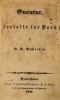
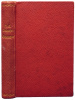
L’un des rares exemplaires du recueil réunissant pour la premiere fois 9 des principaux contes d’Andersen.Le premier opuscule regroupe 4 contes en second tirage (1842) : « Fyrtoiet »(Le Briquet), « Lille Claus og store Claus » (Grand Claus et petit Claus), « Prindsessen paa Aerten » (La Princesse au petit pois) et « Den lille Idas Blomster » (Les fleurs de la petite Ida).La seconde partie présente 3 contes également dans le deuxième tirage (1844) : « Tommelise » (La petite Poucette), « Den uartige Dreng » (Le vilain garçon) et « Reisekammeraten » (Le compagnon de route). Le troisième recueil comporte l’édition originale de deux des contes les plus celebres d’Andersen : « La petite sirène » et « Les habits neufs de l’empereur » (« Den lille Havfrue » et « Kejserens nye Klaeder »). Les premiers contes d’Andersen furent seulement publiés à 200 exemplaires, ce qui explique leur grande rareté sur le marché. Les quelques exemplaires qui sont parvenus jusqu’à nous présentent presque tous une compilation des différents tirages de ces contes ; d’autre part, ils sont rarement complets de tous les feuillets de titre, de faux titre et de table.Le collectionneur Jean Hersholt écrivait d’ailleurs en 1954 que « no copy with all its title-pages and tables of contents has ever been offered for sale by any dealer or at any auction sale”. « The tales of Hans Christian Andersen are unique. Unlike Perrault’s and Grimm’s, his stories were original inventions […] The “Eventyr” are fairy tales of supernatural creatures and fantastic happenings. […] Over and above their intrinsic merit Andersen’s stories signalized a new and fundamentally different approach to the writing of books for children. Mawkishness, didacticism, and moral proselytizing were totally abjured and he was the harbinger of a new era in this genre” (Printing and the Mind of Man, n°299). Hans Christian Andersen (1805-1875) est un écrivain danois qui, grâce à ses nouvelles et à ses Contes, incarne le génie populaire nordique. C’est à trente ans, après le traditionnel voyage en Italie que se doit d’accomplir tout jeune écrivain romantique, qu’il publie un court recueil de « Contes pour les enfants » (Eventyr fortalte for Born). D'autres parties, complétant le premier volume, apparurent en 1837.Après un départ hésitant, le succès fut foudroyant et, en quelques années, le petit vagabond d’Odense allait devenir l’un des écrivains les plus fêtés du monde. Véritables créations littéraires, dans un style très personnel, ces contes sont remarquables par leur ironie et l’absence des morales traditionnelles. Bon exemplaire de ce recueil rare et recherché qui comporte la première impression de deux des contes les plus importants d’Andersen : « La petite sirène » et « Les habits neufs de l’empereur ».
Eventyr fortalte for Børn. (1.-3. Hefte) + Eventyr fortalte for Børn. Ny Samling (1.-3. Hefte). 2 Bind. [I.e. Fairy Tales Told for Children. 6 issues, divided into two volumes - all that was issued]. - [INAUGURANTING THE FAIRY TALE-GENRE]
Kjöbenhavn, 1837-1847. Bound in one nice contemporary half calf binding with blindstamped and gilt ornamentation to spine. Gilding vague, also the gilt title. Minor bumping to corners. Internally a bit of scattered brownspotting, but overall unusually nice, clean, and fresh. A truly excellent copy. See collation below.
A magnificent set - unusually nice and clean and bound together in a contemporary binding, which is almost never the case - of the first edition of this exceedingly rare collection of Andersen's earliest fairy tales. This legendary fairy tale-collection that created the fairy tale-genre and brought Andersen international fame, consists in six parts that together make up two volumes. As with most of the other few existing copies, the present set is a mixture of issues (though here, merely two of the parts are in second issue). ""With the passing of each year, Andersen's genious brought forth new ""wonder stories"", and the fame he had so desperately craved and striven for became a reality. Little did he know in the spring of 1835, when he all but had to beg his publisher to accept these remarkable tales, that one day they would make him immortal. And little did the critics, nearly all of whom advised him to give up his ""experiment"" and devote himself to his other writings, ever dream that they would live to see him gain world acclaim for these tales. For almost a hundred years now, generation after generation has been brought up on Andersen's stories. Take the English-speaking world, for instance. Since the first appearance of Andersen's Fairy Tales in London and New York, in 1846, over seven hundred different editions, including dozens of varied translations, illustrated by more than a hundred different artists, have been published in the United States alone. Indeed, Andersen's stories will live on as classics - as much part of our civilization as the two primary educational factors, reading and writing."" (Jean Hersholt, p. 27). Due to the fact that the six little pamphlets together, printed in different years, all have their own title-pages, half-titles, contents, etc. and that there were then also printed all of this for each volume of three (times two) together, the book binders almost always removed several of these ""extra"" leaves, as they seemed superfluous. It was never the intention of the publisher that the single half-titles, title-pages or tables of contents be preserved. However, due to the many different laves that were deemed ""superfluous"" or not, all existing sets of these two little volumes have their individual mix-up of half-titles, titles, and tables of contents. Thus, no copies are known to exist with all leaves present. ""During Andersen's lifetime 162 of his Fairy Tales were published, but the scarcest and most difficult to obtain are these six little pamphlets. We do not know exactly how many, or how few, copies were printed, but we do know that no copy with all the title pages and tables of contents has ever been offered for sale by any dealer or at any auction. To my knowledge, only five or six complete copies of the first printings (1835-1842) still exist. Even the second printing of the six pamphlets in their entirety (1842-1847) is exceedingly scarce and difficult to obtain."" (Jean Hersholt).Here follows a collation including mention of issues and lacunae: Vol. I: VIII pp. (joint title-page (dated 1837) for the three parts, contents-leaf for all three parts, and preface (""Til de ældre Læsere""). The joint half-title merely stating ""Eventyr for Børn"" has not been bound in.First Part: 61 (including the title-page), (3) (blank verso of p. 61 and the contents-leaf for part one) pp. The half-title has not been bound in. Second issue, 1842.Second Part: 76 (including half-title and title-page), 2 (contents-leaf for part two) pp. + 1 f. (blank). Second issue, 1844.Third Part: 60 (including half-title and title-page) pp., 2 (contents-leaf for part two) pp. + 1 f. (blank). First issue, 1837.Vol. II: 3 ff. (joint title-page, dedication-leaf (for Mrs. Heiberg), contents-leaf for all three parts). First Part: 58 (including title-page), (2) (contents-leaf for part one) pp. The half-title has not been bound in. First issue, 1838.Second Part: 53 (including title-page), (3) (verso of p. 53 and contents-leaf for part two) pp. The half-title has not been bound in. First issue, 1839.Third Part: 49 (including title-page), (3) (verso of p. 49 and contents-leaf for part three) pp. The half-title has not been bound in. First issue, 1842..This is one of the most complete copies we have ever seen, as the only leaves not withbound are some of the half-titles. Usually a lot more leaves have been left out by the binders, and it's even rare to find copies that have all title-pages. The separate contents-leaves are very rarely found preserved in copies that have the joint contents-leaves, and the blank leaves are almost never withbound. BFN: 266" Hersholt: 23 PMM: 299.
Improvisatoren. Original Roman i to Dele. - [ANDERSEN'S DEBUT NOVEL]
Kiøbenhavn, C. A. Reitzel, 1835. Bound in two lovely, uniform, contemporary half calf bindings with richly gilt spine. Hinges expertly restored. An excellent copy, printed on fine paper. Indbundet i to nydelige samtidige ensartede halvlæderbind med rig rygforgyldning. False særdeles pænt restaureret med de originale rygge bevaret. Tidligere ejers navnetræk på forsatsbladene. Med begge smudstitelblade samt errata. Få spredte brunpletter ellers ren indvendig. På velinagtigt papir. Med forgyldt superexlibris på indersiden af forpermerne. Et særdeles fint eksemplar.


Scarce first edition of Andersen's third debut, his first novel, which brought him fame as one of the foemost novel-writers. ""Improvisatoren"" is considered one of the most perfect works by Andersen and the work that seriously made him famous, especially in Europe, where he first and foremost came to be known as an eminent author of novels. With his great first novel, Andersen paves the way for the new modern genre of the novel and places himself at the very front of this literary movement. ""Improvisatoren"" also constitutes Andersen's efforts throughout the 30'es to write in a picturesque manner. He is extremely proud to say due to his novel, his German translator, ""Professor Kruse [...] says that I am the greatest painter and Ørsted says that I should have the brush as well as the pen."" (Letter to Henriette Wulff, March 16, 1835). Andersen is extremely occupied with the novel and focuses greatly upon its reception. To his extreme joy, ""Improvisaoren"" is tremendously well received, and Andersen almost cannot believe his success. ""People adore Improvisatoren, everything I say and speak they find terrific, everything I utter an urge for they give me. They ask me what dished I would like, if I want to drive on trips. You can very well believe that Oehlenschläger at his Prince is not being flattered more than me. It is the first time that I feel the comfort of being a poet."" (Letter to Edvard Collin 5 Juli 1835). Later in the same letter, he asks Collin, if he has heard about the German translation and what impressions that is making - ""I long to hear what kind of impression it is making on the Germans.""In April 1835, he writes to Henriette Wulff: ""My novel Improvisatoren has now been published in Danish and is being published in German as I write... Never before has any work by me caught the masses so vividly,... ""I am ""on a wave""" but my heart is full of gratitude towards the good God" from him I feel that it is all a gift, a blessing, he has allowed to flow through my soul."" (Letter to Henriette Wulff, April 29, 1835). BFN 264.
"EXNER, JULIUS & CHRISTIAN WINTHER - HANS CHRISTIAN ANDERSEN
Reference : 59791
(1862)
Billeder og Vers. Billederne tegnede med Pen paa Steen af J. A. Kittendorff i Tegner & Kittendorffs lithographiske Institut. - [INSCRIBED BY HANS CHRISTIAN ANDERSEN]
Kjøbenhavn, P. G. Philipsens Forlag, (1862). 8vo. Bound in the original cardboard binding. With minor wear to capitals, otherwise almost completely fresh. Neatly restored tear to title page. Small ink stain to outer right margin of the last leaves. With a long gift inscription by H. C. Andersen to front free endpaper. Internally clean.


A beautiful copy of Julius Exner's and Christian Winther's ""Billeder og Vers"" with a charming dated gift inscription from H. C. Andersen to a young boy, Jørgen: ""Til Tak for hvert Smiil jeg fik i det / gamle Aar af min lille Ven Jørgen, / bringer jeg ham her en Billedbog og den / vil han engang læse i og tænke paa / sin gamle Ven / H. C. Andersen / Kjøbenhavn Nytaars Ugen 1862."" (Translation: As thank for every smile I recieved in the old year from my small friend Jørgen, I bring him here a picture-book and in this he will in due time read and think of his old friend H. C. Andersen. Copenhagen new-year week 1862). Julius Exner (1825-1910) was a Danish painter known for his romantic paintings of the life of the peasants. Christian Winther (1796-1876) was one of the greatest Danish poets of the 19th century. Winther is best known for his poem ""Hjortens Flugt"" which is considered to be one of the classics of Danish literature. The inscription is written to Jørgen Hansen Koch (1861-1935). Jørgen, who was only 1 year old at the time the inscription was written, later became president of the Maritime and Commercial Court and Det Classenske Fideicommis. Jørgen and his family had a close relationship with H. C. Andersen and they are mentioned frequently in his diaries. H. C. Andersen wrote in his diary that he visited the Koch family January 2 1862. It was presumably during that visit that he gave Jørgen this copy. Works of other authors inscribed by H. C. Andersen are very rare.
Eventyr fortalte for Børn. (1.-3. Hefte) + Eventyr fortalte for Børn. Ny Samling (1.-3. Hefte). 2 Bind. [I.e. Fairy Tales Told for Children. 6 issues, divided into two volumes]. - [INAUGURANTING THE FAIRY TALE-GENRE]
Kjöbenhavn, 1835-1847. Bound in two lovely perfectly matching bindings, vol. 1 in contemporary black full cloth with lovely gilding to spine, volume 2 in a perfectly matching newer pastiche-binding of full black morocco with the exact same gilding to spine as vol. 1 (i.e. with the use of the same gilding stamps). A truly lovely set that at a first glance looks completely uniform (although vol. 2 is slighty larger in size). Light occasional brownspotting. See collation below.
A lovely set of this exceedingly rare collection of Andersen's earliest fairy tales. This legendary fairy tale-collection, which created the fairy tale genre and brought Andersen international fame, consists in six parts that together make up two volumes. As with most of the other few existing copies, the present set is a mixture of issues and likewise has certain wants concerning title pages, half-titles and tables of contents. ""With the passing of each year, Andersen's genius brought forth new ‘wonder stories’, and the fame he had so desperately craved and striven for became a reality. Little did he know in the spring of 1835, when he all but had to beg his publisher to accept these remarkable tales, that one day they would make him immortal. And little did the critics, nearly all of whom advised him to give up his ‘experiment’ and devote himself to his other writings, ever dream that they would live to see him gain world acclaim for these tales. For almost a hundred years now, generation after generation has been brought up on Andersen's stories. Take the English-speaking world, for instance. Since the first appearance of Andersen's Fairy Tales in London and New York, in 1846, over seven hundred different editions, including dozens of varied translations, illustrated by more than a hundred different artists, have been published in the United States alone. Indeed, Andersen's stories will live on as classics – as much part of our civilization as the two primary educational factors, reading and writing."" (Jean Hersholt, p. 27). The six little pamphlets together, printed in different years, all have their own title pages, half-titles, contents, etc. and the volumes where they are bound together (two volumes of three pamphlets each) have their own title pages, half-titles and contents at the beginning. Therefore, the book binders almost always removed several of the ""extra"" leaves in the individual pamphlets, as they seemed superfluous in a collected binding. It was never the intention of the publisher that the single half-titles, title pages or tables of contents be preserved. However, due to the many different leaves that were deemed ""superfluous"" or not, all existing sets of these two little volumes have their individual mix-up of half-titles, titles, and table of contents. Thus, no copies are known to exist with all leaves present. In some cases, like ours, some of the leaves have been supplied in facsimiles. In our case, most of the facsimiles are of such high quality that it is very difficult to determine that they are in fact facsimiles. ""During Andersen's lifetime 162 of his Fairy Tales were published, but the scarcest and most difficult to obtain are these six little pamphlets. We do not know exactly how many, or how few, copies were printed, but we do know that no copy with all the title pages and tables of contents has ever been offered for sale by any dealer or at any auction. To my knowledge, only five or six complete copies of the first printings (1835-1842) still exist. Even the second printing of the six pamphlets in their entirety (1842-1847) is exceedingly scarce and difficult to obtain."" (Jean Hersholt). Here follows a collation including mention of issues, lacunae, and facsimiles: Vol. I: VIII, (2) pp. (complete - being: Joint half-title (""Eventyr for Børn""), joint title page (dated 1837) for the three parts, preface (""Til de ældre Læsere""), Contents-leaf for all three parts). DUE TO THE PRESENT LEAVES BEING BOUND IN, THE SEPARATE HALF-TITLES, TITLES, AND CONTENTS-LEAVES WOULD NOT BE EXPECTED TO BE BOUND IN, AS THESE 8 LEAVES SUBSTITUTE THOSE FOR THE SEPARATE ISSUES. Thus, the leaves supplied in facsimile are to be considered extra. First Part: Half-title and title page supplied in facsimile. 61 pp. No table of contents (as the joint table of contents is present at the beginning). Second issue, 1842. Second Part: Half-title and title page supplied in facsimile. 76 pp. No table of contents. First, 1835. Third Part: Half-title and title page supplied in facsimile, 60 pp. No table of contents. First issue, 1837. Vol. II: 3 leaves supplied in what we suppose are facsimiles (it is very difficult to determine): Joint title page, dedication-leaf (for Mrs. Heiberg), contents-leaf for all three parts. First Part: Half-title, title page, 58 pp. and table of contents. Second issue, 1846. Second Part: (no half-title present), title page, 53pp. (pp.47-48 in facsimile) and table of contents. Second issue, 1847. Third Part: (no half-title present), title page, 49 pp., (no table of contents present). Second issue, 1847. BFN: 266" Hersholt: 23 PMM: 299.
Nye Eventyr og Historier. Anden Række (første samling). - [FIRST EDITION WITH A LOVELY PRESENTATION-INSCRIPTION]
Kjøbenhavn, 1861. Uncut in the original, printed, illustrated wrappers. A bit of minor wear and soiling, but an excellent copy in completely original condition. Previous owner's signature to front wrapper (P. Renck) and title-page (Ragna/Ragnar(?) Rohde). (6), 86 pp.
First edition in the original printed wrappers, with a lovely presentation-inscription to the title-page: ""Den fortræffelige, aandfulde,/ Fru Agentinde Renck/ sender denne Bouquet Historier/ fra min Digterhave i dette Foraar/ Hjerteligst og ærbødigst/ H.C. Andersen"" (own translation: The splendid, the spirited,/ Mrs. Agentinde Renck/ send this bouquet of stories/ from my garden of poetry this spring/ Most heartfelt and respectfully/ H.C. Andersen.""). This excellent copy of the separately published first part of the second series of ""Nye Eventyr og Historier"" contains first printings of one of Andersen's most famous, most beloved and most frequently recounted fairy-tales/stories: ""Hvad Fatter gør er altid det rigtige"" (""What the Old Man does is Always Right""). Apart from that masterpiece of moral story-telling, the present publication contains five other of Andersen's great stories in first printings: ""Tolv med Posten"", ""Skarnbassen"", ""Sneemanden"", ""I Andegaarden"", ""Det nye Aarhundredes Musa"", as well as ""De vises Sten"", which had been printed two years earlier, in ""Folkekalender for Danmark"". Catharine Marie Renck, b. Röseler (1821-99) was married to Detlev Renck in Neumünster. Only two other presentation-copies to C. Renck are known. The present gift-copy with the lovely inscription, is presumably prompted by Andersen meeting Mrs. Rinck and her husband in November of the previous year, in Neumünster. Andersen writes in his diary ""Driven to the train station where I met Renck from Neumünster and his wife, we drove together, he is director of the railway station" invited me to them in the evening, but I did not accept but promised to come another year" he announced to the post director in Flensburg that I was coming and booked a seat for me to Odense."" (Wednesday November 7).
Skibet, Vaudeville i een Act. Bearbeidet efter Scribes og Mazeres ""La Quarantaine"". - [ONE OF THE SCARCEST ANDERSEN-TITLES]
Kjöbenhavn (Copenhagen), 1831. Bound in a very nice, elegant brown half calf binding with gilt spine (Kyster). Upper edge gilt. Partly uncut and printed on good paper. Ex-libris pasted on to verso of front board. A very nice copy.


Exceedingly scarce first edition of Andersen's second theatre-performed piece. The work is extremely rare and almost never turns up in the trade. Apart from his debut book, ""Ungdoms-Forsøg""/""Palnatokes Grav"", this is presumably the scarcest Andersen-title. Hans Christian Andersen inaugurated his dramatical production with ""Kjærlighed paa Nicolai Taarn"" in 1829, a genre that came to mean a lot to him, and for which he continued producing plays for forty years, amounting to about as many plays. The question as to acceptance from the theatre and the the set-up of the plays, however, -especially at the beginning of his career - would often postpone the actual theatre debut by many months, sometimes years. And thus, although Andersen had translated/ re-written two other plays for the stage, before he re-wrote ""Skibet"" (""The Ship""), after Scribe and Mazere's ""La Quarantaine"", ""Skibet"" came to be the very first re-worked play by Andersen that was performed at the theatre and only the second play at all, following his own ""Kjærlighed paa Nicolai Taarn"". Together with ""Kjærlighed paa Nicolai Taarn"", ""Skibet"" constitutes his dramatical/theatre-debut and was of immense importance to him. After ""Skibet"", he continued to re-write foreign pieces for the stage and gained more and more success in this endeavour. BFN 166.
The True Story of My Life: A Sketch. Translated by Mary Howitt. - [THE FIRST SEPARATE EDITION OF THE AUTOBIOGRAPHY OF H.C.A.]
London, Longman, Brown, Green, and Longmans, 1847. Orig. red-brown full cloth. Boards and back blindtooled (Remnant & Edmonds, London). Capitals worn, especially upper capital, small nick to upper part of back. Inner hinges a bit weak. Internally nice and clean. W. half-title. VIII, 298 pp + Publisher's Catalogue (32 pp).


First English language edition, being the first separate edition, of Hans Christian Andersen's first official autobiography. The English edition preceded the Danish with 95 years (!), as the first Danish edition did not appear until 1942, when it was issued by H. Topsøe-Jensen under the title ""Mit eget Eventyr uden Digtning"" (i.e. ""My Own Fairy Tale Without Poetry""). The first German edition appeared as an introduction in the collected German edition of Andersen's works, also in 1847, under the title: ""Das Märchen meines Lebens ohne Dichtung."" The general idea that underlies the work is that life is like a fairy tale and that God makes curious things happen. ""This True Story of his Life will not be found the least interesting of his writings"" indeed, to me it seems one of the most so. It furnishes the key, as it were to all the rest [...]"" (Translator's preface). The autobiography is written in the same wonderful language and with the same straightforward mystique that characterizes H.C. Andersen's other writings, and the person H.C.A. cannot be said to be less interesting or intriguing than his fairy tales. ""My life is a lovely story, happy and full of incident. If, when I was a boy, and went forth into the world poor and friendless, a good fairy had met me and said, ""Choose now thy own course through life [...]"" (the initiating lines of Chapter one). H.C. Andresen wrote his autobiography while travelling in Europe. Numerous interruptions appeared, and Andersen sent the sheets of the manuscript off to the publisher as they were written, which meant that he did not have the earlier parts of the work with him when he wrote the latter. The work also much exceeded the length that he had intended. The manuscript was written in Danish and was translated into English and German the year after he had finished the final sheets (August 1846). For this work he only worked on one single manuscript, and made all of the numerous corrections directly in this, meaning that it was exceedingly difficult to read and that it could not be sent to a translator straight away. The publisher had been told to send the sheets of the manuscript directly to his friend and financial advisor, Edvard Collin, as they arrived, and Collin, realizing that no stranger would be able to read the manuscript, made a fair copy of the entire manuscript, correcting all of Andersen's linguistic and stylistic errors. In return he got to keep the manuscript, which is why it was still in existence almost 100 years later, when the first Danish edition of it was to be printed. Andersen borrowed his manuscript from Collin, when, some years later, he had to deliver a Danish autobiography for the edition of his collected works. He used it as the basis for ""Mit Livs Eventyr"" (The Fairy Tale of My Life""), which appeared in his collected works in 1854-55, but which is much different from the present and principal autobiography.
Digte. - [FIRST PRINTING OF ANDERSEN'S FIRST FAIRY TALE]
Kjöbenhavn (i.e. Copenhagen), 1830. Simple contemporary black half cloth. Internally only light scattered brownspotting. An excellent copy.


The rare first edition of the first published collection of Andersen's poetry - Andersen's third published book (at the age of 25) - containing, at the end, the first printing of any of his fairy tales, being also his very first fairy tale, ""Dødningen, et fyensk Folke-eventyr"" (i.e. ""The Ghost"" (also sometime ""The Spectre""), ""A Folk- Fairy Tale from Funen""). This is the first time that Andersen uses the term ""Eventyr"" (fairy tale), the term which came to denote the genre for which he received world-wide fame as one of the most important writers of all time. ""The Ghost"" was later rewritten and published for the second time in Andersen's first fairy tale collection, ""Eventyr fortalte for Børn"" (PMM 299), 1835, under the title ""The Travelling Companion"". As Andersen would later explain, his first fairy tale was based upon a folk tale from Funen he had heard as a child. This seminal publication lays the foundation for Andersen's activity as an author of fairy tales. This collection furthermore contains 46 poems, 20 of which are published here for the first time (the rest were published separately in various periodicals). BFN 51.
Skibet, Vaudeville i een Act. Bearbeidet efter Scribes og Mazeres ""La Quarantaine"". - [ONE OF THE SCARCEST ANDERSEN-TITLES]
Kjöbenhavn (Copenhagen), 1831. Bound in a lovely, elegant blue half morocco binding with gilt spine (Kyster). Partly uncut and printed on good, heavy paper. A very pretty copy.


Exceedingly scarce first edition of Andersen's second theatre-performed piece. The work is extremely rare and almost never turns up in the trade. Apart from his debut book, ""Ungdoms-Forsøg""/""Palnatokes Grav"", this is presumably the scarcest Andersen-title. Hans Christian Andersen inaugurated his dramatical production with ""Kjærlighed paa Nicolai Taarn"" in 1829, a genre that came to mean a lot to him, and for which he continued producing plays for forty years, amounting to about as many plays. The question as to acceptance from the theatre and the the set-up of the plays, however, -especially at the beginning of his career - would often postpone the actual theatre debut by many months, sometimes years. And thus, although Andersen had translated/ re-written two other plays for the stage, before he re-wrote ""Skibet"" (""The Ship""), after Scribe and Mazere's ""La Quarantaine"", ""Skibet"" came to be the very first re-worked play by Andersen that was performed at the theatre and only the second play at all, following his own ""Kjærlighed paa Nicolai Taarn"". Together with ""Kjærlighed paa Nicolai Taarn"", ""Skibet"" constitutes his dramatical/theatre-debut and was of immense importance to him. After ""Skibet"", he continued to re-write foreign pieces for the stage and gained more and more success in this endeavour. BFN 166.
Andersen H.K. Tales by Hans Christian Andersen. In Russian /Andersen Kh.K. Skaz
Andersen H.K. Tales by Hans Christian Andersen. In Russian /Andersen Kh.K. Skazki Khansa Kristiana Andersena. M. Olma Media Group 2012.We have thousands of titles and often several copies of each title may be available. Please feel free to contact us for a detailed description of the copies available. SKUalb29e603cf18ad3889.


