 Write to the booksellers
7 books for « festus m verrius fl... »Edit
-
Language
French (6)
Latin (1)
-
Topics
Encyclopaedia (1)
Fables (1)
Greek (1)
Latin (2)
Philology (1)
Tales (1)
-
Countries
France (2)
Netherlands (4)
Switzerland (1)
-
Syndicate
ILAB (1)
SLAM (1)
Sexti Pompei Festi De verborum significatione fragmentum. Ex vetustissimo exemplari Bibliothecae Farnesianae descriptum. Schedae quae Festi fragmento detractae apud Pomponium Laetum extabant. Ex bibliotheca Fulvi Ursini. Notae in Sex. Pompei Festi fragmentum, schedas & epitomam.
(Genève), apud Petrum Santandreanum, 1583.

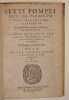
8vo. (1),196,(18),62 p. Vellum 17 cm (Ref: 1 GLN 3005; Schweiger 2,354, Smitskamp 60) (Details: Six thongs laced through the joints. Veritas printer's device on the title: a woman, the naked truth, seated on a cubus, holding a radiant sun in her right hand; in her left hand she holds an opened book and a palm leaf; her feet rest on the globe; the garland of fruit which surrounds her shows a ribbon with the text in Greek: 'Alêtheia Pandamatôr', i.e. 'Allmighty Truth'). (Condition: Vellum partly soiled. Right margin of title slightly thumbed; title slightly browning) (Note: Festus is a 2nd century grammarian, who produced an abbreviation of a lexicographic work by Marcus Verrius Flaccus, a wellknown antiquarian and grammarian living in Augustan Rome. Verrius compiled an enormous lexicon in 80 books, full of unusual, difficult, and archaic words, with discussions about customs, political institutions, belief and Roman law. Remains of his work survive in the epitome of 20 books made by Sextus Pompeius Festus. Festus also added examples found in other sources; the original work of Verrius is completely lost, and only 1 manuscript of Festus survived the Middle Ages in an heavily mutilated form. The first reliable text, which was a great improvement compared to earlier editions was published in 1559 by Antonio Agustin, 1517-1586, who made good use of the Farnese manuscript at Naples, and aimed at reconstructing the text in a strict alphabetical order from A to V, with the help of other Medieval epitomes of Festus. GLN 15-16 states that this edition is a reissue of an edition published in 1581 in Rome. According to Smitskamp 60 Fulvius Ursinus simply reproduces Scaliger's edition without mentioning his name. In the praefatio to the 62 pages with learned notes the reader is assured that this edition (of 1583) is a faithful transcription of the sole surviving MS of Festus) (Collation: A-N8, O4; A-C8, D8 (minus leaf D8) (Photographs on request)
M. Verrii Flacci quae extant. Et Sex. Pompei Festi De verborum significatione libri XX. Cum vetusto Bibliothecae Farnesianae exemplari Romae nuper edito, collati; ex quo lacunae pene omnes sunt suppletae. In eos libros Ant. Augustini annotationes, ex editione Veneta, Io. Scaligeri castigationes recognitae, ex Parisiensi, Ful. Ursini notae, ex Romana. Accesserunt nunc denique doctissimorum virorum notae ex eorum scriptis hinc inde collectae.
Paris (Parisiis), Apud Arnoldum Sittart, 1584.
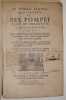
8vo (XXVIII),CCCIX,(1 blank),(22 index),(2 blank); LXXV,(1 blank),(10),CCXVI,(24 index),84 p. Limp vellum 17 cm (Ref: Smitskamp 61; Schweiger 2,355 & 1134; Brunet 5,2 1148; Renouard-1926, n° 1044 (Renouard et alii, 'Imprimeurs et libraires parisiens du XVIe siècle', Paris, 1964)) (Details: 5 thongs laced through the joints. Engraved printer's mark of Arnoldus Sittart on the title, his motto: 'Finis coronat opus', 'the end crowns the work'. (BaTyR : Base de Typographie de la Renaissance, no. 28409) The printer's mark shows the coat of arms of Cologne, the city where Arnoldus Sittart was born: the escutcheon bears 3 crowns and beneath them are twelve drops; the escutcheon is supported by a standing crowned griffin and idem lion; above the shield a helmet with peacock feathers as crest. (See for an explanation Wikipedia 'Kölner Wappen') (Condition: The vellum is probably recycled from another book; that is why the cover is wrinkled, dog-eared, slighlty soiled, and cut short. A small piece of the outer-edge of the backcover has gone. Three names and a small inscription on the title, 1 name has been erased. Partly slightly waterstained at the lower margin. Some hardly visible pinpoint wormholes near the right lower corner of one quarter of the book) (Note: Festus is a 2nd century grammarian, who produced an abbreviation of a lexicographic work by Marcus Verrius Flaccus, a wellknown antiquarian and grammarian living in Augustan Rome. Verrius compiled an enormous lexicon in 80 books, full of unusual, difficult, and archaic words, with discussions about customs, political institutions, beliefs and Roman law. Remains of his work survive in the epitome of 20 books made by Sextus Pompeius Festus. Festus also added examples found in other sources; an other epitome of this epitome of Festus was made in the 9th century by the historian Paulus Diaconus. The original work of Verrius is completely lost, and only 1 manuscript of Festus survived the Middle Ages in a heavily mutilated form. The first reliable text, which was a great improvement compared to earlier editions was published in 1559 by Antonio Agustin, 1517-1586, who made good use of the Farnese manuscript at Naples. He also added a commentary. It remained dominant for 2 centuries. Fulvius added in this edition suggestions concerning Greek material. J.J. Scaliger, 1540-1609, produced a highly acclaimed edition in 1575. He was praised for having successfully completed the gaps and damaged passages of the Farnese manuscript. Grafton says about this edition that 'fluency in conjecture and attention to detail could hardly be raised to a higher level'. (A. Grafton. Joseph Scaliger, a study in the history of classical scholarship, Oxf. 1983, vol. 1, p. 134/160) This edition of 1584 repeats Scaliger's of 1575. The text of Agustin is also printed, followed by 75 p. with his annotations, and followed by a 216 p. commentary by Scaliger; at the end we find the notes of Ursinus) (Collation: +6, *8, a-x8, A-V8, X2, 2A-2E8, 2F2) (Photographs on request)
Sex. Pompeii Festi et Mar. Verrii Flacci De verborum significatione lib. XX. Notis et emendationibus illustravit Andreas Dacerius in usum Delphini. Accedunt in hac nova editione notae integrae Josephi Scaligeri, Fulvii Ursini, & Antonii Augustini, cum fragmentis & schedis, atque indice novo.
Amsterdam (Amstelodami), Sumptibus Huguetanorum, 1700.
4to. (32 including frontispiece),596,(4),96,(24 index) p. Vellum 25 cm (Ref: STCN ppn 844243612; Schweiger 2,355; Brunet 4,798; Graesse 2,574; Ebert 7501; Spoelder p. 491: Amsterdam 10) (Details: Prize copy, without the prize. Back gilt, and with 5 raised bands. On both boards the gilt coat of arms of Amsterdam within 2 gilt borders, which consist of a repetition of floral motifs and the city's coat of arms. Frontispiece, showing the jump of Arion from his ship while playing the lyre, and being watched by the dolphin that would save him; between Arion and the dolphin on a banner 'Trahitur dulcedine cantus'; at the bottom of the plate a portrait of Festus, flanked by sea deities; at the top 2 angels present the coat of arms of the Dauphin, the heir to the throne of France. Title in red & black, and with the engraved coat of arms of the Dauphin) (Condition: Vellum soiled; small hole in the first compartment of the back. Front joint starting to split. Vellum on the upper board slightly damaged. All 4 ties gone. The prize was removed) (Note: Festus is a 2nd century abbreviator of a lexicographic work in 80 books by Marcus Verrius Flaccus, that dates from the first century B.C. This Festus of 1700 is a revised and augmented edition of a work which appeared previously in the 'Ad usum Delphini' series. It was first published in Paris in 1681, and produced for the education of the Dauphin (in usum Delphini), the young crown prince of France, Louis of France, who was born in 1661 as the eldest son of Louis XIV, King of France. His title was, as the heir apparent to the throne, Dauphin (Delphinus). Since he died before his father, he never became king. Great care was bestowed on the editing and printing of the series. 39 editions of Latin authors, from Cicero to Ausonius, also difficult ones like Manilius and this Festus, were published by leading or promising French scholars. The series was also meant for a broader public (des honnêtes gens) and offered introductions, reliable and readable texts, easy interpretations, and philological, educational and historical notes without too much philological niceties, or textual criticism. The series was a huge success. The edition of Festus and its accompanying commentary is the starting point of the career of the French classical scholar André Dacier, 1651-1722. He follows the texts proposed by Agustin and Scaliger, and aimed at presenting a clear and educationally useful text. In the preface, also adopted in this edition of 1700, Dacier tells that he wants to present the prince useful information about Roman law, ancient treaties, foundations of power, the royal laws of Rome, etc. Its interest lies in the realia, not in its literary worth. Dacier was the first to publish a readable text of Festus. (See 'La collection Ad usum Delphini', Grenoble, 2000/5, volume 2, p. 263-72) Dacier's Festus was repeated in 1692, and reissued in 1699 and in 1700 with additions of great scholars like Scaliger. Brunet calls this Amsterdam edition 'recherchée') (Collation: pi1, *4 (minus leaf *4), 2*-4*4; A-4X4) (Photographs on request)
M. Verrii Flacci quae extant et Sex. Pompei Festi de Verborum significatione libri XX. Cum vetusto Bibliothecae Farnesianae exemplari Romae nuper edito, collati; ex quo lacunae pene omnes sunt suppletae. In eos libros Ant. Augustini annotationes, ex editione Veneta, J. Scaligeri castigationes recognitae, ex Parisiensi, F. Ursini notae, ex Romana. Accesserunt nunc denique doctissimorum virorum notae ex eorum scriptis hinc inde collectae. (Bound with:) Q. Asconii Pediani Patavini Commentationes in aliquot orationes M. Tullii Ciceronis. (...) Francisci Hotomani studio & diligentia post omnes omnium editiones quam emendatissimae. (...) Eiusdem Hotomani expositiones suae in Asconium operae & diligentiae.
Ad 1: (Genève), Apud Petrum Santandreanum, 1593. Ad 2: Lyon (Lugduni), Apud Joan. Tornaesium & Gul. Gazeium, 1551.
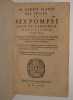
8vo. 2 volumes in 1: Ad 1: (XVI),CCCIX,(1 blank),(23 index),(1); LXXV,(1 blank),(10),CCXVI,(22 = index),(4),84 (recte 80) p. Ad 2: (XXIV),171,(1) p. H.leather. 17 cm (Ref: Ad 1: GLN-3651; Schweiger II,1135; Bernays, see p. 258/59 & 279; Ad 2: A. Cartier, Bibliographie des éditions des Tournes, no. 185; Schweiger I,18) (Details: 2 Back with 5 raised bands, and a black shield; Ad 1: 'Veritas' printer's device on the title: a woman, the naked truth, seated on a cubus, holding a radiant sun in her right hand. In her left hand she holds an opened book and a palm leaf. Her feet rest on the globe; the garland of fruit which surrounds her shows a ribbon with a motto in Greek: 'Alêtheia Pandamatôr', i.e. 'Allmighty Truth'. Ad 2: completely printed in italics; engraved printer's mark on title, a 'Ouroboros', with motto: 'quod tibi fieri non vis, alteri ne feceris', type no. 5. (See Cartier p. 40); Prism mark, type d on the verso of the last leaf, with motto 'Nescit labi virtus' (See Cartier p. 42) (Condition: Back rubbed; corners bumped; paper on covers slightly worn; a few small wormholes in the second half of the first work only; occasional faint pencil underlinings; old ownership entry at the upper margin of the title of Asconius erased; first title slightly soiled) (Note: Ad 1: Festus is a 2nd century abbreviator of a lost lexicographic work by Marcus Verrius Flaccus, dating from the first century B.C. Remains of his work survive in Festus; J.J. Scaliger, 1540-1609, produced a highly acclaimed edition in 1575. He was praised for his success at completing blank portions of the Farnese manuscript. The editor uses both Paulus Diaconus and Festus for a reconstruction of the text in strict alphabetical order, from A to V; Bernays tells us that the 216 pages with the 'Castigationes' of Scaliger are 'unverändert abgedruckt' in this edition of 1593 (Bernays p. 279). Scaliger's notes are followed by the notes of lesser gods, but nevertheless 'docti viri'. Ad 2: Asconius Pedianus, probably 3-88 A.D, produced for his sons a historical commentary on a number of the orations of the Roman politician/orator Cicero, the Verrines, pro Cornelio, contra M. Antonium & Catilinam, contra Pisonem, pro Scauro, & pro Milone. François Hotman, 1524-1590, was a French protestant jurist and author) (Provenance: Engraved bookplate of Jonkheer Henri de Brauw, depicting his coat of arms) (Collation: Festus: q - 2q8, a - v8 x8 (minus x8 blank); A - V8 X2; 2A - 2E8 2F2. Asconius: a - m8 n4 (lacking the blanks n3 and n4) (Photographs on request)
De Verborum significatione libri XX. Notis et emendationibus illustravit Andreas Dacerius, in usum Serenissimi Delphini. Accedunt in hac nova editione notae integrae Josephi Scaligeri, Fulvii Ursini, & Antonii Augustini, cum fragmentis & schedis, atque indice novo
Amsterdam, Huguet, 1699 2 parties en un fort vol. in-4 carré, [15] ff. n. ch. (titre, dédicace, préfaces, au lecteur), 596-[4]-96 pp., [12] ff. n. ch. d'index, demi-veau bouteille, dos lisse orné de filets dorés, pièce de titre crème, tranches mouchetées (rel. du XIXe siècle). Dos insolé.
La première édition "delphinale" de ce texte due à André Dacier (1651-1722) parut en 1681.Le De Verborum significatione du grammairien Festus ne forme en réalité qu'un abrégé du De Verborum significatu de Verrius Flaccus, et c'est pour cela qu'on le place traditionnellement sous les noms des deux auteurs, mais cela ne doit pas occulter que le traité de Flaccus ne nous est pas parvenu. De surcroît, le texte de Festus ne nous a été lui-même transmis que partiellement (sa seconde moitié) dans un abrégé de Paul Diacre. Tel quel, l'ouvrage demeure précieux pour l'étymologie et la lexicologie latines.Brunet IV, 798. - - VENTE PAR CORRESPONDANCE UNIQUEMENT - LIEN DE PAIEMENT, NOUS CONSULTER.


POMPEIUS (Sextus Pompeius Festus) - VERRIUS FLACCUS Marcus - SCALIGER Joseph
Reference : 14650
(1574)
M. Verrii Flacci quae extant Sex. Pompei Festi De Verborum Significatione libri XX.
M. Verrii Flacci quae extant Sex. Pompei Festi De Verborum Significatione libri XX. Et in Eos Josephi Scaligeri Iul. Caesaris Filii Castigationes nunc primum publicatae.Marcus Verrius Flaccus (né vers 55 avant J.-C., mort en 20 après J.-C.), est un savant érudit, historien, philologue, poète, grammairien et maître d'école (grammaticus) romain, exerçant sous les règnes d'Auguste et de Tibère.Festus Grammaticus, Sextus Pompeius Festus est un grammairien latin de la fin du IIe siècle ap. J.-C, ayant peut-être vécu à Narbo (Narbonne).Il avait composé, sous le titre de Significatione Verborum, une sorte de dictionnaire précieux pour la connaissance des antiquités romaines, de la langue latine et de la mythologie.Joseph Juste Scaliger, fils de Jules César Scaliger, né en 1540 à Agen et mort en 1609 à Leyde est l'un des plus grands érudits français du XVIe siècle. Il surpassa de loin son père comme philologue, et se fit en outre un nom comme chronologiste et historien.Sans lieu (Genève), Apud Petrum Santandreanum 1574-1575. Préface, 200 pages, index, et Annotationes (1574), 76 pages.Reliure plein vélin de l'époque. Dos à nerfs avec titre manuscrit (restauré). Quelques mouillures. 2 coins frottés. Pas de rousseur. Bon état. Format in-12°(17x12).

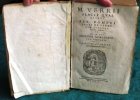
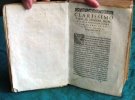
Sex. Pompei Festi et Mar. verrii Flacci de verborum significatione. Lib. XX. Notis et emendationibus illustravit Andresas Dacerius, in usum serenissimi Delphini. Accedunt in hac Nova Editione Notae integrae Josephi Scaligeri, Fulvii Ursinii, & Antonii Augustini, cum fragmentis & schedis, atque Indice novo.
Amstelodami, Sumptibus Huguetanorum, 1699. In-4 de [30- titre- epistola- praefatio- admonitio]-596-[4]-96-[24-index] pages, plein veau blond, dos à 5 nerfs orné de filets, roulettes, fleurons et titre dorés, étiquette de titre bordeaux, petite étiquette de papier avec titre et date calligraphiés à la plume, tranches rouges, roulette dorée sur les coupes. Coiffe supérieure frottée, quelques petites épidermures, second plat taché. Intervertion de 15 cahiers, sans manque de texte.

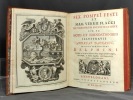
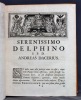
Illustré d'un frontispice et d'un bandeau répété une fois, lettrines et culs-de-lampe. De Significatione Verborum, est une sorte de dictionnaire précieux pour la connaissance des antiquités romaines, de la langue latine et de la mythologie.

