Write to the booksellers
1364 books for « f m braun »Edit
-
Type
Book (1331)
Engraving (14)
Magazine (4)
Maps (7)
Music sheets (2)
New book (1)
Photographs (5)
-
Latest
Last month (81)
Last week (24)
-
Language
English (1)
French (1359)
Latin (1)
Russian (3)
-
Century
16th (29)
17th (4)
18th (2)
19th (37)
20th (641)
21st (74)
-
Countries
Belgium (101)
Canada (1)
Côte d'Ivoire (5)
Denmark (8)
France (1160)
Germany (1)
Greece (1)
Netherlands (3)
Switzerland (79)
United Kingdom (2)
United States of America (3)
-
Syndicate
ALAC (1)
CLAM (3)
CLAQ (1)
CNE (2)
ILAB (524)
NVVA (25)
SLACES (25)
SLAM (471)
SNCAO (1)
Topics
- Alsace (26)
- Archaeology (4)
- Architecture (13)
- Astronautic (5)
- Astronomy (6)
- Autographs (3)
- Beauty (5)
- Belgium (13)
- Bible (8)
- Biblical studies (6)
- Bibliography (3)
- Biography (5)
- Botany (5)
- Braun patrick (24)
- Brecht bertolt (3)
- Caricature (4)
- Castles (3)
- Chartier Emile, dit alain (2)
- Christ (the) (5)
- Christianity (9)
- Christmas (3)
- Churches (4)
- Clock-making (4)
- Collections (3)
- Comic strip (7)
- Couple (4)
- Detective novels (181)
- Drawings (4)
- Early printed books (5)
- Economics (5)
- Education (13)
- Education - morals (6)
- English (11)
- Engraving (books about) (10)
- Essays (3)
- Europe (12)
- Exegesis (6)
- Fine arts (3)
- First edition (5)
- Fleuve noir (3)
- Football (8)
- Football (8)
- Geography (4)
- Germanic languages (31)
- Germany (14)
- Gibert (4)
- Gospel (3)
- Helvética (13)
- History (37)
- Illustrators (4)
- Industrial arts & crafts - fine arts (7)
- Iron (5)
- Italian (4)
- Italy (5)
- Journalism (6)
- Latin (3)
- Law (5)
- Literature (147)
- Lorrain (10)
- Magazine (5)
- Maps (22)
- Mathematics (4)
- Medicine (11)
- Military arts (3)
- Museums (3)
- Newspapers press (13)
- Painting (4)
- Paris (3)
- Philosophy (17)
- Photography (27)
- Poetry (19)
- Police (28)
- Psychology (5)
- Railway (8)
- Regionalism (4)
- Religions (15)
- Review (23)
- Reviews (8)
- Romance (3)
- Romanic art (4)
- Sciences (3)
- Scores (4)
- Sports (9)
- Spying (105)
- Surrealism (3)
- Switzerland (15)
- Tea (4)
- Theology (18)
- Topography (3)
- Travel (3)
- Troy (8)
- United states (3)
- Various (10)
- War (6)
- Wash tint (8)
Traduction par les Pères D. Buzy R. Leconte L. Marchal et F.-M. Braun
Reference : 500387637
(1955)
Les Saints Évangiles
LETOUZEY ET ANÉ ÉDITEURS A PARIS 1955 1955. Cet ouvrage publié par Letouzey et Ané propose une nouvelle traduction française des Évangiles accompagnée d'introductions et de notes par D. Buzy R. Leconte L. Marchal et F.-M. Braun. Il s'agit d'une édition savante destinée à un public catholique avec plusieurs tirages entre 1955 et 1958


Bom estado
Passion mexicaine
Harlequin Sans date. Passion mexicaine est un roman de Jackie Braun publié en 2006 dans la collection Azur des éditions Harlequin. Il s'agit d'une romance à portée fermée (closed door) écrite par une autrice primée


Bon état
Cartes anciennes des grandes villes d'Europe. Une sélection des plus beaux plans de Braun et Hogenberg.
P., Solar, 1992. In-folio cartonnage éditeur sous jaquette illustrée en couleurs, 143 pp., reprod. en couleurs à pleine page, bibliogr., index des noms.
Reproduction de 67 plans du XVIe siècle. Toutes petites déchirure à la jaquette, très bonne condition au demeurant. - Frais de port : -France 8,4 € -U.E. 10 € -Monde (z B : 15 €) (z C : 33 €)


Oreste stretto al parricidio dal fato. Specchio etrusco di Giuseppe Basseggio
Rome, Alessandro Monaldi, 1841 in-4, 12 pp., avec un frontispice gravé au trait, demi-veau cerise, dos lisse orné de filets et guirlandes dorés (reliure de l'époque). Rousseurs, mais bon exemplaire.


Giuseppe Basseggio ou Baseggio le Jeune appartenait à cette grande famille de Rovigo qui a donné graveurs et sculpteurs à l'Italie, et, en dépit de l'ambiguïté du titre, la monographie porte bien sur un miroir étrusque découvert par lui, et non reproduit à l'identique.L'opuscule remonte à la brève époque (1833-1834) où l'archéologue August Emil Braun (1809-1856) accompagna Gerhard dans son voyage à Rome et occupa des fonctions de bibliothécaire à l'Istituto archeologico germanico. Seulement deux exemplaires au CCF (BnF et Strasbourg). - - VENTE PAR CORRESPONDANCE UNIQUEMENT - LIEN DE PAIEMENT, NOUS CONSULTER.
L'Assiette au Beurre n°56 - Pour être député
L'assiette au beurre, 1902. Revue in-4 (32 x 25 cm) illustrations en noir et en couleurs de L. BRAUN, 8 feuillets. Excellent état.


L'Assiette au Beurre n°61 - Tête de Turcs
L'assiette au beurre, 1902. Revue in-4 (32 x 25 cm) illustrations en noir et en couleurs de L. BRAUN, 10 feuillets. Excellent état.


Portraits de Chaucahrd, Deschanel, Dr Doyen, Henri Rochefort, Boni de Castellane, Massent, Porel, Millevoye, Rostand, Brieux, E. Drumont, Lemaître, Barrès, Constans, Bourget, Puech, Roujon, Coppée, Déroulède.
Alsace romane
Reliure toile de l'éditeur sous jaquette, 29X22 cm, 2010, 475 pages, nombreuses photos en couleurs, itinéraires romans, éditions Faton. Très bon état.

Ce monstre incomparable... Malraux ou l'énigme du moi.
Broché, 21X13 cm, 1983, 165 pages, éditions Armand Colin. Très bon état.

BRAUN, FERDINAND. - THE INVENTION OF THE CATHODE-RAY INDICATOR TUBE - SEEING BY ELECTRICITY.
Reference : 43448
(1897)
Ueber ein Verfahren zur Demonstration und zum Studium des zeitlichen Verlaufes variabler Ströme" (On a Method for the demonstration and study of currents varying with time).
Leipzig, Johann Ambrosius Barth, 1897. No wrappers. In ""Annalen der Physik und Chemie, Neue Folge"", Bd. 60, No 3. Pp. 401-576, textillustr. and 2 folded plates. (the entire issue offered, ""Heft 3""). Braun's paper: pp. 552-559 a. 6 textillustrations (showing the Braun tube and its operations). Clean and fine.
First printing of this groundbreaking paper being the first description of the principles governing the ""BRAUN TUBE"", which moves the elctron beams of alternating voltage, the principle on which ALL TELEVISON TUBES operate. - Braun shared the Nobel Prize for 1909 with Marconi ""in recognition of their contributions to the development of wireless telegraphy"".""Cold cathode tube with side anode, annular diaphragm to control spot size, and built-in fluorescent screen. Beam deflection by one external coil with the trace viewed indirectly in a rotating mirror, or by two coils at right angles for direct viewing. Excitation by hand-drive influence machine (friction generator) or by an induction coil. This ""indicator tube"", which enabled Braun to demonstrate how a variety of periodic and transient electrical phenomena could be visually examined, is the ancestor of electric oscilloscopes, televison picture tubes, and other electron-beam display devices.""( Shiers & Shiers ""Early Televison. A Bibliography to 1940"", No. 263).""The first oscilloscope, or Braun tube, was introduced in 1897. In order to study high-frequency alternating currents Braun used the alternating voltageto move the electron beam within the cathode tube. The trace on the face of the cathode tube represented the amplitude and frequency of the alternating-current voltage. He then produced a graph of this trace by use of a rotating mirror. The Braun tube was a valuable laboratory instrument, and modifications of it are a basic devise in electronic testing and research. The principle of the Braun tube, moving a electron beam by means of alternating voltage, is the principle on which all televison operate.""(DSB II, pp. 427-428).In 1909 he shared the Nobel Prize for physics with Guglielmo Marconi for their development of wireless telegraphy.
ONVOLTOOIDE GESCHIEDENIS
Antwerpen , De Vries - Brouwers, 1982 Paperback, 69pp. in prima staat. 13/20cm ISBN 9789064170751.
Novelle van de belangrijke DDR-auteur Volker Braun (geb. '39); voor het eerst gepubliceerd in '75 in een tijdschrift, in '77 door Suhrkamp uitgegeven. Het verhaal gaat over een 18-jarig meisje. Haar vader is partijfunctionaris en zij is dus volgens de doctrines opgevoed. Als haar de omgang met haar vriend verboden wordt omdat hij staatsgevaarlijk zou zijn, raakt zij in grote innerlijke onzekerheid en wordt ze geconfronteerd met de DDR-werkelijkheid. Het verhaal speelt op 3 niveaus: een in reportage-stijl weergegeven werkelijkheid, dat het grootste deel vormt, en de niveaus van reflectie en droom. De werkelijkheid wordt vaak in zeer korte zinnen weergegeven met gebruik van hoofdletters voor belangrijke woorden. Braun staat bekend om het aanpakken van taboes en zijn eis dat literatuur in dient te grijpen in de werkelijkheid. Voor de Nederlandse lezer die enigszins op de hoogte is van de DDR, brengt dit boek niets nieuws.(NBD|Biblion recensie, Wilma van Kasbergen)
"BRAUN, FERDINAND. - THE DISCOVERY OF SEMICONDUCTOR RECTIFIER EFFECT.
Reference : 49327
(1874)
Ueber die Stromleitung durch Schwefelmetalle.
Leipzig, Johann Ambrosius Barth, 1874. 8vo. Contemp. hcalf. 5 raised bands, gilt spine and gilt lettering to spine. A few scratches to spine. Small stamp on verso of first -and general- titlepage. In: ""Annalen der Physik und Chemie. Hrsg. von J.C. Poggendorff"", Sechste Reihe Bd. 3, (= Poggendorff Bd. 153). X,636 pp., 4 plates. (Entire volume offered). Braun's paper: pp. 556-563.
First printing of Brown's importent paper in which he described his discovery of a semiconductor diode, noting that electrical currents flows freely in only one direction at the contact between a metal point and a galena crystal.""In 1874 Braun published the results of his research on mineral metal sulfides. He found that these crystals conducted electric currents in only one direction. This information was important in electrical research and in measuring another property of substances, the electrical conductivity, but Braun’s discovery did not have immediate practical application. In the early twentieth century the principle that Braun had discovered was employed in crystal radio receivers.""(DSB).The Nobel Prize in Physics 1909 was awarded jointly to Guglielmo Marconi and Karl Ferdinand Braun ""in recognition of their contributions to the development of wireless telegraphy"".
Catalogue Braun
Mulhouse - Paris - Lyon, Braun Imprimeurs-éditeurs, s.d (vers 1970), in-4, [40] pp, Cartonnage de l'éditeur illustré en couleurs, Rare catalogue de promotion des techniques d'impression des imprimeurs éditeurs Braun avec démonstration de leur savoir-faire. Réalisé par Jacques Duboid, le catalogue est illustré de superbes héliogravures en noir et de reproductions photographiques en couleurs de Robert Doisneau, Henri Cartier-Bresson, Jean-Pierre Sudre, Werner Bischof, etc. Textes de Jean Jourdan. Reportage photographique de Robert Doisneau dans les presses de Braun. Quelques frottements et pliure sur la première de couverture. Couverture rigide
Bon [40] pp.
Estampes. Organe des Editions d'art Braun & Cie N°1 1933 (2ème année)
Mulhouse: Braun & Cie, 1933 in-8, 16 pages, illustrations. Agrafé, petites marques d'usage, bon état.
Estampes. Organe des Editions d'art Braun & Cie N°1 1933 (2ème année) (Mulhouse: Braun & Cie, 1933). [M.C.: catalogue d'éditeur]
Repanic-Braun, Mirjana, and Mario Braun
Reference : 121719
(2020)
ISBN : 9789533473673
Monuments of the Holy Trinity in Osijek / Spomenik Svetoga Trojstva U Osijeku
Repanic-Braun, Mirjana, and Mario Braun: Monuments of the Holy Trinity in Osijek / Spomenik Svetoga Trojstva U Osijeku. 2020. 298 pages, fully illustrated in colour. Hardback. 31 x 25cms. Study of the historical, urban, architectural and social events inside Osjek's fortification system from the late 17th to the early 20th centuries.c. Text in English and Croatian.
Study of the historical, urban, architectural and social events inside Osjek's fortification system from the late 17th to the early 20th centuries.c. Text in English and Croatian
Le rire N°155 de la nouvelle série - Jiu Jistsu parlementaire.
Tonnelle. 20 janvier 1906. In-4. Broché. Bon état, Couv. convenable, Dos satisfaisant, Intérieur frais. 16 pages, gravures noir et blanc in et hors texte, une gravure double en couleurs, 1ère et dernière page couleurs par Braun.. . . . Classification Dewey : 70.441-Journaux satiriques anciens
Emile Champion honoraire par Braun, Dialogue de courtisanes par Guillaume, A la conférence d'Algésiras par Testevuide, Un extra par Hermann-Paul, Dépaquit, Grignon, Mark, Haye, Une séance de Jiu Jitsu à la Chambre par Braun,Echos du rire par Somm, Le senatorium par Grandjouan, Le nouveau président par Edward, Le Jiu Jitsu congressiste par Braun. Classification Dewey : 70.441-Journaux satiriques anciens
Francis Jammes et Thomas Braun. Correspondance (1898-1937).
Bruxelles Palais des Académies 1972 1 vol. broché gr. in-8, broché, 239 pp., 3 planches hors-texte, bibliographie et index. Texte établi par Daniel Laroche. Introduction du Benoît Braun. Bon exemplaire, non coupé avec un envoi du fils de Thomas Braun.

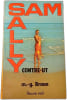
Sam et Sally : Tu ne verrais plus son sourire
Fleuve Noir 1977 1977. tu ne verrais plus son sourire

Bon état