 Write to the booksellers
5 books for « estella diego de »Edit
-
Century
17th (1)
20th (2)
-
Topics
Catholicism (1)
Ethic (1)
Philosophy (1)
Religions (1)
-
Countries
Denmark (1)
France (4)
-
Syndicate
ILAB (3)
SLAM (2)
ESTELLA (Diego Ballestero de San Cristóbal y Cruzat, dit Diego de), PANICAROLA (Francesco).
Reference : 240622
Introductio ad lecturae theologicae & praedicationis evangelicae officium pro religionis Seraphicae studentibus. Tractatus elementarius tripartitus, polemicus, biblicus, hierorhetoricus ; videlicet summula dogmaticae de Ecclesia catholica ; eiusque hostium catalogus. Notitia librorum canonicorum Sacrae Scripturae, praxes sacrae concionis. Haec recusa, caetera comportata per fratrem Octavium Iadertinum Dalmatam [= Oktavije Jankovic Spader, de Zara] (..). Iussu, & auspiciis reverendissimi patris Fr. Antonii ab Introduco [Antonio de Antrodoco] (..)
Rome, Giuseppe Vannacci, 1693 in-4, [4] ff. n. ch. (titre, dédicace, corrigenda, approbations), 386 pp., [3] ff. n. ch. de table, vélin rigide, dos lisse (reliure de l'époque). Nombreuses rousseurs.
Ce manuel destiné à la formation des Frères mineurs est formé d'une compilation des oeuvres dogmatiques et spirituelles des deux religieux franciscains Diego de Estella (1524-1578), parent de François Xavier, et Francesco Panigarola ou Panicarola (1548-1594).Seulement trois exemplaires au CCF (BNU de Strasbourg, Lyon, Bibliothèque diocésaine de Nice). - - ACTUELLEMENT EN CONGÉS, DE RETOUR LE 17 AOÛT - VENTE PAR CORRESPONDANCE UNIQUEMENT - LIEN DE PAIEMENT, NOUS CONSULTER.


In sanctum Iesu Christi Evangelium secundum Lucam, doctissime pariter & piissima Commentaria.
Lyon, Librairie de Giunta, 1592. 2 tomes en 1 fort vol. in-folio, basane fauve, dos à nerfs orné de filets et petits fleurons à froid, triple encadrement de triples filets à froid sur les plats avec petits fleurons argentés aux angles des deux premiers, losange formé de triples filets à froid inscrit dans l'encadrement central avec petits fleurons argentés aux angles, couronne de laurier argentée au centre. Reliure de l'époque, trous de vers en tête au dos, mors sup. fendu en tête, épidermures sur les plats et qq. manques de cuir en tête du plat sup. Premier titre en rouge et noir orné de la marque à la fleur de lys, lettres blanches historiées, texte sur 2 coll., (4) ff., 464 pp.; 596 pp., (22) ff. Signatures : +4 [a-z]6 [A-P]6 Q4; [AA-ZZ]6 [Aaa-Ccc]6 Ddd4 [Eee-Ggg]6 Hhh4. Quelques mouillures marginales.
Oeuvre majeure du mystique franciscain espagnol Diego de Estella (1524-1578), ce copieux commentaire sur l'évangile de St Luc fut interdit par l'Inquisition espagnole lors de sa première parution en 1574. Il contenait en effet plusieurs passages litigieux et d'autres jugés franchement hérétiques. Cette édition lyonnaise est expurgée des passages contestés et comporte à la fin du second tome l'ouvrage d'Estella sur l'art de bien composer un sermon, qui eut un grand succès. Baudrier VI, 412.
A methode unto mortification: called heretofore, the contempt of the world, and the vanitie thereof Written at the first in the Spanish. - [A SOURCE FOR SHAKESPEARE'S ""LOVE'S LABOUR'S LOST""]
London, Iohn Windet, 1608. 12mo. In contemporary full calf. Small paper-label pasted on to top of spine. Wear to extremities, corners bumped. Edges of boards with loss of leather. Previous owner's names to front and back end paper (""Robert Wilson"" & ""Edvard Wilson, anno domini 1666""). Internally with a few light dampstains. (20), 328, 328-499, (4) pp.
The exceedingly rare second edition (the first being from 1586) of Rogers’ somewhat free translation of ‘Papist’ Diego de Estalla’s work “Libro de la vanidad del mundo (Toledo, 1562). Rogers admits that he had no access to the original but had to use the Italian and Spanish translations. The present English translation, however, is of significant interest, as recent research suggests it was a source and inspiration for Shakespeare’s ‘Love’s Labour’s Lost’: At the opening of ‘Love’s Labour’s Lost’, the vow to renounce worldly pleasure has barely been announced before one of Navarre’s book-men declares his success: “Dumaine is mortified” (I.i.28). This ‘mortified’ is not a word Shakespeare would use often. It appears here in the sense of ‘having the appetites and passions in subjection’ and insensible or impervious to (the world and its pleasures), the latter informing Dumaine’s gloss: ‘To love, to wealth, to pomp. I pine and die’. The fact that this is the earliest use of ‘mortified’ in the Shakespearean canon is the first clue that one of the sources for Love’s Labour’s Lost was Thomas Roger’s A Methode unto Mortification, published in London in 1586 and again in 1608. Shakespeare’s pleasure in frustrating the ambitions of this book went some way to shaping his play”. (Kingsley-Smith, A Method unto Mortification: A New Source for Love’s Labour’s Lost). ""Love's Labour's Lost"" is one of William Shakespeare's early comedies, believed to have been written in the mid-1590s. The play revolves around the King of Navarre and three of his noble companions who make a pact to swear off women and focus on scholarly pursuits for three years. However, their resolve is tested when the Princess of France and her entourage arrive on a diplomatic mission. Each of the men falls in love with one of the women, leading to a series of comedic misunderstandings, romantic entanglements, and wordplay. “It is also possible that some facts about the original author sparked Shakespeare’s interest. Diego de Estella was born in Navarre, and spent time the court of Philip II of Spain before incurring disapproval for his criticism of court life and being forced into a Franciscan monastery. Armado, the braggart and clown of Love’s Labour’s Lost, is the first Spaniard to appear in Shakespeare”. (Kingsley-Smith, A Method unto Mortification: A New Source for Love’s Labour’s Lost).
Modo de predicar y modus concionandi - TOMO I & II
Instituto miguel de cervantes 1951 in8. 1951. Broché. 2 volume(s).
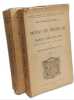
couvertures défrîachies bords frottés (accrocs) nombreuses pages non-coupées intérieur propre
Cien meditaciones devotisimas del amor de Dios,
Escritura en pagina primera ; HASP-475, Editorial Cisneros, Madrid 1960
Satisfaisant

