 Write to the booksellers
17 books for « diaghilev »Edit
-
Language
French (9)
Russian (8)
-
Topics
Apollinaire guillaume (1)
Architecture (1)
Contemporary look (1)
Dance & ballet (4)
Dancing (1)
History (1)
Opera (1)
Opera ballet (3)
Picasso (1)
Russia (1)
Theatre (1)
-
Countries
Belgium (1)
Denmark (1)
France (7)
United States of America (8)
-
Syndicate
ILAB (4)
SLAM (3)
"APOLLINAIRE, GUILLAUME - PICASSO (ILLUSTR.) - JEAN COCTEAU - LÉON BAKST - SERGE DIAGHILEV.
Reference : 60103
(1917)
BALLETS RUSSES. PROGRAMME. PARIS 1917. Les Ballets Russes a Paris. Représentations Exceptionelles avec le gracieux Concours des Artistes de M. Serge de Diaghilew. - Programme des Ballets Russes. Les Ballets Russes à Paris. Saison - Mai 1917. [Guillau... - [HAND-PAINTED BY PICASSO - COINING ""SURREALISM""]
Paris, Mai 1917. Folio. Original illustrated extra wrappers (with a picture by Picasso on the front and the décor for ""Baba Iaga"" on the back)"" original illustrated wrappers for ""Théatre du Chatelet"" (drawing by André Marty on front, and advertisements on back) in grey and red"" original illustrated coloured wrappers for ""Programme des Ballets Russes"" (front wrapper illustrated by Picasso with the Chinaman-costume from ""Parade""). A bit of soiling to the extra-wrappers and small professional restorations to upper front cover and top of spine (this barely noticeable) as well as to blank margin of back wrapper. Apart from that, an excellent and very well perserved copy with only slight browning to some leaves. Apart from the described wrappers and extra-wrappers, there are, in all, 24 leaves with -mostly photographic- illustrations (four of them with original hand-colouring on top) and 6 leaves of text.With the original errata-leaf laid in loose, stating also that the illustrations ""Femmes de bonne humeaur"" and ""Parade"" have been hand-painted by Carlos Socrate, after the designs of Bakst and Picasso, and that the front wrapper for ""Parade"" (the Chinaman) has been handpainted by Picasso himself.
Scarce original printing of this seminal avantgarde-publication, the May 1917 ""Théatre du Chatelet""- publication that presents Diaghilev's ""Ballets Russes"" in Paris - here containing the entire separate publication mainly devoted to Jean Cocteau's groundbreaking ballet ""Parade"" - being one of the most important publications in the history of modern art. It is here, in his presentation-article to ""Parade"" that Apollinaire coins the term ""surrealism"" and thus lays the foundation for the seminal cultural movement that Bréton came to lead. Furthermore, the ballet ""Parade"" represents a historical collaboration between several of the leading artistic minds of the early twentieth century: Erik Satie, Jean Cocteau, Pablo Picasso, Léonide Massine, and Serge Diaghilev, and is famous, not only for its contents and its music, but also for its magnificent costumes designed by Picasso, the drawings of which are presented in the present publication for the first time - most famously the front cover for the ""Parade""-programme, which depicts the ""Costume de Chinois du ballet ""PARADE""/ Aquarelle de Picasso"", an etching with original, stunning pochoir-colouring (hand-painted by Picasso himself!).It is the 1917 ballet ""Parade"" - the first of the modern ballets - originally presented for the first time in the present publication, that marks Picasso's entry into the public and bourgeois institutions of ballet and theatre and presents Cubism on the stage for the first time. The present publication constitutes an outright revolution in the history of art, theatre, and ballet.Several variants of this spectacular publication exist, but the one we have here is as original and complete as it comes, containing the entire contents of the different variants. We not only have the extremely scarce and fragile dust-wrapper and the equally scarce illustrated coloured double-wrappers (front: ""Peinture de Picasso"""" back: Décor de Larionow pour le ballet ""BABA IAGA""""), but also the entire 1917 ""Théatre du Chatelet""-programme (in original illustrated wrappers) with the entire separate ""parade""-issue -also entitled ""Programme des Ballets Russes""- (also in original illustrated wrappers), with more than 20 leaves of photographic illustrations containing pictures of the actors and actresses, also in their spectacular avant-garde-costumes, Bakst's portrait of Leonide Massine, Picasso's portrait of Stavinski, Bakst's portrait of Picasso, Picasso and Massine in the ruins of Pompei, Picasso's drawings of a scene from ""Parade"" and of Massine, as well as several (mostly humorous) advertisements. But more importantly, we have, apart from the above-mentioned famous Chinaman by Picasso, in original pochoir-colouring, the other famous etching by Picasso ""Costume d'acrobate du ballet ""Parade""/ Aquarelle de Picasso"", also in original pochoir-colouring (bright blue), the seminal presentation-article by Apollinaire, which coins the term ""surrealism"" (see bottom of description for full translation of this groundbreaking preface), the two ""Les Femmes de Bonne Humeur""-figures by Bakst, Constanza and Battista, printed and heightened in gold (pochoir), the printed costume by Larionow, ""Les contes russes"", which is with original bright red and blue pochoir-colouring, and the ""Le Mendiant""-costume by Bakst for ""Parade"", and, of course, the texts by Bakst (on choreography and décor), Georges-Michel (Ballets Russes after the War), as well as the texts for the various ballets (listing the actors and their rôles as well as a resume of the plot). "" ""Tact in audacity consists in knowing how far we may go too far."" Jean Cocteau, poet, writer, and arts advocate, made this statement in his 1918 manifesto, The Cock and Harlequin. Cocteau, in collaboration with Erik Satie and Pablo Picasso, discovered ""how far"" to ""go too far"" in the circus-like ballet Parade-one of the most revolutionary works of the twentieth century. Parade incorporates elements of popular entertainment and uses extra-musical sounds, such as the typewriter, lottery wheel, and pistol, combining them with the art of ballet. Cocteau wrote the scenario for the one-act ballet and contracted the other artists. Satie wrote the score to the ballet, first in a piano four-hands version and then in full orchestration, while Picasso designed the curtain, set, and costumes. Later, Léonide Massine, a dancer with the Ballet Russes, was brought in as the choreographer. Serge Diaghilev's Ballet Russes premiered the ballet Parade on May 18, 1917. The program notes for the ballet were written by the poet Apollinaire. They became a manifesto of l'esprit nouveau or ""the new spirit"" which was taking hold in Paris during the early twentieth-century. Apollinaire described the ballet Parade as ""surrealistic,"" and in doing so created a term which would develop into an important artistic school."" (Tracy A. Doyle, Erik Satie's ballet PARADE, p. 1).When the French poet and army officer Guillaume Apollinaire wrote the program notes For ""Parade"", he created the manifesto of the ""l'esprit nouveau"" - ""the new spirit"". Cocteau had called the ballet ""realistic"", but Apollinaire took it an important step further and described it as ""surrealistic"", thus coining a term that would soon develop into an important artistic movement. With Picasso, Apollinaire had established the aesthetic principals of Cubism and was considered a leader in the European avant-garde. ENGLISH TRANSLATION OF APOLLINAIRE'S PROGRAMME NOTES TO ""PARADE"": ""Definitions of Parade are blossoming everywhere, like the lilac bushes of this tardy spring...It is a scenic poem transposed by the innovative musician Erik Satie into astonishingly expressive music, so clear and simple that it seems to reflect the marvelously lucid spirit of France. The cubist painter Picasso and the most daring of today's choreographers, Léonide Massine, have here consummately achieved, for the first time, that alliance between painting and dance, between the plastic and mimetic arts, that is a herald of the more comprehensive art to come. There is nothing paradoxical about this. The Ancients, in whose lives music played such an important role, were totally unaware of harmony, which constitutes the very basis of modern music. This new alliance - I say new, because until now scenery and costumes were linked only by factitious bonds - has given rise, in Parade, to a kind of surrealism, which I consider to be the point of departure for a whole series of Manifestations of the New Spirit that is making itself felt today and that will certainly appeal to our best minds. We may expect it to bring about profound changes in our arts and manners through universal joyfulness, for it is only natural, after all, that they keep pace with scientific and industrial progress. Having broken with the choreographic tradition cherished by those who used to be known, in Russia, under the strange name 'balletomanes', Massine has been careful not to yield to the temptation of pantomime. He has produced something totally new-a marvelously appealing kind of dance, so true, so lyrical, so human, and so joyful that it would even be capable (if it were worth the trouble) of illuminating the terrible black sun of Dürer's Melancholy. Jean Cocteau has called this a realistic ballet. Picasso's cubist costumes and scenery bear witness to the realism of his art. This realism - or this cubism, if you will - is the influence that has most stirred the arts over the past ten years. The costumes and scenery in Parade show clearly that its chief aim has been to draw the greatest possible amount of aesthetic emotion from objects. Attempts have often been made to return painting to its barest elements. In most of the Dutch painters, in Chardin, in the impressionists, one finds hardly anything but painting. Picasso goes further than any of them. This is clearly evident in Parade, a work in which one's initial astonishment is soon replaced by admiration. Here the aim is, above all, to express reality. However, the motif is not reproduced but represented-more precisely, it is not represented but rather suggested by means of an analytic synthesis that embraces all the visible elements of an object and, if possible, something else as well: an integral schematization that aims to reconcile contradictions by deliberately renouncing any attempt to render the immediate appearance of an object. Massine has Adapted himself astonishingly well to the discipline of Picasso's art. He has identified himself with it, and his art has become enriched with delightful inventions, such as the realistic steps of the horse in Parade, Formed by two dancers, one of whom does the steps of the forelegs and the other those of the hind legs. The fantastic constructions representing the gigantic and surprising features of The Managers, far from presenting an obstacle to Massine's imagination, have, one might say, served to give it a liberating impetus. All in all, Parade will change the ideas of a great many spectators. They will be surprised, that is certain" but in a most agreeable way, and charmed as well Parade will reveal to them all the gracefulness of the Modern movements, a gracefulness they never suspected. A magnificent vaudeville Chinaman will make their imaginations soar" the American Girl cranking up her imaginary car will express the magic of their daily lives, whose wordless rites are celebrated with exquisite and astonishing agility by the acrobatin blue and white tights.""
Hommage à Diaghilew. Collections Boris Kochno et Serge Lifar
Paris, éd., Musée Galliéra - Les Presses Artistiques, juin - septembre 1972, EDITION ORIGINALE, pt. in-4, cartonnage souple, agrafé, couv. ill. en coul. de Picasso (costume pour Parade 1917), non paginé (32 pp.), très nb. photos et reproductions d'œuvres d'art en noir, en frontispice le "masque" de Diaghilev, La catalogue de l'exposition Diaghilev du mois de juin à septembre au Musée Galliéra à Paris, Descriptif des 331 objets exposés. Très belle couverture d'un dessin couleur de Picasso de 1917. Très RARE Très bon état
Librairie spécialisée en gastronomie , œnologie et tabagie
Serge De Diaghuliv. Savie, son œuvre, sa légende
Coll. "Les Introuvables", Paris, éd. D'Aujourd'hui, 1982, in-8, cartonnage souple, couv. ill. en noir sur fond orange éditeur, 320 pp., chronologie, table des matières, Réédition de l'édition originale de 1954 de ce grand classique sur la vie et l'œuvre du chrorégraphe Serge De Diaghilev, "père" des ballets russes. rès bon état, quelques petites rousseurs sur la tranche de tête
The Diaghilev-Lifar library. [the property of maitre Serge Lifar]... : [Vente, Monte Carlo, Sporting d'hiver, 28 novembre - 1er décembre 1975] / [par Sotheby Parke Bernet Monaco S.A.]
London, Sotheby 1975 In-4 25,5 x 18,5 cm. Cartonnage éditeur vert-pâle, titre en noir sur le dos et le premier platornés d’un décor floral doré, 317 pp., 35 planches hors texte. Exemplaire en très bon état.
Texte en anglais. La bibliothèque de Diaghilev était composée de plus de 800 livres parmi lesquels des imprimés du XVIe siècle et beaucoup d’éditions originales ; environ un huitième fut acquis par la bibliothèque de l'université Harvard. Très bon état d’occasion
Opredelitel' vesennikh i ranne-letnikh rasteniy Predbaykal'ya. In Russian /Iden
Short description: In Russian. Diaghilev, Victor Filippovich. Identifier of spring and early-summer plants in Prebaikal. Irkutsk: Region Publishing House, 1938: Typical Trust Polygraphbook. You are welcome to reach out to us for a detailed description of the copies currently available. Delivery of this book may take longer than usual including extended processing and pre-shipping time, no expedited shipping is available. Please advise us if you have a set date or a deadline to receive your order.SKU5323335
Ville de Strasbourg. Les BALLETS RUSSES de Serge DIAGHILEV. 1909-1929. Exposition à l'ancienne Douane du 15 Mai au 15 Septembre 1969.
in 8° broché, 331 pages et 127 reproductions en noir et quelques unes en couleurs ; couverture illustrée (très légèrement fanée).
...................... Photos sur demande ..........................


Phone number : 04 77 32 63 69
Tovarno-denezhnye otnosheniya i finansy pri sotsializme. In Russian /Commodity
Short description: In Russian. Dyachenko, Vasily Petrovich. Commodity and Money Relations and Finance under Socialism. Moscow: Science, 1974. You are welcome to reach out to us for a detailed description of the copies currently available. Delivery of this book may take longer than usual including extended processing and pre-shipping time, no expedited shipping is available. Please advise us if you have a set date or a deadline to receive your order.SKU7118974
Prichudy starika. In Russian /Old Man's Quirks
"Short description: In Russian. Dell, Floyd. Old man's quirks. Moscow; Leningrad: State Publishing House, 1927 (Moscow: type. The Red Proletarian ). You are welcome to reach out to us for a detailed description of the copies currently available. Delivery of this book may take longer than usual including extended processing and pre-shipping time, no expedited shipping is available. Please advise us if you have a set date or a deadline to receive your order.SKU9028764"
Medsanbat 0013. In Russian /Medsanbat 0013
In Russian. Diaghilev, Vladimir Yakovlevich. Medsanbat 0013. Leningrad: Lenizdat, 1976. All images are for identification of editions only. Several books of the same edition may be available. Please feel free to request photos of available books. SKU6932206
Zhadina. In Russian /Jadina
In Russian. Diaghilev, Vladimir Yakovlevich. Zhadina. Leningrad: Det. lit. Leningrad detachment, 1970. All images are for identification of editions only. Several books of the same edition may be available. Please feel free to request photos of available books. SKU7119252
Vechnoe derevo. In Russian /Eternal tree
In Russian. Diaghilev, Vladimir Yakovlevich. Eternal tree. Leningrad: Soviet writer. Leningrad detachment, 1971. All images are for identification of editions only. Several books of the same edition may be available. Please feel free to request photos of available books. SKU7119249
Zmeya i chasha. In Russian /Snake and bowl
In Russian. Diaghilev, Vladimir Yakovlevich. Snake and bowl. Moscow: Sovremennik, 1975. All images are for identification of editions only. Several books of the same edition may be available. Please feel free to request photos of available books. SKU6927663
Sestra Il'icha. In Russian /Ilyich's Sister
In Russian. Diaghilev, Vladimir Yakovlevich. Ilyich's Sister. Moscow: Politizdat, 1970. All images are for identification of editions only. Several books of the same edition may be available. Please feel free to request photos of available books. SKU7119254
GUENNE (Jacques) - ZAHAR (Marcel) - L'Art vivant - CAHEN (Jean-Fernand) - (Ballets russes) - (DIAGHILEV) - BLANCHE (Jacques-Emile) - VAUDOYER (Jean-Louis) - ASTRUC (Gabriel) - LALIQUE (René) -
Reference : 37541
L'Art vivant - 15 septembre 1929 - N°114 : Serge de Diaghilew et les Ballets Russes -
Paris : Larousse (impression Georges Lang), 1929 - un volume broché (24,5x32cm) sous couverture illustrée d'une vignette photographique, 40 pages abondamment illustrées de photographies reproduites en héliogravure - couverture légèrement frottée sinon bon état -
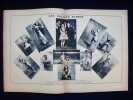
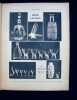
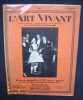
Dans ce numéro, 19 pages consacrées aux Ballets russes et 5 pages à Emile Gallé et René Lalique. Lancée en janvier 1925 par Jacques Guenne, avec pour rédacteur en chef Florent Fels, L'Art vivant se consacre aux arts décoratifs et appliqués, à la peinture et à la mode. Ce mensuel laisse une place importante à la photographie jusqu'à sa disparition en 1939. Tous nos livres sont visibles sur notre site : https://www.livrepoesie.com/
DIAGHILEV Serge - Daniel Katz Gallery London - Alexander SCHOUVALOFF ( introduction) :
Reference : 43129
"Julian Barran Ltd. presents Serge Diaghilev ; The Cantenary Exhibition of Les Ballets Russes 1909 - 2009. At the Daniel Katz Gallery ... London"
2. Castle Cary (Somerset), Julian Barran Ltd., 2009, in-4°, stapled, orig. stiff wrapper. 51 pp, 72 items, colour ills. Price list lossely inserted.
Les Ballets Russes.
P. Bibliothèque Nationale 1979. In-4° broché sous couverture illustrée en couleurs pelliculée, 166 pages.
![Les Ballets Russes.. [DIAGHILEV] :](https://static.livre-rare-book.com/pictures/LIQ/liq-5502_1_thumb.jpg)
Superbe catalogue préfacé par Georges LE RIDER. Abondamment illustré en noir et en couleurs.
LES BALLETS RUSSES
BIBLIOTHEQUE NATIONALE. 1979. In-4. Broché. Bon état, Couv. convenable, Dos satisfaisant, Intérieur frais. 166 pages. Nombreuses illustrations en noir et blanc et en couleurs dans le texte et hors texte. Première de couverture illustrée en couleurs.. . . . Classification Dewey : 782.1-Théâtre musical, opéra
Classification Dewey : 782.1-Théâtre musical, opéra

