 Write to the booksellers
171 books for « broglie louis de »Edit
-
Language
French (170)
Latin (1)
-
Century
18th (1)
19th (2)
20th (104)
21st (7)
-
Countries
Belgium (10)
Canada (1)
Denmark (10)
France (142)
Switzerland (8)
-
Syndicate
ALAC (1)
ILAB (82)
NVVA (2)
SLACES (2)
SLAM (69)
Topics
- Almanac (4)
- Alsace (1)
- Architecture (1)
- Army (3)
- Astronomy (1)
- Autographs (2)
- Biography (3)
- Broglie louis de (14)
- Chanson paul (1)
- Charmet raymond (1)
- Civilisation (1)
- Daniel-rops (4)
- Decoration (1)
- Dictionaries (1)
- Diderot et d'alembert (1)
- Diplomacy (1)
- Discovery (3)
- Drink (1)
- Early printed books (2)
- Education (1)
- Education - morals (1)
- Einstein (1)
- Electronics (2)
- Encyclopaedia (2)
- Essays (1)
- First edition (2)
- Hackney (1)
- History (2)
- Illustrated books (1)
- Inventions (2)
- Italy (1)
- Journalism (1)
- Languedoc (3)
- Literature (5)
- Louis xv of france (1)
- Malesherbes (1)
- Manuscripts (1)
- Marie antoinette (2)
- Mathematics (3)
- Mauriac françois (2)
- Mechanics (3)
- Medicine (5)
- Newspapers press (1)
- Optics (2)
- Pascal Blaise (1)
- Philosophy (5)
- Photography (1)
- Physics (43)
- Port-royal (1)
- Quercy (1)
- Review (1)
- Revolution 1789 (2)
- Rostand edmond (2)
- Rousseau jean jacques (1)
- School (1)
- Sciences (32)
- Sciences & technique (1)
- Sling (1)
- Songs (2)
- Tea (3)
- Teaching (2)
- Terrain (1)
- Waves (2)
"BROGLIE (DE BROGLIE), LOUIS DE . - DISCOVERY OF THE WAVE THEORY OF MATTER AND CREATION OF WAVE-MECHANICS
Reference : 49718
(1923)
Ondes et quanta. Note de M. Louis de Broglie, présentée par M. Jean Perrin. (Séance du 10 Septembre 1923). (+) Quanta de lumière, diffraction et interférences. Note de M. Louis de Broglie, transmise par M. Jean Perrin. (Séance du 24 Septembre 1923). (...
Paris, Gauthier-Villars et Cie, 1923. 4to. Bound in one contemp. full buckram. Spines gilt and with gilt lettering. In: ""Comptes Rendus Hebdomadaires des Séances de L'Academie des Sciences"", Tome 177. Bound with orig. printed front-wrapper to No. 1, half-title and title-page to vol. 177. 1513 pp. (Entire volume offered). De Broglie's papers: pp. 507-510, pp. 548-551 a. pp. 630-32. Clean and fine. A punched stamp on foot of title-page.
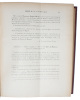
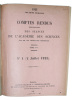
First edition of these papers which ESTABLISHED A NEW ERA IN PHYSICS by introducing the epochal new principle that particle-wave duality should apply not only to radiation but also to matter and thus CREATING QUANTUM MECHANICS. These 3 papers were extended to form his doctoral thesis of 1924 ""Recherches sur la Théorie des Quanta.""De Broglie relates ""After long reflection in solitude and meditation, I suddenly had the idea, during the year 1923, that the discovery made by Einstein in 1905 should be generalized by extending it to all material particles and notably to electrons"" (Preface to his PhD thesis 1924).""He made the leap in his September 10, 1923, paper: E=hv should hold not only for photons but also for electrons, to which he assigns a 'fictitious associated wave'. In his September 24 paper, he indicated the direction in which one 'should seek experimental confirmations of our ideas': a stream of electrons traversing an aperture whose dimensions are small compared with the wavelenght of the electron waves 'should show diffraction phenomena' .""(Pais ""Subtle is the Lord"", pp. 425-436).In the third paper (October 8) he discusses ""The interplay between the propagation of the particle and of the waves could be expressed in more formal terms as an identity between the fundamental variational principles of Pierre de Fermat (rays), and Pierre Louis Maupertuis (particles) as de Broglie discussed it further in his last communication . Therein he also considered some thermodynamic consequences of his generalized wave-particle duality. He showed in particular how one could, using Lord Rayleigh’s 1900 formula for the number of stationary modes for phase waves, obtain Planck’s division of the mechanical phase space into quantum cells.Louis de Broglie achieved a worldwide reputation for his discovery of the wave theory of matter, for which he received the Nobel Prize for physics in 1929. His work was extended into a full-fledged wave mechanics by Erwin Schrödinger and thus contributed to the creation of quantum mechanics. After an early attempt to propose a deterministic interpretation of his theory, de Broglie joined the Copenhagen school’s mainstream noncausal interpretation of the quantum theory.""(DSB).""This idea [i.e. de Broglie's that matter might behave as waves] was tested and confirmed by Davisson and Germer in 1927... Thus the duality of both light and matter had been established, and physicists had to come to terms with fundamental particles which defied simple theories and demanded two sets of 'complementary' descriptions, each applicable under certain circumstances, but incompatible with one another."" (Printing and the Mind of Man, 417).
GEORGES (A.) - TONNELAT (A.) - DESTOUCHES (J.L.) - COSTA DE BEAUREGARD (O.) - LOCHAK (G.) - etc -- DE BROGLIE (Louis)
Reference : 1617
LOUIS DE BROGLIE. Sa conception du monde physique -- EDITION ORIGINALE
P., Gauthier-Villars, 1973, un volume in 8 relié en pleine toile éditeur, 28pp., 387pp., nombreuses figures dans le texte et hors texte
---- EDITION ORIGNALE ---- Articles de A. GEORGES, F. KUBLI, A. TONNELAT, J.L. DESTOUCHES, J.J. TRILLAT, R. DAUDEL, O. COSTA DE BEAUREGARD, etc... ---- Oeuvres de LOUIS DE BROGLIE - Vue d'ensemble sur la carrière de LOUIS DE BROGLIE - La thèse de 1924 - Influence de la relativité sur LOUIS DE BROGLIE - Les recherches de LOUIS DE BROGLIE sur l'électrotecnique, les guides d'ondes, le principe de Huygens et la diffraction - La description des particules fondamentales dans l'oeuvre de LOUIS DE BROGLIE - etc**1617/M4
Eléments de théorie des Quanta de la mécanique ondulatoire
Paris, Gauthier-Villars, 1953, in-8, VIII-302 pp, Broché, couverture imprimée de l'éditeur, Cet ouvrage fait partie du Traité de physique théorique et de physique mathématique de Louis de Broglie (1892-1987), ouvrages réunis par Jean-Louis Destouches. Nouveau tirage. Il reproduit l'essentiel du cours que le physicien professait à l'École Normale Supérieure depuis 1934, à l'occasion du programme du certificat d'études supérieures de théories physique. Louis de Broglie est à l'origine de l'idée révolutionnaire que les particules de la matière possèdent à la fois des propriétés corpusculaires et ondulatoires. Cette découverte lui valut le prix Nobel de Physique en 1929. Bon exemplaire. Couverture rigide
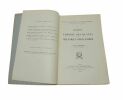
Bon VIII-302 pp.
L'électron magnétique (Théorie de Dirac)
Paris, Hermann et Cie, 1934, in-8, VIII-315 pp, Broché, couverture imprimée de l'éditeur, Deux planches dans le texte. Édition originale cet ouvrage dans lequel Louis de Broglie expose sa théorie de la lumière dite "neutrinienne", fondée sur l'idée que le photon résulte de la fusion de deux particules neutres, les hypothétiques neutrinos de Dirac. Louis de Broglie (1892-1987) contribua au développement de la mécanique ondulatoire, puis quantique. Il est à l'origine de l'idée révolutionnaire que les particules de la matière possèdent à la fois des propriétés corpusculaires et ondulatoires. Cette découverte lui valut le prix Nobel de Physique en 1929. Couverture rigide
Bon VIII-315 pp.
Une tentative d'interprétation causale et non linéaire de la mécanique ondulatoire. (la théorie de la double solution).
Paris, Gauthier-Villars, 1956. Royal8vo. Uncut in the original printed wrappers. Fine and clean. VII, (1), 297, (2) pp.
First printing of de Broglie's important work on nonlinear wave mechanics. ""The early 1950s again witnessed a major change in de Broglie’s views. Impressed by the nonlocal theory put forth by David Bohm in 1951, which reintroduced pilot-waves, de Broglie turned back to his first theoretical convictions. Surrounded by some faithful followers, de Broglie resumed his quest for a causal interpretation, this time supplementing his initial views with the idea of nonlinear dynamics for the singular wave. This was, however, increasingly perceived as a marginal research program, even in his own country, where quantum theoreticians preferred to stick to more mainstream physics, less fundamental and closer to the wealth of new experimental data emerging in the 1950s."" (DSB).
DE GAULLE (Général) - LOUIS XIV - BROGLIE (Louis de) - CELINE (Louis-Ferdinand) - GIDE (André) - SCHWOB (Marcel) -
Reference : 40959
Importants manuscrits et correspondances autographes relatifs à l'histoire, à la science et à la littérature -
Catalogue de la vente aux enchères organisée à Drouot-Richelieu le 11 décembre 1998 - un volume 22x28cm broché de 161 notices - bon état -
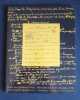
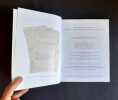
21 lettres autographes de Louis XIV, trois manuscrits du général de Gaulle, grand manuscrit scientifique de Louis de Broglie, deux importants manuscrits autographes de Céline, traductions autographes par Gide de Typhon de Conrad et de poèmes de Walt Whitman. Manuscrits, correspondances et archives de Marcel Schwob (1867-1905) - Tous nos livres sont visibles sur notre site : https://www.livrepoesie.com/
Notice historique sur la vie et les travaux de M. le duc Albert de Broglie par M. Fagniez.
Paris Firmin-Didot 1902 1 vol. broché in-4, broché, non coupé, 101 pp. Ce discours a été lu durant les séances des 5, 12 et 19 avril 1902 de l'Académie des sciences morales et politiques. Premier plat désolidarisé avec manques aux extrémités et dos.
Notice sur la vie et l'?uvre de Frédéric Joliot, Membre de la section de physique
Paris, Palais de l'Institut, 1959, in-4, Portrait, 27 pp, Broché, couverture verte imprimée, Lecture faite le 14 décembre 1959 au cours de la séance annuelle des prix de l'Académie des sciences, par son secrétaire perpétuel, Louis de Broglie (1892-1987). L'auteur relate la vie de Frédéric Joliot (dit Joliot-Curie, 1900-1958), depuis les travaux menés avec son épouse Irène Curie (1897-1956), qui ont permis de connaître la véritable valeur de la masse du neutron. De Broglie insiste ensuite sur la découverte fondamentale de la radioactivité induite et de la radioactivité artificielle en 1934, qui valut aux deux savants le prix Nobel de chimie en 1935, puis sur son rôle dans le CNRS et le Haut commissariat à l'énergie atomique. Le secrétaire perpétuel conclut sa lecture en rendant un hommage à Frédéric Joliot et à sa femme : "Nombreux sont ceux qui ont pensé que la mort prématurée de Frédéric Joliot et de sa femme était due à l'action nocive des radiations auxquelles ils avaient été constamment exposés pendant toute leur vie de travailleurs de laboratoire. On ignorait encore à l'époque leurs dangereux effets physiologiques et on ne cherchait pas suffisamment à s'en protéger. S'il en était ainsi, nous devrions placer Frédéric Joliot et sa femme au nombre de ceux qui ont donné leur vie pour la science". ON JOINT : Francis PERRIN, Funérailles Nationales de Frederic Joliot, Membre de la section de physique à Paris, le mardi 19 août 1958. Paris, Institut de France, 1958. In-4, 8 pp. Broché, sans couverture. Couverture rigide
Bon Portrait, 27 pp.
La mécanique ondulatoire. ‘Memorial des sciences physiques’, fasc. 1.
Paris, Gauthier-Villars, 1928, in-4°, 58 p., many hw. notes in German and underlining with pencil, untrimmed copy, original wrappers.
First edition of this paper, an important expansion of the ingenious ideas presented in his earlier publications, notamment «Recherches sur la théorie des quanta» (1924) and «Ondes et mouvements» (1926), in which Louis de Broglie introduced his discovery that constitutes the basis for developing the general theory nowadays known by the name of wave mechanics, a theory which has utterly transformed our knowledge of physical phenomena on the atomic scale.For his remarkable contributions to our knowledge of an entirely new aspect of the properties of matter the 1929 Nobel Prize was awarded to De Broglie for the discovery of the wave nature of electrons. The discovery was not only of fundamental importance for our concept of nature. It also gave research an extremely important and serviceable method for investigating the structure of matter, especially as it may be applied with ease to extremely small quantities.

(SLACES, NVVA)
Phone number : 41 (0)26 3223808
Continu et Discontinu en Physique moderne.
Albin Michel. (1941). 3 mille.,année d"édition. In-8 br. couverture imprimée, 268pp. De la Collection Sciences d"Aujourd"hui.
bon etat, Remise de 20% pour toutes commandes supérieures à 200 €
Sur la théorie des particules de spin quelconque.
(Paris, Gauthier-Villars), 1939. 4to. No wrappers. In: ""Comptes Rendus hebdomadaires des Séances de L'Academie des Sciences"", tome 209, No 5. Pp. (265-) 332. (Entire issue offered). De Broglie's paper: pp. 265-268. A stamp to the first page. Disbound.
First printing on an importent paper by De Broglie on Quantum Spin and statistics.
Ondes et Mouvements.
Paris, Gauthier-Villars et Cie, 1926. 8vo. Bound with orig. printed wrappers in contemp. hcloth. Spine gilt with gilt lettering. A small part of lower spine with a bit of discolouring after a papelabel. A punched stamp on top of title-page. Light wear along edges of boards.VI,133,(1) pp. and (2) pp. of announcements. Textfigs. Internally clean.
First edition. In this work De Broglie set forth the idea that electrons, as was previously regarded as particles, also have wave-quaracters, as well as light has. The idea was tested and confirmed by Davisson and Germer the year after in 1927. Also Schrödinger took up the idea and formulated his wave-equation, explaning the stationary states of the electron of Niels Bohr, by applying De Broglie's concept of electrons as waves to the hydrogen atom. ""Thus the duality of both light and matter had been established, and physicists had to come to terms with fundamental particles which defied simple theories and demanded two sets of 'complementary' descriptions, each applicable under certain circumstances, but imcompatible with one another."" (PMM: 417).
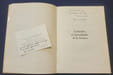
Certitudes et incertitudes de la sciences - Envoi Autographe Signé
Paris Albin Michel 1966 Albin Michel, 1966 - in8 broché 302pp - avec une carte de visite signée et un envoi autographe. Louis De Broglie ( 1892/1987) fut l'un des grands physiciens du XXe. Il obtint le prix Nobel de physique en 1929. C'est lui qui posa les principes de base de la mécanique ondulatoire. Envoi à Robert Levieuge, postier dans la Sarthe, et célèbre collectionneur d'autographe, seul Français à paraître dans le livre des Records pour son incroyable collection d'autographes.


Très bon
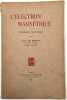
L'Électron Magnétique (Théorie de Dirac)
Paris, Hermann et Cie, éditeurs, 1934, in-8, VIII-315 pp, Broché, couverture imprimée, Édition originale cet ensemble de cours professés par le physicien français Louis de Broglie (1892-1987) - récipiendaire du Prix Nobel de 1929 pour ses travaux sur la mécanique ondulatoire, expose sa théorie de la lumière dite "neutrinienne" - fondée sur l'idée que le photon résulte de la fusion de deux particules neutres, les hypothétiques neutrinos de Dirac. Petits manques et déchirures à la couverture. Couverture rigide
Bon VIII-315 pp.
?Interaction entre le noyau et son cortège électronique réunions d'études et de mises au point?
Paris, Éditions de la revue d'optique théorique, 1949, in-8, 201 pp, Broché, couverture de l'éditeur, Louis de Broglie (1892-1987) contribua au développement de la mécanique ondulatoire, puis quantique. Il est à l'origine de l'idée révolutionnaire que les particules de la matière possèdent à la fois des propriétés corpusculaires et ondulatoires. Cette découverte lui valut le prix Nobel de Physique en 1929. Bon exemplaire non coupé. Dos insolé. Couverture rigide
Bon 201 pp.
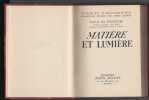
MATIERE ET LUMIERE
1941 Albin michel/ sciences d'aujourd'hui. 1941. In-8. reliure demi toile à coins, Bon état, Intérieur frais. 342 pages.
Remise de 20% pour toutes commandes supérieures à 200 €
Introduction à l'étude de la Mécanique Ondulatoire
Paris, Hermann, 1930, in-8, portrait, XVI, 292, (2)pp, 2pl, Broché, PREMIERE EDITION. Rare. Portrait de Louis de Broglie et 2 pl. h.t. L'auteur essaya de concilier les différentes théories conflictuelles sur les quanta. Il posa ses principes, dès 1924, dans sa thèse de doctorat ; quelques années plus tard, il les reprend et les développe dans un premier essai paru en 1928, "La mécanique ondulatoire" (58pp.). Cette théorie sera l'une des bases de la science moderne. Ex libris manuscrit sur la page de titre Couverture rigide
Bon portrait, XVI, 292, (2)pp.,
Louis de Broglie, physicien et penseur.
1952 P., Albin Michel (Les Savants et le Monde), 1952, fort in 8 broché, XI-497 pages ; non coupé ; bibliographie in-fine.
...................... Photos sur demande ...................

Phone number : 04 77 32 63 69
Encyclopédie française - Tome II - La Physique.
Paris, Société nouvelle de l'Encyclopédie française, 1956 1 volume 24,7 x 29,5cm Reliure éditeur à vis vert foncé au titre blanc. Pagination multiple par fascicule (3,2 cm d'épaisseur); nombreuses figures in texte, 16 planches hors texte.
Réalisé par une équipe d'une cinquantaine de spécialistes, 2è volume, dirigé par Louis de BROGLIE (1892-1987), Prix Nobel de physique 1929, de cette "Encyclopédie française" fondée par Anatole de Monzie, mise en oeuvre par le grand historien Lucien FEBVRE (1878-1956), et continuée sous la direction générale de Gaston Berger; avant-propos de Lucien FEBVRE: "L' "Encyclopédie française" ne se propose pas d'atteindre à tout prix et par tous les moyens un public d'incompétents. Elle fournit de la Science physique telle que la pensent ses créateurs l'image la plus serrée, la plus fidèle, la plus dense. Elle n'expose pas [...] le savoir d'hier. Elle dit ce savoir d'aujourd'hui qui se profile en encorbellement sur le savoir de demain. Ainsi est-elle l'image [...] de l'effort de nos savants [...] sans traduction, sans trahison." "[Elle] n'essaie pas de [...] de rendre banal cet admirable combat de l'esprit humain, acharné à définir une réalité qu'il s'efforce chaque jour de compliquer et de diversifier."; index bio-bibliographique des collaborateurs; bibliographie. Bon état (charnières un peu frottées; petit cachet d'ex-libris).
Broglie Louis De. Andre Therive. Raymond Charmet [Et Al]
Reference : AUI30CC
ISBN : B0039K9AEU
Lot de 2 livres de Louis de Broglie : Continu et discontinu en physique moderne + Matière et lumière - Collection sciences d'aujourd'hui.
Albin Michel. 1941. In-8. Broché. Etat d'usage, Couv. légèrement passée, Dos satisfaisant, Papier jauni. 268 pages + 342 pages - ex libris René Mariaux sur la page de garde de 2 volumes - couverture jaunie.. . . . Classification Dewey : 530-Physique
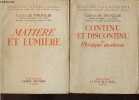
Collection sciences d'aujourd'hui. Classification Dewey : 530-Physique
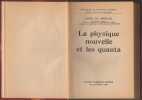
La physique nouvelle et les quanta (Bibliothèque de Philosophie scientifique)
1947 Flammarion. 1947. In-12.Couverture rigide- demi toile à coins, 307 pages.. Bibliothèque de Philosophie scientifique
Remise de 20% pour toutes commandes supérieures à 200 €
La mécanique ondulatoire.
Paris, Gauthier-Villars et Cie, 1929. In-8 broché de [6]-53-[5] pages.
Première édition parue dans le "Mémorial des sciences physiques publié sous le patronage de l'Académie des Sciences de Paris […]" en 1928. L'année suivante il recevra le prix Nobel de physique, à 36 ans, pour sa découverte de la nature ondulatoire de l'électron. Précieux et rare exemplaire avec un envoi autographe de Louis de Broglie à Léon Lecornu, membre de l'Institut. Petite tache dans la marge sup. de 4 ff.
Certitudes et incertitudes de la science.
1970 sl, Société normande du livre illustré 1970 Livre-objet in-folio oblong en feuillets en forme de double cercle, sous couverture en plastique transparente dans un emboîtage magnétique orné d'une composition de Longobardi en réserve. Structurations et linogravures de Xavier LONGOBARDI. Premier plat de l'emboîtage coulissant ;bon état,poids postal =10 kg.
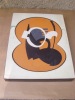
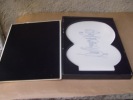
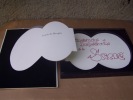
S.l., Société normande du livre illustré, 1970, in-4 oblong, en ff. découpées en forme de guitare sous couverture plastique et emboîtage en bois avec composition en couleurs sur le premier plat. Structurations et linogravures de Xavier LONGOBARDI. Tirage : 100 ex. numérotés de 1 à 100 et 40 ex. numérotés de I à XL réservés aux collaborateurs. Celui-ci n° XL ?. Étonnant ouvrage dont la découpe, l'assemblage et l'emboîtage ont été réalisés par Bernard Duval, Claude Arnoult a été le conseiller pour le matériau magnétique,rare Remise de 20% pour toutes commandes supérieures à 200 €
Mécanique ondulatoire du photon et théorie quantique des champs
Paris, Gauthier-Villars, 1949, in-8, VI-208 pp, Toile ocre à la bradel, Première édition. Louis de Broglie reprend et développe ici les résultats exposés dans des ouvrages précédents : Une nouvelle théorie de la lumière : la mécanique ondulatoire du photon (1940-1942) et la Théorie générale des particules à spin (1943). Bon exemplaire. Couverture rigide
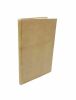
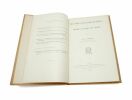
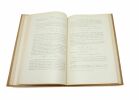
Bon VI-208 pp.

