 Write to the booksellers
167 books for « broglie de louis »Edit
-
Century
18th (1)
19th (2)
20th (103)
21st (7)
-
Countries
Belgium (10)
Canada (1)
Denmark (10)
France (137)
Switzerland (9)
-
Syndicate
ALAC (1)
ILAB (79)
NVVA (2)
SLACES (2)
SLAM (66)
Topics
- Almanac (4)
- Alsace (1)
- Architecture (1)
- Army (1)
- Astronomy (1)
- Autographs (2)
- Biography (3)
- Broglie louis de (15)
- Chanson paul (1)
- Charmet raymond (1)
- Civilisation (1)
- Daniel-rops (4)
- Decoration (1)
- Dictionaries (1)
- Diderot et d'alembert (1)
- Diplomacy (1)
- Discovery (3)
- Drink (1)
- Early printed books (2)
- Education (1)
- Education - morals (1)
- Einstein (1)
- Electronics (1)
- Encyclopaedia (2)
- Essays (1)
- First edition (2)
- Hackney (1)
- History (2)
- Illustrated books (1)
- Inventions (2)
- Italy (1)
- Journalism (1)
- Languedoc (3)
- Literature (5)
- Louis xv of france (1)
- Malesherbes (1)
- Manuscripts (1)
- Mathematics (3)
- Mauriac françois (2)
- Mechanics (3)
- Medicine (5)
- Newspapers press (1)
- Optics (2)
- Pascal Blaise (1)
- Philosophy (6)
- Photography (1)
- Physics (41)
- Port-royal (1)
- Quercy (1)
- Revolution 1789 (2)
- Rostand edmond (2)
- Rousseau jean jacques (1)
- School (1)
- Sciences (30)
- Sciences & technique (1)
- Sling (1)
- Songs (1)
- Tea (3)
- Teaching (2)
- Terrain (1)
- Waves (2)
"BROGLIE (DEBROGLIE), LOUIS de. - DISCOVERY OF THE WAVE THEORY OF MATTER AND CREATION OF WAVE-MECHANICS.
Reference : 46949
(1923)
Ondes et quanta. Note de M. Louis de Broglie, présentée par M. Jean Perrin. (Séance du 10 Septembre 1923). (+) Quanta de lumière, diffraction et interférences. Note de M. Louis de Broglie, transmise par M. Jean Perrin. (Séance du 24 Septembre 1923). (...
Paris, Gauthier-Villars et Cie, 1923. 4to. Bound in 2 contemp. full cloth. Spines gilt and with gilt lettering. In: ""Comptes Rendus Hebdomadaires des Séances de L'Academie des Sciences"", Tome 177. With htitle a. titlepage. 1513 pp. (Entire volume offered). De Broglie's papers: pp. 507-510, pp. 548-551 a. pp. 630-32. Clean and fine. A stamp to verso of titlepage.
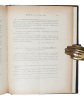
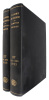
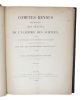
First edition of these papers which ESTABLISHED A NEW ERA IN PHYSICS by introducing the epochal new principle that particle-wave duality should apply not only to radiation but also to matter and thus CREATING QUANTUM MECHANICS. These 3 papers were extended to form his doctoral thesis of 1924 ""Recherches sur la Théorie des Quanta.""De Broglie relates ""After long reflection in solitude and meditation, I suddenly had the idea, during the year 1923, that the discovery made by Einstein in 1905 should be generalized by extending it to all material particles and notably to electrons"" (Preface to his PhD thesis 1924).""He made the leap in his September 10, 1923, paper: E=hv should hold not only for photons but also for electrons, to which he assigns a 'fictitious associated wave'. In his September 24 paper, he indicated the direction in which one 'should seek experimental confirmations of our ideas': a stream of electrons traversing an aperture whose dimensions are small compared with the wavelenght of the electron waves 'should show diffraction phenomena' .""(Pais ""Subtle is the Lord"", pp. 425-436).In the third paper (October 8) he discusses ""The interplay between the propagation of the particle and of the waves could be expressed in more formal terms as an identity between the fundamental variational principles of Pierre de Fermat (rays), and Pierre Louis Maupertuis (particles) as de Broglie discussed it further in his last communication . Therein he also considered some thermodynamic consequences of his generalized wave-particle duality. He showed in particular how one could, using Lord Rayleigh’s 1900 formula for the number of stationary modes for phase waves, obtain Planck’s division of the mechanical phase space into quantum cells.Louis de Broglie achieved a worldwide reputation for his discovery of the wave theory of matter, for which he received the Nobel Prize for physics in 1929. His work was extended into a full-fledged wave mechanics by Erwin Schrödinger and thus contributed to the creation of quantum mechanics. After an early attempt to propose a deterministic interpretation of his theory, de Broglie joined the Copenhagen school’s mainstream noncausal interpretation of the quantum theory.""(DSB).""This idea [i.e. de Broglie's that matter might behave as waves] was tested and confirmed by Davisson and Germer in 1927... Thus the duality of both light and matter had been established, and physicists had to come to terms with fundamental particles which defied simple theories and demanded two sets of 'complementary' descriptions, each applicable under certain circumstances, but incompatible with one another."" (Printing and the Mind of Man, 417).
Trillat (Jean-Jacques) - Maurice de Broglie et Louis de Broglie (préface)
Reference : Z47700GLW
ISBN : B0046HNOW4
Découverte de la matière - Préface de Maurice et Louis de Broglie (Microscope électronique) [Paperback]
Broché bon état .Contenu propre . 1er et 4ème plats légèrement déchirés du haut .1956.358 pages. Découverte de la matière. PHOTOS SUR DEMANDE
Merci de nous contacter à l'avance si vous souhaitez consulter une référence dans notre boutique à Authon-du-Perche.
"BROGLIE (DEBROGLIE), LOUIS de. - COINING THE TERMS 'ANTIPARTICLE' AND 'ANTINEUTRINO'.
Reference : 48952
(1934)
Sur la nature de photon.
(Paris, Gauthier-Villars), 1934. 4to. No wrappers. In: ""Comptes Rendus hebdomadaires des Séances de L'Academie des Sciences"", tome 198, No 2. Pp. (129-) 212. (Entire issue offered). De Broglie's paper: pp. 135-138. A stamp to the first page. Disbound.
First apperance of de Broglie's importent paper on antiparticles and the Neutrino of light. The antiparticle having the same mass as another but opposite values for its other properties.""In a communication dated January 8, 1934 (the paper offered)... de broglie stated that this new particle is an 'antiparticle which is related to (the neutrino) like the positive electron to the negative electron in the whole theory of Dirac'. In this note the terms 'antiparticle' and 'antineutrino' enter physics for the first time.""(Pais in ""Inward Bound"", p. 418).
Ondes corpuscules - mécanique ondulatoire
Albin Michel, Science d'aujourd'hui 1945 In-8 1 vol. broche - 164 pp. bon état, avec les 12 planches ht annonçées,:électricité (discontinue) - théorie des électrons - Quanta de Planck - Lumière, radiation, ondes et protons - mécanique ondulatoire et défraction des éléments - Heisenberg
Théorie des électrons - Quanta de Planck - Lumière, radiation, ondes et protons - mécanique ondulatoire et défraction des élémentbon etat, Remise de 20% pour toutes commandes supérieures à 200 €
ROUSSEAU - GUINGUENE (Pierre-Louis), BROGLIE (Charles Louis Victor de)
Reference : 39014
(1791)
Pétition à l'Assemblée Nationale contenant la demande de la translation des cendres de J.J. Rousseau, au Panthéon français. IIe séance du 27 août 1791 [signé par GUIGUENE, etc.]. [Suivi de :] Pétition des citoyens de la ville et du canton de Montmorency à l'Assemblée Nationale. [Suivi de :] Réponse de M. le Président de l'Assemblée Nationale [V. BROGLIE].
1791 In-8, broché, couverture de papier moderne, 16 p. (dern. p. bl.) Paris, Imprimerie Nationale, 1791.
Edition originale. En août 1791, le journaliste et écrivain Pierre-Louis Ginguené rédigea une pétition visant à transférer les cendres de Jean-Jacques Rousseau au Panthéon.Soutenue par 300 signataires, dont les noms figurent sur ce document, cette demande fut portée par deux délégations: l'une composée de Parisiens et l'autre dhabitants de Montmorency, ville où Rousseau avait autrefois résidé. Malgré cet élan, le projet demeura en suspens jusqu'à ce que Thérèse Levasseur, veuve de Rousseau, intervienne auprès de la Convention nationale le 11 avril 1794. Les troubles de la Terreur retardèrent néanmoins la panthéonisation, qui n'eut lieu que le 11 octobre 1794.(Conlon, Rousseau, 871. Martin & Walter, 14883). Très bon exemplaire, très frais.

Rapport relatif à une pétition du Régiment de Languedoc fait à l'Assemblée Nationale. Imprimé par ordre de l'Assemblée Nationale
Paris, Imprimerie Nationale, 1790 in-8, 8 pp., dérelié.
Projet de décret présenté par M. de Broglie, sur le déplacement du Régiment de Languedoc de la place de Montauban, où il était stationné depuis plus de six ans, et sur l'effervescence locale que cette mesure produisit. L'auteur était député de Colmar.Martin & Walter, 5348. - - ACTUELLEMENT EN CONGÉS, DE RETOUR LE 17 AOÛT - VENTE PAR CORRESPONDANCE UNIQUEMENT - LIEN DE PAIEMENT, NOUS CONSULTER.
[FRONDE PARLEMENTAIRE - TOULOUSE] BROGLIE (Charles-Louis-Victor de)
Reference : 139952
Rapport relativement à deux arrêtés du Parlement de Toulouse, des 25 et 27 septembre dernier.
Paris, Imprimerie Nationale, s.d. (1790) in-8, 7 pp., dérelié. Petite déchirure sans manque.
Réplique cinglante à la fronde du Parlement de Toulouse. L'auteur annonce des poursuites contre les rebelles.Martin et Walter, 5349. - - ACTUELLEMENT EN CONGÉS, DE RETOUR LE 17 AOÛT - VENTE PAR CORRESPONDANCE UNIQUEMENT - LIEN DE PAIEMENT, NOUS CONSULTER.
Rapport sur les troubles qui ont eu lieu dans la ville de Toulouse, les 16, 17, et 18 du mois de Mars.
Paris, Imprimerie Nationale, s.d. (1791) in-8, 19 pp., dérelié.
L'auteur était alors député du Haut-Rhin.Martin et Walter, 5351. - - ACTUELLEMENT EN CONGÉS, DE RETOUR LE 17 AOÛT - VENTE PAR CORRESPONDANCE UNIQUEMENT - LIEN DE PAIEMENT, NOUS CONSULTER.
"BROGLIE (DE BROGLIE), LOUIS DE . - DISCOVERY OF THE WAVE THEORY OF MATTER AND CREATION OF WAVE-MECHANICS
Reference : 49718
(1923)
Ondes et quanta. Note de M. Louis de Broglie, présentée par M. Jean Perrin. (Séance du 10 Septembre 1923). (+) Quanta de lumière, diffraction et interférences. Note de M. Louis de Broglie, transmise par M. Jean Perrin. (Séance du 24 Septembre 1923). (...
Paris, Gauthier-Villars et Cie, 1923. 4to. Bound in one contemp. full buckram. Spines gilt and with gilt lettering. In: ""Comptes Rendus Hebdomadaires des Séances de L'Academie des Sciences"", Tome 177. Bound with orig. printed front-wrapper to No. 1, half-title and title-page to vol. 177. 1513 pp. (Entire volume offered). De Broglie's papers: pp. 507-510, pp. 548-551 a. pp. 630-32. Clean and fine. A punched stamp on foot of title-page.
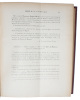
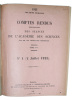
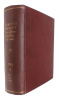
First edition of these papers which ESTABLISHED A NEW ERA IN PHYSICS by introducing the epochal new principle that particle-wave duality should apply not only to radiation but also to matter and thus CREATING QUANTUM MECHANICS. These 3 papers were extended to form his doctoral thesis of 1924 ""Recherches sur la Théorie des Quanta.""De Broglie relates ""After long reflection in solitude and meditation, I suddenly had the idea, during the year 1923, that the discovery made by Einstein in 1905 should be generalized by extending it to all material particles and notably to electrons"" (Preface to his PhD thesis 1924).""He made the leap in his September 10, 1923, paper: E=hv should hold not only for photons but also for electrons, to which he assigns a 'fictitious associated wave'. In his September 24 paper, he indicated the direction in which one 'should seek experimental confirmations of our ideas': a stream of electrons traversing an aperture whose dimensions are small compared with the wavelenght of the electron waves 'should show diffraction phenomena' .""(Pais ""Subtle is the Lord"", pp. 425-436).In the third paper (October 8) he discusses ""The interplay between the propagation of the particle and of the waves could be expressed in more formal terms as an identity between the fundamental variational principles of Pierre de Fermat (rays), and Pierre Louis Maupertuis (particles) as de Broglie discussed it further in his last communication . Therein he also considered some thermodynamic consequences of his generalized wave-particle duality. He showed in particular how one could, using Lord Rayleigh’s 1900 formula for the number of stationary modes for phase waves, obtain Planck’s division of the mechanical phase space into quantum cells.Louis de Broglie achieved a worldwide reputation for his discovery of the wave theory of matter, for which he received the Nobel Prize for physics in 1929. His work was extended into a full-fledged wave mechanics by Erwin Schrödinger and thus contributed to the creation of quantum mechanics. After an early attempt to propose a deterministic interpretation of his theory, de Broglie joined the Copenhagen school’s mainstream noncausal interpretation of the quantum theory.""(DSB).""This idea [i.e. de Broglie's that matter might behave as waves] was tested and confirmed by Davisson and Germer in 1927... Thus the duality of both light and matter had been established, and physicists had to come to terms with fundamental particles which defied simple theories and demanded two sets of 'complementary' descriptions, each applicable under certain circumstances, but incompatible with one another."" (Printing and the Mind of Man, 417).
Eléments de théorie des Quanta de la mécanique ondulatoire
Paris, Gauthier-Villars, 1953, in-8, VIII-302 pp, Broché, couverture imprimée de l'éditeur, Cet ouvrage fait partie du Traité de physique théorique et de physique mathématique de Louis de Broglie (1892-1987), ouvrages réunis par Jean-Louis Destouches. Nouveau tirage. Il reproduit l'essentiel du cours que le physicien professait à l'École Normale Supérieure depuis 1934, à l'occasion du programme du certificat d'études supérieures de théories physique. Louis de Broglie est à l'origine de l'idée révolutionnaire que les particules de la matière possèdent à la fois des propriétés corpusculaires et ondulatoires. Cette découverte lui valut le prix Nobel de Physique en 1929. Bon exemplaire. Couverture rigide
Bon VIII-302 pp.
L'électron magnétique (Théorie de Dirac)
Paris, Hermann et Cie, 1934, in-8, VIII-315 pp, Broché, couverture imprimée de l'éditeur, Deux planches dans le texte. Édition originale cet ouvrage dans lequel Louis de Broglie expose sa théorie de la lumière dite "neutrinienne", fondée sur l'idée que le photon résulte de la fusion de deux particules neutres, les hypothétiques neutrinos de Dirac. Louis de Broglie (1892-1987) contribua au développement de la mécanique ondulatoire, puis quantique. Il est à l'origine de l'idée révolutionnaire que les particules de la matière possèdent à la fois des propriétés corpusculaires et ondulatoires. Cette découverte lui valut le prix Nobel de Physique en 1929. Couverture rigide
Bon VIII-315 pp.
Une tentative d'interprétation causale et non linéaire de la mécanique ondulatoire. (la théorie de la double solution).
Paris, Gauthier-Villars, 1956. Royal8vo. Uncut in the original printed wrappers. Fine and clean. VII, (1), 297, (2) pp.
First printing of de Broglie's important work on nonlinear wave mechanics. ""The early 1950s again witnessed a major change in de Broglie’s views. Impressed by the nonlocal theory put forth by David Bohm in 1951, which reintroduced pilot-waves, de Broglie turned back to his first theoretical convictions. Surrounded by some faithful followers, de Broglie resumed his quest for a causal interpretation, this time supplementing his initial views with the idea of nonlinear dynamics for the singular wave. This was, however, increasingly perceived as a marginal research program, even in his own country, where quantum theoreticians preferred to stick to more mainstream physics, less fundamental and closer to the wealth of new experimental data emerging in the 1950s."" (DSB).
DE GAULLE (Général) - LOUIS XIV - BROGLIE (Louis de) - CELINE (Louis-Ferdinand) - GIDE (André) - SCHWOB (Marcel) -
Reference : 40959
Importants manuscrits et correspondances autographes relatifs à l'histoire, à la science et à la littérature -
Catalogue de la vente aux enchères organisée à Drouot-Richelieu le 11 décembre 1998 - un volume 22x28cm broché de 161 notices - bon état -
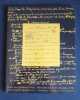
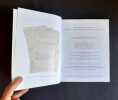
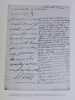
21 lettres autographes de Louis XIV, trois manuscrits du général de Gaulle, grand manuscrit scientifique de Louis de Broglie, deux importants manuscrits autographes de Céline, traductions autographes par Gide de Typhon de Conrad et de poèmes de Walt Whitman. Manuscrits, correspondances et archives de Marcel Schwob (1867-1905) - Tous nos livres sont visibles sur notre site : https://www.livrepoesie.com/
Notice sur la vie et l'?uvre de Frédéric Joliot, Membre de la section de physique
Paris, Palais de l'Institut, 1959, in-4, Portrait, 27 pp, Broché, couverture verte imprimée, Lecture faite le 14 décembre 1959 au cours de la séance annuelle des prix de l'Académie des sciences, par son secrétaire perpétuel, Louis de Broglie (1892-1987). L'auteur relate la vie de Frédéric Joliot (dit Joliot-Curie, 1900-1958), depuis les travaux menés avec son épouse Irène Curie (1897-1956), qui ont permis de connaître la véritable valeur de la masse du neutron. De Broglie insiste ensuite sur la découverte fondamentale de la radioactivité induite et de la radioactivité artificielle en 1934, qui valut aux deux savants le prix Nobel de chimie en 1935, puis sur son rôle dans le CNRS et le Haut commissariat à l'énergie atomique. Le secrétaire perpétuel conclut sa lecture en rendant un hommage à Frédéric Joliot et à sa femme : "Nombreux sont ceux qui ont pensé que la mort prématurée de Frédéric Joliot et de sa femme était due à l'action nocive des radiations auxquelles ils avaient été constamment exposés pendant toute leur vie de travailleurs de laboratoire. On ignorait encore à l'époque leurs dangereux effets physiologiques et on ne cherchait pas suffisamment à s'en protéger. S'il en était ainsi, nous devrions placer Frédéric Joliot et sa femme au nombre de ceux qui ont donné leur vie pour la science". ON JOINT : Francis PERRIN, Funérailles Nationales de Frederic Joliot, Membre de la section de physique à Paris, le mardi 19 août 1958. Paris, Institut de France, 1958. In-4, 8 pp. Broché, sans couverture. Couverture rigide
Bon Portrait, 27 pp.
Discours de réception de M. le Prince Louis-Victor de Broglie à l'Académie Française et réponse de M. le Duc de Broglie
Albin Michel | Paris 1945 | 13.50 x 19 cm | broché
Edition originale, un des 800 exemplaires numérotés sur Hollande, seuls grands papiers. Un infime manque en pied du dos, deux petites taches en tête du premier plat. - Photographies et détails sur www.Edition-Originale.com -
La mécanique ondulatoire. ‘Memorial des sciences physiques’, fasc. 1.
Paris, Gauthier-Villars, 1928, in-4°, 58 p., many hw. notes in German and underlining with pencil, untrimmed copy, original wrappers.
First edition of this paper, an important expansion of the ingenious ideas presented in his earlier publications, notamment «Recherches sur la théorie des quanta» (1924) and «Ondes et mouvements» (1926), in which Louis de Broglie introduced his discovery that constitutes the basis for developing the general theory nowadays known by the name of wave mechanics, a theory which has utterly transformed our knowledge of physical phenomena on the atomic scale.For his remarkable contributions to our knowledge of an entirely new aspect of the properties of matter the 1929 Nobel Prize was awarded to De Broglie for the discovery of the wave nature of electrons. The discovery was not only of fundamental importance for our concept of nature. It also gave research an extremely important and serviceable method for investigating the structure of matter, especially as it may be applied with ease to extremely small quantities.

(SLACES, NVVA)
Phone number : 41 (0)26 3223808
Continu et Discontinu en Physique moderne.
Albin Michel. (1941). 3 mille.,année d"édition. In-8 br. couverture imprimée, 268pp. De la Collection Sciences d"Aujourd"hui.
bon etat, Remise de 20% pour toutes commandes supérieures à 200 €
Sur la théorie des particules de spin quelconque.
(Paris, Gauthier-Villars), 1939. 4to. No wrappers. In: ""Comptes Rendus hebdomadaires des Séances de L'Academie des Sciences"", tome 209, No 5. Pp. (265-) 332. (Entire issue offered). De Broglie's paper: pp. 265-268. A stamp to the first page. Disbound.
First printing on an importent paper by De Broglie on Quantum Spin and statistics.
Ondes et Mouvements.
Paris, Gauthier-Villars et Cie, 1926. 8vo. Bound with orig. printed wrappers in contemp. hcloth. Spine gilt with gilt lettering. A small part of lower spine with a bit of discolouring after a papelabel. A punched stamp on top of title-page. Light wear along edges of boards.VI,133,(1) pp. and (2) pp. of announcements. Textfigs. Internally clean.
First edition. In this work De Broglie set forth the idea that electrons, as was previously regarded as particles, also have wave-quaracters, as well as light has. The idea was tested and confirmed by Davisson and Germer the year after in 1927. Also Schrödinger took up the idea and formulated his wave-equation, explaning the stationary states of the electron of Niels Bohr, by applying De Broglie's concept of electrons as waves to the hydrogen atom. ""Thus the duality of both light and matter had been established, and physicists had to come to terms with fundamental particles which defied simple theories and demanded two sets of 'complementary' descriptions, each applicable under certain circumstances, but imcompatible with one another."" (PMM: 417).
Certitudes et incertitudes de la sciences - Envoi Autographe Signé
Paris Albin Michel 1966 Albin Michel, 1966 - in8 broché 302pp - avec une carte de visite signée et un envoi autographe. Louis De Broglie ( 1892/1987) fut l'un des grands physiciens du XXe. Il obtint le prix Nobel de physique en 1929. C'est lui qui posa les principes de base de la mécanique ondulatoire. Envoi à Robert Levieuge, postier dans la Sarthe, et célèbre collectionneur d'autographe, seul Français à paraître dans le livre des Records pour son incroyable collection d'autographes.
Très bon
L'Électron Magnétique (Théorie de Dirac)
Paris, Hermann et Cie, éditeurs, 1934, in-8, VIII-315 pp, Broché, couverture imprimée, Édition originale cet ensemble de cours professés par le physicien français Louis de Broglie (1892-1987) - récipiendaire du Prix Nobel de 1929 pour ses travaux sur la mécanique ondulatoire, expose sa théorie de la lumière dite "neutrinienne" - fondée sur l'idée que le photon résulte de la fusion de deux particules neutres, les hypothétiques neutrinos de Dirac. Petits manques et déchirures à la couverture. Couverture rigide
Bon VIII-315 pp.
Didier Ozanam et Michel Antoine (publié par) / (Louis XV) / (Comte de Broglie)
Reference : Bufdg37
(1956)
Correspondance secrète du Comte de Broglie avec Louis XV (1756-1774), tome 1 seul (1756-1766), Librairie C. Klincksieck - Paris, 1956
15,8 cm X 24,2 cm, 392 pp, couverture souple. Broché.
Bords un peu frottés, plats très légèrement salis. Très bon état par ailleurs. Intérieur frais.
Compléments de mathématiques à l'usage des ingénieurs de l'électrotechnique et des télécommunications (2eme édition revue et augmentée) - préface de Louis de Broglie [Paperback]
Relié. Skivertex marron souple. Photo sur demande.
Merci de nous contacter à l'avance si vous souhaitez consulter une référence dans notre boutique à Authon-du-Perche.
?Interaction entre le noyau et son cortège électronique réunions d'études et de mises au point?
Paris, Éditions de la revue d'optique théorique, 1949, in-8, 201 pp, Broché, couverture de l'éditeur, Louis de Broglie (1892-1987) contribua au développement de la mécanique ondulatoire, puis quantique. Il est à l'origine de l'idée révolutionnaire que les particules de la matière possèdent à la fois des propriétés corpusculaires et ondulatoires. Cette découverte lui valut le prix Nobel de Physique en 1929. Bon exemplaire non coupé. Dos insolé. Couverture rigide
Bon 201 pp.
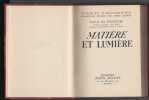
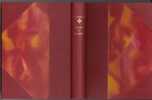
MATIERE ET LUMIERE
1941 Albin michel/ sciences d'aujourd'hui. 1941. In-8. reliure demi toile à coins, Bon état, Intérieur frais. 342 pages.
Remise de 20% pour toutes commandes supérieures à 200 €

