 Write to the booksellers
3 books for « azara felix de »Edit
-
Topics
Geography (1)
Paraguay (1)
Travel (2)
Zoology (1)
-
Countries
Denmark (2)
France (1)
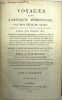
Voyages dans l'Amérique Méridionale, par Don Félix De Azara, Commissaire Et Commandant Des Limites Espagnoles Dans Le Paraguay, depuis 1781 jusqu'en 1801. - [MAIN WORK ON THE RIO DE LA PLATA-REGION]
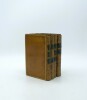
Paris, Dentu, 1809. 8vo & Folio. Four text-volumes and one atlas-volume. Text-volumes uniformly bound (by Harry Larsen) uncut with contemporary blue blank wrappers in recent half calf with gilt lettering to spines. A stamp to title-page in all volumes. With repaired worm-tracts throughout, primarily affecting margins, but with occassional loss of text, otherwise internally clean. LX, 389 (4), 562 + three folding tables (4), 479" (4), 380 pp.Atlas-volume in contemporary half calf with gilt lettering to spine. Worm-tract to inner margin and light margin brownpostting. 25 numbered plates: An engraved portrait of the author, 5 detailed folded maps, 7 plates depicting animals, 8 city plans and views, including a double page plan and view of Buenos Aires, and four bird plates. A complete set.
The preferred first French edition of Azara's highly influential and important work on the region around Río de la Plata, here he charted the region while delineating the boundary between Spanish and Portuguese interests. His work, however, also included his observations on many topics ranging from the geography of the region to characteristics of the many indigenous groups and to zoology in the region. Consequently, he became a naturalist of some note, and Charles Darwin had a high regard for his work. In 1777, Spain and Portugal signed the Treaty of San Ildefonso. As dictated by the treaty, each nation would send a delegation to the Río de la Plata region to negotiate the border dispute between the Portuguese and Spanish colonies. Azara, being a Spanish military officer and engineer, was selected as a member of this delegation and departing quickly for the New World. The Portuguese delegation, however, never arrived, and Azara ended up remaining in the region from 1781 to 1801. In the 20 year period Azara ventured on several expedition in which he began observing the nature of the region. Over the course of his time there, he ""described 448 birds...This number is reduced to 381 when duplications of sex, age, and plumage are taken into account (eight remain unidentified), and 178 of them are the types upon which the scientific names are based."" (Beddall, ""Isolated Spanish Genius. He also identified 78 quadrupeds, 43 of which were new. A number of animals were named after him, including Azara's night monkey (Aotus azarae), Azara's agouti (Dasyprocta azarae), Azara's grass mouse (Akodon azarae), Azara's spinetail (Synallaxis azarae), and Azara's tree iguana (Liolaemus azarai ). Dorsum Azara on the Moon is also named after him.The present work is by far the most extensive and wide-ranging work he published. Vol 3-4 and to a large extend translated from his ""Apuntamientos para la historia natural de los pa?jaros del Paraguay y Rio de la Plata"" (Madrid, 1802-05). Palau 20975 Sabin 2541 Wood, p. 214.

Voyages dans l'Amérique Méridionale par Don Félix Azara. Commissaire et commandant des Limites Espagnoles dans le Paraguay depuis 1781 jusqu'en 1801. Accompagnés d'un Atlas de Vingt-Cinq Planches. Texte Seul.
Paris, Dentu, Imprimeur-Libraire. 1809, 4 volumes in-8 (20x13cm), LX-389pp., 2ff. - 562pp., 3 tableaux dépliants, 2ff.-II-477pp., 2ff.-380pp., relié veau époque, dos lisse avec pièces de titre, auteur et tomaison, frises dorées aux plats, estampage à froid avec écoinçons, roulette dorée intérieure, tranches cailloutées. Charnières fendues, charnière fragile au tome 2, frottements, accrocs au dos tome 2, coiffes abimées, coins usés, manque une pièce d’auteur et une de tomaison De la Bibliothèque de George Willbraham avec son ex-libris gravé en page de garde. Texte seul de l’édition originale du voyage de Félix de Azara.
Première édition française recherchée de l’œuvre d’Azara consacrée à la région du Río de la Plata, où il entreprit la cartographie du territoire tout en définissant la frontière entre les zones d’influence espagnole et portugaise. Son travail, cependant, dépasse la simple géographie : il comprend des observations détaillées sur les peuples indigènes, la faune et la flore locales. Naturaliste de grand talent, Azara fut hautement estimé par Charles Darwin, qui reconnut la valeur scientifique de ses études. À la suite du traité de San Ildefonso signé en 1777 entre l’Espagne et le Portugal, les deux nations décidèrent d’envoyer une délégation dans la région du Río de la Plata afin de résoudre leurs différends frontaliers. Officier et ingénieur militaire, Azara fut désigné pour représenter l’Espagne et partit rapidement pour le Nouveau Monde. La mission portugaise n’arrivant jamais, il demeura sur place de 1781 à 1801. Durant ces vingt années, il mena de nombreuses expéditions et observa minutieusement la nature du pays. Il décrivit 448 espèces d’oiseaux, dont 178 servent de base aux noms scientifiques modernes (Beddall, Isolated Spanish Genius). Il identifia également 78 quadrupèdes, dont 43 étaient nouveaux pour la science. Plusieurs espèces animales portent son nom : le singe de nuit d’Azara (Aotus azarae), l’agouti d’Azara (Dasyprocta azarae), la souris des herbes d’Azara (Akodon azarae), la synallaxe d’Azara (Synallaxis azarae) et l’iguanidé arboricole d’Azara (Liolaemus azarai). L’ouvrage présenté constitue de loin le plus vaste et le plus complet publié par Azara. Les volumes III et IV reprennent en grande partie la traduction de son Apuntamientos para la historia natural de los páxaros del Paraguay y Rio de la Plata (Madrid, 1802-1805). M1-Et5 Sabin 2541, Chadenat 10
Reise nach Süd=Amerika...in den Jahren 1781 bis 1801. Aus d. Spanischen mit Anmerkungen und einer Nachricht von dem leben des Verfassers hrsg. von Walenaer.
Bln., 1810. Cont. hcalf. XXVI,479 pp. a. 1 large fold.engr.plt.(Neues Magazin v merkw.Reisebeschreibungen Bd.7).

