 Write to the booksellers
771 books for « angelo »Edit
-
Type
Autograph (3)
Book (720)
Disk (1)
Drawings (4)
Engraving (1)
Manuscript (1)
Maps (1)
Music sheets (40)
-
Latest
Last 24h (2)
Last 3 days (2)
Last month (19)
Last week (1)
-
Language
English (1)
French (751)
Italian (15)
Latin (1)
Russian (3)
-
Century
16th (3)
17th (5)
18th (9)
19th (44)
20th (326)
21st (64)
-
Countries
Belgium (68)
Canada (1)
Denmark (11)
France (580)
Greece (3)
Italy (1)
Switzerland (101)
United Kingdom (3)
United States of America (3)
-
Syndicate
ALAC (1)
CLAM (3)
ILAB (314)
NVVA (17)
SLACES (17)
SLAM (271)
SNCAO (2)
Topics
- Alps (8)
- Ampelography - wines (3)
- Archaeology (5)
- Architecture (9)
- Astronomy (2)
- Autographs (12)
- Bayle pierre (2)
- Belgium (2)
- Biography (9)
- Botany (3)
- Brazil (2)
- Catholicism (3)
- Chemistry (3)
- Christianity (7)
- Cinema (2)
- Comedy (4)
- Comic strip (7)
- Communism (3)
- Contact sports (2)
- Curiosa (2)
- Dedication (8)
- Dictionaries (4)
- Dorin rene (5)
- Drawings (3)
- Economics (3)
- Engraving (books about) (2)
- Entomology (3)
- Ethnology (4)
- Europe (3)
- Faust (3)
- Fine arts (14)
- First edition (15)
- Flora (2)
- Gallimard (3)
- Genealogy (2)
- Geography (5)
- Grammar (2)
- Greece (6)
- Head edition (5)
- Helvética (13)
- History (43)
- Industrial arts & crafts - fine arts (5)
- Italian (52)
- Italian literature (3)
- Italy (30)
- Latin (6)
- Law (4)
- Linguistics (3)
- Literature (68)
- Magazine (3)
- Malacology (3)
- Manuscripts (3)
- Mathematics (3)
- Medicine (6)
- Motor vehicle (3)
- Music (4)
- Mythology (4)
- Navy (3)
- Newspapers press (4)
- Oceanography (2)
- Opera (4)
- Opera ballet (4)
- Painting (3)
- Palaeography (5)
- Paris (4)
- Philology (4)
- Philosophy (7)
- Photography (5)
- Poetry (4)
- Policy (4)
- Prague (2)
- Procopiou angelo (8)
- Psychoanalysis (3)
- Raphael (8)
- Religions (21)
- Reverend (4)
- Reviews (2)
- Ripellino angelo maria (4)
- Rome (3)
- Rooster (2)
- Sciences (7)
- Scores (47)
- Signed binding (2)
- Songs (34)
- Sports (2)
- Switzerland (13)
- Theatre (2)
- Theology (10)
- Travels & tourism (2)
- United kingdom (2)
- Vatican city (7)
- Venice (4)
- Vintage (3)
- War (5)
VENISE ( Dessin original en couleurs sur papier fort, signé parAngelo Griscelli )
Sans lieu, XXème 0 29 x 21 cms 1 dessin original en couleurs sur papier fort, signé à la plume en bas à gauche. Dessin à la plume de forme ovale, rehaussé au crayons de couleurs, figurant au premier plan 2 personnages vus de dos (dont une femme nue), assistant au passage d'une gondole devant un palais vénitien. Angelo Griscelli, peintre français, né à Sète en 1893, décédé à Montpellier en 1978. Beaux-Arts de Montpellier, Paris. Illustrateur, affectionnant les sujets grivois ou galants, et brillant dessinateur de presse satirique ( Photographies sur demande / We can send pictures of this book on simple request )
Très bon Pas de couverture
[Eugène Courboin] - STENDHAL (Henri Beyle, DE). Eugène COURBOIN, illustrateur. Angelo MARIANI (provenance). UZANNE, Octave (directeur de la publication, éditeur).
Reference : AMO-4499
(1890)
L'ABBESSE DE CASTRO avec des illustrations d'Eugène Courboin.
Paris, Publié pour les Sociétaires de l'Académie des Beaux Livres (Bibliophiles contemporains), 1890 (achevé d'imprimer le 20 décembre 1890). 1 volume grand in-8 (26 x 18 cm), 170-(2) pages. Toutes les pages sont décorées d'encadrements en camaïeu par Eugène Courboin, eaux-fortes dans le texte gravées par Manesse d'après les dessins d'Eugène Courboin. Reliure de l'époque plein maroquin violine, dos à deux nerfs, plats décorés d'une guirlande de fleurs oranges et feuillage de houx, décor mosaïqué au centre du premier plat avec rehauts de motifs au fer à dorer avec la devise dorée AMOR A -MORT (avec serpents argentés, anges souffleurs de trompettes, le tout surmonté par une tête de mort en majesté cernée de rayons d'or), avec feuillages. Dos mosaïqué de fleurs de lis avec titre doré au centre. Encadrement intérieur mosaïqué de fleurettes rouges et feuillage doré, doublures et gardes de tabis gris, filet doré sur les coupes, tranches dorées. Etui bordé. Reliure signée CH. MEUNIER 97 (Charles Meunier, 1897). Exemplaire parfaitement conservé. Quelques décharges en regard des gravures.
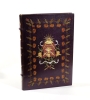
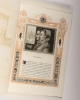
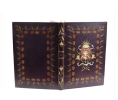
Tirage à 160 exemplaires pour les membres de la Société des Bibliophiles Contemporains. Celui-ci imprimé pour Monsieur Angelo Mariani. Les encadrements par Eugène Courboin sont d'une inventivité et d'une imagination qui annoncent le Symbolisme et l'Art nouveau. Les eaux-fortes insérées dans les pages (différentes tailles) apportent un aspect esthétique supplémentaire à l'ensemble. Ce livre peu connu des bibliophiles, d'un tirage rare, mérite cependant toute leur considération. L’Abbesse de Castro est la plus connue des Chroniques italiennes de Stendhal et constitue un condensé particulièrement riche de l’écriture stendhalienne. L’écriture de cette chronique est contemporaine de celle de La Chartreuse de Parme : la découverte en 1833 de manuscrits italiens dans les bibliothèques ou chez de riches particuliers fournit la première impulsion à l’imagination de l’auteur, qui ne se démentira jamais jusqu’à sa mort prématurée. Stendhal s’empare de ce matériau et se l’approprie, tant et si bien que la majeure partie de L’Abbesse de Castro n’est en rien une traduction, mais bien une invention. Cette chronique se présente comme une histoire d’amour impossible entre Hélène, élevée au couvent de Castro, riche héritière d’une puissante famille des environs de Rome, et Jules, fils de brigand, et pauvre parmi les pauvres. Leur différence sociale, la religion, une sourde fatalité : tout s’oppose à leur union et concourt à leur perte. Histoire effrénée d’amour, de violence et de mort dans l’Italie du XVIe siècle, L’Abbesse de Castro revisite les grands mythes amoureux de la littérature. Il s'agit du deuxième ouvrage publié par les soins d'Octave Uzanne pour les membres de la jeune société des Bibliophiles contemporains, née à peine un an auparavant (novembre 1889). Octave Uzanne en est le maître d'œuvre. Il emploie ici le talent d'Eugène Courboin qui participera à d'autres publications bibliophiliques pour le Prince des Bibliophiles. Provenance : de la bibliothèque Angelo Mariani relié pour lui et imprimé à son nom. Angelo Mariani (1838-1914) fut l'inventeur et le propagateur du vin tonique à la coca, dit vin Mariani. Il fut l'ami intime d'Octave Uzanne et de son frère Joseph qui fut son secrétaire et le directeur des Figures Mariani (biographies de personnolités) recueillies entre 1894 et 1914 (puis avec le fils de Mariani de 1914 à 1925). Mariani fut également mécène et bibliophile. Splendide exemplaire relié en maroquin mosaïqué richement décoré pour Monsieur Angelo Mariani, ami de l'auteur et célèbre inventeur et propagateur du vin à la coca dit Vin Mariani. Un des plus beaux exemplaires qu'on puisse imaginer pour cet ouvrage.
Souvenirs - Lettres à Angelo Mariani.Frontispice, en-têtes et culs-de-lampe composés par l'auteur.
1912 Mesnil-sur-l'Estrée, Typographie Firmin-Didot et Cie, 1912, 1 vol. in-12 (195 x 142 mm) broché sous couverture beige rempliée imprimée en noir, de (2) ff. (faux-titre, titre et justificatif au verso) - 390 pp.Très bel exemplaire en grande partie non coupé.
![Souvenirs - Lettres à Angelo Mariani.Frontispice, en-têtes et culs-de-lampe composés par l'auteur.. [Angelo MARIANI] - Eugène MOUCHON.](https://static.livre-rare-book.com/pictures/AUR/14678_1_thumb.jpg)
![Souvenirs - Lettres à Angelo Mariani.Frontispice, en-têtes et culs-de-lampe composés par l'auteur.. [Angelo MARIANI] - Eugène MOUCHON.](https://static.livre-rare-book.com/pictures/AUR/14678_2_thumb.jpg)
![Souvenirs - Lettres à Angelo Mariani.Frontispice, en-têtes et culs-de-lampe composés par l'auteur.. [Angelo MARIANI] - Eugène MOUCHON.](https://static.livre-rare-book.com/pictures/AUR/14678_3_thumb.jpg)
Edition originale non mise dans le commerce de ces souvenirs de ce grand graveur, sous forme de recueil de lettres adressées à Angelo Mariani "Vulgarisateur de la Coca".Tirée à 135 exemplaires, 1 des 120 sur vélin teinté (N°65).Illustré par l'auteur de 2 autoportraits placés en frontispice (« M. E. Mouchon à sa table de graveur » et « M. E. Mouchon imprimant ses épreuves ») ainsi que de 29 culs-de-lampe et 38 bandeaux.


Amore è il piu bello [ Livre dédicacé par l'auteur ]
1 vol. in-12 br., Quaderni di Poesia, Rebellato Editore, 1972, 54 pp.
![Amore è il piu bello [ Livre dédicacé par l'auteur ]. BELLETTATO, Angelo](https://static.livre-rare-book.com/pictures/CDL/55791_thumb.jpg)
![Amore è il piu bello [ Livre dédicacé par l'auteur ]. BELLETTATO, Angelo](https://static.livre-rare-book.com/pictures/CDL/55791_2_thumb.jpg)
![Amore è il piu bello [ Livre dédicacé par l'auteur ]. BELLETTATO, Angelo](https://static.livre-rare-book.com/pictures/CDL/55791_3_thumb.jpg)
Bel envoi autographe d'Angelo Bellettato à l'écrivain bordelais Michel Suffran, "poète de l'âme, avec l'admiration de Angelo Bellettato". Etat très satisfaisant (qq. rouss.). Poeta, traduttore ed editore, Angelo Bellettato (1941-2004) ha diviso la sua vita fra Veneto e Lazio.
( Catalogues de Ventes Littérature - Illustrateurs ) - Angelo Di Marco - François Meyniel.
Reference : 28750
(2015)
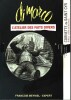
Di Marco. L'Atelier des Faits Divers. Catalogue de Vente Angelo Di Marco du samedi 17 juin 2017 chez Cornette de Saint Cyr.
Cornette de Saint Cyr, Commissaires Priseurs 2017. In-4 broché de 96 pages au format 29,5 x 20,5 cm. Couvertures, illustrées recto/verso. Dos carré. Plats et intérieurs frais. Magnifique catalogue de la vente du samedi 17 juin 2017 chez Cornette de Saint Cyr, entièrement consacré à l'illustrateur et artiste Angelo Di Marco. Présentation de l'expert François Meyniel. Contient 341 lots décrits avec estimations et presque tous reproduits. On y trouve des illustrations et affiches, en noir et blanc et en couleurs. Edition originale en état superbe.
Vente exclusivement par correspondance. Le libraire ne reçoit, exceptionnellement que sur rendez-vous. Il est préférable de téléphoner avant tout déplacement.Forfait de port pour un livre 10 € sauf si épaisseur supérieure à 3 cm ou valeur supérieure ou égale à 100 €, dans ce cas expédition obligatoire au tarif Colissimo en vigueur. A partir de 2 livres envoi en colissimo obligatoire. Port à la charge de l'acheteur pour le reste du monde.Les Chèques ne sont plus acceptés.Pour destinations extra-planétaire s'adresser à la NASA.Membre du Syndicat Lusitanien Amateurs Morues
Calcolo differenziale e principii di calcolo integrale, pubbicato con aggiunte dal Dr. Giuseppe Peano. - [A FOUNDATIONAL WORK OF THE SCIENCE OF INFINITESIMAL CALCULUS]
Torino, Fratelli Bocca, 1884. 8vo. Cont. full green cloth w. gilt title and ornamentation to spine. Minor occasional browning. A very nice and clean copy. XXXII, 333, (5, -index and errata) pp.
The scarce first edition of Peano's first major publication, his first book, the work that brought him international fame, and one of the most important calculus texts since the time of Euler and Cauchy.The present book, which has a somewhat strange history, contributing to its scarcity, is considered a constitutional work of the science of infinitesimal calculus. In 1899 it was translated into German, and in 1903 into Russian.The famous Italian mathematician, logical philosopher, pioneer of symbolic logic, and a founder of mathematical logic and set theory, Giuseppe Peano (1858 -1932), studied mathematics at the University of Turin, where he was employed just after graduating (1880), and where he stayed almost all of his life, devoting his life to mathematics. After having graduated with honours, he was employed to assist first Enrico D'Ovidio, and then the renowned Angelo Genocchi, who possessed the chair of Infinitesimal calculus. At this time, Genocchi's health was declining, and the teaching of the infinitesimal calculus course was handed over to Peano already in 1882. In 1880 Peano had published his first paper, and the following year he published another three" in 1884 he published his first book, the foundational ""Calculus and Principles of Integral Calculus"", which constitutes one of ""the most important works on the development of the general theory of functions since the work of the French mathematician Augustin-Louis Cauchy (1789-1857)"". (Encycl. Britt.)As is evident from the title-page, the work was based on Genocchi's lectures on calculus"" however, the book turned out to be much more than, and in fact something completely different from, that. Peano stands as the editor of the work, but in fact most of the book is written by Peano himself. Apparently, Genocchi had given his approval to the publication of an edited version of his lectures, but when he saw the final result, he regretted the fact that it had appeared under his name. Genocchi stated in a letter that ""... the volume contains important additions, some modifications, and various annotations, which are placed first. So that nothing will be attributed to me which is not mine, I must declare that I have had no part in the compilation of the aforementioned book and that everything is due to that outstanding young man Dr Giuseppe Peano ..."".Peano assumed full responsibility for the work and also recognised it as his own. He later saw the importance that this book has had on the development of the science of infinitesimal calculus. ""In 1915 he (Peano) printed a list of his writings, adding: ""My works refer especially to infinitesimal calculus, and they have not been entirely useless, seeing that, in the judgment of competent persons, they contributed to the constitution of this science as we have it today."" This ""judgment of competent persons"" refers in part to the ""Encyclopädie der mathematischen Wissenschaften"", in which Alfred Pringsheim lists two of Peano's books among nineteen important calculus texts since the time of Euler and Cauchy. The first of these books was Peano's first major publication and is something of an oddity in the history of mathematics, since the title page gives the author as Angelo Genocchi, not Peano: ""Angelo Genocchi, Calcolo differenziale e principia de calcolo integrale, publicato con aggiunte dal Dr. Guiseppe Peano."" The origin of the book is that Bocca Brothers wished to publish a calculus text based on Genocchi's lectures. Genocchi did not wish to write such a text but gave Peano permission to do so. After its publication Genocchi, thinking Peano lacked regard for him, publicly disclaimed all credit for the book, for which Peano then assumed full responsibility."" (D.S.B. X:441).Later the same year, after the publication of this his first major work, Peano became professor at the university of Turin. His first work now stands, not only as one of the founding texts of modern infinitesimal calculus, but also as a prime example of Peano's excellent style, which perfectly mixes simplicity and rigour. ""Beginning with a strict definition of real number, essentially that of Dedekind, he develops the calculus systematically, formulating every theorem with the greatest possible accuracy and precision, and strictly avoiding in the proofs any illegitimate appeal to intuitive properties of curves. When the customary enunciations of theorems are too loose, or conditions that need to be satisfied are not as a rule clearly stated, Peano often constructs counter-examples to show that assertions made in standard textbooks are incomplete or erroneous...."" (Kneebone, Mathematical Logic and Foundations of Mathematics, p. 142). Cellerino nr. 1. ""Prima edizione del primo libro di Peano che venne tradotto nel 1899 in tedesco e nel 1903 in russo. Pubblicato sotto il nome di Genocchi di cui Peano era assistente, il volume è in realtà interamente opera sua tanto che Genocchi lo disconobbe publicamente dando origine ad una breve polemice. Questa è l'opera che diede a Peano notorietà internazionale."" (Cellerino, Guiseppe Piano e la sua scuola. Catalogo monografico. Milano, 2004).
Dessin original Lavis encre de chine Roman-Photo Télé Poche
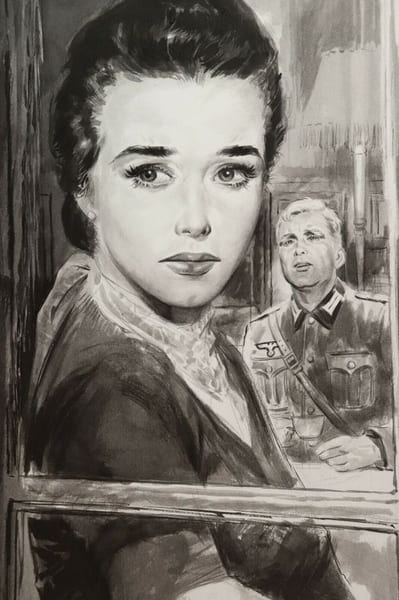
Très beau dessin original lavis d'encre de Chine signé par Angelo Di Marco (DiMarco) Grand format dessin 33 x 23 cm environ sur carton 43 x 25,5 cm Ce dessin est signé par Angelo Di Marco Sujet : femme au regard inquiet à la fenêtre avec militaire au second plan Dessin original exécuté pour un roman-photos et publié probablement dans le programme TV Télé Poche entre 1966 et 1967 (aucune mention précise sur ce dessin) Annotations au bas (voir photos). Très beau dessin par un maître du genre Angelo Di Marco (1927-2016) est connu et reconnu pour son talent d'illustrateur.
Dessin original Lavis encre de chine Roman-Photo Télé Poche
Très beau dessin original lavis d'encre de Chine non signé mais par Angelo Di Marco (DiMarco) Grand format dessin 31 x 24 cm environ sur carton 32 x 24,5 cm Ce dessin n'est pas signé mais est bien d'Angelo Di Marco Sujet : scène d'intérieur à trois personnages Dessin original exécuté pour un roman-photos intitulé "Colombella" et publié dans le programme TV Télé Poche n°37 (numéro du 21 mai 1966 - première année de parution de ce périodique pour la télévision) Annotations au bas et au verso (voir photos). Très beau dessin par un maître du genre Angelo Di Marco (1927-2016) est connu et reconnu pour son talent d'illustrateur.
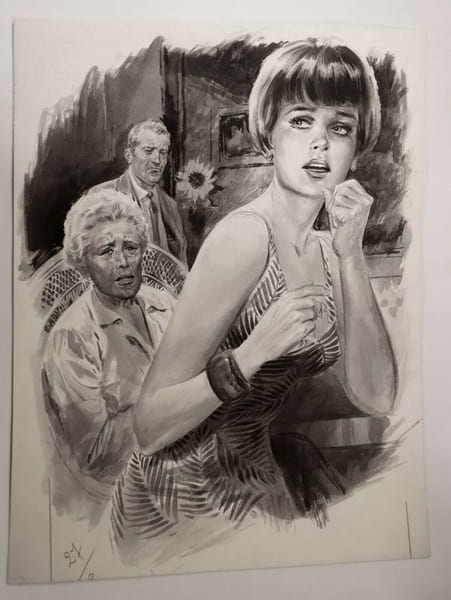

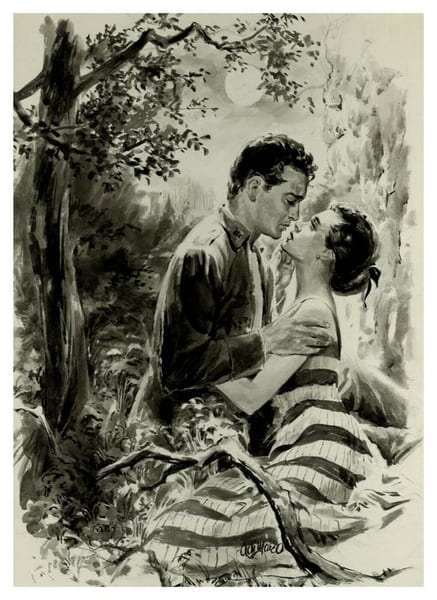
Dessin original encre de chine Roman-Photo Télé Poche
Très beau dessin original signé par Angelo Di Marco (DiMarco) Grand format dessin 29 x 21 cm environ sur carton 32,5 x 22,5 cm Signé à l'encre en bas dans le dessin en bas "A. Di Marco" Sujet : scène romantique d'amour entre un homme et une femme, dans la nature Dessin original exécuté pour un roman-photos publié dans le programme TV Télé Poche n°13 (numéro du 6 avril 1966 - première année de parution de ce périodique pour la télévision) Annotations au bas et en marge supérieure du dessin et au verso (voir photos). Très beau dessin par un maître du genre Angelo Di Marco (1927-2016) est connu et reconnu pour son talent d'illustrateur. Biographie résumée de l'artiste (source Wikipédia) : Angelo Di Marco, né le 10 juillet 1927 à Paris1 et mort le 21 décembre 2016 dans la même ville2, est un dessinateur de presse et de bandes dessinées français, surtout connu pour ses illustrations de faits diversréalisées pour certains grands journaux (tels que France-Soir, Radar, Détective ou encore France Dimanche). Angelo Di Marco commence d’abord à réaliser des illustrations de faits divers3 dans les années 1950. Il se forge alors une réputation d'illustrateur réaliste confirmé, parfois même qualifié d'hyperréaliste. Obtenant une certaine notoriété, il publie dans Bravo puis dans Le Parisien libéré sa première bande dessinée : Capitaine Ardent. Puis il crée en 1960 Ivanhoé dans Télé 7 Jours suivi du Petit Shérif et des Trois Mousquetaires. À la fin des années 1960, il reprend dans Pif Gadget le personnage de Nasdine Hodja, scénarisé par Roger Lécureux, à la suite de Pierre Leguen et Roger Bastard. À partir du n° 1257 (Pif Gadget n° 19) L’insaisissable prend la mouche 20 planches du 5 juillet 1969 au n° 1407 (Pif Gadget n° 169), La pastèque creuse 20 planches de mai 1972. Ce sont les aventures picaresques d'un Robin des bois oriental, qui se joue des califes et autres pachas, avec beaucoup de ruses et de tours divers. Il dessina 16 récits complets et mena cette belle série, née en 1946 dans Vaillant, à son terme... Il est surtout connu pour ses unes de l'hebdomadaire de faits divers Détective. Elles étaient affichées dans les kiosques à journaux pour annoncer les nouveaux numéros, et il y dessinait, avec son style très réaliste, l'ultime moment avant le crime : « La nature même de mes dessins protège la victime », déclara-t-il avec humour « puisque j’arrête le geste du meurtrier juste avant qu’il ne se produise. La victime reste ainsi sauve pour la postérité ». En 1959, un de ses dessins, fait et refait dans ses moindres détails avec un témoin, la voisine de palier de la victime, constitue même un remarquable portrait-robot et permet à la police d'identifier le meurtrier4. Dans les années 1990, il poursuit sa carrière avec Arthur et Stéphane, Yankee et l'adaptation de la série télévisée K 2000. Il publie également des bandes dessinées érotiques, sous le pseudonyme d'Arcor5, dans Bédéadult' tels que Dr. Sex et Pot Bouille.
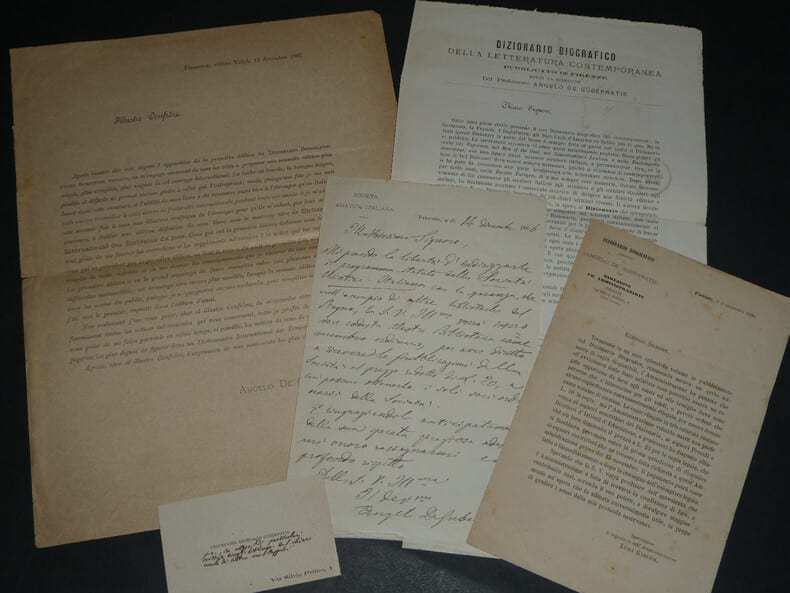
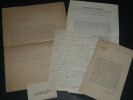
Angelo De Gubernatis - Lettre autographe signée et divers documents 1886
Angelo De Gubernatis. Lettre autographe signée, 1886. Lettre autographe signée datée de Florence 14 décembre 1886 adressée à l'historien et bibliothécaire Antonio Cappelli (1818 - 1887). Une page in-8, sur papier à en-tête de la "Asian-Italian Society". Joint : note autographe et trois documents imprimés relatifs à la publication du Dizionario Biografico degli scrittori contemporanei, édité par De Gubernatis en 1879 pour Le Monnier. État : Bon. Angelo De Gubernatis, né le 7 avril 1840 à Turin et mort le 20 février 1913 à Rome, est un ethnologue, philologue, orientaliste, historien de la littérature et dramaturge italien.
Les Dames de France Rinaldi, Angelo
BROCHE. correct Pliures au dos, aspect jauni, coins cornés, intérieur propre. BON ETAT.. Dimensions 14,0 x 20,5 x 1,7 cm. 305 gr. 288 pages. PHOTOS SUR DEMANDE. Les dames de France ~ Rinaldi, Angelo. Gallimard, Broché, 1977
Merci de nous contacter à l'avance si vous souhaitez consulter une référence dans notre boutique à Authon-du-Perche.
Les Dames de France Rinaldi, Angelo
BROCHE. correct Pliures au dos, aspect jauni, coins cornés, intérieur propre. Dimensions 14,0 x 20,5 x 1,7 cm. 305 gr. 288 pages. PHOTOS SUR DEMANDE. Les dames de France ~ Rinaldi, Angelo. Gallimard, Broché, 1977
Merci de nous contacter à l'avance si vous souhaitez consulter une référence dans notre boutique à Authon-du-Perche.
Ranalalalulu CXXXIV
Ferdinand Sartorius Éditeur 1872 in12. 1872. Relié. Ouvrage littéraire français originalement publié en 1872 par Angelo Sorr réimprimé dans le cadre d'un programme de conservation patrimoniale. Le contenu reflète les courants de pensée de son époque dont certains pourraient être jugés condamnables aujourd'hui. Il s'agit d'un fac-similé fidèle à l'édition originale
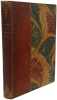
Bon état pages avec un minimum de taches
Où finira le fleuve. Roman [ Livre dédicacé par l'auteur à Maurice Druon ]
Envoi ms. de l'auteur, 1 vol. in-8 br., Fayard, Paris, 2006, 382 pp.
![Où finira le fleuve. Roman [ Livre dédicacé par l'auteur à Maurice Druon ]. RINALDI, Angelo](https://static.livre-rare-book.com/pictures/CDL/70074_thumb.jpg)
![Où finira le fleuve. Roman [ Livre dédicacé par l'auteur à Maurice Druon ]. RINALDI, Angelo](https://static.livre-rare-book.com/pictures/CDL/70074_2_thumb.jpg)
![Où finira le fleuve. Roman [ Livre dédicacé par l'auteur à Maurice Druon ]. RINALDI, Angelo](https://static.livre-rare-book.com/pictures/CDL/70074_3_thumb.jpg)
Bel envoi d'Angelo Rinaldi "A Maurice Druon, qui sait d'où vient l'aurore - qui l'a toujours su - avec une admiration et une amitié augmentant avec les années et les rendez-vous du jeudi, et en hommage aussi à sa fougue de cavalier. Angelo Rinaldi. Mes respectueux hommages à Mme Druon". Bon état (couv. lég. frottée) pour cet exemplaire du tirage ordinaire (après 25 Arches), venant de la bibliothèque de Maurice Druon, Secrétaire Perpétuel de l'Académie Française de 1985 à 1999.
Mère Teresa, Devananda Scolozzi Angelo
Reference : R200140065
(1991)
ISBN : 2853132366
Par la parole et par l'exemple - Dédicacé par Père Angelo.
Nouvelle cité. 1991. In-8. Broché. Etat d'usage, Coins frottés, Dos plié, Quelques rousseurs. 182 pages - papier jauni, accro en coin en pier du 1er plat - Dédicacé par Père Angelo (photo dispo).. . . . Classification Dewey : 97.2-Dédicace, envoi

Traduction de Jean-Marie Wallet. Classification Dewey : 97.2-Dédicace, envoi
L'Education de l'Oubli
Denoël | Paris 1974 | 11.50 x 20 cm | broché
Edition originale pour laquelle il n'a pas été tiré de grands papiers, un des exemplaires du service de presse. Quelques piqûres affectant principalement les gardes et la tranche. Bel envoi autographe signé d'Angelo Rinaldi : " A Dominique Aury qui, la première a lu ce livre, et qui, la seule, a vu l'image dans le tapis - ajoutant cette gentillesse et cette récompense à tant de marques d'amitié, pour lui dire toute ma gratitude. Angelo Rinaldi. Paris 174." - Photographies et détails sur www.Edition-Originale.com -
Perspectives on Byzantine Archaeology. From Justinian to the Abbasid Age (6th?9th Centuries AD)
, Brepols, 2022 Paperback, 251 pages, Size:216 x 280 mm, Illustrations:100 b/w, 5 col., Language: English. ISBN 9782503596846.
Summary From the rule of Justinian (AD 527-AD 565) up to the Islamic conquests in the Byzantine Empire, the lands of the Mediterranean basin underwent significant change from the sixth to the ninth centuries AD. Urban and rural areas were transformed, landscapes altered, and material cultures saw a fundamental shift. But such changes were by no means uniform across the region. From Jordan, Greece, and the Danube, to the Italian peninsula, Sicily, Spain, and the Horn of Africa, the contributions gathered together in this volume explore new advances and perspectives from the field of 'Byzantine' archaeology over the longue dur e in order to shed new light on this period. What was the impact of the reconquest of Justinian? What was the impact of Byzantium in archaeological record? What are the archaeological indicators of urban and rural transformations from the sixth to the ninth centuries? Did architecture represent a marker of socio-economic and cultural change within the Byzantine world? By engaging with such key questions, and by drawing on new data from surveys, excavations, material culture, and historical sources, this volume offers new insights into archaeological perspectives on the broader Byzantine world. TABLE OF CONTENTS List of illustrations 1. Shifting Paradigms in a Shifting Background: An Introduction Angelo Castrorao Barba and Gabriele Castiglia Cities 2. Thessaloniki in Transition (Sixth to Ninth Centuries): The transformation of a Late Antique Imperial Metropolis into a Medieval Urban Center Konstantinos T. Raptis 3. Rome ?The Legacy of the Gothic War in the Urban Defensive Systems Lucrezia Spera 4. Ravenna, the Last Capital of the Western Roman Empire Enrico Cirelli Landscapes 5. The Justinian Renaissance in the East: Reality or Illusion? Basema Hamarneh 6. Umm al-Rasas / Kastron Mefa'a (Jordan) along the Limes Arabicus. Transformation and Resilience of a Cultural Landscape between Byzantine and Early Islamic Period Carmelo Pappalardo 7. Settled Lansdscapes in the Late Antique Peloponnese: A Review for a Topographical Reassessment Priscilla Ralli 8. Aquae in the De Aedificiis. Territorial and Administrative Issues in Dacia Ripensis during the Sixth Century Ivan Gargano 9. From Twilight to a New Dawn: Byzantine Southern Italy Paul Arthur 10. The Sicilian countryside during the Byzantine period: Archaeological Perspectives on Settlement Patterns Giuseppe Cacciaguerra and Angelo Castrorao Barba 11. Shaping a Christian Empire: Early Christianity in the Horn of Africa from Alexandria to Byzantium Gabriele Castiglia and Philippe Pergola Material culture 12. The Circulation of Coinage in Two Byzantine Cities: Rome and Naples in Comparison Flavia Marani 13. Movable Churches, or How Byzantium Influenced Hispania: An Archaeological Reflection on a Current Debate Mar a de los ngeles Utrero Agudo 14. Material Encounters in a Byzantine Setting (Sixth/Seventh to Tenth Centuries AD) Joanita Vroom
Dissertazione sopra un antico mezzo busto. falsamente attribuito ad Annibale Cartaginese
Naples, Angelo Trani, 1813 in-4, 88 pp., [2] ff. n. ch. (table et errata), avec un frontispice gravé au trait par Cataneo, demi-veau havane, dos lisse cloisonné en long, pièce de titre noire en long, tranches mouchetées (rel. du milieu du XIXe). Rousseurs.
Professeur de paléographie à l'Université de Naples, Angelo Antonio Scotti (1786-1845) avait décliné en 1815 la proposition du pape Pie VII de venir diriger en tant que préfet la Bibliothèque Vaticane. Très lié avec la famille royale de Naples (il fut précepteur du futur Ferdinand II), il devint cependant préfet de la Real Biblioteca Borbonica en 1817. La plupart de ses écrits concernent la diplomatique, mais il composa aussi dans sa jeunesse quelques monographies archéologiques, dont notre opuscule.Au CCF, exemplaires seulement à la BnF et à l'INHA. - - VENTE PAR CORRESPONDANCE UNIQUEMENT - LIEN DE PAIEMENT, NOUS CONSULTER.
EXTRAIT DE L'ECHO DES FEUILLETONS - RECUEIL DE NOUVELLES, CONTES, ANECDOTES, EPISODES, ETC - L'étoile de la mer par Pier-Angelo Fiorentino, Une partie d'échecs, Sarah par A. Genevay, Les eaux d'Abano par E. Souvestre, La fiancée de Madrid
CHEZ LES EDITEURS. 1843. In-12. Broché. Bon état, Couv. convenable, Dos satisfaisant, Intérieur frais. Paginé de 1 à 168.. . . . Classification Dewey : 840.8-Anthologies, recueils
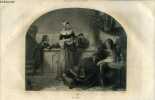
Extrait de la presse contemporaine, par MM. J-B. Fellens et L.-P. Dufour. Sommaire : L'étoile de la mer par Pier-Angelo Fiorentino, Une partie d'échecs, Sarah par A. Genevay, Les eaux d'Abano par E. Souvestre, La fiancée de Madrid par Molé-Gentilhomme, L'amour médecin par Ch. Paul de Kock, Louise de Lorraine par Clémence Robert, L'horoscope par Viennot, Le domino blanc par Moléri, Simple histoire par Clémence Lalire Classification Dewey : 840.8-Anthologies, recueils
Incartamento Generale della umanitaria opera Escarcerazione dei detenuti civili nelle provincie meridionali d'Italia disposta dell'invitto generele Giuseppe Garibaldi. - [GARIBALDI'S AMNESTY]
[No place or printer], 1861. Small folio. Bound in contemporary half vellum. Dampstaining in top corner throughout. Binding slightly loose. Pp. 48 + 5 folded tables.
Rare first edition (only?) of Neapolitan police inspector Angelo Falangola's account of a plea made on behalf of imprisoned debtors for an amnesty.This most likely unprecedented legal action is documented in detail, reprinting the correspondence between Falangola, different legal instances and Garibaldi's permission to free the debtors.During the height of the final battles for Italian unity and against the remnants of autocracy in Southern Italy, when Garibaldi figured as 'Dittatore dell'Italia Meridionale Generale Garibaldi,' the Neapolitan inspector of the police Angelo Falangola made a plea on behalf of imprisoned debtors for an amnesty, which was granted by Garibaldi, after a collection of money had been carried out in all Neapolitan provinces in order to raise money as a guarantee for the debts. Falangola here presents a documentation of the history of this amnesty, the legal and financial wranglings, including tables of the debtors, the amount of debts and the creditors. The amnesty was given during the famous Expedition of the Thousand an event of the Italian Risorgimento took place in 1860. A corps of volunteers led by Giuseppe Garibaldi landed in Sicily in order to conquer the Kingdom of the Two Sicilies, ruled by the Bourbons.The project was an ambitious and risky venture to conquer, with a thousand men, a kingdom with a larger regular army and a more powerful navy. The expedition was a success and concluded with a victory that brought Naples and Sicily into the Kingdom of Sardinia, the last territorial conquest before the creation of the Kingdom of Italy on March 17, 1861.
DISQUE VINYLE 33T : L'OEUVRE INSTRUMENTALE - I Solisti di Milano, dir. Angelo Ephrikian
HARMONIA MUNDI. NON DATE. In-12. Broché. Bon état, Couv. convenable, Dos satisfaisant, Intérieur frais. Pochette non illustrée. Annotation. I Solisti di Milano, dir. Angelo Ephrikian.. . . . Classification : 410-33 Tours
Disque n° HMU 312. Classification : 410-33 Tours
FIGURES CONTEMPORAINES tirees de l'Album Mariani.portraits biographies autographes T. III.Tirage grand luxe. Soixante-dix-huit gravures à l'eau-forte par A. Lalauze.F.Desmoulins,L.Dautrey,F.Masse , notices, autographes
1897 Paris : H. Floury : 1897,ill. ; gr. in-8 broche,Tome. III. Soixante-dix-huit biographies, notices, autographes et portraits imprimes sur Verge de Hollande,exemplaire numeroté 298/500,78 notices biographiques (2 pages de texte, 1 feuillet du tirage en noir avec la lettre, avec autographe.Chaque portrait est suivi du fac-similé d'un texte autographe (complété selon l'auteur d'un dessin, poème etc..) signé par la célébrité et adressé à Angelo MARIANI pour le complimenter sur son vin apéritif. Il s’agit d’une magnifique idée publicitaire pour un vin contenant de la coca du Pérou fortement dosée, qui eût beaucoup de succés jusqu’en 1925 (avec 1000 notices en tout).
rare sur grand papier justifié, non rogné,bon etat Remise de 20% pour toutes commandes supérieures à 200 €
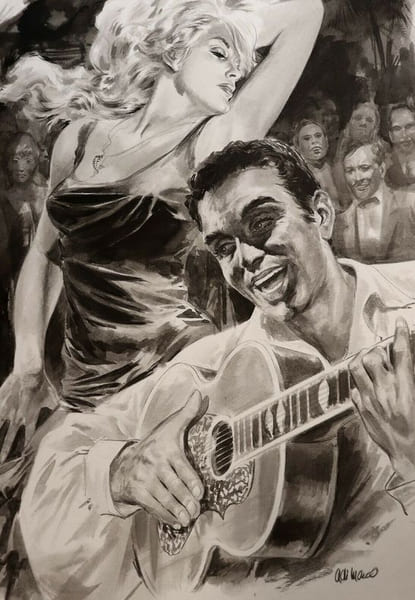
Dessin original Lavis encre de chine Roman-Photo Télé Poche
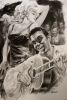
Très beau dessin original signé par Angelo Di Marco (DiMarco) Grand format dessin 35 x 25 cm environ sur carton 38 x 30,5 cm Signé à l'encre en bas dans le dessin en bas "A. Di Marco" Sujet : un joueur de guitare et une danseuse au milieu d'une fête. Dessin original exécuté pour un roman-photos intitulé "Colombella" publié dans le programme TV Télé Poche n°32 (numéro du 17 août 1966 - première année de parution de ce périodique pour la télévision) Annotations et cachet en marge (voir photos). Très beau dessin par un maître du genre Angelo Di Marco (1927-2016) est connu et reconnu pour son talent d'illustrateur.

Les Jours ne s'en vont pas longtemps Rinaldi,Angelo
Gallimard poche
Merci de nous contacter à l'avance si vous souhaitez consulter une référence dans notre boutique à Authon-du-Perche.
Les Jardins du Consulat
Gallimard 1984 264 pages 14 2x2x19 8cm. 1984. broché. 264 pages.
Bon état

