 Write to the booksellers
8 books for « aeschines »Edit
Demosthenis et Aeschinis Mutuae accusationes de ementita Legatione, et de Corona, ac contra Timarchum quinque numero, cum earum argumentis, ipsorum oratorum vita, et Aeschinis Epistola ad Athenienses, ac indice copioso. Nuper a bene docto viro traductae. Dictorum series versa pagina conintetur. Cum Privilegio Veneto.
Venice (Venetiis), Apud Hieronymum Scotum, 1545.
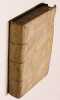
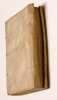
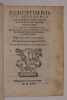
223,(1 blank) leaves. Limp overlapping vellum. 16 cm (Ref: Edit16 CNCE 16736; Hoffmann 1,528) (Details: Latin translation only. Woodcut printer's mark on the title page and at the end of the book, depicting a branch of olive and a palm tree, graft onto a trunk, with between them an anchor; anchor and trunk are held together bij the initials SOS (Signum Octaviani Scoti); a banner runs around with the motto: 'In tenebris fulget'. Printed in italics, except for the title. Some historiated and ornamental woodcut initials) (Condition: Vellum age-tanned and slightly soiled. 2 tiny holes in both boards, because of the 2 ties which have disappeared) (Note: In the preface of this book the learned anonymous translator explains his readers that it was his aim to collect for those who are not able to read Greek (qui graeca non legerant) in one volume (in unum eundemque codicem ac seorsum ab reliquis) five speeches, translated into Latin, of Demosthenes and Aeschines, because those speeches, full of mutual accusations and attacks, belonged together (inter se sint connexae (...) ut una ab altera divelli non possit). They shared the same actors and the same subject matter, and showed to the consent of all, the power of speech, and the art of oratory in her perfection (tota ars dicendi & vis orandi). Demosthenes and Aeschines were at daggers drawn, and therefore the collections begins with the 'Contra Timarchum oratio', because this speech was the beginning of their enmity (quod inde Demosthenis & Aeschinis inimicitiae exordium habuerint). In this preface he severely criticizes the clumsy Latin translation of Leonardus Aretinus (Leonardo Aretino, known to us also as Leonardo Bruni, ca. 1370-1444). He calls his translations 'mendosae' and unreliable. The anonymous translator not only translated speeches of Demosthenes and Aeschines, he added also relevant material from other sources, such as Libanius, Philostratus, and Apollonius, which he now translates into Latin for the first time (adiunctis tam Libanii quam aliorum argumentis ad eas ipsas orationes). (Interpres lectori S.P.D., leaf 2/3) Translated are beside Aeschines' 'Contra Timarchum Oratio', the 'Oratio de ementita legatione' of Demosthenes and Aeschines, now commonly known as 'De falsa legatione', and the 'Oratio contra Ctesiphontem de Corona', and the 'Oratio de Corona pro Ctesiphonte' of both men. Added are biographic sketches, argumenta and testimonia. The Athenian Demosthenes, 384-322 BC, was without doubt the greatest orator of his time. His surviving speeches are mostly connected with his politics. He was a fierce opponent of Philippus II, king of Macedon since 359, who gradually tried to subject the whole of Greece. In 351 he delivered his first Philippic, against him. His speeches against Philippus, known as Philippics, are one long warning against the growing Macedonian power. Demosthenes attacked also the pro-Macedonian elements in Athens, who sought peace with Philippus, and wanted to give in. One of their leaders was the orator Aeschines, 389-314 BC. In 345 Demosthenes and his Athenian ally Timarchus tried to impeach in a speech, called 'De falsa legatione' or 'On the false embassy', Aeschines 'for wilfully neglecting the interest of Athens as a member of the embassy which had negociated the peace' (H.J. Rose, A handbook of Greek literature, London 1965, p. 291). Demosthenes held Aeschines responsible for Philip's use of the peace negotiations to intervene in other Greek city-states. Demosthenes was unsuccessful and Aeschines was acquitted, having delivered a speech in which he defends himself against accusations of treason and collusion with the enemy. Instead of refuting the accusations directly, Aeschines used Athenian Civil Procedure to argue against Timarchus as a qualified prosecutor. The feud reached its peak in 330 with Demosthenes' most famous oratorical effort, the so-called speech 'On the Crown'. A member of his party, Ctesiphon, had proposed in 336 to honor Demosthenes for his services, as was customary, with a golden crown. Nothing came of it the next 6 years, mainly because Aeschines accused Ctesiphon of legal irregularities, but in effect he attacked Demosthenes' policy. In 330, after a charge of Aeschines, 'Demosthenes replied in the masterpiece, commonly known in modern times as the 'De Corona'. It is partly a formal rebuttal of the charge against Ktesiphon, but this is the weakest part of it, for technically Aischines had the law on his side. Substantially, it is a magnificent defence of the principles guiding the anti-Macedonian party, justifying them in face of failure. Less to modern taste is its bitter personal attack on Aischines, who however had not spared Demosthenes in his own speech'. (Rose, p. 292)) (Provenance: On the front flyleaf in pencil '7 januari 1961', written by the Flemish linguist Walter Couvreur, 1914-1996, who was an Orientalist, and professor of Indoeuropean linguistics at the University of Gent. It is the date of acquisition. The place of acquisition he wrote on the flyleaf at the end: 'Turijn, Bottega d'Erasmo') (Collation: A-2E8, last leaf blank, pagination sometimes irregular) (Photographs on request)
AISCHINOU TOU SÔKRATIKOU DIALOGOI TREIS. Aeschinis Socratici Dialogi tres. De novo recensuit, vertit, et animadversionibus suis auxit Petrus Horreus G.F. Accedunt ad calcem Fragmenta & Indices copiosi.
Leeuwarden (Leovardiae), Excudit Franciscus Halma, Ordinum Frisiae Typographus, 1718.
8vo. (XVI),181,(66 indices),(1 blank) p. Vellum. 21 cm (Ref: STCN ppn 15718997X; Hoffmann 1,29: 'der Herausg. besserte zwar vieles, war aber nicht sorgsam genug in Benutzung der früheren Ausgg.'; Dibdin 1,234; Brunet 1,75; Ebert 177; Schweiger 1,6: 'Selten'; Graesse 1,28) (Details: 6 thongs laced through the joints. Title in red & black. Woodcut printer's mark on the title, in its center a medallion of Constantine the Great, the motto reads: 'In hoc signo', short for 'in hoc signo vinces'; In a vision Constantine the Great heard these words, and saw in the sky a Cross, or the Greek letters Chi and Rho, before his conversion to Christianity, and the battle of Milvian Bridge in 312 AD; the cross in the sky is also depicted on the printer's mark. Greek text with parallel Latin translation, commentary in 2 columns below the text. Thick paper of good quality) (Condition: Vellum slightly soiled and spotted. Small name on the front pastedown. Old calligraphed Latin inscription entitled 'De Aeschine vel eius Dialogis' on a leaf inserted before the front flylaef. On the front flyleaf an old ownership inscription in ink) (Note: Aeschines was born ca. 430/20 B.C. and died after 375/6. He was a pupil of the Athenian philosopher Socrates, and was present at his famous deathbed. He wrote 7 dialogues with Socrates as the main speaker, all of which have been lost. Presented here are three dialogues which already in antiquity were ascribed to him: 'De virtute, an doceri possit', 'Eryxias, sive de divitiis', and 'Antiochus sive de morte'. They were first published in the Plato edition of Aldus Manutius in 1513, and repeated in the Stephanus edition of Plato of 1578. Le Clerc was the first to publish the 3 dialogues separately under the name of Socrates Scholasticus (Amsterdam, 1711). Brunet considers the edition of Le Clerc to be inferior to that of Horreus, 'ou sont des notes meilleurs et plus concises'. Since Bekker (Heidelberg 1810) they are considered to be spurious again, and nowadays they are numbered among the spurious works of Plato. The genuine, but lost dialogues seem to have been full of Socratic irony. Hermogenes, 'Peri Ideon', considers Aeschines as superior to Xenophon in elegance and purity of style. Aeschines must have been much like his master. Ancient authors tell about him that he had his character, and that his dialogues are true accounts of the Socratic dialogues. (NP 1,346/7) Petrus Horreus, 1695-1772, of Frisian birth, stayed close to home and began his studies at the University of Franeker. In 1718, when still a student, he published these 3 'spurious' dialogues of Aeschines. In the praefatio Horreus explains that his Praeceptor Lambertus Bos, professor Greek since 1704, encouraged him to publish Aeschines Socraticus. Later in life, while a minister of the protestant church, he published his 'Observationes criticae' (Leeuwarden 1735), and 3 years later 'Miscellanorum criticorum libri duo'. (Leeuwarden/Harlingen 1738) (NNBW 8,849)) (Provenance: Frisian provenance. On the front flyleaf: 'Dono mihi dedit huncce librum vir Amplissimus ac gravissimus Hobbe Baerd â Sminia, Supremae Frisiae Curiae Senator Primarius, Ao 1718'. The donator of this book is Hobbe Baerdt van Sminia, member of a Frisian noble family. Hobbe, 1655-1721, was President Councillor at the Court of Justice of Frisia at Leeuwarden, i.e. 'Consiliarius Primarius' or 'Senator Primarius' of the 'Suprema Frisiae Curia'. (NNBW 10,939) He gave this book in the year it was published to one '? Reinalda, ? D:M: op ????'. The Reinalda family also belonged to the Frisian elite. On the front pastedown in ink: 'G.C. Gonggrijp, 1760'. Not much is known of this member of the Frisian family Gonggrijp. Mr. G.C. Gonggrijp was a jurist. He died before 1809, and was once the owner of real estate in Bakkeveen and in Leeuwarden. He made also the calligraphed inscription on the front flyleaf) (Collation: *8, A-M8, N-R4, S8 (leaf S8 verso blank)) (Photographs on request)
DEMOSTHENE [DEMOSTHENES] & ESCHINE [AESCHINES] (AUGER, trad. & PLANCHE J., ed.)
Reference : K98193
(1819)
Oeuvres complètes de Démosthène et d'Eschine, en grec et en français [10 volumes, complet]
Paris, chez Verdière, Carez, Thomine et Fortic 1819-1821 Série complète en 10 volumes: 544 + 489 + 514 + xvi,504 + 533 + 444 + 467 + 472 + 464 + 520 pp., illustré d'un portrait de Démosthèhe gravé par m. Mécou (dans tome 1) et d'une table généaologique dépliante (dans tome 8), "Nouvelle édition revue et corrigée par J. Planche", 22cm., texte bilingue: grec-français, reliures uniformes cart. d'époque (plats marbrés, dos en cuir avec titre et faux-nerfs dorés, coins peu usés), feuilles de garde marbrées, rousseurs (texte toujours bien lisible), cachet sur la fausse page de titre et au verso de la p.d.t., bon ensemble, poids: 7kg., K98193
Aeschines Orationes. Iterum edidit Fridericus Franke. Biblioteca Scriptorum Graecorum et Romanorum Teubneriana.
Lipsiae, In Aedibus B. G. Teubneri 1893, 180x120mm, XXVIII - 230pages, broché. Bel exemplaire.
préface en latin, texte en grec ancien, Pour un paiement via PayPal, veuillez nous en faire la demande et nous vous enverrons une facture PayPal
Aeschines Orationes. Post Fr. Frankium curavit. Fridericus Blass. Editionem alteram correctiorem anni MCMVIII iterum correxit Udalricus Schindel.
Lipsiae, In Aedibus B.G. Teubneri 1978, 175x125mm, LII - 329pages, reliure d'éditeur sous jaquette. Couvertures de la jaquette tachées, autrement bel exemplaire.
préface en latin, texte en grec ancien, Cachet de possesseur. Pour un paiement via PayPal, veuillez nous en faire la demande et nous vous enverrons une facture PayPal
In Ctesiphontem oratio. Recensuit, explicavit Andreas Weidner.
Leipzig, B.G. Teubner, 1877.
XL,211 p. Half cloth. 21 cm (Rebound. Paper yellowing, first and last leaf browning) (Introduction, Greek text, Latin commentary)
Oeuvres complètes de Démosthène et d'Eschine - traduction nouvelle faite sur le texte des meilleures éditions critiques par J.F. Stiévenart
Paris, Firmin Didot 1842 679pp., 26cm., reliure cart. (dos en toile), texte imprimé en deux colonnes, bel état, texte en français
Oratoris Opera. Nova Editio accurata in usum Praelectionum Academicarum et Scholarum. (4 parts).
Leipzig, Weigelii, 1817. Small 8vo. Contemp. hcalf. Stamps to titlepage. Titlepage brownspotted and with scattered browspots. Ca. 650 pp. Text in Greek.


