 Write to the booksellers
3454 books for « abel f m »Edit
-
Type
Autograph (6)
Book (3330)
Engraving (1)
Magazine (10)
Music sheets (100)
Photographs (6)
Posters (1)
-
Latest
Last 24h (8)
Last 3 days (19)
Last month (46)
Last week (7)
-
Language
English (6)
French (3305)
Greek (1)
Italian (1)
Portuguese (1)
Russian (140)
-
Century
16th (2)
17th (2)
18th (15)
19th (435)
20th (1437)
21st (61)
-
Countries
Belgium (114)
Brazil (1)
Canada (4)
China (11)
Denmark (20)
France (3052)
Germany (8)
Greece (4)
Netherlands (2)
Switzerland (96)
United States of America (142)
-
Syndicate
ALAC (4)
CLAM (2)
CLAQ (3)
ILAB (1737)
NVVA (10)
SLACES (10)
SLAM (1681)
SNCAO (19)
Topics
- Alsace (15)
- Animals (10)
- Archaeology (16)
- Architecture (12)
- Autographs (38)
- Auvergne (22)
- Bibliophilism (24)
- Biography (40)
- Bonnard abel (51)
- Brittany (16)
- Burgundy (17)
- Caricature (11)
- Chevalley abel (12)
- Children’s books (14)
- China (14)
- Christianity (27)
- Cinema (16)
- Colette (32)
- Comic strip (10)
- Dedication (14)
- Dictionaries (9)
- Dignimont (10)
- Drawings (21)
- Early printed books (13)
- Esotericism (10)
- Faivre abel (111)
- Fine arts (27)
- First edition (89)
- French literature (12)
- Genealogy (13)
- Geography (28)
- Grammar (17)
- Greece (20)
- Hagiography (9)
- Hermann-paul (37)
- Hermant abel (563)
- History (188)
- Hugo abel (19)
- Hugo victor (30)
- Humour anecdotes (13)
- Illustrated books (19)
- Industrial arts & crafts - fine arts (11)
- Jeanniot (30)
- Joanne adolphe (13)
- Journalism (53)
- Lefranc abel (32)
- Linguistics (15)
- Linnean society of lyons (13)
- Literature (237)
- Lorrain (14)
- Lyons and area (13)
- Lyons college (13)
- Lyons college pc (13)
- Lyons revue (13)
- Magazine (19)
- Manuscripts (27)
- Mathematics (17)
- Medicine (11)
- Memories (9)
- Morocco (11)
- Mosaic (68)
- Napoleon i (10)
- Navy (17)
- Newspapers press (237)
- Paris (28)
- Paz octavio (10)
- Philosophy (53)
- Photography (14)
- Plato (9)
- Poetry (34)
- Policy (11)
- Popular literature (23)
- Psychology (21)
- Rabier benjamin (32)
- Regionalism (48)
- Religions (24)
- Reliure (13)
- Review (17)
- Reviews (50)
- Sciences (29)
- Scores (134)
- Sociology (10)
- Songs (101)
- Steinlen (33)
- Theatre (33)
- Theology (11)
- Toulouse lautrec (30)
- Travel (11)
- Various (17)
- Verne jules (34)
- Villemain (57)
- Waltz (12)
- War (42)
- Willette (34)
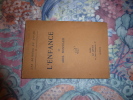
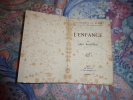
BONNARD (Abel) : L’Enfance. Paris, Le Divan, 1927. Plaquette petit in-8 sensu stricto, 72pp. [dont faux-titre et titre]-(1) f. [blanc / achevé d’imprimer], brochée, couverture imprimée ocre (de très bonne apparence, malgré une petite trace d’enfoncement en bas du dos, par contre, à l’intérieur, invasion de taches brunes – déjà - : papier de très mauvaise qualité). ÉDITION ORIGINALE, dans la collection « Les Soirées du Divan », n° 25, tirée à 925 exemplaires numérotés (celui-ci un des huit cents sur « bel alfa bouffant » (sic). D’entrée, le propos se veut rassurant : « J’aime plus l’enfance que les enfants » (p.7), mais, l’éducation doit être sévère : « (elle) n’est que le dernier cas du dressage » (p.59). Par ailleurs, quelle condescendance, quelle suffisance envers les plus démunis : « Un petit pauvre regarde avec une sorte d’étonnement et d’indépendance la misère de ses parents, qui n’est pas encore la sienne [sic !]» (p.44). Quel détachement du petit malheureux sur son sort : il est vrai que la religion est là, qui lui promet un bel avenir post-mortem. Surtout, pas de révolte, car, « rien de plus sinistre qu’un polisson gouailleur (…), c’est pourquoi le type de Gavroche est si repoussant » (p.41). Rien que çà. Autobiographie ? : « Un petit garçon de quatre ans jouait souvent avec une jeune fille, qui le maniait comme une poupée (…). Moi aussi, dit-il, quand je serai une jeune fille comme toi. – Mais, mon chéri, répondit-elle, tu ne seras jamais une jeune fille. Il faillit pleurer » (p.45). Dépit. Il faudra choisir, drame freudien / cornélien, attirance/répulsion : « Les enfants excellent à manier les grandes personnes (…) Dans ces manèges, l’adresse des deux sexes n’est pas égale (…) [Les garçons] sont plus simples, plus rudes (…) Les petites filles sont des femmes dès leur naissance, et les premières armes de ces innocentes sont celles des courtisanes » (p.63). Malgré tout, le Bonnard poète jaillit in fine : « Les enfants sont l’illusion de l’espèce, comme le printemps est l’illusion de l’année » (p.70)
Reference : G425
Abel BONNARD (Poitiers, 1883-Madrid, 1968) était plus italien que corse, dit-on, par son père biologique, le comte Joseph, Napoléon, dit « Gégé », PRIMOLI, « homme du monde », descendant de Joseph et Lucien BONAPARTE, rien que ça. Le poète sera promu Ministre de l’Education Nationale, en avril 42. Il avait toutes les qualités requises pour exercer cette haute fonction, comme en témoigne sa profession de foi sur l’Education : « Il n’est pas bon de répandre aveuglément l’instruction » ; elle doit être réservée à une élite (note 3). Et, pour enfoncer le clou, « L’instruction n’est bonne, ni pour les femmes, ni pour le peuple » ; surtout pour les femmes du peuple…. Pour lui, la diffusion de l’instruction [est] responsable de « l’abject érotisme répandu (…) dans ces derniers temps », mélange de polissonnerie du XVIII° siècle et de « lourde sensualité juive » (note 4). Il restera ministre jusque dans le dernier carré, à Sigmaringen, avant de passer en Espagne; condamné à mort par contumace, il sera quasiment blanchi en 1960, sa peine étant commuée en dix ans de bannissement (date d’effet : 1945) : en conséquence, il était en droit de demander réparation à la République ; mais n’acceptant pas cette flétrissure morale, il retourne chez Franco ; il trépassera à Madrid, parfaitement oublié. Pas tout à fait : ses nombreux surnoms ont surnagé au désastre : « Abetz Bonnard », « La belle Bonnard », l’élégant « Abel Connard » et surtout « Gestapette » (note 5), en raison de ses affinités électives et sexuelles. Sur le Web, comme d’habitude, on trouvera tout et son contraire, pile ou face, endroit et envers (note 6) : aujourd’hui, les gays revendiquent ses mœurs (note 7), les moralisateurs nostalgiques de la Révolution Nationale insistent lourdement sur ses fréquentations… exclusivement féminines (note 8). En ce qui concerne l’inventeur du terme « Gestapette », c’est la foire d’empoigne : ne prêtant qu’aux riches, c’est tout d’abord attribué au Maréchal en personne, le quel n’aimait pas les « tapettes » ; à Londres, ce serait Pierre Dac : improbables tous les deux. On ne trouve trace de ce « mot » chez les praticiens de l’humour vache, Henri Jeanson et Galtier-Boissière, les références données à leurs écrits étant fausses, « Le Canard enchaîné » et « Le Crapouillot » ayant cessé de paraître dès 1939. Peut-être s’agit-il d’une boutade lancée, microphone fermé, par un quelconque cacique dans une école de la Collaboration, devant un béat parterre de veaux quiets, diffusée de façon illégale dans les réseaux « amis », avant de passer dans ceux de la Résistance ; procédé malhonnête et très contestable, qui, bien sûr, ne pourrait pas se reproduire aujourd’hui. ADDENDUM LES « SECRETS » DE LA NAISSANCE D’ABEL BONNARD Presque toutes les plumes de la littérature historique s’accordent pour affirmer qu’Abel, par l’intermédiaire de son père biologique, descendait de la famille Bonaparte ; avec des variantes : fils naturel « d’un Bonaparte » (chire.com), d’un des frères de Napoléon « Joseph » (medias.presse.info, Rey Cabietes, Yves Morel) ; Lucien est rarement cité (note 9). Quelques rares fausses notes dans cette quasi unanimité : la « paternité » du bonhomme, lointain bâtard de l’Empire et de la Papauté, est aujourd’hui remise en cause par Amado M. Rey Cabieses (note 10) : « Giuseppe Primoli falleciό solterio (…) Existe una idea segùn laqual G.P., de sus amores con Marie-Pauline Benielli, casada con E.A.E. Bonnard (…) habria tenido un hijo, Abel Bonnard (…) Usό [SIC!] el pseudόnimo de Gestapette. Sin embargo, otras fuentes aseguran que Bonnard era simplemente amigo de Premoli ». [ souligné par nous] (note 11) Qu’en est-il réellement ? La fille de Joseph, Zénaïde Bonaparte (1801-1854) avait épousé son cousin germain, Charles Lucien Bonaparte (1803-1857), fils de Lucien. Parmi leurs rejetons viables, la Princesse Charlotte (1832- 1901) épousa le Comte Pietro PRIMOLI di FOGLIA (1821-1883), Officier de la Maison Pontificale. Après le décès d’un de leurs fils, en 1882, suivi de près par la perte de son mari (1883), Carlita dut être internée à Paris, dans le service du Docteur Blanche, psychiatre renommé, qui ne put la guérir : consanguinité quand tu nous tiens… La suite : Joseph, Napoléon Primoli, l’autre fils engendra Abel, de sa liaison avec Pauline Benielli « qui ne pouvant l’épouser, se résolut à un mariage de raison » (Yves Morel) (note 12) ; le Prince n’épousa pas la bergère. Personnellement, j’ai un penchant, une inclination pour la prime au lit conjugal…
FAKE HISTORY Cette histoire n’est qu’un conte, une histoire à dormir debout. Les historiens se sont fourvoyés, volontairement ou non : une ascendance noble, fut-elle impériale et illégitime, flatte l’orgueil du bourgeois. Seulement voilà : comme la terre, l’État Civil ne ment pas, …au moins sur les dates. On trouvera dans les Archives de la Corse du Sud, l’acte de mariage de Pauline Benielli et Ernest Bonnard, dans celles de la Vienne, l’acte de naissance d’Abel : le premier en date du 10/02/1880 (note 13), le second, en date du 19/12//1883 (note 14). Que la gestation fut longue ! Et on comprend mieux l’attachement d’Abel à sa maman ! Elle mourra dans la villégiature pétainiste de Sigmaringen en 1945. Mais il a encore mieux : Abel n’était pas fils unique, avant lui étaient nés un frère et une sœur, décédés tous deux en bas âge (note 15). =================
Note 3- Abel Bonnard : Pour l’élite intellectuelle, dans la Revue hebdomadaire, t.7, 07/07/1936, p.248). Note 4- cité d’après B. Pénicaud et Vincent Vidal-Naquet : Les révolutions de l’Amour (etc.). Note 5- aujourd’hui remis à la mode par nos chères politiques, NKM à propos de Patrick Buisson, la Marine au sujet du beau Florian… [en 2017…] Note 6- cf. Pierre Dac, qui à Radio Londres, fustigeait le ministre : dans son parti, « l’envers vaut l’endroit ») Note 7- hexagonegay.com précise qu’à l’époque, « les lieux de rencontre homos parisiens (cinémas et vespasiennes) connaiss[ai]ent bien sa silhouette » ; en revanche, il déplore que « Je Suis Partout » ni la presse d’extrême- droite, si prompts à dénoncer l’homosexualité (…) n’ont fait état de l’homosexualité de Bonnard ». Note 8- pour present.fr/tag/abel-bonnard/ : « La belle Bonnard… Gestapette… Yves Morel le sait : immanquablement, ce sont les plaisanteries qui fuseront de la bouche des sots si vous jetez le nom d’A.B. dans une conversation (même universitaire). Et pourtant, voilà une personnalité plus complexe que sa mauvaise renommée : on ne lui connaît que des liaisons féminines ». Sans rire ! Note 9- Buisson (Patrick) : 1940-1945. Années érotiques (Paris, Albin Michel, 2009.2 volumes. « Abel Bonnard, le scandaleux » (t. I, p.263 et suiv.) nous apprend que « son vrai père est un aristocrate italien, J.N. Primoli, descendant de Lucien Bonaparte, qui séduisit sa mère, Marie-Paule [sic !] Benielli, peu de temps avant son mariage [re-sic !!]». Note 10- Descendia de José Bonaparte, Rey de Espana y de las Indias, y sus entronques i talianos y franceses (Anales de la Real Academia Matritense de Heràldica y Genealogia, vol.XII, 2009, pp. 143-327). Note 11- Pasquali, Costanza : Proust, Primoli. La Moda. Otto lettere inedite di Proust e tre saggi. Roma, Ed. di Storia et litteratura, 1961, p.32. Note 12- Yves Morel ( Abel Bonnard. Coll. Qui suis-je ? Editions Pardès, 2017) : « Ne pouvant épouser le père de son enfant, Pauline Benielli se résolut à un mariage de raison avec Ernest Bonnard (…) qui reconnut Abel et lui donna son nom », qui complète bien la formule de P. Buisson (note 9). Note 13- Archives Départementales de Corse du Sud Ajaccio, Mariages, 1880 (f° 55-56/159) Note 14- Archives Départementales de la Vienne, Naissances, 1883 (9 E, p. 251), avec cette note marginale manuscrite : « Décédé à Madrid (Espagne) le 31 mars 1968 ». Confirmation de sa naissance, post mortem. Note 15- Abel- Jean- Désiré (A) aux prénoms identiques et Fanny-Françoise-Justine (B) (A) Melun, avril 1881- Poitiers, 26/06/1883. A.D. de la Vienne , Décès 1883, n°490, f° 147/278 (B) AD de la Vienne, Poitiers, 08/07/1885 [Naissances 1885, n°438, f°121/250]- 12/05/1886 [Décès 1886, n°370, f° 102/259. « Nom de la mère : Pauline Bennieni »] !! Aujourd’hui, (08/2022), que l’on consulte Wikipédia, ou des sites dits sérieux ( ?) de généalogie (geneanet, geneastar), la fausse généalogie prospère. Une lueur d’espoir : la généalogie d’Ernest Bonnard, le père « nourricier »… Patatras ! Si le frère aîné Abel (1881-1883) est bien mentionné, on trouve immédiatement après un « demi-frère Abel, etc.). Errare humanum est, perseverare diabolicum.
"ABEL, NIELS HENRIK. - ""A MONUMENT MORE LASTING THAN BRONCE"" (LEGENDRE).
Reference : 35935
(1841)
Mémoire sur une propriété générale d'une classe trés-étendue de fonctions transcendantes. - [ABEL'S THEOREM]
Paris, Académie des Sciences, 1841 (submitted 1826). 4to. (257x197mm). Extract from: 'Mém. Acad. d. Sciences de Paris', 1841, pp.176-264. Contemporary half calf with gilt spine lettering. Spine with a little wear. Some light brown spotting throughout. Otherwise fine and clean.
Very scarce first edition of Abel's main paper, in which he first presented his theorem for elliptic integrals - Abel's theorem. ""After studying at Christiania and Copenhagen, Abel received a scholarship that permitted him to travel. In Paris he was presented to Legendre, Laplace, Cauchy, and Lacroix, but they ignored him. ... Abel knew the work of Euler, Lagrange, and Legendre on elliptic integrals and may have gotten suggestions for the work he undertook from remarks made by Gauss, especially in his 'Disquisitiones Arithmeticae'. He himself started to write papers in 1825. He presented his major paper on integrals to the Academy of Sciences in Paris on October 30, 1926, for publication in its journal. This paper, [the offered item], contained Abel's great theorem. Fourier, the secretary of the Academy at the time, read the introduction to the paper and then referred the paper to Legendre and Cauchy for evaluation, the latter being chiefly responsible. The paper was long and difficult, only because it contained many new ideas. Cauchy laid it aside to favor his own work. Legendre forgot about it. After Abel's death, when his fame was established, the Academy searched for the paper, found it, and published it in 1841. ... Because Abel's main paper of 1826 was not published until 1841, other authors, learning the more limited theorems published in between these dates, obtained independently many of Abel's 1826 results."" (Kline: Mathematical Thought from Ancient to Modern Times, pp.644-55). Sotheran: Bibliotheca Chemico-Mathematics, Third Supplement, describes this paper as ""very scarce"".
HISTOIRE DE REDON (L'Abbaye et la ville)...par Jean Abel-Compadre,
Redon Imprimerie BOUTELOUP 1928 -in-12 broché un volume, broché crème in-douze Editeur (paperback in-12 Editor)(18,2 x 13 cm), dos imprimé en noir, 1ère de couverture à rabat imprimée en noir et rouge,toutes tranches non rognées (edges no smooth), tirage limité à 600 exemplaires numérotés et signés à l'encre noire par l'Auteur (N°177), orné de 10 gravures hors-texte en noir par Jean ABEL-COMPADRE + rajoutée en plus : 1 gravure volante sur bristol, gravée en noir par ABEL-COMPADRE : Redon Ancien : l'Hôtel ABEL-COMPADRE(époque Louis XVI), facade sur le quai Duguay-Trouin, 108 pages, 1928 Redon Imprimerie BOUTELOUP Editeur,
TRES BEL EXEMPLAIRE ...... état neuf (very good condition). ETAT NEUF
Niels Henrik Abel in Memoriam. (Herausgegeben - Redigée von G. Mittag-Leffler). 3 Bde.
Berlin, Uppsala & Stockholm, Paris, Almqvist & Wiksell, 1902-1904. 4to. Bound in 3 contemp. hcloth. A small nick to top of spine on one volume. Stamps on titlepages (Carl Zeiss Jena). (6),400(8),389(8),394 pp. a. 1 letter in facsimile. (= Acta Mathematica Bd. 26, 27 and 28). Internally fine and clean.
First printing of this series of important papers by leading mathematicians from all over the world, commemorating Abel in the 100-year of his birth, by presenting works of their own which are inspired by Abel or as continuations of Abel's works.The contributors are: Poincare (Sur les Fonctions abélienne), Hilbert (Über die Theorie der relativ-Abel'schen Zahlkörper), Hurwitz, Noether, Darboux, Picard, Fuchs, Minkowski (Úber periodische Approximationen algebraischer Zahlen), Mittag-Leffler, Appel, Painlevé (Sur la Fonctions qui admettent un théoréme d'additation), Liouville (Sur une équation différentielle du premier ordre), Volterra, Goursat, Hadamard (Deux theoremes d'Abel sur la convergance des séries), Borel, Pringsheim, Boutroux, Markoff and many others. In all 54 papers by 54 authors.
Recherches sur les fonctions elliptique.
Berlin, G. Reimer, 1827. 4to. No wrappers. In ""Journal für die reine und angewandte Mathematik. Hrsg. von A.L. Crelle"", Bd. II, Heft 2, pp. 101-196 (the whole Issue, Heft 2). Abel's paper: (2= titlepage to vol. II) + pp.101-181.
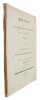
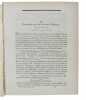
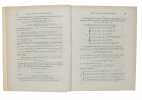
First appearence of Abel's discovery of Elliptic Functions and the discovery of their double periodicity, in print. In 1826 Abel ""presented his major paper on integrals to the Academy of Science in Paris on October 1926, for publication in its journal. This opaper , ""Memoire sur und proprieté générale d'une classe tres-etendu de fonctions transcendentes"", contained Abel's great theorem. Fourier, the secretary at the time, read the introduction to the paper and then referred the paper to Legendre and Cauchy for evaluation, the latter being chiefly responsible. The paper was long and difficult, only because it contains many new ideas. Cauchy laid it aside to favour his own work. Legendre forgot about it. After Abel's death, when his fame was established, the Academy searched for the paper, found it, and published it in 1841...Abel published other papers in Crelles Journal on equations and elliptic functions (the first offered here). These appeared from 1827 on."" (Morris Kline).
[DELUERMOZ] - MORAND (Paul), HERMANT (Abel), BONNARD (Abel) et COLETTE.
Reference : 82340
(1934)
Affaires de coeur.
Paris Edition Nativelle 1934 1 vol. Broché gr. in-8, broché, couverture rempliée, 86 pp. Edition originale de ces quatre nouvelles illustrées chacune de trois compositions en couleurs, respectivement par Hermine David, Jean Berque, Deluermoz et Dignimont. Tirage hors commerce sur vélin d'Arches réservé au corps médical à l'occasion du cinquantenaire du laboratoire Nativelle.En 1868, le pharmacien et chimiste Claude-Adolphe Nativelle met au point un procédé de cristallisation de la digitaline. Un Laboratoire Nativelle est créé en 1884 pour exploiter ce médicament présenté comme «un régulateur du cœur et de la circulation» et à l'occasion de son cinquantenaire on sollicite quatre écrivains pour parler d’«Affaires de cœur». Si Abel Hermant évoque «le cœur et la littérature», Abel Bonnard, «le cœur sentimental» et Paul Morand «le cœur moteur», pour Colette c’est l’occasion de revenir sur un sujet qu’elle connaît bien «le cœur des bêtes», titre qu’elle reprendra pour plusieurs conférences prononcées à la fin des années 30. Il y est finalement moins question du cœur des bêtes que de la place des bêtes dans le cœur de l’écrivaine, qu’il s’agisse de Souci, la chienne-bull-de-toute-beauté, au cœur délicat et fragile, de la chienne Belle-Aude,«une de ces rares compagnes qui ferment les yeux avec une discrétion amère devant tout ce que leur dérobe la changeante amitié humaine», de la jument grise d’Achille, son frère, «une jument entre les juments, qui n’accepta ni la retraite, ni le pré vert», des deux hirondelles apprivoisées, ou des chats, tous ces chats qui l’accompagnèrent et à qui elle accordait sa préférence, à moins que ce ne soit l’inverse…Le titre quant à lui demeure ambigu. S’il est vrai que les histoires de cœur inspirent les écrivains, les problèmes de cœur, eux, enrichissent l’industrie pharmaceutique. Mais qui a dit que littérature et argent faisaient mauvais ménage? Les affaires sont les affaires…. (Notice de Frédéric Maget pour le catalogue de la collection Colette des Clarac)
L'Esclavage dans l'Antiquité. Leçon extraite du Cours d'Histoire
Caen Imprimerie de Delos 1857 plaquette in-8 Broché, couverture rose
EDITION ORIGINALE rare. En couverture, ENVOI autographe signé de l'auteur. Rousseurs éparses. >Avant de rejoindre Douai en 1858 où il effectuera l'essentiel de sa carrière jusqu'en 1886, Abel Desjardins fut professeur d'histoire à l'Université de Caen (1856-1858) : il y donna un cours sur l'esclavage antique dans lequel le professeur laisse affleurer son indignation devant le phénomène qu'il décrit. À Caen, dans le cadre de son cours d'histoire - où il avait choisi Athènes comme fil directeur, abordant la question de la démocratie, puis celle du paganisme pour en arriver à l'esclavage, Abel Desjardins proposa quelques modestes réflexions sur ce phénomène après la somme magistrale publiée par Henri Wallon dix ans plus tôt, en 1847. S'adressant à un public strictement masculin (« Messieurs...» dit-il à l'ouverture et en conclusion de sa leçon) - rappelons qu'il n'y a pas de femmes à l'Université avant 1861 - , le professeur dresse un tableau sans complaisance de l'esclavage athénien où résonnent les indignations de l'humaniste républicain. Ce cours, initialement publié dans le journal L'Ordre et la Liberté les 5 et 7 mars 1857, fut ensuite édité la même année à Caen sous forme d'une brochure de 20 pages. Il constitue de fait l'un des rares travaux publiés d'Abel Desjardins sur l'Antiquité : en effet, après avoir produit deux thèses en histoire ancienne, celui-ci a publié fort peu d'ouvrages dans cette spécialité même s'il faut tout de même signaler que, comme son frère Ernest, il contribua au Daremberg & Saglio avec plusieurs articles en rapport avec ses recherches doctorales. RARE Très bon 0
LES MAITRES HUMORISTES ABEL FAIVRE
1909 broché in-octavo (paperback in-octavo), dos blanc (white spine), couverture illustrée (cover illustrated), toutes tranches lisses (all smooth edges), illustrations de Abel Faivre, sans pagination (unpaginated) - 156 pages, 1909 à Paris Société d'Editions et de Publications Librairie Félix Juven,
Collection "Les Maîtres Humoristes" deuxième série (the second series), numéro (number) 4 - deuxième album (the second album) - bon état général (good condition)
JOURS DE GUERRE 1915-1919. Tomes 1-2
Paris Editions Pierre Lafitte 1921 in 8 (19,5x15) 2 volumes reliures demi percaline rouge. 206 pages et 204 pages de dessins par Abel Faivre, dessins à pleine page légendés. Collection des Grands Humoristes. Abel Faivre, Lyon 1867 - Nice 1945, peintre, affichiste, lithographe, illustrateur et caricaturiste français. Raymond Recouly, Saint-Pons-de-Mauchiens (Hérault) 1876-1950, journaliste, et homme de lettres français, correspondant de guerre pour le journal Le Temps. Envoi autographe signé par l'auteur à Raymond Recouly: '' souvenir de son vieux camarade et ami ''. Bel exemplaire ( Photographies sur demande / We can send pictures of this book on simple request )
Très bon Broché Signé par l'auteur
Niels Henrik Abel - Un mathématicien romantique , Traduit et préfacé par Gilles Chatelet
Belin , Un Savant, une Epoque Malicorne sur Sarthe, 72, Pays de la Loire, France 1989 Book condition, Etat : Bon broché, sous couverture imprimée éditeur noir, illustrée d'un portrait de N.H. Abel In-8 1 vol. - 367 pages
quelques illustrations dans le texte en noir et blanc 1ere édition, 1989 "Contents, Chapitres : Biographie - Annexes : Notes - Chronologie - Equations algébriques - Les fonctions elliptiques - Les travaux d'Abel - Index - Niels Henrik Abel (1802-1829) est un mathématicien norvégien. Il est connu pour ses travaux en analyse mathématique sur la semi-convergence des séries numériques, des suites et séries de fonctions, les critères de convergence d'intégrale généralisée, sur la notion d'intégrale elliptique ; et en algèbre, sur la résolution des équations. - Niels Henrik Abel est à l'origine de la notion de nombre algébrique (solution d'une équation polynomiale à coefficients rationnels). Il laisse aussi de nombreux résultats sur les séries et les fonctions elliptiques. (source : Wikipedia)" trace de pliure au coin supérieur droit du plat supérieur, sinon bon exemplaire, intérieur frais et propre
Oeuvres complètes. Nouvelle édition publiée aux frais de l'Etat Norvégien, par L. Sylow et S. Lie. 2 parts in 1 volume.
Christiania, Grøndahl, 1881, in-4to, 2 leaves + VIII + 621 p. + 1 blanc leaf; 2 leaves + 338 p. + 2 leaves ( 2 tables, et errata), light foxing in places, mainly limited to one margin, annexe: Niels Hendrik Abel, In Memoriam. p. 223-233, half vellum with marbled paper, upper spine hinge starting, two or three small scrapes to marbled paper of rear cover.
New edition of the complete works by the Norwegian genious in mathematics, particularly on elliptic integrals. “All of Abel's works carry the imprint of an ingenuity and force of thought which is unusual and sometimes amazing, even if the youth of the author is not taken into consideration. One may say that he was able to penetarte all obstacles down to the very foundations of the problems, with a force which appeared irrisistable ...” (Crelle's extensive eulogy of Abel, who died of tbc at the age of 28).Joint an appendice of 12 p.: Niels Hendrik Abel, In Memoriam. p. 223-233, with an article by S. PINCHERLE, entitled «Sur une série d'Abel». DSB I/12-17.

(SLACES, NVVA)
Phone number : 41 (0)26 3223808
(7 papers in ""Crelle's Journal"":) 1. Untersuchung der Functionen zweier unabhängig veränderlichen Grössen x und y, wie f(x,y), welche die Eigenschaft haben, dass f(z, f(x,y)) eine symmetrische Function von z,x und y ist. - 2. Beweis der Unmöglichkeit ...
Berlin, Duncker und Humblot, 1826. 4to. Contemp. hcalf. Part of spine lacks, some of spine loose. IV,387,(1) pp. and 5 folded engraved plates. Wide margins, on good paper, light marginal browning, a few scattered brownspots. The whole volume of ""Journal für die reine und angewandte Mathematik. Herausgegeben von A.L. Crelle"" Erster Band. In 4 Heften. Mit 5 Kupfern. Abel's papers: pp. 11-15, pp. 65-84, pp. 159-60, pp. 185-221, pp. 311-339, pp. 153-160, pp. 117-136.
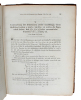
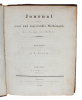

First edition of all 7 papers, among these 3 of Abel's masterpieces: his attempt to demonstrate the impossibility of solving the quintic equation algebraically (Beweis der Unmöglichkeit...), one of the most celebrated theorems in mathematics and here offered as no. 2, the first direct use and solution of an integral equation (Auflösung einer mechanischen Aufgabe), here offered as no 6, and his investigations into the domaine of convergence of the binominal series (Untersuchungen über die Reihe...), here offered as no. 5.""Crelle's Journal was the leading German mathematical periodical during the nineteenth century. The first volume alone contains seven papers by Abel and the following volumes contains many more, most of them of preeminent importence in the history of mathematics. Among the first is the expanded version of the proof of the impossibility of the solution of the general quintic equation by radicals. Here Abel developed the necessay algebraic backgriund, including a discussion of the algebraic field of extensions."" (DSB).""All of Abel's works carry the imprint of an ingenuity and force of thought which is unusual and sometimes amazing, even if the youth of the author is not taken into consideration. One may say that he was able to penetrate all obstacles down to the very foundations of the problems, with a force which appeared irresistible"" he attacked the problems with an extraordinary energy...all the difficulties seemed to vanish under the victorious onslaught of his genius..."" (A.L. Crelle).Also contained in this volume is : ""Über Gauss Methode, die Werthe der Integrale nährungsweise zu finden."", pp. 301-307.
BERLIN HITLER ET MOI
AVALON Grand In Octavo, reliure pleine toile rouge sous jaquette ill noire et blanche (défilé Nazzi), 280 pages ainsi que 32 pages de clichés d'Abel Bonnard-bon ensemble frais et engageant.
Bon Etat *** PROCHAINE MISE A JOUR DU CATALOGUE LE 12 JUIN 2026 *** Paiement PayPal immédiat, Colissimo contre signature pour les envois de plus de 50 euros, Mondial Relay accepté pour : FRANCE Allemagne, Autriche, Belgique, Espagne, Italie, Portugal, Luxembourg, Pays-Bas, Pologne (Communiquer votre point ou locker si connu). Une participation supplémentaire peut être demandée pour les colis lourds hors France où les envois compris entre 5 et 25 kg sont dégressifs : 2 à 4 kilogrammes - 7.99 / 5 à 10 kg - 15.99 / 15 -25 kg - 25.99. Certaines de nos collections ( Vian, Céline, Camus (...) peuvent être expédiées en Franco de port. Pour linternational hors Europe (Suisse, Canada, Japon, Etats-Unis, les frais dexpéditions peuvent varier selon le poids (mise à jour : 1 juin 2026).
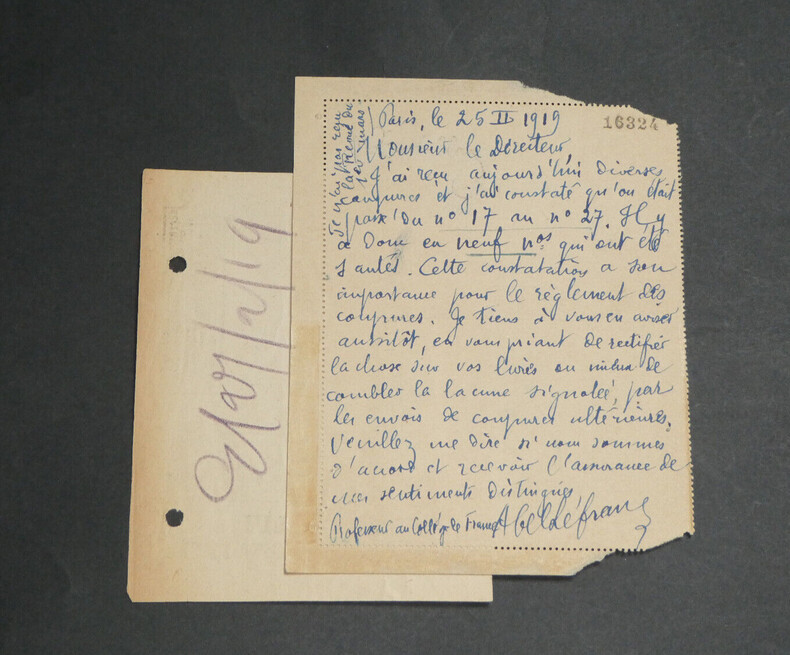
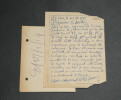
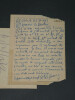
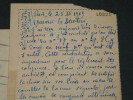
Abel LEFRANC - Carte lettre autographe signée au Directeur du Courrier de la Presse, 1919
Abel LEFRANC. Carte lettre autographe signée au Directeur du Courrier de la Presse, 1919 Carte lettre autographe signée à Monsieur le Directeur du Courrier de la Presse, datée du 25 février 1919. Dimensions : 12,2 x 16 cm Nombre de pages : 1 page Abel LEFRANC Abel Jules Maurice Lefranc, né à Élincourt-Sainte-Marguerite le 27 juillet 1863 et mort à Paris le 26 novembre 1952, est un historien de la littérature français.
MORAND (Paul). Affaires de cSur. Illustrations d'Hermine David, Jean Berque, Deluermoz et Dignimont.
Paris Editions Nativelle 1934 In-8, broch, couverture imprime.Edition originale des quatre textes: Le CSur et la littrature par Abel Hermant, Le CSur sentimental par Abel Bonnard, Le Coeur des btes par Colette et Le Coeur moteur par Paul Morand. L'illustration comporte 12 hors-texte en couleurs, dont 3 par Hermine David, 3 par Jean Berque, 3 par Henri Deluermoz et 3 par Andr Dignimont. Tirage unique limit 600 exemplaires numrots sur vlin d'Arches. Ce livre a t offert par le Laboratoire Nativelle pour marquer son cinquantenaire. Exemplaire complet de la petite carte imprime cette occasion: Le Laboratoire Nativelle, l'occasion de son cinquantenaire, vous prie d'accepter, en hommage, cet exemplaire de l'dition originale de "Affaires de CSur".
Affaires de Coeur.
1934 Paris, Laboratoires Nativelle, imp. Darantière, 1934. Un volume broché de format in 4° carré de 94 pp.; illustrations en couleurs par Hermine David, Jean Berque, Deluermoz, Dignimont. Couverture illustrée et rempliée.
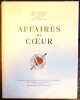
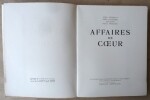
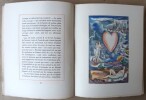
Publié à l'occasion du centenaire du laboratoire Nativelle. Comme neuf.
[Prevel ] - - Dominicy,Desmoulins R.,Henri J.,Normand A.,Chiron Gustave,Gay Abel,Graveline Léon,Vila André,Lagueny Lucien - Henri J.,Voillequin Ernest,Lelandais V.,Duprilot E.,Balador,Weissenberger Jean,Dorsay Eugène,Dehme Georges,Loubeinje,Villard Elise,Dravill Elsie,Desclaud Paul,Gay Abel,Liénard E.,Printen Jan,Carthame Henry
Reference : 93656
(1919)
[Prevel ] - - Henri J.,Normand A.,Gay Abel,Graveline Léon - Hens Juan,Voillequin Ernest,Graveline Léon,Dehme Georges,Gay Abel
Reference : 104492
"... des détails insignifiants s'aggravent souvent avec les nerfs des femmes ! " Lettre autographe signée adressée à Carlo Rim concernant Nelly Kaplan et la femme d'Abel Gance
Paris 1960 | 21 x 27 cm | une feuille
Lettre autographesignée d'Abel Gance, depuis son domicile parisien, adressée à Carlo Rim, 19 lignes à l'encre noire, réclamant la discrétion de Carlo Rim afin de ménager les susceptibiltés de Nelly Kaplan et de la femme d'Abel Gance : "Cher Carlo, soyez gentil - & je compte sur votre discrétion totale, de ne rien dire à Nelly Kaplan au sujet de la demande que je vous ai faite pour mad.e Gance - Des détails insignifiants s'aggravent souvent avec les nerfs des femmes !" Abel Gance, pris par le projet pharaonique de son film "Austerlitz" (sorti en 1960 avec Pierre Mondy, Jean Marais et Martine Carol) n'est pas certain d'apparaître lors du festival de Cannes : "J'essaierai de venir à Cannes les 2-3 derniers jours - Cela dépendra de la finition de ma copie d'Austerlitz mais je ne crains de terminer que le 21 mai". Pliures centrales inhérentes à la mise sous pli, légères déchirures et pliures marginales sans gravité en marges de la lettre. Carlo Rim fut un écrivain provençal, auteur notamment de "Ma belle Marseille", un caricaturiste, un cinéaste : "Justin de Marseille", "L'armoire volante", "La maison Bonnadieu", et fut notamment l'ami de Fernandel, de Raimu et Marcel Pagnol mais aussi de Max Jacob et André Salmon qu'il rencontra à Sanary. - Photographies et détails sur www.Edition-Originale.com -

Phone number : 01 56 08 08 85
Poème autographe de jeunesse daté et signé d'Abel Gance intitulé "La pluie" et dédié à Baudelaire
S. n. | s. l. 1907 | 21 x 27 cm | une page
Quatrain autographe de jeunesse daté et signé de seize strophes en alexandrins d'Abel Gance, alors âgé de 18 ans, 18 lignes écrites à l'encre violette sur une feuille déchirée d'un cahier d'écolier. Le poème a été redigé à Montluçon et est daté de 1907. Traces de pliures inhérentes à la mise sous pli, une rature à l'encre noire en angle inférieur gauche du feuillet. Triste et beau poème dédié à Charles Baudelaire et intitulé : "La pluie" qui a été probablement publié en 1909 dans son seul et très rare recueil de poèmes alors qu'Abel Gance envisageait de débuter une carrière dans le théâtre à Bruxelles : "Undoigtsurleclavier" "Vertige désolé de la morne eau de pluie Au cinglement pervers giclant sur le pavé, Pleureuse léthargie éveillant des avé, Lugubre égrènement plus sombre que la suie... ... Et l'espace voilé d'un funèbre indécis Enlizant le cerveau de son réseau de brume Fait que le coeur béant ébarbé exhume Un flot de vieux chagrin qu'il croyait obscurcis." Influencé par John Keats, Charles Baudelaire, et Arthur Rimbaud, Abel Gance, alors à Bruxelles pour poursuivre une carrière dans le théâtre, stoppe son activité poétique jugeant sa production trop impersonnelle et revient désespéré à Paris. - Photographies et détails sur www.Edition-Originale.com -
Phone number : 01 56 08 08 85
Deux poème autographes de jeunesse datés et signés d'Abel Gance qu'il a dédicacés, au recto, à "Ma Line adorée"
S. n. | s. l. Mai 1909 | 19.50 x 24.50 cm | une page
Deux quatrains autographes de jeunesse datés et signés de seize et douze strophes en alexandrins d'Abel Gance, alors âgé de 20 ans, 18 et 14 lignes écrites à l'encre noire avec ajouts d'encre violette pour le premier poème et à l'encre violette pour le second ; ces poèmes rédigés sur une feuille détachée d'un cahier d'écolier. Au recto, le e premier poème est daté de Mai 1909 et il est dédicacé à l'encre violette : "A ma chère Line adorée. Mai 1909. AGance". Le second, au verso, est daté de Bruxelles 9 Janvier 1909 AGance. Traces de pliures inhérentes à la mise sous pli, corrections et ajouts à l'encre violette ou au crayon de papier pour le premier quatrain. Ce mélancolique poème a été probablement publié en 1909 dans son seul et très rare recueil de poèmes : "Undoigtsurleclavier"alors qu'Abel Gance envisageait de débuter une carrière dans le théâtre à Bruxelles. "J'aurais voulu ce soir tant mon âme défaille Broyer jusqu'à la mort des oeillets et des lys. J'aurais voulu crier, pleurer comme jadis Te souviens-tu, lointaine, avant que tu t'en ailles... ... Si je pouvais pleurer ma douleur serait belle ! Peut-être aurais-je pu vous l'immortaliser ! ... Mais ma pensée obscure interdite chancelle Non, non, on ne peut pas rappeler son baiser..." Le second, qui comporte une correction à l'encre bleue, est également empreint de mélancolie : "C'était une femme étrange Qui passait en noir sur mon chemin clair, je lui demandais : n'êtes-vous pas l'ange Que je dois trouver par un soir d'hiver?... Je suis, comprends-tu, belle qui vendange les coeurs qui ont pris le chemin de l'enfer !... C'était une fois une femme étrange Qui passait en noir sur mon chemin clair..." Influencé par John Keats, Charles Baudelaire, et Arthur Rimbaud, Abel Gance, alors à Bruxelles pour poursuivre une carrière dans le théâtre, stoppe son activité poétique jugeant sa production trop impersonnelle et revient désespéré à Paris. - Photographies et détails sur www.Edition-Originale.com -
Phone number : 01 56 08 08 85
"Bel éphèbe au front mat, candide amoureux pur, Irridiant de sa chair en clarté rose et blonde..." Poème autographe de jeunesse daté et signé d'Abel Gance intitulé "A Dédé" inspiré du roman Dédé d'Achille Essebac
S. n. | s. l. s. d. [1909] | 21 x 27 cm | une page
Sixain autographe de jeunesse signé de vingt-quatre strophes en alexandrins d'Abel Gance, alors âgé de 20 ans, 32 lignes écrites à l'encre noire sur une feuille déchirée d'un cahier d'écolier. Précision manuscrite d'Abel Gance en début et en fin du poème : "Une idée fausse peut avoir tels arguments que la raison ne peut combattre qu'au détriment des sentiments du raisonneur". Composé à Paris ce 3 octobre en 2 heures à la suite d'une lecture de Dédé roman de Essbach" (sic), (en réalité Achille Essebac). Traces de pliures inhérentes à la mise sous pli, une rature à l'encre noire en angle inférieur gauche du feuillet. Beau poème inspiré du grand roman homosexuel d'Achille Essebac : "Dédé" paru en 1901 chez Ambert. "Bel éphèbe au front mat, candide amoureux pur, Irridiant de sa chair en clarté rose et blonde Un enivrant réseau de volupté profonde ; En ton trouble sensuel ne germe rien d'impur... ... Parmi ces yeux séduits s'abreuvant de tes yeux, N'as-tu pas remarqué, vêtu de simple serge, Auréolé de blond, une humble et douce vierge Qui, depuis ta beauté, ne fixe plus les cieux?" Influencé par John Keats, Charles Baudelaire, et Arthur Rimbaud, Abel Gance, alors à Bruxelles pour poursuivre une carrière dans le théâtre, stoppe son activité poétique jugeant sa production trop impersonnelle et revient désespéré à Paris. - Photographies et détails sur www.Edition-Originale.com -
Phone number : 01 56 08 08 85
"Avait-elle un coeur ? Non, car c'était une femme ! Mais si pourtant... je me souviens..." Deux poèmes autographes de jeunesse datés et signés d'Abel Gance qu'il a dédicacés à un couple d'amis et intitulés "Salomé et "Chanson vague"
S. n. | s. l. Mai 1909 | 19.50 x 24.50 cm | une page
Deux poèmes autographes de jeunesse datés et signés de quatorze strophes chacun en alexandrins d'Abel Gance, alors âgé de 20 ans, 18 et 21 lignes écrites à l'encre violette pour chacun des poèmes ; ces poèmes rédigés sur une feuille détachée d'un cahier d'écolier. Au recto, le premier poème est daté du 3 Janvier 1909 et il est dédicacé à un couple d'amis : "A Myriam Deroxe à Victor Fransses pieux admirateurs de Salomé, ce témoignage d'un esprit comprenant presque leur enthousiasme. " Le second, au verso, est intitulé "Chanson vague" ; il est daté de Bruxelles du 28 Janvier 1909 ert signé AGance. Traces de pliures inhérentes à la mise sous pli. Ces poèmes ont été probablement publiés en 1909 dans son seul et très rare recueil de poèmes : "Undoigtsurleclavier"alors qu'Abel Gance envisageait de débuter une carrière dans le théâtre à Bruxelles. "En ce temps Salomé vivait en Palestine, ... Ses yeux étaient de l'or dont on fait les douleurs, Elle avait une rose aux lèvres, des pâleurs, un corps souple et brûlant de volupté féline. ... Et dans ma vie... elle viendra... je crois la voir ! - Avait-elle un coeur ? Non, car c'était une femme ! Mais si pourtant... je me souviens... c'était un soir : " Le second, qui comporte une bande de scotch au niveau du titre, est également empreint de mélancolie : "Je laisserai ce soir un peu traîner des fleurs Sur le parvis de marbre où je viendrai l'attendre ; Mon coeur, doucement gris, sera si doux, si tendre Que pour glisser du monde à l'infini des pleurs Sur le parvis de marbre où je viendrai l'attendre ; Il suffira d'un peu de sa bouche à surprendre Je laisserai ce soir un peu traîner des fleurs..." Influencé par John Keats, Charles Baudelaire, et Arthur Rimbaud, Abel Gance, alors à Bruxelles pour poursuivre une carrière dans le théâtre, stoppe son activité poétique jugeant sa production trop impersonnelle et revient désespéré à Paris. - Photographies et détails sur www.Edition-Originale.com -
Phone number : 01 56 08 08 85
COLETTE (Sidonie Gabrielle), HERMANT (Abel), BONNARD (Abel), MORAND (Paul). DELUERMOZ (Henri), DAVID (Hermine), BERQUE (Jean), DIGNIMONT (André).
Reference : 19905
(1934)
Affaires de coeur.
Paris Nativielle 1934 1 Paris, Nativielle, 1934, in-8, broché, couverture rempliée illustrée, 86 pages.
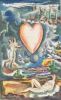
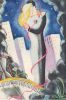
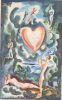
Édition originale de Affaires de coeur, imprimé sur vélin d'Arches, recueil de quatre textes qui sont la rencontre entre un auteur et un illustrateur : "Le coeur et la littérature", par Abel Hermant de l'Académie française avec les trois illustrations pleine page en couleur de Hermine David, puis "Le coeur sentimental" par Abel Bonnard avec les trois illustrations pleine page en couleurs de Jean Berque, puis "Le coeur des bêtes" par Colette, illustré de trois planches en couleurs d'Henri Deluermoz, et enfin de "Le coeur moteur" de Paul Morand, illustré de trois planches en couleurs d'André Dignimont. Le Laboratoire Nativelle, à l'occasion de son cinquantenaire, vous prie d'accepter, en hommage, cet exemplaire de l'édition originale de "Affaires de Coeur". Couverture légèrement tachée, piqures internes.
[Hermine David, Jean Berque, Deluermoz et Dignimont ] - HERMANT Abel; BONNARD Abel; COLETTE; MORAND Paul Hermine David, Jean Berque, Deluermoz et Dignimont
Reference : 17258
AFFAIRES DE COEUR
Paris Editions Nativelle 1934 petit in 4 (24,5x19,5) 1 volume broché, couverture rempliée, 86 pages, papier vélin d'Arches. Edition originale hors-commerce réservée au corps médical, et publiée à l'occasion du cinquantenaire du laboratoire Nativelle 1884-1934. Quatre textes de Abel Hermant, Abel Bonnard, Colette et Paul Morand chacun illustré de trois compositions en couleurs hors-texte par Hermine David, Jean Berque, Deluermoz et Dignimont. Bel exemplaire
Très bon Broché

