Write to the booksellers
GOETHE (Johann Wolfgang) - LAURENS (Jean-Paul, ill. de).
Faust.
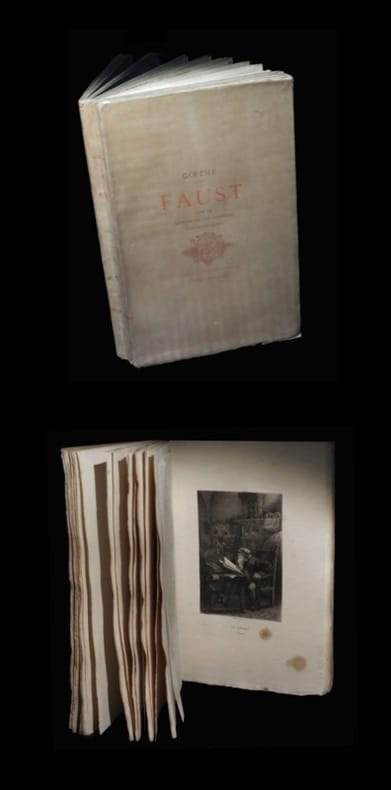
Paris, [Jouaust] / Librairie des Bibliophiles, 1885. Un fort vol. au format in-8 (259 x 167 mm) de 1 f. bl., 2 ff. n.fol., 1 frontispice gravé n.fol., lv - 227 pp. et 1 f. bl., broché, sous couverture à rabats rempliés.
Reference : 26766
Belle impression sur vergé d'édition. L'exemplaire s'ouvre sur un frontispice gravé et recèle en outre 6 (sur 6) jolies planches gravées par Champollion d'après Jean-Pierre Laurens. Lequel ''témoigna dès son plus jeune âge d'exceptionnelles dispositions artistiques et d'un invincible désir de faire de la peinture. Son savoir et sa conscience artistique le placent au rang des véritables maîtres.'' (in Bénézit). Deux pièces de Goethe sont intitulées Faust, du nom d'un alchimiste allemand du xviesiècle et héros d'un conte populaire. Goethe a travaillé sur le thème de Faust pendant une longue partie de sa vie et Faust est souvent considérée comme l'œuvre la plus importante de la littérature allemande. L'oeuvre éponyme présente Faust tel un homme admiré par le peuple pour sa sagesse, épris de connaissance profonde, vivante, transcendante. Mais accablé par l'insignifiance de son savoir et désespérant de ne rien découvrir qui puisse le satisfaire, il signe un pacte avec Méphistophélès. Celui-ci doit l'initier aux jouissances terrestres et le servir fidèlement dans ce monde. En échange de cela, Faust s'engage à lui livrer son âme dès que, au lieu de chercher sans trêve de nouvelles jouissances, il dira paresseusement à l'instant qui passe «Arrête-toi, tu es si beau!». Vicaire III, Manuel de l'amateur de livres du XIXème, 1016 - Bénézit VI, Dictionnaire des peintres, p. 481 - Osterwalder I, Dictionnaire des illustrateurs, p. 591. Quelques rousseurs ou tâches claires dans le corps d'ouvrage. Du reste, belle condition. Exemplaire en partie non coupé.
Bookseller's contact details
Babel Librairie
M. Mathieu Salzgeber
3, Rue André Saigne
24000 Périgueux
France
06.84.15.59.05
Payment mode

Sale conditions
Conformes aux usages de la profession.
5 book(s) with the same title
6 chromos Liebig : Opéra Faust (série complète)
Liebig Chromolithographie "6 chromolithographies publicitaires (10,7 x 7,3 cm) éditées par la marque Liebig, série complète ""Opéra Faust"", comprenant les vignettes suivantes : Acte I - L'évocation de Méphistophéles. Apparition de Marguerite à Faust ; Acte II - Faust rencontre Marguerite ; Acte III - Scène du jardin ; Acte IV - Marguerite à l'église ; Acte IV - Duel de Valentin ; Acte V - Marguerite en prison ; coins légèrement frottés, par ailleurs bel état général. Livraison a domicile (La Poste) ou en Mondial Relay sur simple demande."


"Le Faust de Berlioz, Etude sur ""Damnation de Faust"" et sur l'âme romantique"
Librairie Plon Broché 1946 In-8 (12 x 19 cm.), broché, marque typographique de l'éditeur sur la couverture, 181 pages, illustrations en noir et blanc hors-texte, quelques cahiers non-coupés ; mouillures sur une partie du livre, dos plié et insolé, coin du premier plat déchiré avec manque, état relativement correct. Livraison a domicile (La Poste) ou en Mondial Relay sur simple demande.
Faust
Aux dépens de l'artiste Livre sous emboitage 1970 Deux volumes in folio, en feuilles sous emboitages : le premier comprenant 'Faust' de 230 pp. avec 80 illustrations de Robert BELTZ dont un frontispice gravées sur bois par Gilbert Poilliot, un des exemplaires hors-commerce signé par Robert BELTZ dédicacé à Maurice Hermann ; le second comprenant le texte original de 120 pp. ainsi que 'Intermède' de 16 pp. illustré + VII pp. de Robert Beltz intitulées 'Le cabinet d'études - Le pentagramme et le nombre d'or' ; emboitages présentant d'infimes taches, très bel exemplaire Livraison a domicile (La Poste) ou en Mondial Relay sur simple demande.
Faust. Ein Fragment. - [PMM 298 - THE FAUST LEGEND]
Leipzig, Göschen, 1790. Orange cardboard binding (presumably the original!) with gilt title-labet to top of spine. Corners bumped, and wear along hinges and capitals. Overall a very nice and charming copy, tight, and completely unrestored. Some brownspotting throughout, but overall very nice. With the famous engraved frontispiece depicting Faust in his study, by Lips, after Rembrandt (loose) and the tittle-page stating ""Goethe's Schriften. Siebenter Band."", with the large engraved vignette by Lips, picturing Bätely bandaging Jery's hand (different from the ones in the seven other volumes), and the half-title stating ""Faust. Ein Fragment"" with ""Goethe's W. 7. B."" to the foot (repeated on all quires). Old owner's name to verso of frontispiece, otherwise no markings or annotations of any kind.
The scarce first printing, in the corrected variant Hagen So, of one of the peaks of world literature, the main work by the greatest German poet ever, and one of the all-times greatest writers of the world, Johann Wolfgang von Goethe. ""Faust"" was first printed, as it is here, as volume seven of Goethe's Schriften in eight volumes from 1787-1790, and was also published separately, likewise under the title ""Faust. Ein Fragment"". The printing of Faust in the seventh volume of Goethe's works is the original printing after the manuscript of the poet. There are two printings of this volume, between which there is traditionally said to be no precedency, although So has been corrected, which Sm has not. The present copy is Hagen variant So, without the misprints (see Hagen 11:7, So), which can be identified by eg. the lack of the repetition of the three lines in pp. 144-145, which appear in Sm (see Hagen, p. 12). Few other writers have been as influential as Goethe, and his works were an immense source of inspiration to everything from drama and music to science and philosophy. He is generally accepted as one of the most important thinkers within Western culture, and his main work, Faust, is considered one of the most important and influential works of world literature. ""If Goethe may justly be called the last representative of the renaissance ideal of the ""oumo universale"", his ""Faust"" embodies the sum total of his poetical growth."" (Printing and the Mind of Man: 298).""Faust"" is arguably the work for which Goethe is most famous, and this is not without reason. The novel emphasizes the strength of the individual and the right to freely investigate aspects of human and divine character. The novel also fights for man's right to determine his own destiny, and is thus considered the first great literary work in the spirit of modern individualism. Faust is also considered highly relevant to science and scientific thought, as Goethe here offers a holistic and non-analytic approach to these areas. The present volume 7 from 1790 has two vignettes: ""Bätely verbindet dem Jery die Hand"", H. Lips fec."" and ""Faust im Studierzimmer, ein am Fenster erscheinendes magisches Zeichen betrachtend"", H. Lips sc. (nach Rembrandt) (see Hagen 11:7). On the last page is written ""Leipzig, gedruckt bey Christian Friedrich Solbrig"" (see Hagen 11). It also includes the separate texts ""Jery und Bätely"" (pp. 169-224) and ""Scherz, List und Rache"" (pp. 225-320). PMM 298 (being the 1834 ed., not the real first)" Hagen 11,7 - So.
Reference : alb87fb4b05c7ca560f
Goethe, J. W.G. de Nerval Goethe, J. W., G. de Nerval Faust et le Second Faust
Goethe, J. W.G. de Nerval Goethe, J. W., G. de Nerval Faust et le Second Faust. Traduation par Gerard de Nerval.Faust and the Second Faust. Translated by Gerard De Nerval. In Russian /Goethe, J. W.G. deNerval Gete, Zh. V., G. de Nerval Faust et le Second Faust. Traduction par Gerard deNerval.Faust i vtoroy Faust. Perevod Zherara De Nervalya. In Russian. Paris Garnier Freres, 1886. 448c. We have thousands of titles and often several copies of each title may be available. Please feel free to contact us for a detailed description of the copies available. SKUalb87fb4b05c7ca560f