 Write to the booksellers
Saint-Olive Paul
Un Original
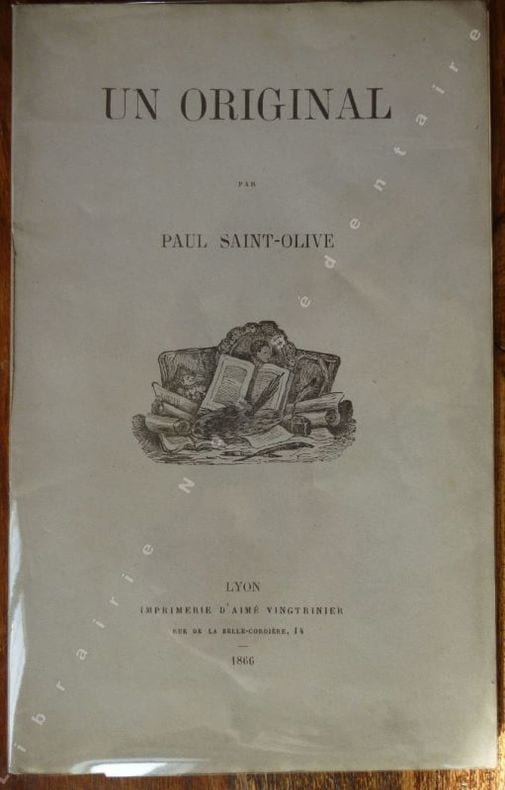
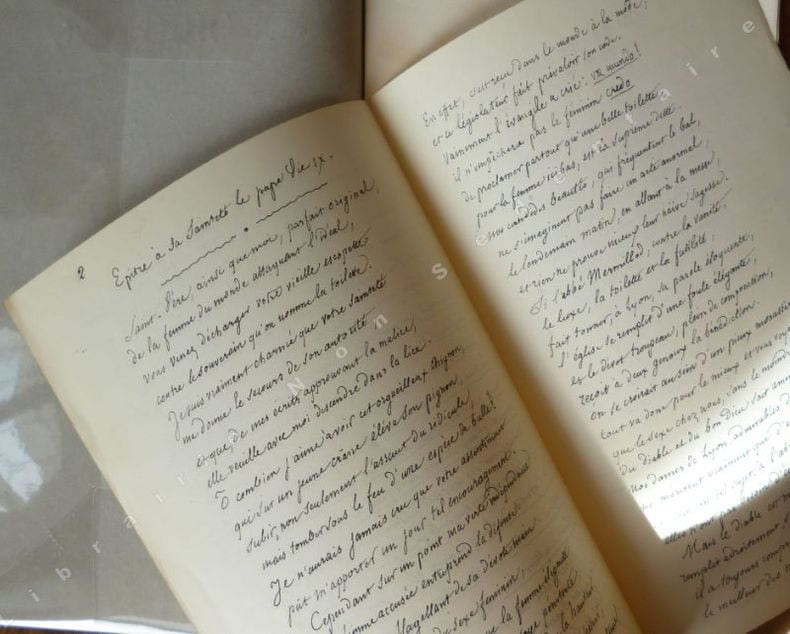
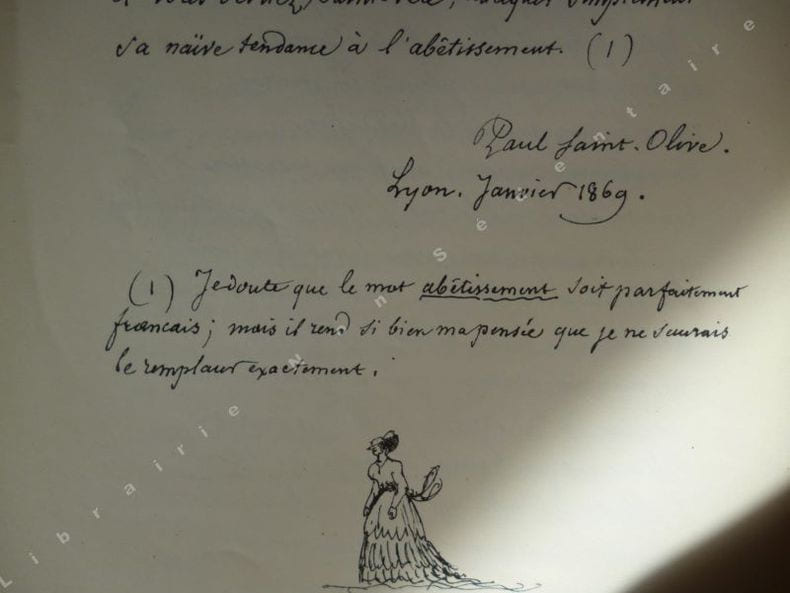
Lyon, Imprimerie d'Aimé Vingtrinier, 1866 - In-8, broché, élégante couverture grise ornée d'une figure composition en noir, 24 pages, élégant exemplaire, on joint le fac-similé d'une lettre de 4 pages de l'auteur (voir clichés).
Reference : 12345
Composition en alexandrins ne retranchant rien à l' intérêt linguistique et historique de cet écrit émaillé de notes et précisions marginales parfois drôles, souvent judicieuses.Edition Originale - Très Bon Etat Mise à jour du Samedi 27 Juin 2026. Paiement PayPal immédiat, Mondial Relay pour : France, Allemagne, Autriche, Belgique, Espagne, Italie, Portugal, Luxembourg, Pays-Bas, Pologne (Communiquer votre point ou locker si connu). Une participation supplémentaire peut être demandée pour les colis lourds hors France où les envois compris entre 5 et 25 kg sont dégressifs : 2 à 4 kilogrammes - 7.99 / 5 à 10 kg - 15.99 / 15 -25 kg - 25.99. Certaines de nos collections ( Vian, Céline, Camus (...) peuvent être expédiées en Franco de port. Pour linternational hors Europe (Suisse, Canada, Japon, Etats-Unis, les frais dexpéditions peuvent varier selon le poids (mise à jour : 1 juin 2026).
Bookseller's contact details
Artlink
M. Moïse Lecomte
+33 47 78 70 476
Payment mode

Sale conditions
Règlement immédiat par PAYPAL, virements acceptés. FRANCO DE PORT dès 30 euros d'achats en France. Nous privilégions la fiabilité de MONDIAL RELAY (Indiquer votre point retrait habituel). Une participation peut être demandée ponctuellement pour un envoi trop pondéreux. Votre versement est bloqué jusqu'à confirmation de bonne réception et conformité. CONTACT 7j/7 - librairie@gmail.com 0685628422.
5 book(s) with the same title
Discours sur le gouvernement, par Algernon Sidney, fils de Robert comte de Leicester, et ambassadeur de la république d'Angleterre près de Charles Gustave roi de Suède. Publiez sur l'original manuscrit de l'auteur. Traduits de l'anglois par P. A. Samson
La Haye, Louis et Henri van Dole, 1702. 870 g 3 volumes in-12, pleine basane, dos ornés à nerfs, [15] ff., 451 pp.; [4] ff., 447 pp.; [4] ff., 438 pp.. Portrait de l'auteur en frontispice par P. Bouttats. Première traduction française. L'édition originale en anglais est parue en 1698. Ouvrage important qui eut une grande influence notamment sur la révolution américaine. Algernon Sidney fut accusé de complot contre le roi Charles II d'Angleterre et fut condamné puis décapité en 1683. Quérard, IX, 131; Brunet, V, 373. Plusieurs ex-libris 18e et 19e : Lucas de St-Ouen, conseiller au parlement de Rouen; Lucas de Lestanville; Raoul de Lestenville [Lestanville]. Reliures d'époque. Usures aux coiffes et aux coins, petits manques. . (Catégories : Politique, Philosophie, )
Contes et nouvelles en vers. Texte original, avec notes par Alphonse Pauly de la Bibliothèque impériale
Paris, Alphonse Lemerre (D. Jouaust imprimeur), 1868. 450 g 2 volumes in-16, demi maroquin havane à coins, dos ornés à faux nerfs, têtes dorées, [2] ff., 248 pp.; [2] ff., 242 pp., [1] f.. Reliure signée de Allô. Légers frottements et usures, mors fendillés. . (Catégories : Littérature, )
[RÉGIONALISME LOIRE-INFÉRIEURE - SAINT-PHILBERT-DE-GRAND-LIEU - CHATEAU DES JAMONIERES] C. BOULLARD DIRECTEUR DES CONTRIBUTIONS DIRECTES DE NANTES
Reference : 28640
(1869)
[PLAN ORIGINAL] PLAN MANUSCRIT ORIGINAL EXTRAIT DU PLAN CADASTRAL DE LA COMMUNE DE SAINT-PHILBERT-DE-GRAND-LIEU SECTION P [PLAN DE L'ANCIEN CHATEAU DES JAMONIERES DETRUIT A LA REVOLUTION], PLAN CERTIFIE CONFORME PAR LE DIRECTEUR DES CONTRIBUTIONS DIRECTES C. BOULLARD, NANTES, LE 30 JUILLET 1869
SAINT-PHILBERT-DE-GRAND-LIEU 1869 un plan ORIGINAL MANUSCRIT dépliant sur toile enduite, format : 86 x 106 cm, coloré en rouge et rose et bleu avec l'emplacement de l'ancien chateau des JAMONIERES détruit à la revolution (et pas encore reconstruit), [PLAN ORIGINAL] PLAN MANUSCRIT ORIGINAL EXTRAIT DU PLAN CADASTRAL DE LA COMMUNE DE SAINT-PHILBERT-DE-GRAND-LIEU SECTION P [PLAN DE L'ANCIEN CHATEAU DES JAMONIERES DETRUIT A LA REVOLUTION], PLAN CERTIFIE CONFORME PAR LE DIRECTEUR DES CONTRIBUTIONS DIRECTES C. BOULLARD, NANTES, LE 30 JUILLET 1869,
Les Jamonières passe, en 1855, aux héritiers de Léon Arthur Patas d'Illiers et de Laurence Mathilde Juchault des Jamonières. puis Léon-Albert Patas d'Illiers ...... Arthur Antonin JUCHAUT, baron des JAMONIÈRES, fit reconstruire ce château en 1881 sur une parcelle de terre du domaine, propriété de la famille (chateau détruit durant la révolution, en 1794, le château aurait été brûlé par un détachement républicain ). ..... TRÉS RARE DOCUMENT ORIGINAL D'ÉPOQUE .......... en bon état malgré les défauts signalés (good condition in spite of the defects indicated). en trés bon état
Original Man : The Tautz Compendium of Less Ordinary Gentlemen
, Die Gestalten Verlag 2014, 2014 Hardcover, 240 pages, English, 265 x 220 mm, in fine condition, . ISBN 9783899555523.
Celebrating style, individuality, and joie de vivre, this book showcases 80 original men who will inspire readers to lead a less ordinary life. Original Man is a compendium of the stories of extraordinary men. From household names including Andy Warhol, Freddie Mercury, and Yves Saint-Laurent to lesser-known personalities, the 80 men presented here are incredibly diverse, yet all share entirely original lives. Featuring famous hell-raisers such as Iggy Pop, indomitable explorers including Ernest Shackleton, visionaries like Federico Fellini, and some less mainstream personalities such as Quentin Crisp or Takeshi Kitano, these biographies are as gripping as any fiction. This book is the brainchild of UK men's fashion maven Patrick Grant. As set about re-awakening the traditional Saile Row tailoring house of E. Tautz after a thirty-year slumber, he wanted to define the kind of man he aspired to clothe. Original Man is the compelling result of his musings--a collection of portraits of men who go beyond a veneer of stylish attire to wring every last drop out of life with their actions, thoughs, or words in a manner scarcely seen nowadays. These are not the biographies of those the world considers to be the best writers, thinkers, or adventurers (though undoubtedly some arguably are). Rather, this book celebrates those that have lived lives that are genuinely different. Whether in the life of a stylist, a libertine, an artist, or a hero, originality and historical precedence trumps prowess; the manner of their endeavors is what counts, not the end result. Reflecting Grant's personal background and experiences approximately half of the book's notable men come from the UK, a quarter from the US, and most of the remainder from Western Europe. Explaining his strong British bias, Grant states ''we seem to breed original characters (or celebrate them more vocally) at a rate which belies our relatively small population.'' Because a claim to inclusion requires sustained effort, not just a brief burst of activity, few of the men featured in Original Man are young. Some, such as Malcolm X and Ayrton Senna, died young, but had a lasting impact. The book also contains a few men well known for their hedonistic lifestyles such as Ozzy Osbourne and Oliver Reed, but it does not celebrate those who simply fritter their lives away at play unless it is done with the greatest sense of style. Often their tales are rather sad ones, like that of snooker player Alex Higgins, and are included in the hope that they are as precautionary as they are laudatory. Aware that there do not seem to be many equivalents to these stories today, Grant wishes to share these portraits to inspire readers--men and women alike--to try to live more interesting and original lives themselves.
PLAN ORIGINAL DE L'ISLE MABON (ISLE MISERY PUIS ISLE LEMAIRE) ET DE L'ISLE COCHARD (DEVENUE ISLE VIDEMENT) NANTES (1810)
Nantes 1810 un Plan ORIGINAL dessiné et aquarellé en lavis de couleur et manuscrit à l'encre brune sur papier vergé ligné filigrané "dessin dans grand ovale", format 30,5 centimètres de haut par 44 centimètres de large, représentant les deux iles superposées présentées ensemble pour les commodités du dessin mais en réalité, l'Isle Lemaire était sitiuée 300 m plus loin en Aval sur la Loire en face de la BUTTE SAINT-ANNE (en face du quai dAiguillon), on peut voir en bas à droite le dessin d'une rue venant de la prairie au duc pour atteindre l'isle - même rue dans le même angle en bas à droite que le dessin de " Île de la Prairie-au-Duc" : cote Archives Municipales de Nantes : 1Fi431 - Titre : Boires et canaux des Prairies au Duc du Balagué et d'aval (fin XVIIIème) - Date du document : Fin du 18e siècle - titre : Plan Figuratif de la Prairie au Duc et de ses accroits : prairie du Balagué, Prairie d'Aval, le Petit et le Grand Banc, leurs boires et canaux, avec écrit de façon manuscrite à l'encre brune, les Nos du Plan correspondant avec le nom des Propriétaires des Parcelles...au N° 33 on lit : Ile Cochard à Julien VIDEMENT et au N° 34 l'ile Lemaire à Mr MABON....... or Mr MABON n'a acheté l'ile LEMAIRE qu'en 1808 (la datation des Archives est donc fausse, ce n'est pas fin XVIIIème mais 1808, on peut le voir à un tout petit détail : le dessin des prémices de la cale de lancement de navires en construction sur l'ile Lemaire, on peut imaginer que Mr Mabon constructeur de navire, a dés l'achat de l'ile mis en chantier cette Cale afin de pouvoir construire ses Navires), j'en déduis au vu de l'avancement des travaux sur le plan Original : la Cale et les Batiments autour étant complètement terminés que l'on peut dater ce Plan vers 1810 maximum,
Au nord de la Prairie-au-Duc : Un îlot isolé, une petite île a porté successivement les noms de « Cochard » et « Videment » en référence à ses différents propriétaires ou locataires. Habitée depuis le 18e siècle, En 1782, lîle Cochard est cédée par le Roi à Monsieur Julien Videment (Négociant Nantais de la fin du XVIIIe siècle, député suppléant des États généraux de 1789, président du tribunal de commerce et conseiller municipal en 1792) par contrat dacensement. Cela signifie quen échange dune redevance appelée le cens le propriétaire peut jouir de sa terre. Dès 1784, les atterrissements autour de l'île permettent de l'agrandir et d'envisager son rattachement à la Prairie-au-Duc. elle ne semble pas être rattachée à la Prairie-au-Duc avant 1811 et, à cette époque, une grosse boire lui donne encore un accès protégé à la Loire (voir Plan ORIGINAL dessiné). En 1831, une fonderie et un atelier de construction de machines y sont installés ainsi quun hameau composé des habitations du propriétaire et des employés. A cette époque, aucune rue ne dessert cet ensemble et la présence dune digue isole plus encore le hameau en favorisant lensablement et amoindrissant la voie deau. En 1840, la disparition de la boire réunit définitivement lîle Videment à la Prairie-au-Duc (reférences : SITE " Les Archives de la ville et de la métropole de Nantes"- Archives numérisées - Cartes et plans - Lieu : PRAIRIE-AU-DUC, lieu-dit....... Mais on peut aussi remarquer le dessin (au dessus de l'isle Cochard) de l'isle LEMAIRE [L'Île Lemaire devenue l'Île Mabon, du nom de ses deux propriétaires successifs, était située dans l'axe de la Loire en face de l'entrepôt des Salorges, à l'ouest de l'île de Nantes, face à la limite des quais Marquis-d'Aiguillon et Ernest-Renaud. Mesurant environ 260 mètres de longueur et 60 mètres dans sa partie la plus large, c'était un îlot de verdure que dominaient de hauts peupliers.] : Pendant la grande épidémie de peste qui fit rage de 1625 à 1627, le Sanitat , hôpital de Nantes (situé à lemplacement actuel de léglise Notre-Dame de Bon-Port) créé en 1572 , est débordé par le nombre important des malades. Sur lîle, située légèrement en aval, on installe rapidement des loges en bois pour y accueillir les convalescents . Peut-être lorigine de son premier nom « Miseiry ».Cette île eut de nombreux propriétaires et dénominations. Sur un plan de Louis Jouaneaulx en 1722 elle est nommée «Pré Lévêque » - Le sieur H . Lemer en 1734 en devient propriétaire et lui donne son nom , qui au cours des ans devient « Le Maire », puis « Lemaire » - Le lundi 25 septembre 1741, elle est revendue au sieur Lemballeur de la Roche - Le samedi 6 juin 1761, une dame Vatard lachète - Le vendredi 19 avril 1776, de nouveaux possesseurs se font connaître : les sieurs Rolland, Hubert et J. B. Baudouin, des associés, mais leur achat nest confirmé quen 1783. A cette époque sa superficie est de 9.362 m2 - En 1808, vint sy installer un Constructeur de Bateaux, établit depuis 1793 sur la rive droite, Francisque MABON. Et là, lîle change de nom et prend le patronyme du nouveau Propriétaire, cest maintenant lîle Mabon. Dans lannuaire on peut lire « Frères Mabon , constructeurs » . Ils demeurèrent dans lîle jusquen 1822 - Le vendredi 14 juillet 1826, cest monsieur Delaporte qui acquiert cette propriété, sa surface a prospérée grâce aux alluvions et atteint 3 hectares et 8 ares, elle est occupée par deux parcelles de pré et une vaste oseraie, sa superficie est gelée, elle ne changera plus jusquà sa disparition - En 1849, encore un changement, le nouveau possédant se nomme Frédéric Bertrand - Le jeudi 24 juillet 1879 lEtat prend possession du lieu en lachetant à monsieur Briau , directeur de la Compagnie des Chemins de Fer de Nantes . Elle est alors longue de 260 mètres et large de 60. En cette fin de XIXème siècle et tout début du XXème, lîle , îlot de verdure , est un lieu de promenade dominicale des Nantais ; ils sont y accueillis dans les guinguettes qui fleurissent sur lîle ; les pêcheurs daloses et de saumons exercent leurs activités sur ses rivages devant un nombreux public friand de poisson tout frais pêché . La nuit tombante , lîle sert aussi de refuge à des marginaux , contrebandiers et petits trafiquants en tous genres. Pour répondre aux besoins de la navigation sa disparition est envisagée en 1901 (Dynamitée), et le terrain la composant fut employé pour combler la boire de Toussaint., bras de Loire séparant l'île de Grande Biesse de l'île de Petite Biesse, Au début de 1902, lîle Lemaire a disparu.......TRES RARE PLAN ORIGINAL DESSINE EN COULEURS ....... en trés bon état (very good condition). en trés bon état

