 Write to the booksellers
GOETHE (Johann Wolfang). DARAGNES (Jean-Gabriel).
Faust.
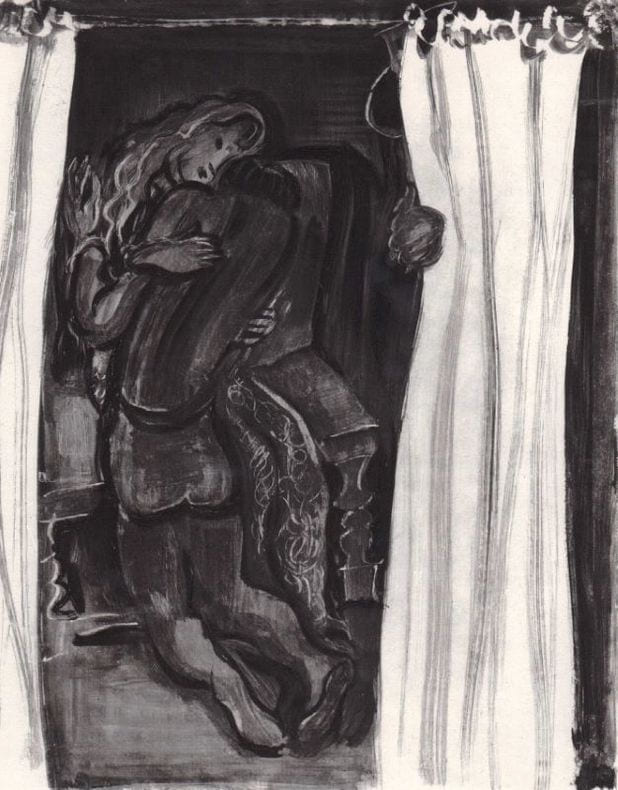
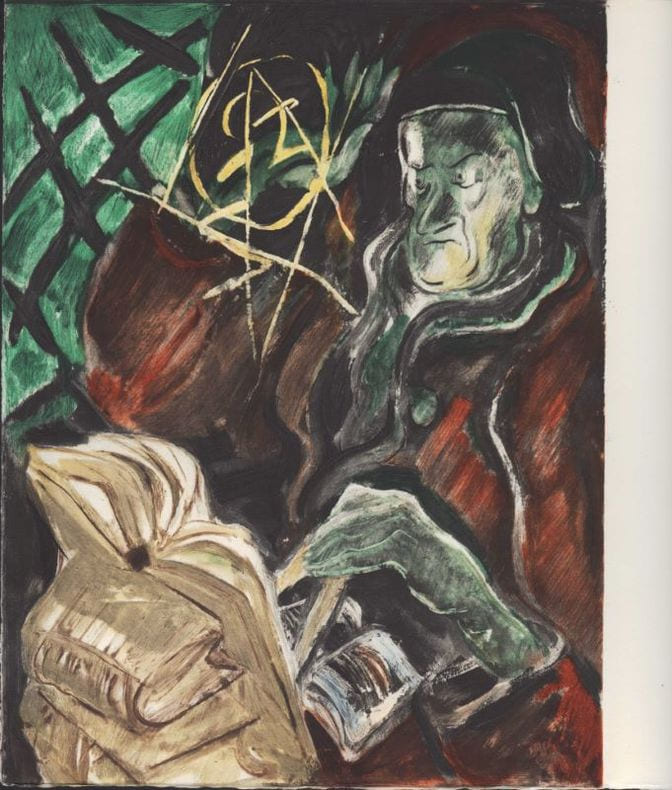
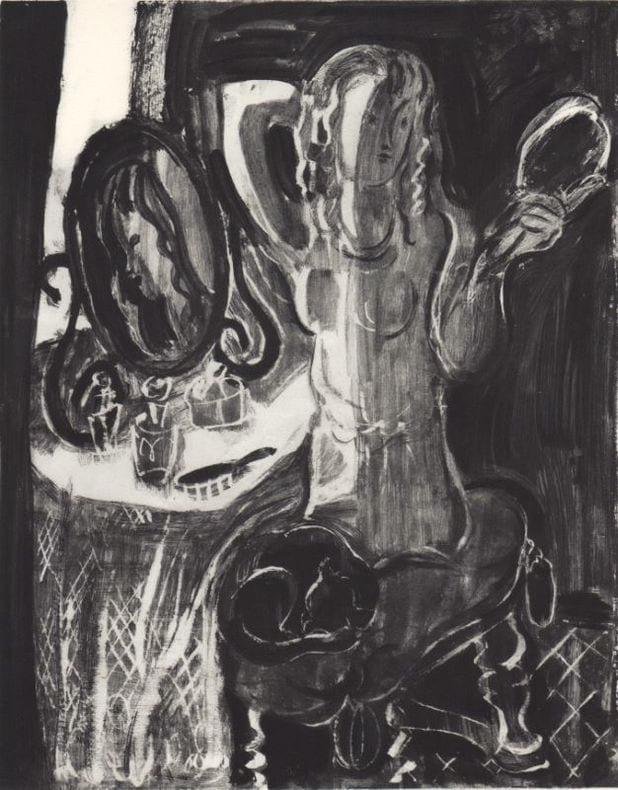
Imprimerie Daragnès 1951 1 in-4 Traduit par Gérard de NERVAL. Hommage à Jean-Gabriel Daragnès par Pierre Mac Orlan. Illustrations de J.-G. DARAGNES. Imprimerie Daragnès,1951, in-4, couverture bleue, titre imprimé en noir, étui bleu, emboîtage bleu, 264 pp.
Reference : 3672
Fameuse pièce de théâtre de Goethe qui s'exprime ainsi : "Un désir oublié, qui pourtant veut renaître, Vient dans sa longue paix, secouer mon esprit ...". Treizième ouvrage des bibliophiles de Provence illustré par Daragnès de dessins à la fois sobres, violents et délicats. Exemplaire numéroté et nominatif sur Rives d'un tirage de 205. Petite restauration à l'étui, infimes usures, dos légèrement insolé.
Bookseller's contact details
Librairie Chrétien
M. Jean Izarn
178 Rue du Faubourg Saint Honoré
75008 Paris
France
33 01 45 63 52 66
Payment mode


Sale conditions
Passez votre commande sans intermédiaire à la librairie ! Contactez nous par téléphone, e-mail ou mieux : Venez nous voir ! Prix nets en euros. Nous acceptons la Visa, chèques français et paiement espèces. Envoi du livre après encaissement du règlement, frais de ports à la charge du client, envoi en recommandé. La librairie est fermée du 1er au 31 Août ...
5 book(s) with the same title
Doktor Faust
Opéra de Lyon, 1997. In-8 carré (19 x 19 cm) broché, couverture illustrée en noir, illustrations : 10 photographies de August Sander, dessins des costumes de Patrice Cauchetier sur bandes de papiers gris insérées, 56 p.
Ce programme contient : résumé, le livret, le sujet (Faust, évolution d'un mythe), l'ouvrage, évaluation, l'inachèvement, le compositeur (Ferucio Busoni 1866-1924, Bussoni et l'opéra).
Le Faust de Berlioz - Etude sur la "Damnation de Faust" et sur l'âme romantique
Librairie Plon, 1945. In-12 reliure demi-basane havane marbré, dos à nerfs à titres et fleuron doré, 179 p.
Faust. Ein Fragment. - [PMM 298 - THE FAUST LEGEND]
Leipzig, Göschen, 1790. Orange cardboard binding (presumably the original!) with gilt title-labet to top of spine. Corners bumped, and wear along hinges and capitals. Overall a very nice and charming copy, tight, and completely unrestored. Some brownspotting throughout, but overall very nice. With the famous engraved frontispiece depicting Faust in his study, by Lips, after Rembrandt (loose) and the tittle-page stating ""Goethe's Schriften. Siebenter Band."", with the large engraved vignette by Lips, picturing Bätely bandaging Jery's hand (different from the ones in the seven other volumes), and the half-title stating ""Faust. Ein Fragment"" with ""Goethe's W. 7. B."" to the foot (repeated on all quires). Old owner's name to verso of frontispiece, otherwise no markings or annotations of any kind.
The scarce first printing, in the corrected variant Hagen So, of one of the peaks of world literature, the main work by the greatest German poet ever, and one of the all-times greatest writers of the world, Johann Wolfgang von Goethe. ""Faust"" was first printed, as it is here, as volume seven of Goethe's Schriften in eight volumes from 1787-1790, and was also published separately, likewise under the title ""Faust. Ein Fragment"". The printing of Faust in the seventh volume of Goethe's works is the original printing after the manuscript of the poet. There are two printings of this volume, between which there is traditionally said to be no precedency, although So has been corrected, which Sm has not. The present copy is Hagen variant So, without the misprints (see Hagen 11:7, So), which can be identified by eg. the lack of the repetition of the three lines in pp. 144-145, which appear in Sm (see Hagen, p. 12). Few other writers have been as influential as Goethe, and his works were an immense source of inspiration to everything from drama and music to science and philosophy. He is generally accepted as one of the most important thinkers within Western culture, and his main work, Faust, is considered one of the most important and influential works of world literature. ""If Goethe may justly be called the last representative of the renaissance ideal of the ""oumo universale"", his ""Faust"" embodies the sum total of his poetical growth."" (Printing and the Mind of Man: 298).""Faust"" is arguably the work for which Goethe is most famous, and this is not without reason. The novel emphasizes the strength of the individual and the right to freely investigate aspects of human and divine character. The novel also fights for man's right to determine his own destiny, and is thus considered the first great literary work in the spirit of modern individualism. Faust is also considered highly relevant to science and scientific thought, as Goethe here offers a holistic and non-analytic approach to these areas. The present volume 7 from 1790 has two vignettes: ""Bätely verbindet dem Jery die Hand"", H. Lips fec."" and ""Faust im Studierzimmer, ein am Fenster erscheinendes magisches Zeichen betrachtend"", H. Lips sc. (nach Rembrandt) (see Hagen 11:7). On the last page is written ""Leipzig, gedruckt bey Christian Friedrich Solbrig"" (see Hagen 11). It also includes the separate texts ""Jery und Bätely"" (pp. 169-224) and ""Scherz, List und Rache"" (pp. 225-320). PMM 298 (being the 1834 ed., not the real first)" Hagen 11,7 - So.

Reference : alb87fb4b05c7ca560f
Goethe, J. W.G. de Nerval Goethe, J. W., G. de Nerval Faust et le Second Faust
Goethe, J. W.G. de Nerval Goethe, J. W., G. de Nerval Faust et le Second Faust. Traduation par Gerard de Nerval.Faust and the Second Faust. Translated by Gerard De Nerval. In Russian /Goethe, J. W.G. deNerval Gete, Zh. V., G. de Nerval Faust et le Second Faust. Traduction par Gerard deNerval.Faust i vtoroy Faust. Perevod Zherara De Nervalya. In Russian. Paris Garnier Freres, 1886. 448c. We have thousands of titles and often several copies of each title may be available. Please feel free to contact us for a detailed description of the copies available. SKUalb87fb4b05c7ca560f
EUROPE REVUE MENSUELLE N° 813-814 - FAUSTAndré DABEZIES:Miroirs du mythe.Claudio MAGRIS:Les métamorphoses de Faust.GüntherMAHAL:Le personnage historique de Faust.Georges THINES:La trahison du disciple.Liliane PICCIOLA
EUROPE. JANV-FEV 1997. In-12. Broché. Bon état, Couv. convenable, Dos satisfaisant, Intérieur frais. 254 pages.. . . . Classification Dewey : 70.49-Presse illustrée, magazines, revues
Sommaire : FAUSTAndré DABEZIES:Miroirs du mythe.Claudio MAGRIS:Les métamorphoses de Faust.GüntherMAHAL:Le personnage historique de Faust.Georges THINES:La trahison du disciple.Liliane PICCIOLA:Le drame ambigu de la magiedémoniaque - Marlowe et Calderôn.Hans HENNING:Goethe et la tradition de Faust.André DABEZIES:Les structures du drame de Goethe.André DABEZIES:Interprétations du drame de Goetheau XIXe siècle.Haroldo de CAMPOS:La « trans-création » du Faustde Goethe.lise GARNIER:Démesure de Grabbe.Christian Dietrich GRABBE:Don Juan et Faust - extrait.Françoise FLAMANT:Le Faust de Goethe et le romantismerusse.Françoise MIES:Avertissement à l’Europe - Les Faustde Klaus et Thomas Mann.Françoise FLAMANT : Un grand roman faustien : Le Maître etMarguerite de Mikhaïl Boulgakov.Michel JARRETY:Valéry : Faust écrit.Francis VANOYE:Résonances faustiennes au cinéma.Alain BANCQUART:Un mythe pour le théâtre lyrique ?André DABEZIES:Faust, mythe du XXe siècle ?_CAHIER DE CRÉATIONLouis CALAFERTE:Maître Faust. Classification Dewey : 70.49-Presse illustrée, magazines, revues


