 Write to the booksellers
COLLECTIF.
L'Institut de France.
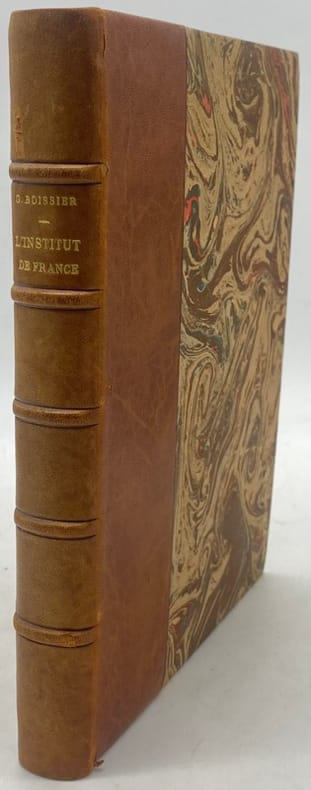
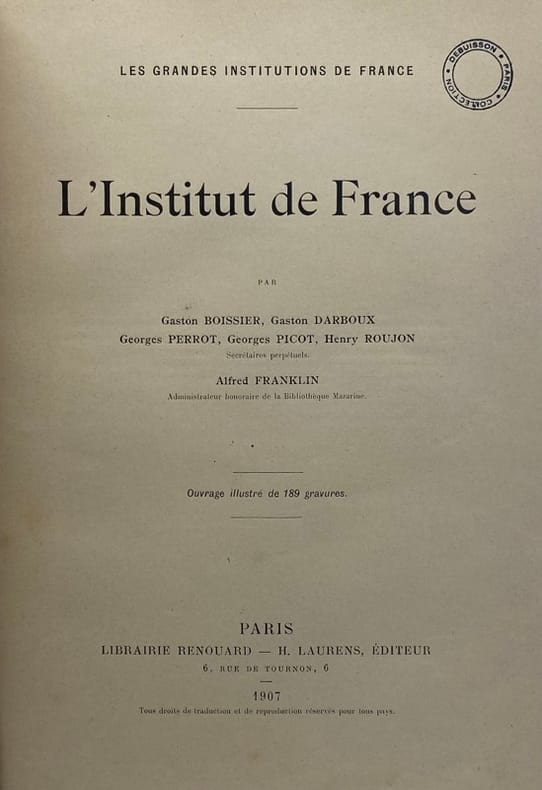
Paris, Renouard, 1907 gr. in-8, 468 pp., nombreuses ill., demi-basane fauve, dos à nerfs, couv. cons. (reliure de l'époque). Dos passé, mouillure angulaire en fin d'ouvrage. Cachet de la collection Debuisson. Ex-libris Yves Louis Mongrolle.
Reference : 227844
- - VENTE PAR CORRESPONDANCE UNIQUEMENT - LIEN DE PAIEMENT, NOUS CONSULTER.
Bookseller's contact details
Librairie Historique Fabrice Teissèdre
M. Fabrice Teissèdre
lecurieux@teissedre-librairie.fr
06 46 54 64 48
Payment mode
Sale conditions
Conditions de vente conformes au règlement du SLAM et aux usages de la LILA (ILAB). Les frais de port et d'assurance sont à la charge du client. Les envois sont effectués en colissimo contre-signature ou DHL. Règlement par chèque, virement bancaire. Pour un règlement par carte bancaire (Visa, Mastercard), un lien de paiement sécurisé (via Lyf), vous sera envoyé par mail.
5 book(s) with the same title
L'INSTITUT de FRANCE
Un ouvrage de 128 pages, format 175 x 112 mm, broché, PUF, collection "Que sais-je ?", publié en 1999, bon état
Au sommaire : Les origines de l'Institut de France ; Les fonctions de l'Institut de France ; Us et coutumes académiques ; L'Institut et le droit ; Le patrimoine de l'Institut ; Le rayonnement de l'Institut de France au service de l'esprit
Phone number : 04 74 33 45 19
L'Institut de France. Lois, Statuts et Règlements concernant les anciennes Académies et l'Institut, de 1635 à 1889. Tableau des Fondations. [ Edition originale ]
Collection publiée sous la Direction de la Commission Administrative Centrale par M. Léon Aucoc, 1 vol. fort in-8 reliure demi-basane marron, Imprimerie Nationale,Paris, 1889, CCVIII-451 pp.
Rare exemplaire de l'édition originale de cet important volume, à ne pas confondre avec la brochure publiée la même année par l'auteur. Le présent ouvrage contient la collection des lois, décret et arrêtés ayant organisé l'Institut depuis l'année 1795 jusqu'à la fin de l'année 1888, ainsi que le tableau des fondations faites en faveur de l'Institut et des diverses Académies. L'ensemble est précédé d'une très longue introduction (208 pages) réunissant les actes relatifs à la création et à l'organisation des anciennes académies fondées au XVIIe siècle sous le patronage de Richelieur, Séguier, Colbert et Pontchartrain, avec lesquelles l'Institut et les Académies ont de nombreux liens. Bon état (dos un peu frotté) pour cet ouvrage de référence.
Le Général, duc d'Aumale - 1822 - 1897(Les jeunes années, Les débuts du soldat, Un attentat, La prise de Smalah, Souvenirs des guerres d'Afrique, Le mariage du duc d'Aumale, Le général d'Aumale et Abd-el-Kader, Le duc d'Aumale et le maréchal Bugeaud, De 1848 à 1849, Le patriote, Le duc d'Aumale et l'Institut de France, Le château de Chantilly, Les dimanches à Chantilly, Le centenaire de l'Institut, Le duc d'Aumale amateur d'art, Le duc d'Aumale bibliophile, L'écrivain, Le duc d'Aumale et la Russie, Souvenirs et anecdotes, La mort et les funérailles du duc d'Aumale, Le duc d'Aumale et les contemporains, Les portraits du duc d'Aumale, La vie intime du duc d'Aumale, Le duc d'Aumale par M. Eugène Guillaume de l'Institut, La statue du duc d'Aumale à Chantilly, Une lettre de Victor Hugo) -
PARIS, à la Librairie Nationale d'éducation et de récréation, Sans date (vers 1900) - Broché - couverture illustrée In-4, 29 x 22 cm - 29 gravures en noir dans le texte et hors-texte dont un frontispice - 223 pages - rousseurs habituelles - correct
Henri Eugène Philippe Louis d'Orléans, prince du sang, prince d'Orléans, duc d'Aumale (1822 - 1897), avant-dernier fils de Louis-Philippe et de Marie-Amélie de Bourbon, princesse des Deux-Siciles. Cnformément à nos conditions générales de vente :Les frais de port sont affichés à titre indicatif. Il se peut que nous devions vous contacter pour vous informer du coût de laffranchissement supplémentaire en fonction du poids et du nombre de livres, surtout pour les envois internationaux Cependant vu l'augmentation des tarifs postaux à l'internationale, nous pouvons expédier les ouvrages en point relais MONDIAL RELAY pour les pays suivants : Allemagne, Autriche, Belgique, Espagne, Italie, Luxembourg, Pays-Bas, Pologne, et Portugal. Merci de nous indiquer en retour le point relais choisi ainsi que votre numéro de téléphone mobile & adresse Courriel pour assurer le suivi du colis.N'hésitez pas à nous interroger.In accordance with our general terms and conditions of sale:Shipping costs are displayed for informational purposes only. We may need to contact you to inform you of the additional postage costs depending on the weight and number of books, especially for international shipments.However, given the increase in international postal rates, we can ship books via Mondial Relay to the following countries: Germany, Austria, Belgium, Spain, Italy, Luxembourg, Netherlands, Poland, and Portugal. Please provide us with your chosen Mondial Relay point, as well as your mobile phone number and email address to ensure package tracking.Please feel free to contact us with any questions
Taine Hippolyte Adolphe Institut de France. Acadmie franºaise
Reference : 007460VPJB
ISBN : B001D6S8L8
Institut de France. Acadmie franºaise. Discours prononcs dans la sance publique tenue... pour la rception de M. Taine le 15 janvier 1880. ëloge de M. Louis de Lomnie par le rcipiendaire rponse de M. J.-B. Dumas
Impr. de Firmin-Didot Broch D'occasion tat correct 01/01/1880 61 pages
Leconte de Lisle Charles-Marie Institut de France Acadmie franºaise
Reference : 007461VPJB
ISBN : B001D814M6
Institut de France Acadmie franºaise. Discours prononcs dans la sance publique tenue... pour la rception de M. Leconte de Lisle le... 31 mars 1887 par le rcipiendaire et M. Alexandre Dumas
Impr. de Firmin-Didot Broch D'occasion tat correct 01/01/1887 64 pages

