 Write to the booksellers
MAXIME DE TYR
Dissertationes. Ex interpretatione Danielis Heinsii. Recensuit & notulis illustravit Joannes Davisius
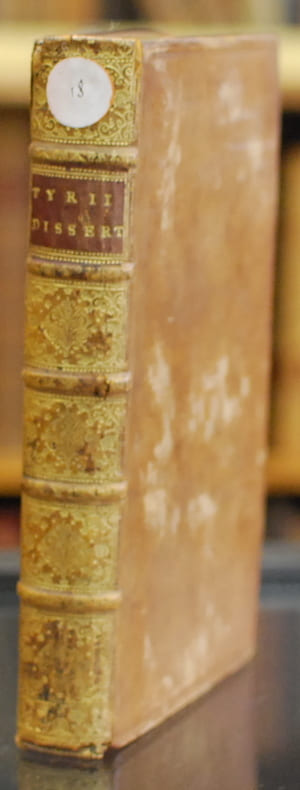
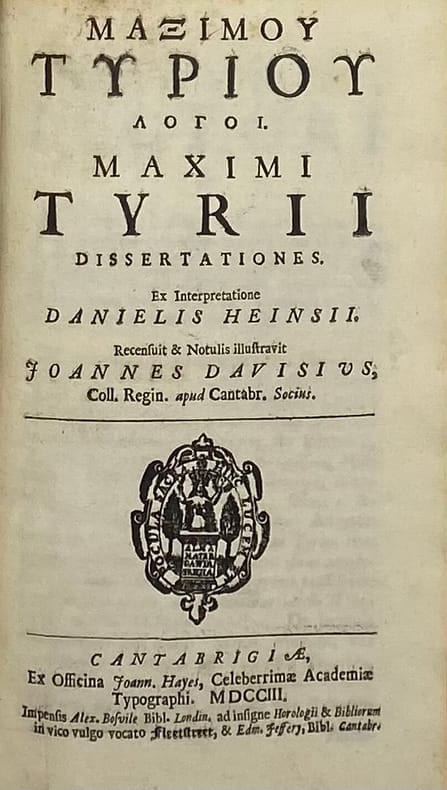
Cambridge, John Hayes, 1703 in-8, [8] ff. n. ch. (titre, préface, table des dissertations), 435 pp., [5] ff. n. ch. de table, texte grec et traduction latine en regard, veau blond, dos à nerfs cloisonné et richement orné, pièce de titre fauve, encadrement de triple filet à froid sur les plats, tranches rouges (reliure de l'époque). Coiffe inférieure rognée, Début de fente à un mors, petite usure aux coins mais bon exemplaire.
Reference : 183833
Nouvelle édition du Maxime de Tyr de Daniel Heinsius, originellement publié en 1697, mais sans l'intégralité des notes. Ces 41 dissertations sont l'oeuvre majeure du philosophe néo-platonicien qui vivait à l'époque des Antonins, et mourut vraisemblablement en 185.Brunet III, 1552. - - VENTE PAR CORRESPONDANCE UNIQUEMENT - LIEN DE PAIEMENT, NOUS CONSULTER.
Bookseller's contact details
Librairie Historique Fabrice Teissèdre
M. Fabrice Teissèdre
lecurieux@teissedre-librairie.fr
06 46 54 64 48
Payment mode
Sale conditions
Conditions de vente conformes au règlement du SLAM et aux usages de la LILA (ILAB). Les frais de port et d'assurance sont à la charge du client. Les envois sont effectués en colissimo contre-signature ou DHL. Règlement par chèque, virement bancaire. Pour un règlement par carte bancaire (Visa, Mastercard), un lien de paiement sécurisé (via Lyf), vous sera envoyé par mail.
1 book(s) with the same title
MAXIMOU TURIOU LOGOI. Maximi Tyrii Dissertationes. Ex interpretatione Danielis Heinsii. Recensuit & notulis illustravit Joannes Davisius, Coll. Regin. apud Cantabr. Socius.
Cambridge (Cantabrigiae), Ex Officina Joann. Hayes, celeberrimae Academiae Typographi, 1703.
8vo. (XVI),435,(1 blank);(10 index),(2 blank) p. Vellum 20 cm (Ref: ESTC Citation No. T98323; Hoffmann 2,586: 'Diese Ausgabe übertrifft die früheren'; Dibdin p. 2,233: 'Foreign critics seem to consider Davies the best editor of Maximus Tyrius. (...) but it is to be regretted that Heinsius's notes are not given entire. At the bottom of each page some short critical and historical observations are given; and there are two very useful indexes'; Brunet 3,1552; Graesse 4,453; Ebert 13454: 'Die Anmerkungen sind theils kritisch, theils die Geschichte der Philosophie betreffend'; Spoelder p. 578, 's-Gravenhage 3) (Details: Prize copy, without the prize. 6 thongs laced through the joints. Boards with double fillet gilt borders and the coat of arms of The Hague in the center. Woodcut printers' mark on title, with the University's motto: 'Hinc lucem et pocula sacra', 'From this place, we gain enlightenment and precious knowledge'. At the end is bound a manuscript 'actio gratiarum' of 16 lines, i.e. a note of thanks. (See Provenance below)) (Condition: Vellum slightly scratched and soiled. Lower margin of the first 30 p. very slightly waterstained. Prize gone) (Note: The Greek Platonist Maximus Tyrius, ca. 125-185 AD, was an itinerant philosopher/lecturer, who lived during the Second Sophistic, and left us 41 dissertations (dialexeis) on theological, ethical and philosophical subjects. The lectures were delivered in Rome, apparently during the reign of Commodus (180-92). They deal with ethics, physics, theology and epistemology, but are not great literature, nor specimina of great learning. Themes are for example: 'die Lust (hêdonê, 29-33), sokratische Liebe (18-22), platonische Theologie (11), 'daimones' (8-9), Gebet (5), Weissagung und freier Wille (13), das Böse (41) und Wiedererinnerung (10)'. (Neue Pauly, 7,1074/75) Maximus Tyrius 'was well read in Greek literature, but apparently not in Greek philosophy except in Plato, of whom he claimed to be a follower. His lectures show no philosophical originality, and are simple eloquent exhortations to virtue decked out with quotations, chiefly from Plato and Homer'. (OCD 2nd ed. p. 658) As a philosophic orator he is comparable with contemporaries like Dio Chrysostomus and Apuleius. He was widely read by the humanists of the 15th century, e.g. Poliziano, Bessarion, Lascaris, Reuchlin. The 'editio princeps' was published in 1557 by the French scholar/publisher Henricus Stephanus. The next important and authorative edition was published in 1607 by the Dutch classicist Daniel Heinsius, 1580-1655. The English scholar John Davies, Fellow of Queens' College at Cambridge based the Greek text of his edition on that of Stephanus, he tells us in the 'praefatio', and adopted the Latin translation of Heinsius with corrections, and with notes and 2 useful indexes of his own. (p. *4 verso) John Davies, or Joannes Davisius, 1679-1732, studied at Queens College, of which he was elected fellow, and subsequently became Rector, or Praeses, in 1717. He chiefly devoted his attention to the philosophical works of Cicero. His editions show great learning and knowledge of the history of and the systems of ancient philosophy. Davies also produced editions of Caesar, Minucius Felix and Lactantius. He was a friend and ally of the greatest classical scholar of his age Richard Bentley) (Provenance: At the end has been added a leaf with the text of the 'Actio gratiarum' of the schoolboy who received this book: 'Celeberissime Princeps. Nobilissimi atque Amplissimi Scholae curatores. Doctissime Rector. Quanto diligentius vestram in me munificentiam mente agito, tanto amplior beneficii vestri magnitudo mihi videtur, Viri Nobilissimi, quod praemio hoc magnifico iterum decoratus laudibusque et victoria clarus in altiorem militiae scholasticae gradum promoveor. Quocirca nolite dubitare, Curatores nobilissimi, sinceram benignitatis vestrae memoriam nullo apud me tempore esse intermorituram. Credite vero nihil unquam quidquam deincpes mihi dulcius fore, quam si meum in Vos animum gratissimum meamque observantiam Vobis probare queam'. See for this kind of speeches Spoelder, Prijsboeken op de Latijnse School. Amsterdam 2000, p. 176/184) (Collation: *8, A-2E8 (leaf 2E8 blank)) (Photographs on request)

