 Write to the booksellers
Aurelii Macrobii Ambrosii Theodosii etc.
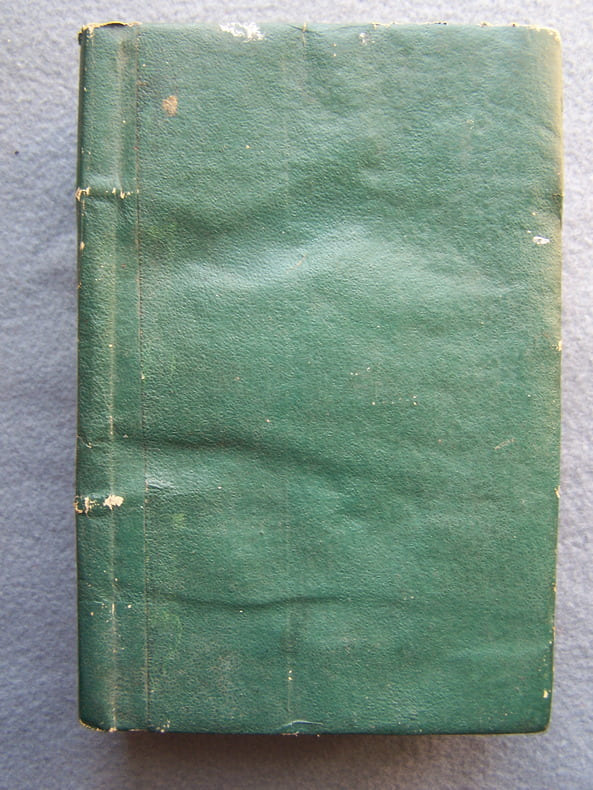
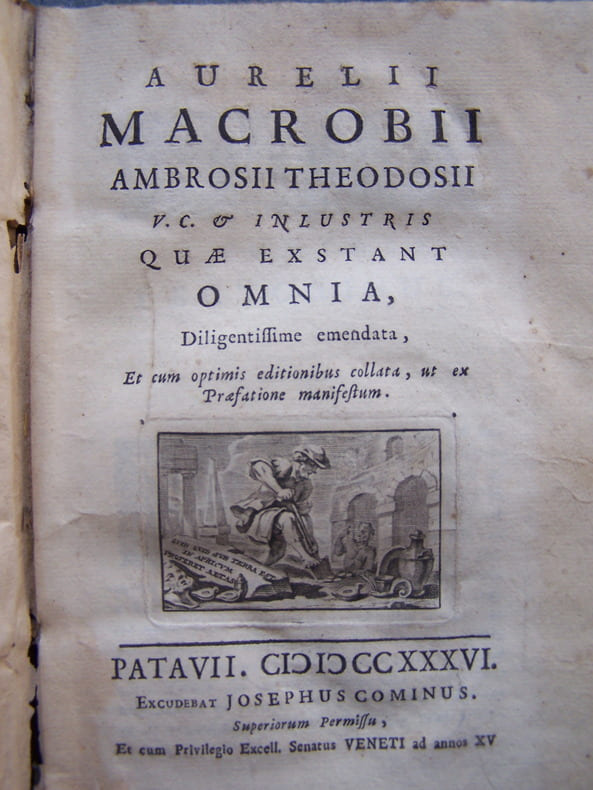
Patavii, 1736, 640 pages plus index, reliure XIX°, bon état
Reference : MPA-431
Bookseller's contact details
Librairie Auvolat
Marie-Paule Auvolat
8 rue Bugeaud
69006 lyon
France
06 09 10 27 19
Payment mode
Sale conditions
paiement par chêques et virement bancaire
5 book(s) with the same title
Macrobii Ambrosii Aurelii Theodosii viri consularis & illustris in Somnium Scipionis libri II. Eiusdem Saturnaliorum libri VII. Ex vetustissimis manuscriptis codicibus recogniti & aucti. (Edited by) Joach. Camerarius.
Basel (Basileae), Ex officina Ioan. Hervagii, 1535. Cum privilegio Caesaris ad quinquennium.
Folio. (XL),334,2 p. Vellum 30 cm (Ref: VD16 ZV 20513; Schweiger 2,586: the first mentioned copy with the privilegium and the corrections. 'Neue, schätzbare Recension von Joach. Camerarius, nach 2 Handschriften'. Dibdin 2,220: 'under the care of the celebrated Camerarius, and by the help of several important MSS. there was hardly a verse in the poets quoted but what received very considerable emendation. (...) A volume, thus intrinsically valuable, will not fail to find a purchaser at a reasonable price'; Ebert 12716; Graesse 4,330) (Details: Later vellum (18th century?). Brown morocco shield on the back. 2 thongs laced through both joints. Large printer's mark of Hervagius (Johann Herwagen the elder) on the title, and a different one on the verso of the last leaf, both depicting a three headed Hermes on a pillar. Woodcut initials, 8 woodcuts and a woodcut map of the world in the text) (Condition: Some small and almost invisible repairs of the vellum. Corners of the shield on the back partly gone. Title browning, paper yellowing, some slight foxing. Wormhole in the right uppercorner of ca. 80 p., not coming near any text. Pastedowns affected by a few small unobjectional wormholes) (Note: Ambrosius Theodosius Macrobius, a Roman senator and a classical scholar of the early 5th century A.D. 'was a notable link between the cultures of antiquity and the Middle Ages'. This edition contains his 2 most important works, the 'Saturnalia' and his 'Commentarii in Somnium Scipionis', the 'Dream of Scipio', a commentary on a part of 'De Republica' of the Roman orator Cicero. The 'Saturnalia' is a learned compilation in 7 books cast in dialogue form, in which the cultural life of the former generation is idealized. Macrobius' aim is to provide his son with all the necessary hard to come by scientific knowledge. He did so in the form of a banquet. Macrobius was inspired by the Ciceronian dialogues 'De Oratore' and 'De Republica'. 'Set during the Saturnalia of 383, it gathers several (conspicuously non-Christian) members of the aristocracy and their entourage to discuss matters ridiculous (...) and sublime, (...) above all the poetry of Virgil. Quarried from mostly unnamed sources - including Gellius, Seneca, Plutarch, and the tradition of scholastic commentary today known from Servius, the discussion presents Virgil as the master of all human knowledge'. More influential in the Middle Ages and Renaissance was the commentary of Macrobius on the 'Somnium Scipionis'. Macrobius uses Cicero's text (De Republica 6,10 ff) as the starting point for a thoroughly Neoplatonic treatment of (especially) cosmology and the soul's ascent to the One, with direct debts to Porphyry and Plotinus.' Discussed are matters of mathematics, physics, cosmology, astronomy, geography and ethics. He thus forged a kind of compendium of science and philosophy, which transmitted classical knowledge to the medieval world, and was to hold a central position in the intellectual development of the West during the Middle Ages. His books belong to the basic sources of the scholastic movement and of medieval science. His work left traces in the works of Dante, Chaucer, Vives and Spenser. (Source for M. and the quotations: 'The Classical Tradition', Cambr. Mass., 2010, p. 553). Joachim Camerarius, 1500-1574, holds one of the foremost places among the German classical scholars of the 16th century. Gudeman calls him even 'der bedeutendste Philologe Deutschlands im 16. Jahrh.' (Grundriss der Geschichte der klassischen Philologie, Lpz. 1909, p. 216) He held professorships at Nuremberg, Tübingen and Leipzig. 'His numerous editions of the Classics, without attaining the highest rank, are characterized by acumen and good taste'. (Sandys, 'History of Classical Scholarship' 2, p. 266/67) Camerarius was a man of vast knowledge. He also wrote on history, theology, mathematics, astronomy and paedagogy. He seems to have been just the man for editing the encyclopaedic works of Macrobius. Camerarius had evidently a high opinion of himself and his talents. Such we gather from the following distich on the titlepage: 'Qui tamen et nostri numerum vult scire laboris, annumeret versus totius ille libri', i.e. he left his mark in every line of verse in Macrobius. This book contains furthermore an interesting Macrobian map, a map which for a 1000 years formed the basis of world geography. It was first printed in 1482, showing the continents in the 'Alveus Oceani', a big Europe, and a rather small Africa and Asia. The round map is typically divided in 5 climatic zones. It shows the pre-Renaissance view of the world, Antipodeans and all. Our map shows the awakening of the passion for exploration and the cartographic progress in this period. Africa and Asia have grown hugely, and Europe has shrunk considerably. The lines of the climatic zone on the first map of 1482 were straight, suggesting a flat earth, on our map the lines are convex, indicating a world which is really a round ball. And the Antipodean part has gone. No sign however of America. The literature on the development of the Macrobian world view is immense) (Provenance: On the front flyleaf in pencil '7 januari 1961', written by the Flemish linguist Walter Couvreur, 1914-1996, who was an Orientalist, and professor of Indoeuropean linguistics at the University of Gent. It indicates the date of aquisition. The place of acquisition he wrote on the flyleaf at the end: 'Turijn, Bottega d'Erasmo') (Collation: alpha - beta6, gamma8, a-z6, A-E6) (Photographs on request)
Macrobii Ambrosii Aurelii Theodosii, Viri consultaris illustris, In Somnium Scipionis, Libri II - Saturnaliorum, Libri VII
Lyon, Ant. Gryphium, 1585. In-16, 745-[112] pp., demi-basane havane, dos long orné de filets et de fleurons dorés, pièce de titre rouge, tranches mouchetées (mors fendus, manques et épidermures, manque angulaire sans atteinte à la p. 3, cahier Y relié dans le désordre, mouillures angulaires, quelques petites rousseurs, galerie de ver sans atteinte).
Édition lyonnaise des deux oeuvres les plus célèbres de Macrobe. Elle est illustrée de sept bois dans le texte. Baudrier, VIII, 392; Rosenthal, 8715 : "Édition rare". Ex-libris manuscrit au titre. * Membre du SLAM et de la LILA / ILAB Member. La librairie est ouverte du lundi au vendredi de 14h à 19h. Merci de nous prévenir avant de passer,certains de nos livres étant entreposés dans une réserve.
MACROBII AMBROSII AURELII THEODOSII, UIRI CONSULARIS, & ILLUSTRIS In Somnium Scipionis (Lib II) , Saturnaliorum Lib VI Ex varijs ac vetustissimis codicibus recogniti, & aucti. (Traduction: De Macrobe, Ambroise, Aurélien,Théodose, Consul éminent, les Saturnales (livre II) , le SONGE DE SCIPION , Les SATURNALES (livre IV) , révisés et augmentés à partir de codex divers et anciens.)
Apud Ioan. Gryphium, VENETIIS, 1575.
Un volume petit in-12° (15, 4 x 11cm), reliure ancienne velin souple ivoire d’aspect irrégulier, dos à trois nerfs, reste d’attaches. Nom de l’auteur (MACROBE) manuscrit sur le dos. 567 pages imprimées en italiques, 32 feuilles d'index , caractères tous en italique (texte en latin et partiellement en grec, soit in-texte soit en notes marginales), 4 illustrations (p. 101, 109, 137 et 144). La dernière d’entre elles étant particulièrement connue (p.144) car il s’agit d’une cartes du monde qui fut une des premières à représenter la terre sous forme d’une globe et à séparer les deux hemisphères. L’ouvrage date en principe de 1575. C’est ce que l’on peut lire sur la page de titre mais on notera qu’un des chiffres romains X a été inscrit à la main... Quoi qu’il en soit ce volume contient 2 textes, comme quasiment chaque édition des oeuvres de MACROBE, lequel en a écrit une troisième, moins connue, un traité de grammaire sur les différences et ressemblances entre le grec et le latin.Ses deux oeuvres majeures donc auraient été composées vers 430. MACROBE, né en Numidie vers 370 fut un haut fonctionnaire de l’Empire romain et ses oeuvres semblent avoir été lues tout long du moyen âge. On peut dire aussi qu’Il fut un philosophe et un philologue néoplatonicien (doctrine de l’antiquité tardive, inspirée non seulement de PLATON mais de plusieurs courants de la spiritualité orientale et grecque. Le COMMENTAIRE DU SONGE DE SCIPION (pp. 3-177 )permit entre autres richesses de retrouver un texte de CICERON (De Republica) qui avait, complètement disparu et qui en occupait les paragraphes 9 à 29 du livre VI . MACROBE en avait extrait ce texte pour le traiter comme une sorte de fable autonome (SCIPION rêve qu’il s’elève jusqu’au ciel pour y retrouver ses aieux , lesquels lui expliquent le mécanisme du cosmos, la place de la Terre et de l'homme au sein de l'univers et le principe de l’immortalité). Dans ce texte MACROBE s’appuie sur une carte du monde.Dans le 2ème texte, LES SATURNALES (pp.178-267), MACROBE nous décrit une sorte de colloque littéraire où au milieu des trois jours des fêtes des Saturnales de l'an 384 douze savants romains, dont un grammairien serbe, décident de s'enfermer pour parler de divers sujets, Virgile, les antiquités et les traditions romaines, la philosophie, la grammaire, l’astrologie, divers citations d’auteurs souvent disparus, des curiosités des anecdotes etc... On peut dire qu’il s’agit avec ce texte, d’un hommage à l'ancienne Rome païenne. Exemplaire compact dans sa reliure d’époque en vélin, et en BON ÉTAT. [50276]


Macrobii Ambrosii Aurelii Theodosii, viriconsularis & illustris, In somnium Scipionis, Lib. II (Le Songe de Scipion). Saturnaliorum, LIb. VII (Les Saturnales). Ex variis ac vetustissimis codicibus recogniti et aucti. Cum indice locupletissimo.
sans lieu (Genève), Apud Iacobum Stoer, 1607, in-16 (8x12cm), pleine reliure en veau marron de l'époque, dos à 4 nerfs orné de fleurons, titre à l'or, toutes tranches jaspées rouge, 745p. Edition contenant les deux plus importants textes de Macrobe : le Commentaire au songe de Scipion et Les Saturnales. Vignette sur la page de titre. In-fine Index rerum et verborum huius operis. Texte imprimé en litalique orné de lettrines. 4 figures dans le texte, nombreux commentaires dans la marge. Petit manque de cuir en coiffe, cuir fendu sur la charnière, exemplaire toutefois solide. Petite restauration de papier sur deux pages. Texte frais.
NB. La librairie est fermée jusqu'à fin septembre. Les questions et commandes seront traitées début octobre.
Macrobii Ambrosii Aurelii Theodosii Viri consultaris illustris, In Somnium Scipionis, Libri II - Saturnaliorum, Libri VII (Le Songe de Scipion - Les Saturnales). Ex variis ac vetustissimis codicibus recogniti et aucti.
Lugduni, Apud Ant. (Antoine) Gryphium (Fils de l'imprimeur-libraire Sébastien Gryphius),1585, 1 volume in-18 de 125x75x40 mm environ, titre avec vignette à la marque de l'imprimeur (le griffon), 745 pages, 56 ff. (index), 3 ff.blancs, parchemin crème à recouvrements avec traces de liens de fermeture. Avec 7 bois gravés, dont la célèbre carte du monde (p. 191). Papier légèrement jauni par endroits, sans les liens de fermeture, quelques notes manuscrites sur la page de titre, petites taches sur le parchemin, sinon bon état. Texte en latin, en caractères italiques.
Macrobe (Flavius Macrobius Ambrosius Theodosius) est un écrivain, philosophe et philologue latin, auteur des Saturnales, et du Commentaire au Songe de Scipion. Il est né vers 370 à Sicca en Numidie (Afrique). C'est avec saint Augustin et Cassiodore l'un des « passeurs de témoin » à la fin de l'Antiquité romaine, notamment en ce qui concerne la question de l'âme. Merci de nous contacter à l'avance si vous souhaitez consulter une référence au sein de notre librairie.

