 Write to the booksellers
SAINTE-CLAIRE DEVILLE, Henri
Leçons sur la dissociation, professées devant la Société chimique le 18 Mars et le 1er Avril 1864.
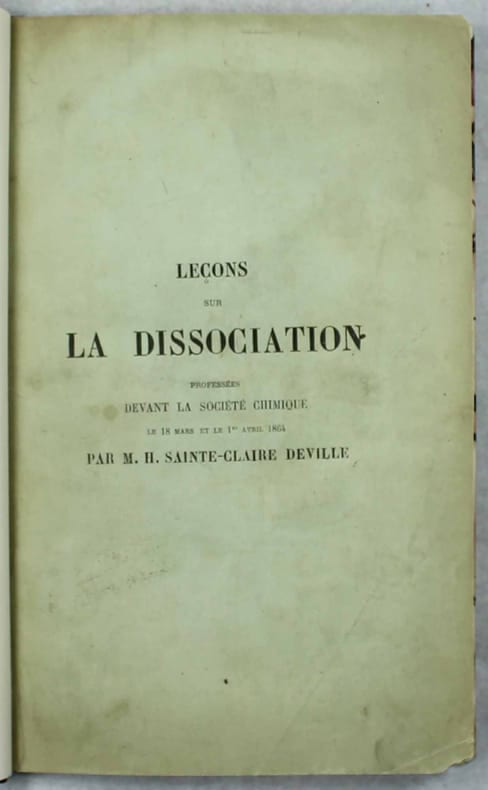
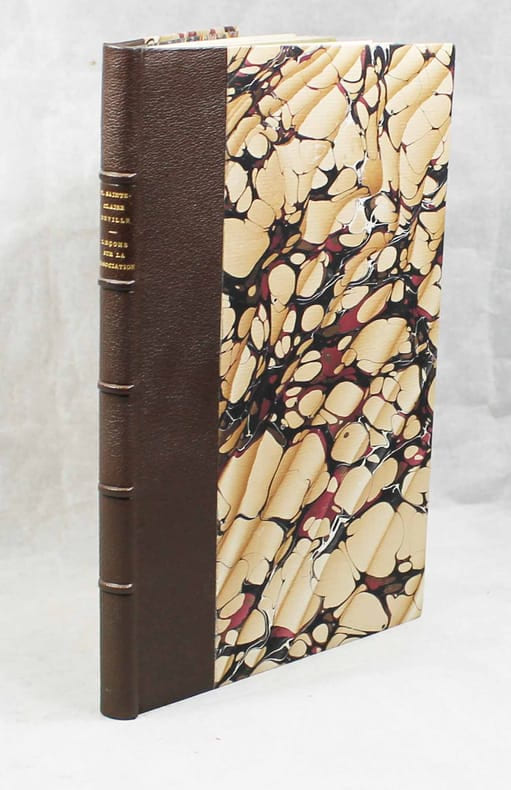
Paris, Lahure, 1864.
Reference : 2625
Première édition. "Ce texte de Sainte-Claire Deville constitue l'un des actes les plus importants qui aient marqué la naissance de la chimie-physique." (Daumas, Hist. de la science, p. 966.) Il y condamnait toutes les "forces" et recommandait d'étudier et de mesurer les effets qui sont "seuls à notre portée." Il est le premier à utiliser le terme de "dissociation", sa plus brillante découverte, selon Désiré Gernez. /// In-8 de (4), 126, (1) pp. Demi-chagrin brun, dos à nerfs, couverture imprimée conservée. (Reliure moderne.) //// First edition. 'This text by Sainte-Claire Deville is one of the most important works marking the birth of physical chemistry.' (Daumas, Hist. de la science, p. 966.) In it, he rejected the concept of 'forces' in favour of studying and measuring the effects within our reach. He was the first to use the term 'dissociation', which, according to Désiré Gernez, was his most brilliant discovery. "In many of his studies, such as those on the artificial production of natural minerals, Deville employed very high temperatures and became a recognized authority on the use of this technique. His measurements of the vapor densities of compounds at various temperatures helped to confirm Avogadros hypothesis. These studies led Deville to his most notable discovery, the dissociation of heated chemical compounds and their recombination at lower temperatures. He heated such substances as water, carbon dioxide, and hydrogen chloride and then cooled them suddenly to recover the decomposition products. This work led to a better understanding of the mechanism of chemical reactions and to significant developments in physical chemistry." (DSB)
Bookseller's contact details
Hugues de Latude
Hugues de Latude
06 09 57 17 07
Payment mode


Sale conditions
Books are guaranteed to be complete and in good condition unless otherwise stated.

