 Write to the booksellers
PICCOLOMINI, Aeneas Sylvius [PIUS II ]
Epistolae familiares.
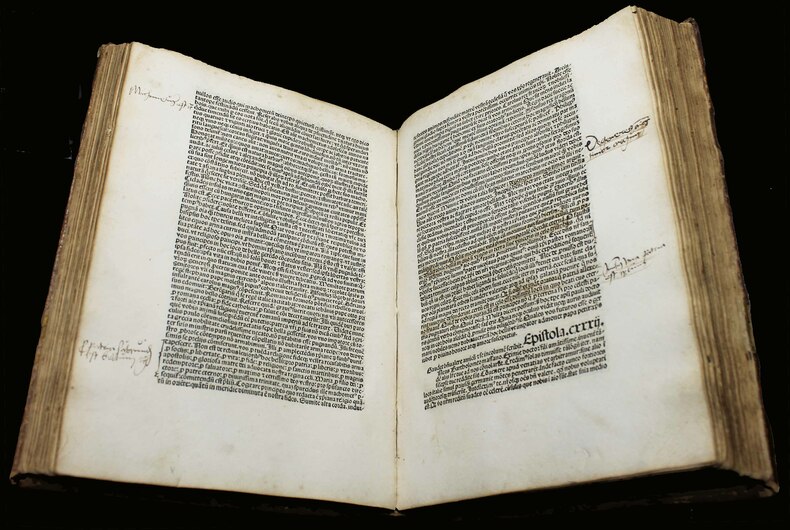
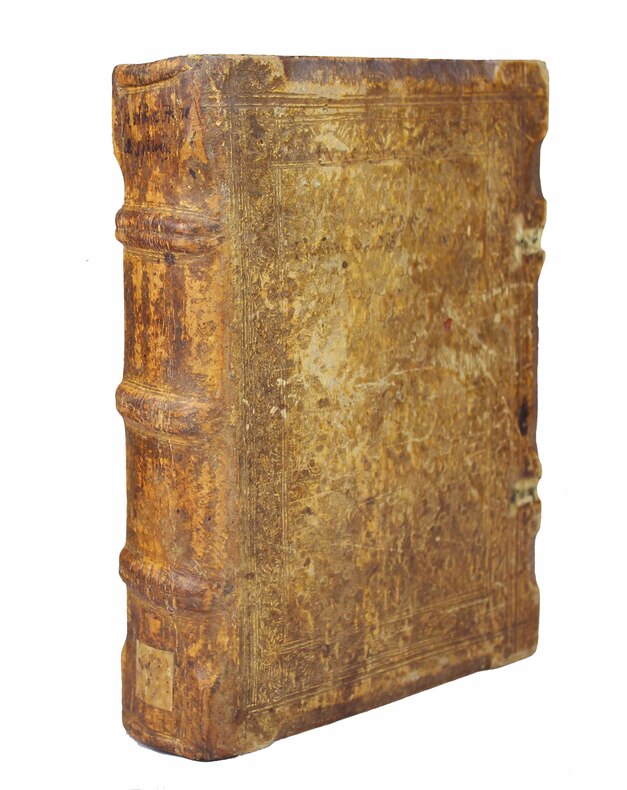
Nuremberg, Anton Koberger, 1486.
Reference : 17868
Silvio Piccolomini (1405-1464) a été l'un des humanistes les plus influents de son époque. Il a travaillé comme diplomate à Vienne et a été élu pape en 1458 sous le nom de Pie II. La plupart de ces lettres abordent des sujets profanes. La lettre 114 est son "Histoire des deux amants", "Hystoria de Eurialo & Lucretia se amantibus", un roman "érotique" rédigé avant qu'il ne devienne Pape. Plusieurs lettres traitent des événements en Hongrie, en Bohème et en Turquie. Pie II avait appelé à la croisade contre les Turcs qui venaient de s'emparer de Constantinople (1453). On y trouve aussi une description de Vienne. La préface est de Nikolaus von Wyle. Un des adages favoris de cet humaniste était : "L'avare nest jamais satisfait de son argent, ni le sage de son savoir". Ex libris manuscrit au feuillet b1 daté Nuremberg, 1515. La même main a ajouté des notes dans les marges, plus particulièrement en marge de "Hystoria de Eurialo & Lucretia". Il manque le feuillet blanc a1. Galerie de vers dans la marge du dernier feuillet sans atteinte au texte. Les liens d'attache manquent, les plats sont frottés, le dos discrètement restauré. Très bel exemplaire dans sa première reliure. /// In-4 de (245) ff. Peau de truie estampée sur ais de bois. (Reliure de l'époque.) //// Silvio Piccolomini (1405-1464) was one of his time's most influential humanists, worked as a diplomat in Vienna and later became pope Pius II. His letters are a rich source of knowledge about the Renaissance in Europe. "Pius II, regarded as a man and not merely as an historical personage, is the most interesting of all the successors of St. Peter". These letters contain amongst others the best selling "Hystoria de Eurialo & Lucretia se amantibus". and "A Tale of Two Lovers", one of the earliest erotic novel - written before he became Pope! - as well as a description of Vienna. Without the blank folio a1. Worming on the interior margin of the last folio. Manuscript ex libris on folio b1 dated Nuremberg, 1515. The same hand has added notes in the margins, most notably along "Hystoria de Eurialo & Lucretia". The ties of the binding are missing, the boards are rubbed, the spine discreetly restored. A very fine copy, contemporary bound in stamped pigskin on wooden boards. ISTC ip00719000. Goff P-719. BMC II, 430. GW M33695.
Bookseller's contact details
Hugues de Latude
Hugues de Latude
06 09 57 17 07
Payment mode


Sale conditions
Books are guaranteed to be complete and in good condition unless otherwise stated.
5 book(s) with the same title
- Orationum volumen Primum- Orationum volumen Secundum.- Epistolae familiares- Pauli Manutii scholia.- Epistolae ad Atticum, ad Brutum, ad Quintum fratrem- Pauli Manutii in Epistola- Philosophia Prima Pars- De Philosophia volumen secundum
Parisiis Ex officina Roberti Stephani, typographi Regii 1543 velin souple poli ivoire à grand recouvrement, tr. dor., titres à l'encre, exemplaires réglés, restes de lies en soie verte. 7 tomes en 6 vol. in-8, T.II. (4ff.), 656pp. ; T III. 539pp. ; TIV. 510pp., (9ff.) et (36ff. - marque au dernier) ; T VI. 649pp., (19ff.) et (20ff.) TVII. 496pp. et T VIII 404pp. (2ff.) (24ff.) T IX 249pp. et (3ff.)
7 tomes en 6 volumes sur les 9 que doit comporter cette belle édition de Robert Estienne.Renouard :" Cette estimable édition est la première dans laquelle Robert Estienne ait fait usage de son bel italique executé à l'image de celui d'Alde ' Characteribus elegantibus Italicos Aldi Manutii characteres proxime referentibus ' Il y a joint les diverses scholies des éditions manutiennes. On trouve dans des catalogues des parties séparées et complètes en elles-mêmes".- Updike: Printing Types. I, pp. 234-5 & 290: "His Italic he based, he admits, on the Aldine italic, and on examination there is a certain similarity, although it is much freer in effect, owing, among other things, to its sloping capitals. Garamond is nearer to Aldus in his italic than he is to Jenson in his roman. (...) a delightful unconventionality of design - free and spirited, yet noble; full of contrast and movement, yet with elegance and precision of line that marks them as French." - Ex-libris de Marillac, parisien (XVIe). Au dernier f. du tome IX un quatrain ambigu :" Quatre garçons madame furent nez" Le plus petit l'ausmone vous demande" Les deux moyens sont par mort terminez" Mais le grand vit je le vous recommande ".Sur un autre volume "Je vy sans Vve"autre ex-libris' A Paris Duhazé'.La reliure est particulierement attachante, non qu'elle soit esthétiquement exceptionnelle, mais les grands recouvrements cachant presque complètement les tranches, le poli vieil ivoire du velin, la fraicheur du papier, en font de beaux objets humanistes, si l'on nous pardonne cette audace.
Epistolae familiares.
Prague, Imprimerie de l'Université Charles-Ferdinand [= Univerzita Karlova], 1753 petit in-8, [6] ff. n. ch. (titre noir et rouge, dédicace, préface, table), 292 pp., basane fauve granitée, dos à nerfs cloisonné et fleuronné, encadrement de simple filet à froid sur les plats, tranches rouges (reliure de l'époque). Manque la pièce de titre, coiffes légèrement rognée, coins abîmés.
Rare petite édition pragoise qui réunit 186 lettres du théologien jésuite. La première édition en avait été donnée en 1650 par son biographe Giacomo Fuligatto.Un seul exemplaire de cette édition au CCF (Facultés Loyola).Vignette ex-libris de la bibliothèque prévôtale de Csorna [abbaye de Prémontrés dans la ville de Csorna, en Hongrie].Ex-libris manuscrit Gabriel Keszler daté de 1827. - - ACTUELLEMENT EN CONGÉS, DE RETOUR LE 17 AOÛT - VENTE PAR CORRESPONDANCE UNIQUEMENT - LIEN DE PAIEMENT, NOUS CONSULTER.


Cicéron epistolae ad familiares - notice sur un mansucrit du XIIe siècle par Charles Thurot
A. Franck 1874 49 pages in8. 1874. Broché. 49 pages. Bibliothèque de l'école des hautes études - sciences philologiques et historiques - 17e fascicule Cicéron epistolae ad familiares
sous papier de soie intérieur taché de rousseurs marquées
[Apud Dionysium Thierry, et Viduam Simonis Benard] - CICERO, Marcus Tullius ; [ CICERON ]
Reference : 44532
(1685)
M. T. Ciceronis ad Familiares Epistolae. Interpretatione & Notis illustravit Philibertus Quartier è Societate Jesu, jussi Christinissimi Regis in Usum Serenissimi Delphini.
1 vol. in-4 reliure de l'époque pleine veau larbré, dos à 5 nerfs orné (fleurons), Apud Dionysium Thierry, et Viduam Simonis Benard, Paris, 1685, 5 ff. n. ch. (dont frontispice), xxxiv pp., 2 ff. [f. Ccciij et f. iij en double], 614 pp.
Agréable exemplaire de cette belle édition des lettres de Cicéron "ad usum delphini" (qq. piq. de vers au dos, petits mq. de cuir en coupes et un petit mq. en mors, coiffes frottées, qq. rouss. mais bon état intérieur).
"Opera D. Leonis Magni, Romani Pontificis , Eius Nominis Primi , Per Canonicos Regulares sancti Martini oppidi & Universitatis Lovaniensis , ex manuscriptis codicibus emendata. Cum Indicibus novis. [Bound with] Idem Epistolae decretales ac familiares, a mendis & maculis variis nunc diligentius repurgatae; per canonicos regulares sancti Martini oppidi & academiae Lovaniensis."
"15. [1] Lovanii (Leuven), apud Hieronymum VVellaeum, ad intersigne Diamantis, execudebat Ioannes Masius 1575 (colophon), 1577, in-8°, (16)nn pp (title with woodengraved printer's mark) + 432 pp + (48)nn pp . (complete). USTC 412655. [2] Lovanii (Leuven), apud Hieronymum VVellaeum, ad intersigne Diamantis, execudebat Ioannes Masius 1575 (colophon), 1575, in-8°, pp. 471(error=371) + (13)nn pp (of which three last - aa7v , aa8r, aa8v- are blank). (complete). USTC 406280. Bound in a somewhat later (17th c. French ?) binding, full calf, triple fillets on both covers, raised gilt spine, edges red spickeld, marbled endpapers. Nice copy although with some wear at extremities and with the upper joint broken. Without any provenance indication. Rare collection of two works by Pope St. Leo I ( the Great) who reigned from 440 - 4461. Together with St. Gregory I it is the only pope to have ''the Great'' added to his name. A first edition of his works was published in Rome by Ardicinio della Porta in 1470. These 2 works edited by theologians of Louvain University are rare. Title [1] lists only with 3 copies (Cambridge- two colleges ; Louvain); title [2] 4 copies (not in a Belgian library)."

