Write to the booksellers
Uris Léon
Q.b.7
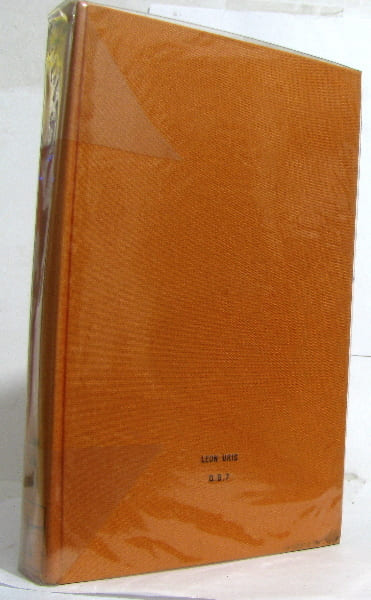
Le club français du livre 1971 445 pages in8. 1971. Relié. 445 pages.
Reference : 283326
Etat Correct sans jaquette recouvert aspect tranche légèrement sali
Bookseller's contact details
Un Autre Monde
M. Emmanuel Arnaiz
07.69.73.87.31
Payment mode
Sale conditions
Conformes aux usages de la librairie ancienne.
5 book(s) with the same title
Dickson Hung: Interior Design + Life and art. - [INTERIOR DESIGN - IN AN UNUSUAL DOUBLE-BINDING]
Hinge Marketing Ltd., Hong Kong, 2014 286x286. 2 volumes, in one original fold-out binding, the joint boards covered in illustrated cloth with printed photography. The other baords and the spine original paper-covered in gren and red. Signature in gold ink to front flyleaf. 196 + 195 pp.
Exclusive signed edition of this unusual work on interior design and artwork of Dickson Hung. Bilingual edition in English and Chinese. Mr. Hung is part of China's first generation of interior designers, witnessing the rise of the industry, and is a pioneer in exploring the development of Chinese design art. After two decades in the field of interior design, Dickson Hung founded Dickson Hung Design Consultants in 2001, and in 2008, he set up DHA / DHO International Design Alliance in order to enhance global cooperation between designers.In 2018, DHO won a prize from the prestigious A' Design Award & Competition for the project ""Long Park Phase II 3C-B Show Flat"". The first volume comprises photographs of his interior design projects, such as hotels and office spaces, while the second volume includes photographs of his artworks and impressive photography from his travels in Nepal and Tibet, amongst other countries. Throughout the books there is explanatory and inspirational text, with quotes from famous figures such as Michelangelo, Matisse, Rodin, Cézanne, Francis Bacon... As Mr. Hung writes, ""the designer is a tailor, tailoring the space from whole to parts, and combining and repeatedly studying, eventually creating an elegant and comfortable living environment"" (p.130, volume 1).

Jugendleben und Träume eines Italienischen Dichters. - [THE FIRST GERMAN TRANSLATION OF ANDERSEN]
Hamburg, August Campe, 1835. 12mo. Contemporary half calf with richly gilt spine and gilt lines to boards. Spine with wear and some internal brownspotting, otherwise clean and neat. X, 320, (2) pp. Owner's signature to front free end-paper: Julie Carstens 1852.
The very rare first edition of the first German translation of Andersen's first novel, Improvisatoren – the first of Andersen's books to be translated into any foreign language. It is fair to say that no other translation before or after was as important to Andersen as the present. Although not immediately recognizable from the lengthy title, this is in fact the first German translation of Andersen's first novel Improvisatoren, which is considered Andersen's third debut. It appears almost simultaneously with the Danish edition and must have been under preparation at the same time. Improvisatoren is considered one of the most perfect works by Andersen and the work that seriously made him famous, especially in Europe, where he first and foremost came to be known as an eminent author of novels. With his great first novel, Andersen paves the way for the new modern genre of the novel and places himself at the very front of this literary movement. In fact, this novel is perceived to be the first Danish bildungsroman. Improvisatoren also constitutes Andersen's efforts throughout the 30'es to write in a picturesque manner. He is extremely proud to proclaim that due to his novel, his German translator, ""Professor Kruse [...] says that I am the greatest painter and Ørsted says that I should have the brush as well as the pen."" (Letter to Henriette Wulff, March 16, 1835). Andersen is extremely occupied with the novel, in both Danish and German, and focuses greatly upon its reception in both countries. To his extreme joy, Improvisatoren is tremendously well received, and Andersen can hardly believe his success. ""People adore Improvisatoren, everything I say and speak they find terrific, everything I utter an urge for they give me. They ask me what dishes I would like, if I want to drive on trips. You can very well believe that Oehlenschläger at his Prince is not being flattered more than me. It is the first time that I feel the comfort of being a poet."" (Letter to Edvard Collin 5 Juli 1835). Later in the same letter, he asks Collin if he has heard about the German translation and what impressions that is making: ""I long to hear what kind of impression it is making on the Germans."" Before the appearance of the work, Andersen is extremely anxious and extremely occupied with the German translation: ""I so hope it will bring me joy! To hear that it is successful, nothing can be more encouraging, more soothing for my soul and spirit, in that chapter I am very much like my Antonio. You cannot believe how I long to see your translation. It will be ready for the Easter fair, I assume?"" (Letter to Kruse (the translator), April 8, 1835). Later in April 1835, he writes to Henriette Wulff: ""My novel Improvisatoren has now been published in Danish and is being published in German as I write…. Never before has any work by me caught the masses so vividly [...] I am 'on a wave'" but my heart is full of gratitude towards the good God" from him I feel that it is all a gift, a blessing, he has allowed to flow through my soul."" (Letter to Henriette Wulff, April 29, 1835). Before the work even appeared, Andersen had a list of recipients for the German translation. Among these was Adelbert von Chamisso (1781-1838), to whom he wrote in April 1835: ""Here I send you my Italian son"" he speaks the German language, so your family can also understand him. I wish that in the great Germany people will be aware of my book and that I may deserve that awareness. That Kruse is introducing me as an author of novels should be somewhat of a recommendation. [...] For making such an effort of being known outside of little Denmark, I think I cannot be blamed."" According to Möller-Christensen (1993), there was an interaction between the author, his biography and his work – Möller-Christensen calls this interplay ""the golden triangle"" – which resulted in the emergence of a myth early on, influencing and promoting the reception of his work in Germany. Biographical information supported the translated work, and, at the same time, the author consciously made himself available to the media via contacts in the literary world (Möller-Christensen 1991, see also Jørgensen 1996). Indeed, there was, and still is, an “effective synergy between Andersen’s life and work, which continues to influence the dissemination of his works” (Thomsen 2025: 15). Furthermore, the national recognition of Andersen’s work “was fostered by its international circulation rather than the reverse"" (Thomsen 2025: 8). This German translation was the foundation for Andersen's international (and even national) reputation and paved the way for further translations. It was through Andersen’s growing popularity in Germany in the early 1840’s that an interest was ignited in France (Thomsen 2025: 2). The first English translation ""The Improvisatore"" or Life in Italy"" (1845), by Mary Howitt, was based on the German translation (Jørgensen 1996: 18). After the first English translation, Andersen attended a party in England, where he met Charles Dickens, to whom the English translation was already known. According to Paul Binding, some key features in Dickens' David Copperfield (1849-50) can be traced back to Andersen's first novel (Binding 2014). Together with two other novels, (""Only a Fiddler"" and ""O.T."" or, Life in Denmark""), it was part of the late romantic era in Germany, where it was “assessed in light of a contemporary literary discussion […] about the legacy of Romanticism and the new experience of fragmentation associated with modernity.” (Thomsen 2025: 9). It was both criticized for failing “in its romantic project and ended up emphasizing division” and “also praised for not adhering to an exhausted romanticism” (Thomsen 2025: 10). At the same time. in England, the realistic features of Andersen’s writing were highly prioritized. (Thomsen 2025, Jørgensen 1996) Binding, Paul. (2014, 1 January). Reflections after writing – Hans Christian Andersen: European Witness. Museum Odense. https://museumodense.dk/udgivelser/reflections-after-writing-hans-christian-andersen-european-witness/ Jørgensen, Aage (1996). H. C. Andersen i Europas Spejl. zusammenfassung: H. C. Andersen im Spiegel Europas. In Niels Oxenwad (ed.), Andersiana. pp. 5-40. H. C. Andersens Hus, Odense. Möller-Christensen, Ivy York (1993). H. C. Andersens gennembrud i Tyskland. In Johan de Mylius, Aage Jørgensen & Viggo Hjørnager Pedersen (ed.), Andersen og Verden. Indlæg fra den første internationale H. C. Andersen-konference, 25.-31. august 1991. pp. 321-28. H. C. Andersen-Centret, Odense Universitet. Odense Universitetsforlag, Odense. Thomsen, T. B. (2025). Andersen Abroad: Literary Circulation in Nineteenth-Century Europe. Journal of World Literature, 10(2), 193-212. Article 3. https://doi.org/10.1163/24056480-01002003
Ved min Velgører Provst Gutfelds Død. [In: Den Vest-Siællandske Avis eller Slagelse Ugeblad for uden- og inden-landske Historie og Dagens vigtigste Nyheder. Redigeret af Pastor og Ridder Bastholm, Trykt og Forlagt af Peter Magnus. No. 9, 9de Aarg. Løv... - [ANDERSEN'S THIRD PUBLICATION - EXTREMELY RARE]
Slagelse, 1823. 4to. Contemporary turquoise cardboard binding with contemporary handwritten title to spine. The poem is found on column 145. All the issues are numbered continuously throughout: 1676 columns (i.e. 838 pp.). All issues with the same contemporary owner's signature to top of first leaf: ""Neergaard"". An excellent copy.
The extremely rare first printing of the 1823-issues of this slightly obscure newspaper, which contains Hans Christian Andersen's third publication. This exceedingly rare piece of Anderseniana was published, when the master of the fairy tale genre was merely 17 years old, namely in February 1823. Hans Christian Andersen constitutes the greatest Danish author ever to have lived, arguably the greatest author of children's literature in the world, the founder of the fairy tale-genre and one of the most famous authors of all time. He almost singlehandedly put Denmark on the literary world map and gave to mankind a completely new way of writing and viewing the world. However, his road to fame was not straightforward and presumably, no one who made the acquaintance of the awkward and poor teenage Hans Christian Andersen would have predicted the role he came to play in the development of world literature. The present publication constitutes one of the two pieces of publication that are at the epicentre of the coming-to-be of the greatest poet and author to emerge from Danish soil. This little piece is a heartfelt, almost perfectly stylized poem that constitutes an obituary of Hans Christian Andersen's early benefactor, provost Gutfeld (1761-1823), who was responsible for Collin accepting to be Andersen's benefactor. It was due to Gutfeld and his belief in Andersen that he made it on into the world and was taken seriously enough – at the mere age of 17 – to later be allowed to follow his heart and his life dream – that of writing. ""As a poor child in the small but self-satisfied provincial centre of Odense, Andersen received throughout the first 14 years of his life impressions and experiences that were to be decisive for his literary production. In the autobiography of his youth, ""Levnedsbogen"" (not published till 1926), Andersen emphasised that the way of life in Odense had preserved popular old customs and superstitions unknown in Copenhagen and therefore available to him as a colourful stimulus to his imagination. However, even more decisive were the disturbing social experiences from the lowest ranks of society and his own urge to cast off the trammels of poverty, break with his social inheritance and realise his potential in the only outlet the times provided, the world of art, an urge that became ever more dominant throughout his childhood [...] A decisive factor that determined the direction of Hans Christian Andersen's life and his fantastic flight to Copenhagen in 1819, with the social and literary rise that followed, is the fact that, as the only town outside the capital, Odense had a theatre. [...] He left home as a 14-year-old 4 September 1819, a few months after his confirmation, to seek his fortune at the theatre in Copenhagen. [...] During Andersen's first years in Copenhagen (1819-22), he fought desperately to gain a foothold in the theatre as a ballet-dancer, actor or singer. Finally, when none of these attempts succeeded, he tried his hand as a playwright"" this was also in vain, but resulted in the director's deciding to send him to school so that something proper might be made of him, and this experience was thus as decisive for his later life and work as the Odense years."" (The Biography of the Hans Christian Andersen Centre). It was here, in Copenhagen, during the early theatre years, after he'd been cast aside as an actor, cast aside as a dancer, and cast aside as a singer that he wrote his play ""Alfsol"", which he handed in to the theatre in order to have it accepted for performance. But that too was cast aside, with the explanation that the author lacked all forms of education and had clearly never learned to write properly. Dean Gutfeld, however, had gotten to know Andersen and saw the potential in the young boy. Therefore, Gutfeld had spoken well of the uneducated boy and asked the theatre director Collin to look mercifully at it. ""[A] well liked speaker, Dean Gutfeld was alive then and was the one person that spoke most warmly and enthusiastically about my tragedy, which had now been completed. He sent it with a recommendation to the theatre direction and I was floating between hope and fear."" (own translation from Danish in Andersen: Mit Eget Eventyr. Uden Digtning, edt. Topsøe-Jensen, 1942, p. 46). Collin still refused the play, but it was this act of Gutfeld's that made Collin take an interest in Andersen and made him take him under his wings – if any, THE decisive moment in Andesen's life. Collin arranged that, at the expenses of the King, Andersen was sent to Slagelse Latinskole to get proper training and education. In the fall of 1822, Andersen left Copenhagen to go to Slagelse. From then on and throughout the rest of his life, Collin was his benefactor in all aspects of his life. Andersen came to consider him the closest to a father that he had, Collin's home became Andersen's home, and Collin's children his siblings and closest friends throughout his life. But Collin wanted Andersen to study and to learn properly before writing more poetry: ""Collin had mildly and friendly mentioned to me that he wished that during my school years I would not write too many verses"" that became a case of consciousness for me, an outright sin. That first year, I wrote merely one poem – for Gutfeld, who had died. I owed him a lot and I loved the man. The poem was published, without my name, in Slagelse Avis, and this is how Reverend Bastholm came to know me. I lent him my ""Alfsol"" [i.e. Andersen's first publication that was refused by Collin, but which he himself had procured money to publish a few months earlier], he wrote me a friendly letter, in which he encouraged me to study and thus more and more educate my poetic inclination."" (own translation from Danish, in: Andersen: Levnetsbog, edt. Hans Brix, 1926, p. 84). ""Hans Christian was virtually ordered to refrain from writing poetry or engaging in competitions at school until he was certain of his studies in language, grammar, and spelling."" (Jean Hersholt, Catalogue of the Collection of Hans Chritsian Andersen). Thus, only the circumstance of his love for Gutfeld and the gratitude he felt to him for having changed his life by making Collin take him under his wings, made Andersen commit the ""sin"" of writing poetry during school – and thus we have the exceedingly scarce third Andersen-publication, in ""Slagelse Ugeblad"", by the 17-year-old budding writer, who was so eager to write, but who otherwise had to suppress his poetic urges to please his benefactor. The publication is extremely rare and we have never seen a copy of it for sale before. Neither are we aware of any copy on private hands, and we have been able to locate only two other copies on OCLC: one in Odense and one in the Royal Library in Copenhagen. As Andersen-publications go, this is one of the two rarest and one might not come across another in one's life-time. BFN: 6. Not in Hersholt.
Fodreise fra Holmens Canal til Østpynten af Amager i Aarene 1828 og 1829. - [ANDERSEN'S ""REAL"" DEBUT]
Kjöbenhavn, 1829. 12mo. Bound with the original wrappers in a lovely slightly later burgundy red half calf with richly gilt spine and marbled covers. A few stains to wrappers and brownspotting to text. In spite of the spotting, all in all a lovely copy. 136 pp. Ex-libris on pastedown: ""Hyllested"". Glued note on the last endpaper.
The rare first edition of Hans Christian Andersen's debut novel, ""Journey on Foot"", here in the extremely scarce original printed wrappers. Andersen himself considered this book his debut and refers to it as ""my first publication"". It came to play a tremendous role in the development of his writing and constitutes one of his most important works. It is the first piece of Andersen that yields any success and the first work for which he gained any recognition. ""It is a well-known fact that Hans Christian Andersen made his début as a writer three times during his youth. The first time he published a book was in 1822, when 'Youthful Attempts' came out [...]. He was 17 years old, penniless and in need for help, but the main part of the circulation ended up in the paper mill [...] The second time he made his début was in 1829, when he published 'Journey on Foot from Holmen's Canal to the Eastern Point of Amager', a book which can hardly be classified as a travel book. To me it seems a subtle and humorous arabesque and a literary satire. This book was published in the year after he had left grammar-school and was qualifying for the entrance examination to academic studies at the university. It can rightly be regarded as a key, which enables us to understand the entire development of his later production [...]. It was Carl Bagger, his friend from the school days, who had instigated him to cultivate his inborn talent for satire, and during the same year he published 'Journey on Foot' they met regularly together with a third mate in the 'Serapionsclub' to which Andersen showed up with a piece of paper sticking out of his pocket. As a free writer it was the fantastic arabesque à la E. T. A. Hoffmann, which came into the centre of their poetic endeavour. What he had learned from Bernhard Severin Ingemann, his fatherly friend, talked about to Carl Bagger and read in Hoffmann, Jean Paul and Ludwig Tieck, he laid out in his book, which as a mixture of an autobiography in disguise and an allegorical satire contains all the basic motifs of his poetic world as a raw material."" (Kofoed) In ""The Fairy Tale of My Life"", Andersen writes: ""Having passed my examinations, the multicoloured fantasies and inventions by which I had been haunted on my walking tours back from my coach, flew like a swarm of bees out in the world in my first publication: 'Journey on Foot from Holmen's Canal to the Eastern Point of Amager', a humours, weird book, a kind of fanciful arabesque, yet perfectly indicating my whole personality and my views at that time."" ""'Journey on Foot' is a grotesque and serious satire foreseeing the deluge of letters in a mass society, and this issue is in my opinion not only superior as a motive in Andersen's first book but also an overall theme in his entire production. A kind of grotesque humour is one of the characteristics of the arabesque, and if we take a look at the collected tales we may easily sort out a series of narratives typical of the same fluttering, self-ironical and even prophetic style."" (Kofoed) See: Kofoed, Niels. (1999). ""The Arabesque and the Grotesque: Hans Christian Andersen Decomposing the World of Poetry"". In Johan de Mylius, Aage Jørgensen and Viggo Hjørnager Pedersen (ed.), Hans Christian Andersen. A Poet in Time. Papers from the Second International Hans Christian Andersen Conference 29 July to 2 August 1996. The Hans Christian Andersen Center, Odense University, Odense University Press. BFN: 22.
Eventyr fortalte for Børn. (1.-3. Hefte) + Eventyr fortalte for Børn. Ny Samling (1.-3. Hefte). 2 Bind. [I.e. Fairy Tales Told for Children. 6 issues, divided into two volumes]. - [INAUGURANTING THE FAIRY TALE-GENRE]
Kjöbenhavn, 1835-1847. Bound in two lovely perfectly matching bindings, vol. 1 in contemporary black full cloth with lovely gilding to spine, volume 2 in a perfectly matching newer pastiche-binding of full black morocco with the exact same gilding to spine as vol. 1 (i.e. with the use of the same gilding stamps). A truly lovely set that at a first glance looks completely uniform (although vol. 2 is slighty larger in size). Light occasional brownspotting. See collation below.
A lovely set of this exceedingly rare collection of Andersen's earliest fairy tales. This legendary fairy tale-collection, which created the fairy tale genre and brought Andersen international fame, consists in six parts that together make up two volumes. As with most of the other few existing copies, the present set is a mixture of issues and likewise has certain wants concerning title pages, half-titles and tables of contents. ""With the passing of each year, Andersen's genius brought forth new ‘wonder stories’, and the fame he had so desperately craved and striven for became a reality. Little did he know in the spring of 1835, when he all but had to beg his publisher to accept these remarkable tales, that one day they would make him immortal. And little did the critics, nearly all of whom advised him to give up his ‘experiment’ and devote himself to his other writings, ever dream that they would live to see him gain world acclaim for these tales. For almost a hundred years now, generation after generation has been brought up on Andersen's stories. Take the English-speaking world, for instance. Since the first appearance of Andersen's Fairy Tales in London and New York, in 1846, over seven hundred different editions, including dozens of varied translations, illustrated by more than a hundred different artists, have been published in the United States alone. Indeed, Andersen's stories will live on as classics – as much part of our civilization as the two primary educational factors, reading and writing."" (Jean Hersholt, p. 27). The six little pamphlets together, printed in different years, all have their own title pages, half-titles, contents, etc. and the volumes where they are bound together (two volumes of three pamphlets each) have their own title pages, half-titles and contents at the beginning. Therefore, the book binders almost always removed several of the ""extra"" leaves in the individual pamphlets, as they seemed superfluous in a collected binding. It was never the intention of the publisher that the single half-titles, title pages or tables of contents be preserved. However, due to the many different leaves that were deemed ""superfluous"" or not, all existing sets of these two little volumes have their individual mix-up of half-titles, titles, and table of contents. Thus, no copies are known to exist with all leaves present. In some cases, like ours, some of the leaves have been supplied in facsimiles. In our case, most of the facsimiles are of such high quality that it is very difficult to determine that they are in fact facsimiles. ""During Andersen's lifetime 162 of his Fairy Tales were published, but the scarcest and most difficult to obtain are these six little pamphlets. We do not know exactly how many, or how few, copies were printed, but we do know that no copy with all the title pages and tables of contents has ever been offered for sale by any dealer or at any auction. To my knowledge, only five or six complete copies of the first printings (1835-1842) still exist. Even the second printing of the six pamphlets in their entirety (1842-1847) is exceedingly scarce and difficult to obtain."" (Jean Hersholt). Here follows a collation including mention of issues, lacunae, and facsimiles: Vol. I: VIII, (2) pp. (complete - being: Joint half-title (""Eventyr for Børn""), joint title page (dated 1837) for the three parts, preface (""Til de ældre Læsere""), Contents-leaf for all three parts). DUE TO THE PRESENT LEAVES BEING BOUND IN, THE SEPARATE HALF-TITLES, TITLES, AND CONTENTS-LEAVES WOULD NOT BE EXPECTED TO BE BOUND IN, AS THESE 8 LEAVES SUBSTITUTE THOSE FOR THE SEPARATE ISSUES. Thus, the leaves supplied in facsimile are to be considered extra. First Part: Half-title and title page supplied in facsimile. 61 pp. No table of contents (as the joint table of contents is present at the beginning). Second issue, 1842. Second Part: Half-title and title page supplied in facsimile. 76 pp. No table of contents. First, 1835. Third Part: Half-title and title page supplied in facsimile, 60 pp. No table of contents. First issue, 1837. Vol. II: 3 leaves supplied in what we suppose are facsimiles (it is very difficult to determine): Joint title page, dedication-leaf (for Mrs. Heiberg), contents-leaf for all three parts. First Part: Half-title, title page, 58 pp. and table of contents. Second issue, 1846. Second Part: (no half-title present), title page, 53pp. (pp.47-48 in facsimile) and table of contents. Second issue, 1847. Third Part: (no half-title present), title page, 49 pp., (no table of contents present). Second issue, 1847. BFN: 266" Hersholt: 23 PMM: 299.