Write to the booksellers
Pierre Loti
Jérusalem
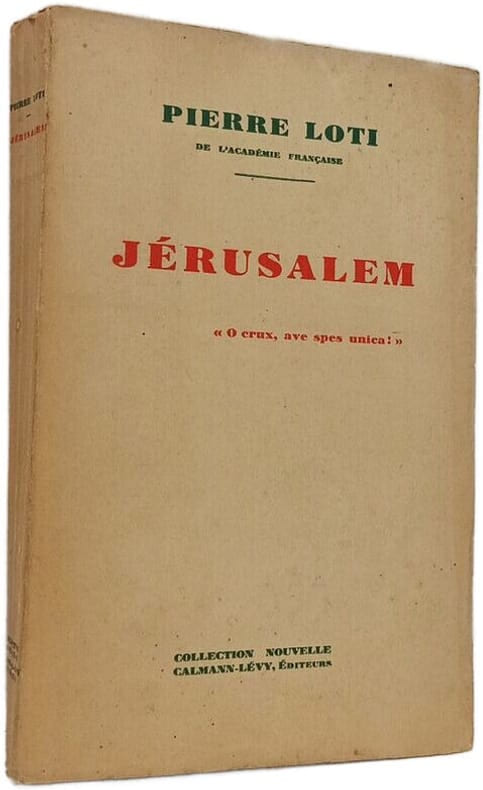
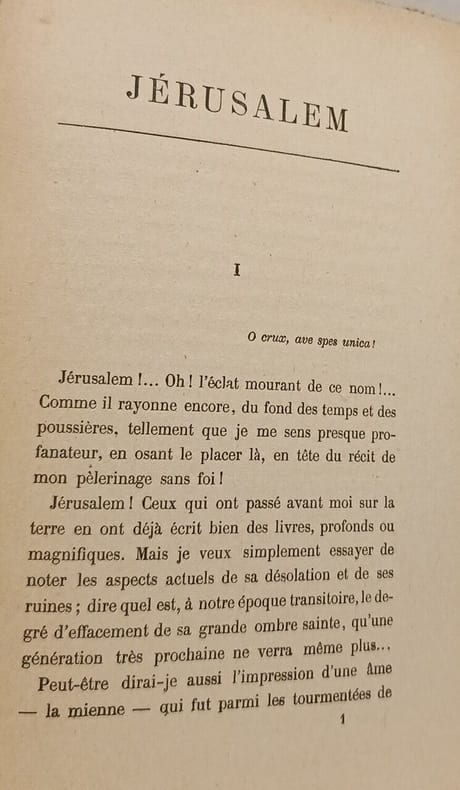
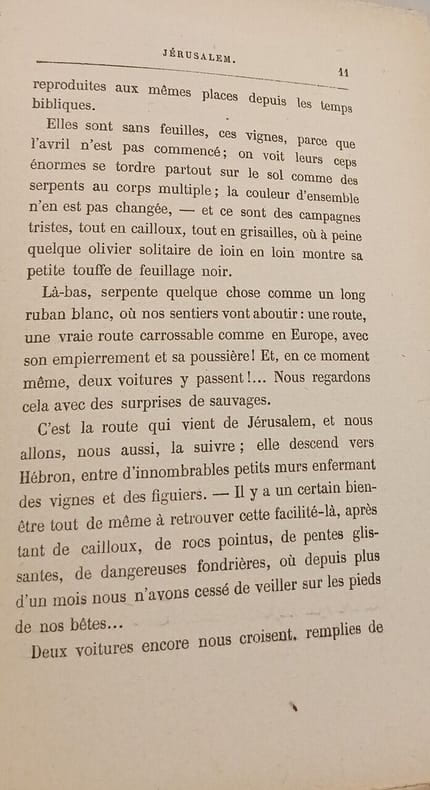
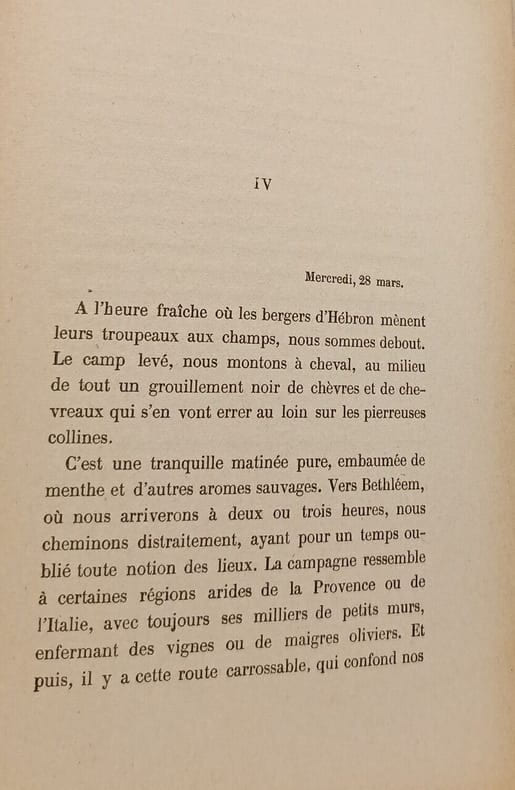
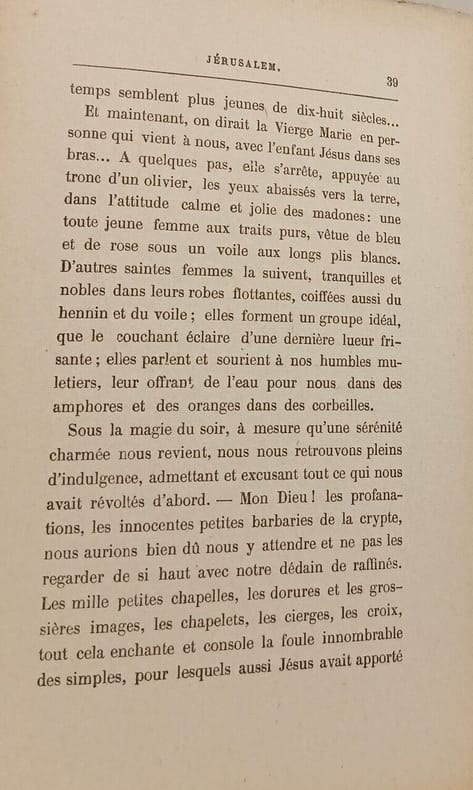
Calmann-lévy in12. Sans date. Broché. En 1894 Pierre Loti écrivain athée mais en proie à une inquiétude religieuse entreprend un voyage en Terre sainte. Son récit 'Jérusalem' (1895) est un journal de voyage introspectif et désabusé décrivant une ville sainte dont il perçoit la désolation les ruines et la perte d'aura sacrée face à la modernité. Il s'agit d'une œuvre à la fois personnelle et historique mêlant impressions de voyage et confrontation aux propres doutes spirituels de l'auteur
Reference : 100148200
Bon état Pages non coupées couverture et pages jaunies intérieur propre
Bookseller's contact details
Un Autre Monde
M. Emmanuel Arnaiz
07.69.73.87.31
Payment mode
Sale conditions
Conformes aux usages de la librairie ancienne.
5 book(s) with the same title
ATALA. ITINERAIRE DE PARIS A JERUSALEM PAR M. LE VICOMTE DE CHATEAUBRIAND, PAIR DE FRANCE, MEMBRE DE L’ACADEMIE FRANCOISE.
PARIS. LEFEVRE, LIBRAIRE-EDITEUR. LADVOCAT, EDITEUR. 1829-1830. 3 VOLUMES IN-8 (15 X 22,5 X 18 CENTIMETRES ENVIRON) RELIURE D'EPOQUE 1/2 VEAU ROUGE A COINS SOULIGNEE D’UN FILET DORE, DOS LISSE ORNE D'UN ELEGANT DECOR ROMANTIQUE A FROID ET DORE, TITRE DORE SUR ETIQUETTE MAROQUIN VERT, TRANCHES MARBREES. COMPREND :- ATALA. RENE. LES AVENTURES DU DERNIER ABENCERAGE. 1830. (4) + XXIV ET 376 PAGES. ILLUSTRE DE 4 GRAVURES SUR ACIER, DONT UNE EN FRONTISPICE, GRAVEES PAR BURDET D’APRES ALAUX.- ITINERAIRE DE PARIS A JERUSALEM, ET DE JERUSALEM A PARIS. 1829. 2 VOLUMES DE (4) + CLX + 350 ET (4) + 411 PAGES. ILLUSTRE D’UNE CARTE DE L’ITINERAIRE REPLIEE. «DE CETTE RANDONNEE MEDITERRANEENNE QUI NE FUT NI SANS CHARMES NI SANS PERILS, L'ITINERAIRE OFFRE UNE RELATION OU LES NOTATIONS PITTORESQUES LE DISPUTENT AUX REFLEXIONS HISTORIQUES ET AUX MEDITATIONS PHILOSOPHIQUES. DERRIERE LES TABLEAUX SOMPTUEUX DE L'ACROPOLE RAYONNANTE, DE LA TRISTESSE DE JERUSALEM ET D'ALEXANDRIE, DES DEBRIS DE SPARTE OU DE CARTHAGE, S'IMPOSE ENCORE UNE FOIS LE SENTIMENT D'UNE SENSIBILITE EXCEPTIONNELLE AUX GRANDS MOUVEMENTS DE L'HISTOIRE». (D. RINCE).QUELQUES PETITS DEFAUTS EXTERIEURS, SINON BEL EXEMPLAIRE DANS UNE JOILE RELIURE STRICTEMENT CONTEMPORAINE.
Jérusalem délivrée, poème Du Tasse-Tomes I et II.
Paris, J.-B.-G. Musier, fils, Libraire, 1774 ; in-12, 6-380 pp. + frontispice, 2-376 pp., reliures d'époque demi cuir, dos lisse orné (dos en mauvais état) pièce de titre bordeaux. Traduction nouvelle par Charles-François Lebrun, troisième consul, duc de Plaisance…Torquato Tasso, dit le Tasse, célèbre poète italien de la Renaissance, naquit en 1544 à Sorrente et mourut en 1595 à Rome. Il publia de nombreux ouvrages. Il est intéressant de noter que ce poème italien, la Jérusalem délivrée (1575) se trouve facilement, alors que son pendant, la Jérusalem conquise (1593) est quasiment introuvable en édition moderne ou ancienne. Il s’agit pour le présent volume d’une nouvelle traduction, rédigée en 1581, récit de la Première Croisade, durant laquelle les chrétiens menés par Godefroi de Bouillon réussirent à prendre Jérusalem aux musulmans. Bon état.
Jérusalem délivrée, poème Du Tasse-Tome I et II.
Paris, Musier Fils, 1774 ; grand in-8, 2-VIII-342 pp. + 12 pl. hors-texte, 2-VI-332 pp. + 13 pl. hors-texte, reliure d'époque demi-cuir, dos lisse orné, pièces de titre et de tomaison, (manque sur le vol. 2) plats en veau restaurés, ornés de filets, avec pages de garde à motif queue de paon, tranches dorées (traces de mouillures). Nouvelle traduction par Charles-François Lebrun, troisième consul, duc de Plaisance…. Torquato Tasso, dit le Tasse, célèbre poète italien de la Renaissance, naquit en 1544 à Sorrente et mourut en 1595 à Rome. Il publia de nombreux ouvrages. Il est intéressant de noter que ce poème italien, la Jérusalem délivrée (1575) se trouve facilement, alors que son pendant, la Jérusalem conquise (1593) est quasiment introuvable en édition moderne ou ancienne. Il s’agit pour le présent volume d’une nouvelle traduction, rédigée en 1581, récit de la Première Croisade, durant laquelle les chrétiens menés par Godefroi de Bouillon réussirent à prendre Jérusalem aux musulmans. Illustré par de nombreuses gravures en taille-douce. Bon état.
La Jérusalem délivrée, traduction nouvelle et en prose.
Paris, J. Mallet & Cie, Éditeurs, 1841 ; in-4 (184 x 271 mm), 8-XX-528 pp. + frontispice et 19 pl. sous serpente hors-texte, reliure demi-cuir, coloris vert noir, dos orné de caissons estampés à 4 nerfs, tête jaspée (coins usés, quelques rousseurs). Augmentée d'une description de Jérusalem, par M. de LAMARTINE, de l'Académie française. Très nombreuses illustrations en noir et blanc, in et hors-texte (illustrations de MM. BARON et C. NANTEUIL.
From Topography to Text: The Image of Jerusalem in the Writings of Eucherius, Adomnán and Bede
, Brepols, 2019 Paperback, xxiv + 262 pages, Size:156 x 234 mm, Illustrations:11 b/w, 10 tables b/w., 3 maps b/w, Language: English. ISBN 9782503580753.
Summary From Topography to Text: The Image of Jerusalem in the Writings of Eucherius, Adomnán and Bede uses topographical detail to examine the source material, religious imagination and the image of Jerusalem in three related Latin texts from the fifth, seventh and eighth centuries. The work introduces an original methodology for analyzing the Jerusalem pilgrim texts, defined by their core interest in the commemorative topography of the Christian holy places. By newly identifying the topographical material in Adomnán's description of Jerusalem, the study exposes key distortions in the text, its exclusive intramural focus on the Holy Sepulchre and the eschatological image of New Jerusalem that emerges from its description of contemporary Jerusalem. The study verifies the post-Byzantine provenance of Adomnán's topographical material, namely, the oral report of Arculf, thus redressing scholarly ambivalence regarding Adomnán's contemporary source. The new insights into Adomnán's De locis sanctis, including its mental map of Jerusalem, provide a template with which to analyze the text's relationship with the writings of Eucherius and Bede. While Bede's De locis sanctis has commonly been regarded as an epitome of Adomnán's work, when the sequence, structure and images of the texts are compared, Eucherius not Adomnán is, for Bede, the authoritative text. From Topography to Text offers a significant discussion on the Jerusalem pilgrim texts and the Christian topography of the Holy City, while analyzing the image of Jerusalem in the writings of three remote authors who never set foot in the city. TABLE OF CONTENTS 1. Introduction 2. The Jerusalem Pilgrim Texts 2.1. Premises 2.2. A Topographical Methodology 2.2.a. The Four Components of Topographical Descriptions 2.2.a.1. Commemoration 2.2.a.2. Location 2.2.a.2.a. Duplicate and Translated Sites 2.2.a.2.b. Biblical Descriptions of Location 2.2.a.3. Appearance 2.2.a.4. Sequence 2.2.a.5. Applying the Four-Fold Methodology 2.2.b. Topographical Templates 2.2.c. Commemorative Credibility 2.2.d. Religious Imagination 2.3. Assessing Textual Images of Jerusalem 2.4. Summary 3. Eucherius' Letter to Faustus 3.1. The Name of Jerusalem 3.2. Mount Sion 3.3. The Holy Sepulchre 3.4. The Temple 3.5. The Pool of Bethesda and the Spring of Siloam 3.6. Extramural Jerusalem 3.7. Eucherius' Image of Jerusalem 3.8. Format and Sources 4. Adomnán's De locis sanctis 4.1. Approaches and Premises 4.1.a. Adls as Pilgrim Text 4.1.b. The Internal Witness of Adls 4.1.c. The Role of Arculf 4.1.d. Adls' Supplemental Sources 4.1.e. The Three Books of Adls 4.2. The City of Jerusalem 4.2.a. Adls 1.1 as Prologue 4.2.b. Intramural Jerusalem 4.2.b.1. Entering Jerusalem 4.2.b.2. The Complex of the Holy Sepulchre 4.2.b.3. The Omission of the Pool of Bethesda 4.2.b.4. The Extramural Status of Holy Sion 4.2.c. Extramural Jerusalem 4.2.c.1. The Jehoshaphat Valley 4.2.c.2. The Jephonias Monument 4.2.c.3. Mount Sion 4.2.c.4. The Interval of Adls 1.20 4.2.c.5. The Mount of Olives 4.3. Maps and Resources 4.3.a. The Jerusalem Circuit 4.3.b. 'Arculf in Jerusalem' 4.4. Conclusion 4.4.a. Adls' Image of New Jerusalem 4.4.b. Adomnán's use of Eucherius 4.4.c. Mapping Jerusalem 5. Bede's De locis sanctis 5.1. Bdls as Epitome 5.2. The Purpose of Bdls 5.3. Scholarship on Bdls 5.4. Bede and His Sources: Adomnán and Eucherius 5.4.a. Bede's use of Adls 5.4.b. Bede's use of Eucherius 5.5. The Jerusalem Material of Bede's De locis sanctis 5.5.a. Bdls 1: The Area of Jerusalem 5.5.b. Bdls 2: Intramural Jerusalem 5.5.b.1. Entering Jerusalem 5.5.b.2. The Complex of the Holy Sepulchre 5.5.b.3. The Temple 5.5.b.4. The Pool of Bethesda and the Spring of Siloam 5.5.b.5. The Church of Holy Sion 5.5.b.6. The Column of the Miraculous Healing 5.5.c. Bdls 3: The Tree of Judas and Aceldama 5.5.d. Bdls 4: The Cloth Relics of Jerusalem 5.5.e. Bdls 5.1: Leaving Jerusalem 5.5.f. Bdls 5: The Jehoshaphat Valley 5.5.f.1. The Tower of Jehoshaphat 5.5.f.2. The Tombs of Simeon and Joseph 5.5.f.3. The Church of Mary's Tomb 5.5.f.4. The Grotto of Gethsemane 5.5.g. Bdls 6: The Mount of Olives and its Holy Places 5.5.g.1. The Church of the Ascension 5.5.g.2. The Tomb of Lazarus 5.5.g.3. The Eleona 5.6. Summary of Bede' De locis sanctis 6. Conclusion Appendix 1: Adls and the Post-Byzantine Sources Appendix 2: A Review of O'Loughlin and the Arculf Debate Appendix 3: Peter of Burgundy