 Write to the booksellers
La Varende
Les Broglie
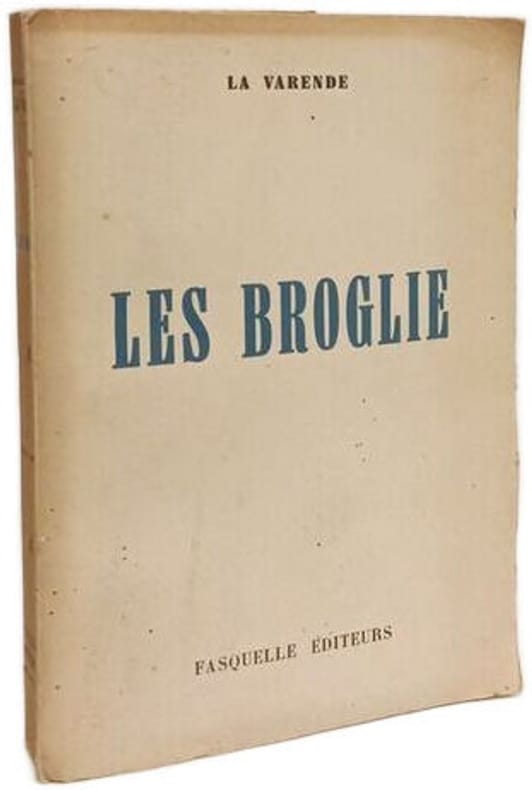
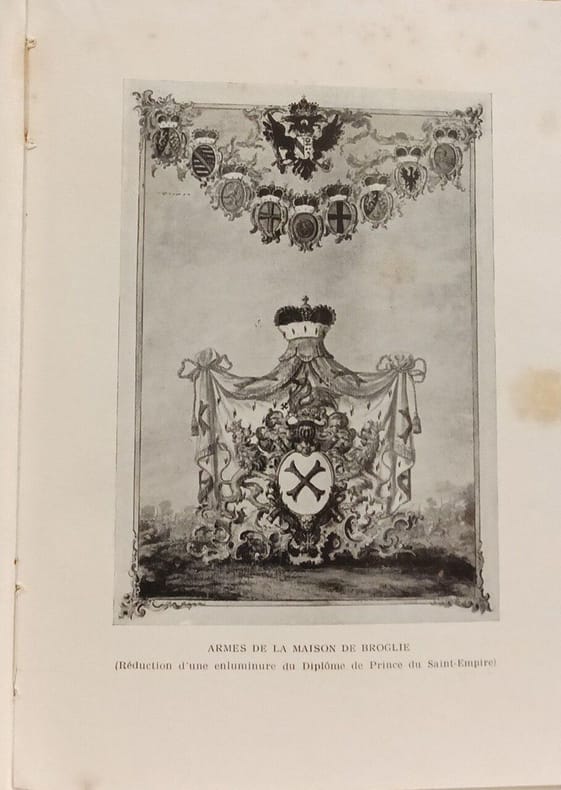
Fasquelle Éditeurs 1950 in8. 1950. Broché.
Reference : 100143163
présence de rousseurs couverture défraîchie
Bookseller's contact details
Un Autre Monde
M. Emmanuel Arnaiz
07.69.73.87.31
Payment mode
Sale conditions
Conformes aux usages de la librairie ancienne.
5 book(s) with the same title
SYSTEME RELIGIEUX DE LEIBNITZ publié d'après le manuscrit original par l'Abbé LACROIX, traduit par Albert DE BROGLIE.
Librairie D' Adrien Le Clere Et Cie Paris 1846 In-12 ( 185 X 110 mm ) de XLVIII-391 pages, demi-veau bronze, dos lisse orné de filets dorés, tranches mouchetées ( Reliure de l'époque ). texte latin avec le texte français en regard. Edition originale. Très bel exemplaire.
De la Pacification religieuse. Quelle est l'origine des querelles actuelles ? Quelle en peut être l'issue ? - Du nouveau projet de loi sur la liberté d'enseignement. - Lettre à Monsieur le Duc DE BROGLIE rapporteur du projet de loi relatif à l'instruction
Jacques Lecoffre Et Cie Paris 1845 4 ouvrages reliés en 1 volume in-8 ( 225 X 135 mm ) de IV-374 pages, demi-veau bronze, dos lisse orné de filets et palettes dorés. Editions originales. Bel exemplaire, rare réunion.- De la Pacification religieuse. Quelle est l'origine des querelles actuelles ? Quelle en peut être l'issue ? 1845. 310 pages.- Du nouveau projet de loi sur la liberté d'enseignement. 1847. 96 pages.- Lettre à Monsieur le Duc DE BROGLIE rapporteur du projet de loi relatif à l'instruction secondaire. 1844. 60 pages.- Seconde lettre à Monsieur le Duc DE BROGLIE rapporteur du projet de loi relatif à l'instruction secondaire. 1844. 81 pages.
Broglie (Louis de), sur - Académie des Sciences - D. Pestre - A. Kozhevnikov - B.R. Wheaton sur Maurice de Broglie - O. Darrigol - F. Kubli - H. Kragh sur Erwin Schrödinger - A. Russo - H. Barreau - W. Kuhn - Y. Ben Dov - Georges Lochak
Reference : 100101
(1994)
La découverte des ondes de matière - Actes du colloque organisé à l'occasion du centenaire de la naissance de Louis de Broglie à Paris, 16-17 juin 1992 , (La physique en France, 1900-1930, un panorama -Light quanta and waves, Einstein reputation as a dualist - The laboratory of Maurice de Broglie and the empirical foundations of matter-waves - Les premiers travaux de Louis de Broglie -Conversations avec Louis de Broglie au sujet de sa thèse -The heritage of Louis de Broglie in the works of Schrödinger and other theoreticians - La découverte des ondes de matière - Le rôle de la relativité dans la pensée de Louis de Broglie - L'influence des images métaphysiques du monde sur le développement des idées fondamentales dans la physique, particulièrement chez Louis de Broglie - De Broglie's conception of the wave-corpuscule duality - Comment Louis de Broglie faisait de la physique)
Académie des Science et Tec Doc Lavoisier - Institut de France Malicorne sur Sarthe, 72, Pays de la Loire, France 1994 Book condition, Etat : Bon broché, sous couverture imprimée éditeur noire, illustrée d'une figure ronde crème grand In-8 1 vol. - 137 pages
1 portrait de Louis de Broglie en frontispice 1ere édition, 1994 Contents, Chapitres : Avant-propos, liste des intervenants, table, vi, Texte, 131 pages - D. Pestre : La physique en France, 1900-1930, un panorama - A. Kozhevnikov : Light quanta and waves, Einstein reputation as a dualist - B.R. Wheaton : The laboratory of Maurice de Broglie and the empirical foundations of matter-waves - O. Darrigol : Les premiers travaux de Louis de Broglie - F. Kubli : Conversations avec Louis de Broglie au sujet de sa thèse - H. Kragh : The heritage of Louis de Broglie in the works of Schrödinger and other theoreticians - A. Russo : La découverte des ondes de matière - H. Barreau : Le rôle de la relativité dans la pensée de Louis de Broglie - W. Kuhn : L'influence des images métaphysiques du monde sur le développement des idées fondamentales dans la physique, particulièrement chez Louis de Broglie - Y. Ben Dov : De Broglie's conception of the wave-corpuscule duality - Georges Lochak : Comment Louis de Broglie faisait de la physique - Louis Victor de Broglie, prince, né le 15 août 1892 à Dieppe et mort le 19 mars 1987 à Louveciennes est un mathématicien et physicien français. À seulement 37 ans, il devient lauréat du prix Nobel de physique de 1929 « pour sa découverte de la nature ondulatoire des électrons ». - Il est initié aux travaux de la physique moderne par son frère aîné, Maurice de Broglie, secrétaire des rencontres Solvay. Si on se réfère à la biographie Nobel, cest à 32 ans, en 1924, six ans après la fin de la Première Guerre mondiale, quil soutient une thèse de doctorat purement théorique devant un jury comprenant Paul Langevin et Jean Perrin6. Quatre ans plus tard, cette thèse lui vaudra dêtre nommé maître de conférences à la faculté des sciences de luniversité de Paris (Institut Henri-Poincaré), et dêtre considéré comme « nobélisable » à 36 ans, et un an plus tard, en 1929, elle lui vaudra le prix Nobel de physique pour sa « découverte de la nature ondulatoire de lélectron », sa thèse théorique ayant été totalement confirmée par deux expérimentateurs américains Davisson et Germer qui ont observé la première diffraction délectron par un cristal. Cette expérience produisant des interférences délectrons, confirma sans ambiguïté lhypothèse de de Broglie. Ses travaux sur la nature ondulatoire des électrons font de lui le physicien qui a associé une onde aux particules massiques. (source : Wikipedia) légères traces de pliures sur la couverture qui reste en bon état, intérieur sinon frais et propre, cela reste un bon exemplaire
"BROGLIE (DE BROGLIE), LOUIS DE . - DISCOVERY OF THE WAVE THEORY OF MATTER AND CREATION OF WAVE-MECHANICS
Reference : 49718
(1923)
Ondes et quanta. Note de M. Louis de Broglie, présentée par M. Jean Perrin. (Séance du 10 Septembre 1923). (+) Quanta de lumière, diffraction et interférences. Note de M. Louis de Broglie, transmise par M. Jean Perrin. (Séance du 24 Septembre 1923). (...
Paris, Gauthier-Villars et Cie, 1923. 4to. Bound in one contemp. full buckram. Spines gilt and with gilt lettering. In: ""Comptes Rendus Hebdomadaires des Séances de L'Academie des Sciences"", Tome 177. Bound with orig. printed front-wrapper to No. 1, half-title and title-page to vol. 177. 1513 pp. (Entire volume offered). De Broglie's papers: pp. 507-510, pp. 548-551 a. pp. 630-32. Clean and fine. A punched stamp on foot of title-page.
First edition of these papers which ESTABLISHED A NEW ERA IN PHYSICS by introducing the epochal new principle that particle-wave duality should apply not only to radiation but also to matter and thus CREATING QUANTUM MECHANICS. These 3 papers were extended to form his doctoral thesis of 1924 ""Recherches sur la Théorie des Quanta.""De Broglie relates ""After long reflection in solitude and meditation, I suddenly had the idea, during the year 1923, that the discovery made by Einstein in 1905 should be generalized by extending it to all material particles and notably to electrons"" (Preface to his PhD thesis 1924).""He made the leap in his September 10, 1923, paper: E=hv should hold not only for photons but also for electrons, to which he assigns a 'fictitious associated wave'. In his September 24 paper, he indicated the direction in which one 'should seek experimental confirmations of our ideas': a stream of electrons traversing an aperture whose dimensions are small compared with the wavelenght of the electron waves 'should show diffraction phenomena' .""(Pais ""Subtle is the Lord"", pp. 425-436).In the third paper (October 8) he discusses ""The interplay between the propagation of the particle and of the waves could be expressed in more formal terms as an identity between the fundamental variational principles of Pierre de Fermat (rays), and Pierre Louis Maupertuis (particles) as de Broglie discussed it further in his last communication . Therein he also considered some thermodynamic consequences of his generalized wave-particle duality. He showed in particular how one could, using Lord Rayleigh’s 1900 formula for the number of stationary modes for phase waves, obtain Planck’s division of the mechanical phase space into quantum cells.Louis de Broglie achieved a worldwide reputation for his discovery of the wave theory of matter, for which he received the Nobel Prize for physics in 1929. His work was extended into a full-fledged wave mechanics by Erwin Schrödinger and thus contributed to the creation of quantum mechanics. After an early attempt to propose a deterministic interpretation of his theory, de Broglie joined the Copenhagen school’s mainstream noncausal interpretation of the quantum theory.""(DSB).""This idea [i.e. de Broglie's that matter might behave as waves] was tested and confirmed by Davisson and Germer in 1927... Thus the duality of both light and matter had been established, and physicists had to come to terms with fundamental particles which defied simple theories and demanded two sets of 'complementary' descriptions, each applicable under certain circumstances, but incompatible with one another."" (Printing and the Mind of Man, 417).

"BROGLIE (DEBROGLIE), LOUIS de. - DISCOVERY OF THE WAVE THEORY OF MATTER AND CREATION OF WAVE-MECHANICS.
Reference : 46949
(1923)
Ondes et quanta. Note de M. Louis de Broglie, présentée par M. Jean Perrin. (Séance du 10 Septembre 1923). (+) Quanta de lumière, diffraction et interférences. Note de M. Louis de Broglie, transmise par M. Jean Perrin. (Séance du 24 Septembre 1923). (...
Paris, Gauthier-Villars et Cie, 1923. 4to. Bound in 2 contemp. full cloth. Spines gilt and with gilt lettering. In: ""Comptes Rendus Hebdomadaires des Séances de L'Academie des Sciences"", Tome 177. With htitle a. titlepage. 1513 pp. (Entire volume offered). De Broglie's papers: pp. 507-510, pp. 548-551 a. pp. 630-32. Clean and fine. A stamp to verso of titlepage.
First edition of these papers which ESTABLISHED A NEW ERA IN PHYSICS by introducing the epochal new principle that particle-wave duality should apply not only to radiation but also to matter and thus CREATING QUANTUM MECHANICS. These 3 papers were extended to form his doctoral thesis of 1924 ""Recherches sur la Théorie des Quanta.""De Broglie relates ""After long reflection in solitude and meditation, I suddenly had the idea, during the year 1923, that the discovery made by Einstein in 1905 should be generalized by extending it to all material particles and notably to electrons"" (Preface to his PhD thesis 1924).""He made the leap in his September 10, 1923, paper: E=hv should hold not only for photons but also for electrons, to which he assigns a 'fictitious associated wave'. In his September 24 paper, he indicated the direction in which one 'should seek experimental confirmations of our ideas': a stream of electrons traversing an aperture whose dimensions are small compared with the wavelenght of the electron waves 'should show diffraction phenomena' .""(Pais ""Subtle is the Lord"", pp. 425-436).In the third paper (October 8) he discusses ""The interplay between the propagation of the particle and of the waves could be expressed in more formal terms as an identity between the fundamental variational principles of Pierre de Fermat (rays), and Pierre Louis Maupertuis (particles) as de Broglie discussed it further in his last communication . Therein he also considered some thermodynamic consequences of his generalized wave-particle duality. He showed in particular how one could, using Lord Rayleigh’s 1900 formula for the number of stationary modes for phase waves, obtain Planck’s division of the mechanical phase space into quantum cells.Louis de Broglie achieved a worldwide reputation for his discovery of the wave theory of matter, for which he received the Nobel Prize for physics in 1929. His work was extended into a full-fledged wave mechanics by Erwin Schrödinger and thus contributed to the creation of quantum mechanics. After an early attempt to propose a deterministic interpretation of his theory, de Broglie joined the Copenhagen school’s mainstream noncausal interpretation of the quantum theory.""(DSB).""This idea [i.e. de Broglie's that matter might behave as waves] was tested and confirmed by Davisson and Germer in 1927... Thus the duality of both light and matter had been established, and physicists had to come to terms with fundamental particles which defied simple theories and demanded two sets of 'complementary' descriptions, each applicable under certain circumstances, but incompatible with one another."" (Printing and the Mind of Man, 417).

