 Write to the booksellers
Gombrowicz Witold Vallee Lillian
Diary
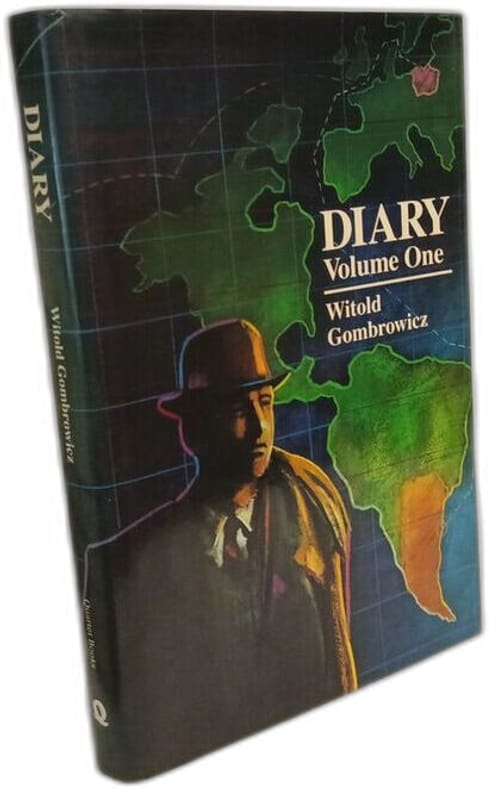
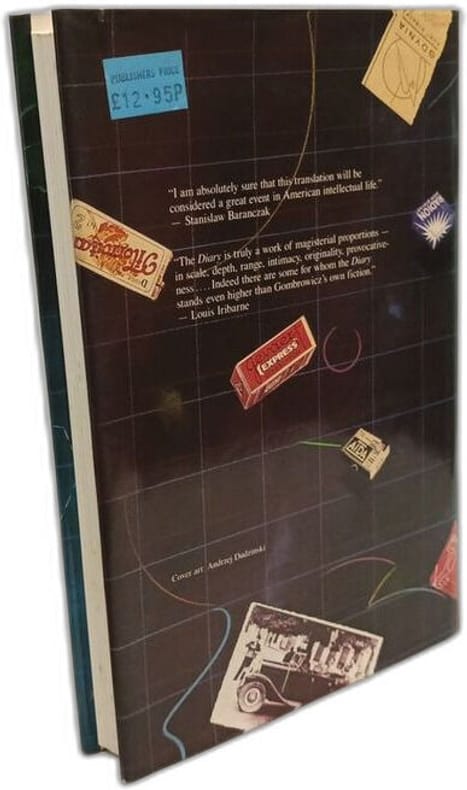
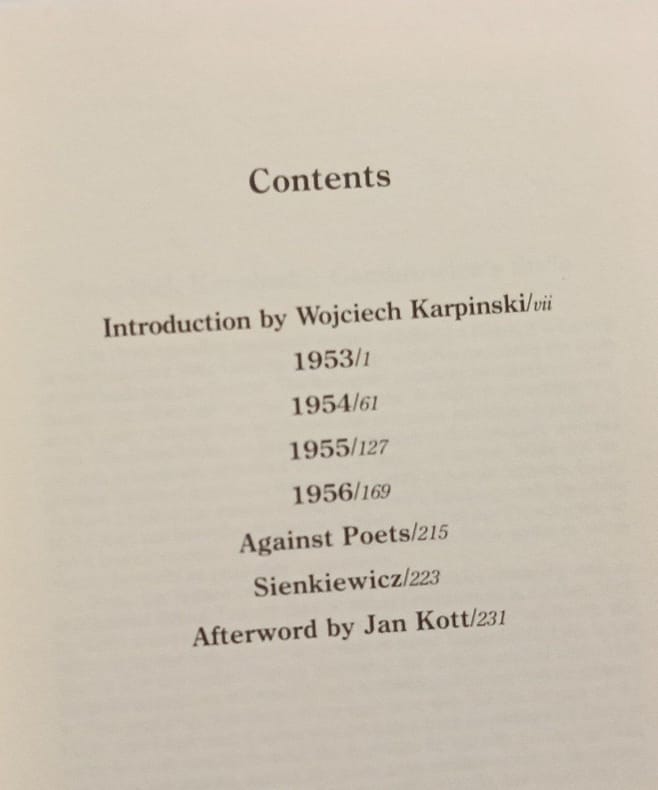
Quartet Books 1988 234 pages 15 6x2 4x23 2cm. 1988. Cartonné jaquette. 234 pages.
Reference : 100138444
Très bon état avec sa jaquette intérieur propre quelques rousseurs en tête
Bookseller's contact details
Un Autre Monde
M. Emmanuel Arnaiz
07.69.73.87.31
Payment mode
Sale conditions
Conformes aux usages de la librairie ancienne.
5 book(s) with the same title
Anne Frank The Diary of a Young Girl.
Doubleday & Company, Inc., New York, 1952. 1952 1 vol in-8° (195 x 135 mm) de: 285 pp. Peine toile noire éditeur, dos lisse titré à l'argent, jaquette polychrome à rabats. (légéres usures aux extrémités de la jaquette, corps d'ouvrage et reliure trés frais).
Première édition américaine en second tirage du célèbre journal dAnne Frank, traduit de son journal rédigé en néerlandais pendant ses deux années de clandestinité avec sa famille durant loccupation nazie des Pays-Bas. Le Journal dAnne Frank, également intitulé « Anne Frank : le journal dune jeune fille », est un témoignage émouvant écrit par une adolescente juive qui se cache avec sa famille pour échapper aux persécutions nazies pendant la Seconde Guerre mondiale. Ce journal, commencé le 12 juin 1942 pour son treizième anniversaire, est adressé à un confident imaginaire quAnne nomme « Kitty ». À travers ses mots, elle raconte les événements qui ont marqué sa vie, ses pensées profondes et ses rêves pour lavenir. En juillet 1942, les Frank (Otto, Edith, Margot et Anne) doivent fuir leur maison à Amsterdam après que Margot reçoit une convocation pour un camp de travail. Ils trouvent refuge dans « lAnnexe », un espace secret aménagé derrière lentreprise dOtto Frank. Ils sont rejoints par une autre famille juive, les Van Daan (Hermann, Auguste et leur fils Peter), et plus tard par un dentiste, Albert Dussel. La vie en clandestinité débute alors, marquée par lisolement, les restrictions et la peur constante dêtre découverts. Dans son journal, Anne raconte les difficultés de cette cohabitation forcée. Les huit personnes vivant dans cet espace confiné doivent respecter des règles strictes pour éviter dêtre entendues par les ouvriers du bâtiment. Anne décrit les disputes fréquentes entre les occupants, notamment entre ses parents et les Van Daan, ainsi que les tensions dues au manque de nourriture et à linconfort. Malgré ces conditions, Anne parvient à conserver une certaine joie de vivre, observant avec une grande maturité les dynamiques humaines autour delle. Anne explore également sa propre personnalité et ses relations avec sa famille. Elle se sent souvent incomprise, notamment par sa mère, avec qui elle a une relation difficile. Elle admire son père, Otto, quelle considère comme un modèle de patience et de sagesse. Elle se compare fréquemment à sa sur Margot, plus réservée et studieuse, et cherche à saffirmer en tant quindividu. Avec Peter Van Daan, elle développe une amitié qui évolue progressivement en une affection romantique, bien quelle doute de ses propres sentiments et de la profondeur de leur relation. Malgré les dangers et lincertitude, Anne nourrit de grands rêves. Elle aspire à devenir écrivain et journaliste, utilisant son journal pour perfectionner son style et exprimer ses idées. Elle réfléchit sur la nature humaine, la guerre et la justice, montrant une incroyable lucidité pour son âge. Ses écrits sont ponctués despoir, même si elle confie parfois son désespoir face à labsurdité de la guerre. Le 4 août 1944, après plus de deux ans de clandestinité, lAnnexe est découverte par la Gestapo à la suite dune dénonciation. Les occupants sont arrêtés et déportés. Anne et sa sur Margot sont envoyées au camp de Bergen-Belsen, où elles meurent du typhus en mars 1945, quelques semaines avant la libération du camp. Otto Frank, seul survivant, retourne à Amsterdam après la guerre. Miep Gies, une des protectrices des clandestins, lui remet le journal dAnne, quelle avait récupéré après leur arrestation. Conscient de limportance du témoignage de sa fille, Otto décide de publier le journal en 1947. Luvre connaît rapidement un immense succès, traduite dans de nombreuses langues et étudiée dans les écoles du monde entier. Ce journal intime, à la fois universel et profondément personnel, est devenu un symbole de lHolocauste, rappelant les horreurs de la guerre et lhumanité derrière les statistiques. Ce second tirage de lédition américaine diffère seulement du premier par labsence de la mention « première édition » sur le titre et sur le rabat de la jaquette le prix de 3,00 $ et le code « AF : T.O.D.A.Y.G. » (Le nôtre porte le n° « A.F. : T.D.O.A.Y.C. »). Superbe exemplaire, très frais. 1 volume 8vo (195 x 135 mm) of: 285 pp. Black cloth binding, smooth spine with silver lettering, polychrome dust jacket with flaps. (Slight wear to the edges of the dust jacket, body and binding in very good condition). First American edition, second printing, of Anne Frank's famous diary, translated from the Dutch original written during her two years in hiding with her family during the Nazi occupation of the Netherlands. The Diary of Anne Frank, also titled Anne Frank: The Diary of a Young Girl, is a moving account written by a Jewish teenager who hid with her family to escape Nazi persecution during World War II. This diary, begun on June 12, 1942, for her thirteenth birthday, is addressed to an imaginary confidante whom Anne calls Kitty. Through her words, she recounts the events that marked her life, her deepest thoughts, and her dreams for the future. In July 1942, the Franks (Otto, Edith, Margot, and Anne) had to flee their home in Amsterdam after Margot received a summons to a labor camp. They found refuge in the Annex, a secret space behind Otto Frank's business. They were joined by another Jewish family, the Van Daans (Hermann, Auguste, and their son Peter), and later by a dentist, Albert Dussel. Life in hiding began, marked by isolation, restrictions, and the constant fear of being discovered. In her diary, Anne recounts the difficulties of this forced cohabitation. The eight people living in this confined space had to follow strict rules to avoid being heard by the construction workers. Anne describes the frequent arguments between the occupants, particularly between her parents and the Van Daans, as well as the tensions caused by the lack of food and the uncomfortable living conditions. Despite these conditions, Anne managed to maintain a certain joie de vivre, observing the human dynamics around her with great maturity. Anne also explores her own personality and her relationships with her family. She often feels misunderstood, especially by her mother, with whom she has a difficult relationship. She admires her father, Otto, whom she considers a model of patience and wisdom. She frequently compares herself to her sister Margot, who is more reserved and studious, and seeks to assert herself as an individual. She develops a friendship with Peter Van Daan that gradually evolves into romantic affection, although she doubts her own feelings and the depth of their relationship. Despite the dangers and uncertainty, Anne has big dreams. She aspires to become a writer and journalist, using her diary to perfect her style and express her ideas. She reflects on human nature, war, and justice, showing incredible clarity for her age. Her writings are punctuated with hope, even though she sometimes confides her despair at the absurdity of war. On August 4, 1944, after more than two years in hiding, the Annex was discovered by the Gestapo following a tip-off. The occupants were arrested and deported. Anne and her sister Margot were sent to the Bergen-Belsen camp, where they died of typhus in March 1945, a few weeks before the camp was liberated. Otto Frank, the sole survivor, returned to Amsterdam after the war. Miep Gies, one of the protectors of the fugitives, gave him Anne's diary, which she had recovered after their arrest. Aware of the importance of his daughter's testimony, Otto decided to publish the diary in 1947. The work quickly became a huge success, translated into many languages and studied in schools around the world. This diary, both universal and deeply personal, has become a symbol of the Holocaust, reminding us of the horrors of war and the humanity behind the statistics. This second printing of the American edition differs from the first only in the absence of the words first edition on the title page and on the dust jacket flap, the price of $3.00, and the code AF: T.O.D.A.Y.G. (Ours bears the number A.F.: T.D.O.A.Y.C.). . Superb copy, very fresh.


Reference : alba30c3a51c6444967
If Verdi kept a diary: If Beethoven kept a diary: If Schumann kept a diary: If L
If Verdi kept a diary: If Beethoven kept a diary: If Schumann kept a diary: If Liszt kept a diary: If Bach kept a diary: If Mozart kept a diary. In Russian (ask us if in doubt)/Esli by Verdi vel dnevnik Esli by Betkhoven vel dnevnik Esli by Shuman vel dnevnik Esli by List vel dnevnik Esli by Bakh vel dnevnik Esli by Motsart vel dnevnik.. description: In Russian (ask us if in doubt).Collection of books from the series-Books-Diaries in 6 books. Budapest Corvina. 1965-1966. 1224s. We have thousands of titles and often several copies of each title may be available. Please feel free to contact us for a detailed description of the copies available. SKUalba30c3a51c6444967
Reference : alb19aedf3b2bab561c
Prokofiev S. Diary 1907-1918. Diary 1919-1933. Diary. Faces. In 3 books. In Russ
Prokofiev S. Diary 1907-1918. Diary 1919-1933. Diary. Faces. In 3 books. In Russian (ask us if in doubt)/Prokofev S. Dnevnik 1907-1918. Dnevnik 1919-1933. Dnevnik. Litsa. V 3-kh knigakh. Paris. SPRKF. 2002. 816s. We have thousands of titles and often several copies of each title may be available. Please feel free to contact us for a detailed description of the copies available. SKUalb19aedf3b2bab561c
Ponary Diary, 1941-1943. A Bystander's Account of a Mass Murder. Edited by Yitzhak Arad.
Yale University Press, 2005, in-8°, xvii-156 pp, un fac-similé, index, reliure éditeur, jaquette illustrée, bon état. Texte en anglais
Par Kazimierz Sakowicz (1894-1944) — About sixty thousand Jews from Wilno (Vilnius, Jewish Vilna) and surrounding townships in present-day Lithuania were murdered by the Nazis and their Lithuanian collaborators in huge pits on the outskirts of Ponary. Over a period of several years, Kazimierz Sakowicz, a Polish journalist who lived in the village of Ponary, was an eyewitness to the murder of these Jews as well as to the murders of thousands of non-Jews on an almost daily basis. He chronicled these events in a diary that he kept at great personal risk. Written as a simple account of what Sakowicz witnessed, the diary is devoid of personal involvement or identification with the victims. It is thus a unique document: testimony from a bystander, an “objective” observer without an emotional or a political agenda, to the extermination of the Jews of the city known as “the Jerusalem of Lithuania.” Sakowicz did not survive the war, but much of his diary did. Painstakingly pieced together by Rahel Margolis from scraps of paper hidden in various locations, the diary was published in Polish in 1999. It is here published in English for the first time, extensively annotated by Yitzhak Arad to guide readers through the events at Ponary. — "This remarkable diary, written by a sympathetic Polish observer, gives a graphic and harrowing account of the mass murder of between fifty and sixty thousand Lithuanian Jews in the forest of Ponary just outside Vilna. It is a unique contribution to our understanding of the Holocaust." (Antony Polonsky, Brandeis University)
The Diary Kept by T. E. Lawrence While Travelling in Arabia During 1911; [together with] An Essay on Flecker.
Southampton Privately printed 1990 Première édition en fac-similé, signée par l'éditeur au bas de son introduction à Flecker. La préface indique que 52 exemplaires d'un tirage total de 500 ont été numérotés et signés. Cet exemplaire n'est pas numéroté, mais porte la signature de Johnston. Il s'agit de reproductions des éditions limitées du journal de Lawrence et de son essai critique sur Flecker publiées par Corvinus Press. En 1911, Lawrence a participé à des fouilles archéologiques dans le nord de la Syrie, et il s'agit d'un fac-similé du récit qu'il a fait de cette période. Le journal a été publié par la Corvinus Press en 1937. Son essai sur Flecker a été publié à seulement 30 exemplaires en 1937. "Le poète James Elroy Flecker [1884-1915] était un ami de Lawrence à Beyrouth avant la guerre. Aucune des parutions de cet essai n'a eu lieu dans des éditions commerciales" (O'Brien : A194a, A198b). Treize planches, illustrations dans le texte dans Diary, limitation en rouge dans Flecker. Très bel exemplaire, propre. Quelques légères marques sur l'étui. 30cm x 20.5cm.
First facsimile edition, signed by the editor at the foot of his introduction to Flecker. The preface stated that 52 copies from a total edition of 500 were numbered and signed. This copy is not numbered, but does bear Johnston's signature. These are reproductions of the Corvinus Press's limited issues of Lawrence's diary and of his critical essay about Flecker. During 1911, Lawrence was employed on an Archaeological dig in Northern Syria, and this is a facsimile of his account of this period. The diary was published by the Corvinus Press in 1937. His essay on Flecker was published in an edition of only 30 copies in 1937. "The poet James Elroy Flecker [1884-1915] had been a friend of Lawrence's in Beirut before the war. None of the appearances of this essay have been in trade editions" (O'Brien: A194a, A198b.) Housed in original cream card slipcase. Thirteen plates, illustrations in text in Diary, limitation in red in Flecker. A very nice, clean copy. A couple of light marks to the slipcase. 30cm x 20.5cm. .

