 Write to the booksellers
MARX (Karl)
Le Capital
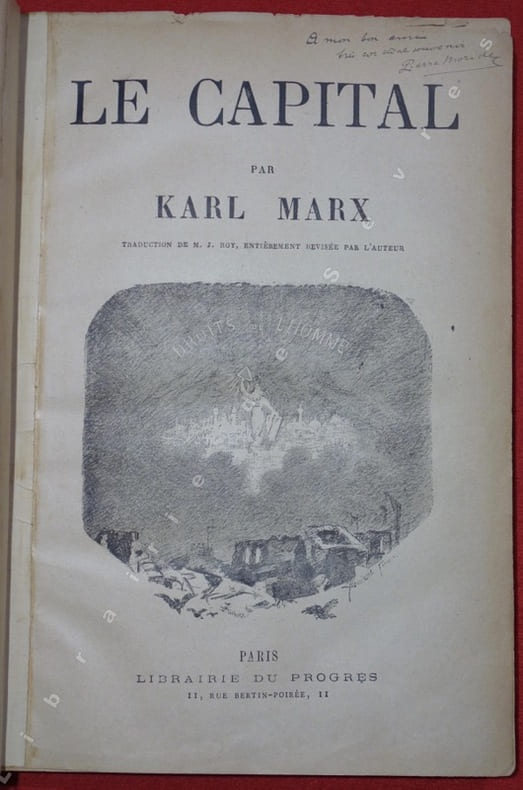
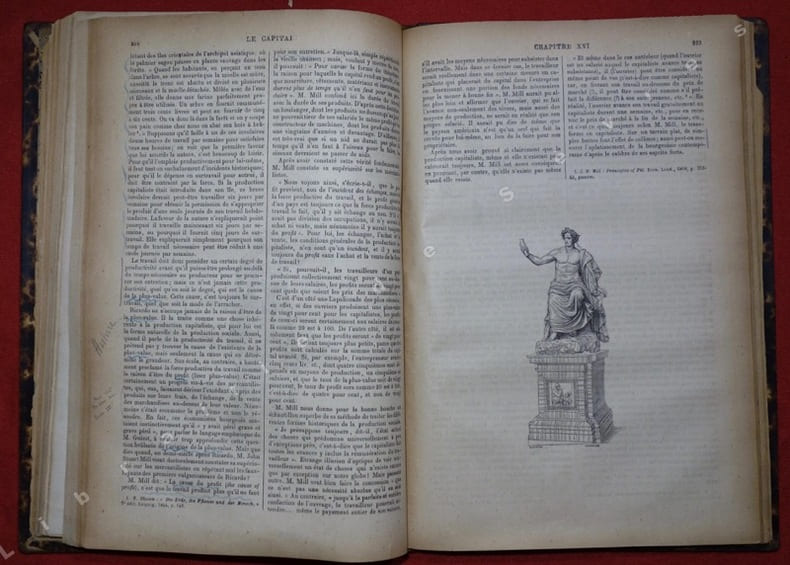

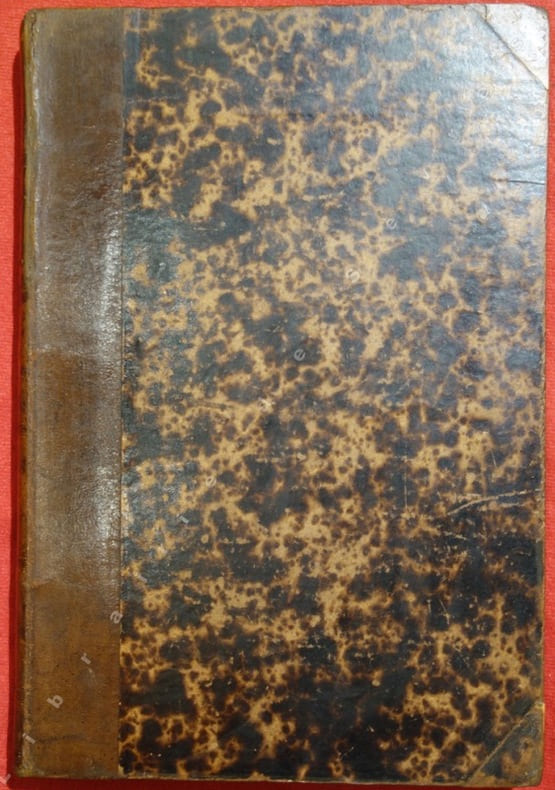
1875 Paris, Librairie du Progrès, sans date (1875), grand in-8 de 351-(1) pp., errata p.351, rel. d'époque demi-basane brune bleu nuit, dos orné du titre doré et de roulettes dorées, bords des deux premiers feuillets éfrangés, bon ex.
Reference : 19430
2e tirage de la première édition française du capital. Exemplaire de travail de Pierre MORIDE (1883-1915), avec ex dono manuscrit de sa main à l'un de ses amis, notes de lecture et passages soulignés au crayon bleu. Pierre MORIDE, avocat, fut reçu Docteur en sciences politiques et économiques en 1908, après avoir présenté une thèse sur « Le produit net des physiocrates et la plus-value de Marx". Pour ce faire, il eut probablement recours à cet exemplaire annoté de sa main. Il fut chargé d’économie politique à la Faculté de Paris, puis en octobre 1912, un poste de chargé de cours d’économie politique auprès de la Faculté de Montpellier lui fut confié. La traduction de J. Roy fut entièrement révisée par l'auteur. Elle parut en 44 livraisons formant 351 pages entre août 1872 et mai 1875. Les révisions et les ajouts apportés par Karl Marx au cours de la publication firent de cette édition française un travail original à part entière. L'auteur alla jusqu'à préciser dans l'Avis au lecteur daté du 28 avril 1875, que l'édition "possède une valeur scientifique indépendante de l'original et doit être consultée même par les lecteurs familiers avec la langue allemande". L'édition, imprimée sur deux colonnes, contient deux titres chacun illustrés d'un grand bois, plusieurs vignettes et en-têtes, un portrait de Karl Marx et le fac-similé d'une lettre de Marx à l'éditeur Maurice Lachâtre. Portrait de Marx, vignettes et culs de lampe.
Bookseller's contact details
Fronhofer Schlösschen Galerie
M. Bernard Esposito
Kreuzstrasse 3
97775 Burgsinn
Germany
+49 9356 6034856
Payment mode

Sale conditions
envoi des livres à réception du règlement virement bancaire, PayPal.
5 book(s) with the same title
On the Nature of Capital (+) On the Nature of Capital: Investment, Intangible Assets, and the Pecuniary Magnate.
(Boston, Stanford University Press), 1908. 8vo. Two offprints in the original printed wrappers. Offprints from ""Quarterly Journal of Economics"", Vol. XXII, August & Vol. XXIII, November 1908. Vol. XXII: Backwrapper detached, a few small nicks to extremities. Vol. XXIII: Front wrapper detached. Fine and clean. Pp. 517-42"" Pp. 103-136.
Two scarce offprints of Veblen's important publications on the theory of capital. Here Veblen broadens the concept of capital to include the capital of knowledge. Thus, Veblen's theory laid ""the foundation for a system of property rights created to enable individuals to productively utilize knowledge that resides within the community as a whole"" (Niman, Henry George and the Development of Thorstein Veblen's Theory of Capital). ""The foundation of Veblen's theory of capital is rooted in the special position knowledge holds in society. Knowledge forms the basis for the productive use of natural resources and is a community asset that, at its most fundamental level, is not owned by a single individual. Thus, Veblen's theory begins by laying the foundation for a system of property rights created to enable individuals to productively utilize knowledge that resides within the community as a whole. These property rights make it possible for the creation and ownership of capital in the form of industrial equipment. With growth in the scale and scope of the community comes the ability to monopolize a portion of the community's asset for pecuniary gain. Monopolization then leads to a form of economic servitude that is similar to slavery."" (Niman, Henry George and the Development of Thorstein Veblen's Theory of Capital).In contrast to conventional theories of capital that are founded on the productive labor of workers and described in individualistic terms, Veblen believed that the history of humanity is not the story of a collection of independent individuals, but, rather, is based on the collective contribution of the group. The group plays an important role because it is the group that forms the entity where knowledge iscaptured and stored.""Thorstein Veblen's theory of capital as an important element in developing an evolutionary economics warrants a closer investigation into the origins of the concept. In his essay outlining the basic theory of capital, Veblen (1908) makes explicit reference to the single taxers, and to the relationship between land as an unearned source of rent and the returns associated with capital.If one considers Veblen's anthropological approach to economics, then it becomes easier to see how, as society develops, capital in the form of community-based knowledge takes on the fundamental role previously played in an earlier era by land. Veblen's theory of capital does not invalidate the earlier focus on land, but, rather, is one step further down the path of economic development."" (Niman, Henry George and the Development of Thorstein Veblen's Theory of Capital).Thorstein Bunde Veblen was an American economist and sociologist, and regarded as being the founding figure of the institutional economics movement. ""He studied economics under John Bates Clark, a leading neoclassical economist, but rejected his ideas. He did his graduate work at Johns Hopkins University under Charles Sanders Peirce, the founder of the pragmatist school in philosophy, and at Yale University under laissez-faire proponent William Graham Sumner. He repudiated their views as well. Veblen did not reject economists' answers to the questions they posed"" he simply thought their questions were too narrow. Veblen wanted economists to try to understand the social and cultural causes and effects of economic changes."" (The Concise Encyclopedia of Economics).

El Capital. Resumido y acompanado de un estudio sobre el socialismo científico por Gabriel Deville. Primera edición [Marx / Deville] (+) Socialismo Utopico y Socialismo Cientifico [Engels] (+) La Ley de Los Salarios y Sus Consecuencias [Guesde]. - [FIRST SPANISH EDITION OF THE MOST IMPORTANT ABRIDGED VERSION OF ""THE CAPITAL""]
Madrid, Ricardo Fé, 1887. 8vo. Contemporary brown half calf with gilt lettering and ornamentation to spine and red paper covered boards. Most leaves evenly browned (due to the quality of the paper) and some brownspotting to last few leaves. Overall a very good copy indeed of this otherwise fragile book. [Socialismo Utopico... :] pp. (1)-91, (1) + frontispiece of Engels" [La Ley de Los Salarios... :] pp. (1)-44 + frontiespiece of Guesde" [El Capital:] pp. (I)-LVI, 263 pp.
The exceedingly scarce first Spanish edition of the most important abridged version of Marx's Capital ever to have appeared, published in the same year as what is generally accepted as the first Spanish edition of ""Das Kapital"" (Zafrilla's abridged version - defectively translated from Roy's French version - which was published in newspaper installments 1886-87).This Spanish translation was made from the French of Gabriel Deville (1854 -1940), the great French socialist theoretician, politician and diplomat, who did more than almost anyone else to raise awareness of Karl Marx's theories of the weaknesses of capitalism - most effectively through the present work, which came to have a profound influence upon the spreading of Marxist thought throughout the Spanish speaking part of the world. ""The epitome, here translated, was published in Paris, in 1883, by Gabriel Deville, possibly the most brilliant writer among the French Marxians. It is the most successful attempt yet made to popularize Marx's scientific economics. It is by no means free from difficulties, for the subject is essentially a complex and difficult subject, but there are no difficulties that reasonable attention and patience will not enable the average reader to overcome. There is no attempt at originality. The very words in most cases are Marx's own words, and Capital is followed so closely that the first twenty-five chapters correspond in subject and treatment with the first twenty-five chapters of Capital. Chapter XXVI corresponds in the main with Chapter XXVI of Capital, but also contains portions of chapter XXX. The last three chapters-XXVII, XXVIII, and XXIX-correspond to the last three chapters-XXXI, XXXII, and XXXIII-of Capital."" (ROBERT RIVES LA MONTE, Intruductory Note to the 1899 English translation).The Spanish translator of the work is Antonio Atienza, a typographer and translator at the press of Ricardo Fé, who in 1886 volunteered his work at the newly founded ""El Socialista"", the Spanish flagship publication of Marxist socialism. It was also in 1886 that Atienza translated the present work, with the publication following in 1887. This translation happened almost simultaneously with the ""translation"" by Zafrilla, which appeared in weekly installments in the rival newspaper ""La Républica"", and the two first versions of ""Das Kapital"" to appear in Spanish tell the story of more than just the desire to spread Marx's ideas in Spain. Both versions were part of an ongoing struggle between political parties vying for the loyalty of Spain's workers (see more below). THE WORK IS OF THE UTMOST SCARCITY, WITH MERELY THREE COPIES LISTED ON OCLC (two in Bristish Library and one in Bibliothèque Nationale) and none at auction over the last 40 years at least.Backgrund for the publication:Among the numerous nascent political organizations that sprouted in the last half of 19th century Spain, many of them as a result to the tumultuous years after the so-called ""Glorious Revolution"" of 1868, was the Partido Socialista Obrero Español (PSOE). The party was founded by Pablo Iglesias in 1879, and it was the second socialist party in Europe, preceded only by the Sozialdemokratische Partei Deutschlands (SPD). Notably, of the original twenty-five founding members sixteen were typographers. March of 1886 was a turning point for the PSOE, as they began to publish a weekly newspaper, ""El Socialista"", in order to reach a wider audience throughout Spain and thus advance the Marxist socialist agenda, of which the paper became the flagship. (To this day, it is the official paper of the PSOE, the present ruling party in Spain, although it was suppressed during the years of Franco's dictatorial regime and published sporadically in exile, in France, or clandestinely in Spain. It was again published regularly since 1978. The PSOE gave up Marxism in 1979 in favor of Democratic Socialism.)In 1886 the translator of the present work, Antonio Atienza, was a typographer and translator at the press of Ricardo Fé. At the same time, he volunteered his work at the newly founded El Socialista, as the PSOE funds were quite limited-he wouldn't have a paid position in the paper until 1913. He translated articles by Engels, Guesde, and Buechner, among others.""Das Kapital"" had been published twenty years earlier. That it took so long to reach Spain in book form reveals, among other things, that up to that moment most of Marx's thoughts had filtered through to the workers' unions and parties by way of the writings of his followers as they were interpreted and explained by the intellectuals in charge of these organizations. It is also evident that the complexity of the book wouldn't be of much use to the average worker, factory and otherwise. Enter Deville's abridged version, which was more accessible in that some of the most basic ideas of Marx were digested and re-explained. The point was not to publish a book that could only be only be understood by economists and philosophers, but one that could be given to the workers. A rival party leftist party, considered by the PSOE as bourgeois, was the Partido Republicano Federal. One of its members, Pablo Correa y Zafrilla, undertook the task of translating the first volume of Das ""Kapital"". Quite usual for Spain at the time, the translation was published in weekly instalments to subscribers of their newspaper, ""La República"", starting in 1886 and ending in 1887. The paper then sold the cloth binding to its subscribers and offered to collect the installments to have the book bound for its customers. According to the ad in ""La República"" (22/1/1886), the translation is purportedly from the German original, but it has been clearly demonstrated that it is a defective translation from the French translation of Roy (Ribas). It seems very plausible that when the PSOE found out that someone else in Spain was beginning to publish a translation of the first volume of ""Das Kapital"", El Socialista decided to publish Deville's translation. In fact, the publication of El Capital by ""La República"" was briefly mentioned once in ""El Socialista"", and not in flattering terms (7/10/1887). That a Marxist newspaper disparaged against the first Spanish publication of ""Das Kapital"" reveals, among other things, that they were not terribly excited about some other party's publication producing a defective rendering of their guiding principles. On the other hand, that ""La República"" had decided to publish the book was probably brought about by the foundation of ""El Socialista"", as they saw that the PSOE now had the means to spread their ideas throughout the country. It is in no small way possible that the haste to publish the book brought about the many defects in the translation from the French of Roy as Correa hurried to finish it.José Mesa y Leompart, a typographer, translator, and Marxist ideologue and activist, had experienced the upheavals of the Commune of Paris during his exile after the 1868 revolution. He developed a friendship with Marx's son in law, Paul Lafargue, and his wife, Laura Marx-who themselves had been in exile in Spain during 1871-72-, as well as with Engels, with whom he shared much correspondence, and many other figures of the Marxist movement. He also met both Marx and Engels during their exile in London. His friendship with Pablo Iglesias was a major driving force behind the formation of the PSOE, and he collaborated with El Socialista both as a writer and as a financial supporter. Mesa writes to Engels in April of 1887 lamenting that some Spanish thinkers were using Marx's theories and the policies of the German Socialist Party to deny the concept of class struggle, despite the fact that ""we have […] proven to them that you and Marx have always said the opposite, and having quoted to them the very clear statements of the German Socialist Party"" [but] they remain unmovable, and at some point they even wanted to publish the abridged Capital by Deville, without the preface, and with notes interpreting the meaning in their own way-which we have impeded-(the Resumen [abridgement] of Deville will soon be published, faithfully translated into Spanish.""Therefore, as early as April of 1887 the present translation was already in progress, and in fact, according to Mesa, soon to be published, so it was apparently very advanced. It is then quite possible that Antonio Atienza was commissioned to translate the Deville's abridgement a few months earlier, and not unlikely as far as 1886, when ""La República"" was still publishing installments of the Correa translation. The PSOE is obviously trying to obscure and minimize Correa's translation by publishing the Deville book, as the task of translating ""Das Kapital"" from the original would be lengthy and costly, and it would have come out too late to ascertain their political hold on Marx's ideas. This translation of Deville, then, sees the light is in the very midst of the bickering between leftist parties, and is in fact a product of the confrontations between leftist ideologies. It was finally published about nine months after Mesa's letter to Engels. The first announcement in ""El Socialista"" appears in their November 11th, 1887 issue. The price is four pesetas, or about the cost of an entire year's subscription to the paper, although subscribers could purchase it at half price. Still, given that many subscribers were workers of scarce means, less than three hundred copies were sent out to the main Spanish cities, and that the total edition was probably about a thousand copies at most.The scarcity of this book can be underlined if one considers the virulent war that was waged against all socialist and Marxist literature during and after the Spanish Civil War by the dictatorial regime of Francisco Franco. Book purges and burnings were considerable throughout Spain since the onset of the war, in 1936. It is not that books were burnt sporadically and occasionally, but rather they were destroyed in a systematic and terrifyingly efficient manner. As early as September of 1936 official orders were given to all civil governors, mayors, school inspectors in the nationalist areas to purge all ""harmful"" books, such as pornography and books of a communist or Marxist content. Teachers, librarians, and private citizens, often purged their own libraries, public or personal, of such works in order to comply with the official orders. Countless people were summarily executed for owning certain books that revealed their political tendencies. Obviously, owning actual edition of a book by Marx was reason enough to be deemed guilty and likely executed. As the war advanced, many other such official orders were issued, and unfathomable numbers of books were burnt. To this is added that many libraries were burnt down during the bombardments that took place throughout the country, and that all the libraries of the leftist parties were systematically destroyed. The end of the war, in 1939, only made it official throughout the entire country that communist and socialist literature was banned. So even the few copies that might have survived the fires and the purges were surely disposed of by their owners. It is no small wonder that this particular copy did manage to survive.Withbound in the present volume is the first Spanish translation of Engels' ""Socialism: Utopian and Scientific"" and Jules Guesde's work on the Law of Wages. See:Ribas, Pedro. ""La primera traducción castellana de El capital, 1886 - 1887"", in Cuadernos Hispanoamericanos, Madrid, junio de 1985, pp. 201-210.Castillo, Santiago. ""Marxismo y socialismo en el siglo XIX español"", in, Movimiento sociales y estado en la España contemporánea, Manuel Ortiz et al (coord.), Universidad de Castila-La Mancha, 2001Boza Puerta, Mariano, and Sánchez Herrador, Miguel Ángel. ""El martirio de los libros: una aproximación a la destrucción bibliográfica durante la Guerra Civil."" In Boletín de la Asociación Andaluza de Bibliotecarios. Año nº 22, Nº 86-87, 2007, págs. 79-96Tur, Francesc. https://serhistorico.net/2018/04/04/el-bibliocausto-en-la-espana-de-franco-1936-1939/
Das Kapital. Kritik der politischen Oekonomie. Zweiter Band. Buch II: Der Cirkulationsprocess des Kapitals. Herausgeben von Friedrich Engels. - [""THE FORGOTTEN BOOK OF CAPITAL""]
Hamburg: Otto Meissner, 1885. 8vo. Very nice contemporary black half calf with gilt spine. A bit of wear to extremitoes. Inner front hinge a little weak. Title-page a littel dusty, but otherwise very nice and clean. Book-plate (Arnold Heertje) to inside of front board. XXVII, (1), 526 pp. + 1 f. With pp. 515-16 in the first state (""Consumtionsfonds"" with a C) and with the imprint-leaf at the end.
Scarce first edition of the second volume of ""The Capital"", edited from Marx's manuscripts by Friedrich Engels and with a 20 pages long preface by Engels. The second volume constitutes a work in its own right and is also known under the subtitle ""The Process of Circulation of Capital "". Although this work has often been to as referred to as ""the forgotten book"" of Capital or ""the unknown volume"", it was in fact also extremely influential and highly important - it is here that Marx introduces his ""Schemes of Reproduction"", here that he founds his particular macroeconomics, and here that he so famously distinguishes two ""departments"" of production: those producing means of production and those producing means of consumption - ""This very division, as well as the analysis of the relations between these departments, is one of the enduring achievements of Marx's work."" (Christopher J. Arthur and Geert Reuten : The Circulation of Capital. Essays on Volume Two of Marx's Capital. P. 7).The work is divided into three parts: The Metamorphoses of Capital and Their Circuits, The Turnover of Capital, The Reproduction and Circulation of the Aggregate Social Capital, and it is here that we find the main ideas behind the marketplace - how value and surplus-value are realized. Here, as opposed to volume 1 of ""The Capital"", the focus is on the money-owner and -lender, the wholesale-merchant, the trader and the entrepreneur, i.e. the ""functioning capitalist"", rather than worker and the industrialist. ""[i]t was here, in the final part of this book [i.e. vol. II of Das Kapital], that Marx introduced his ""Schemes of Reproduction"", which influenced both Marxian and orthodox economics in the first decades of the twentieth century."" (Arthur & Reuten p. 1).The first volume of ""Das Kapital"" was the only one to appear within Marx' life-time. It appeared 1867, followed by this second volume 18 years later, which Engels prepared from notes left by Karl Marx.
"MARX, CARLOS [KARL] (+) GABRIELLE DEVILLE (+) [Translator:] ALBANO DE MORAES.
Reference : 62679
(1912)
O Capital. (i.e. Portuguese: ""Das Kapital""). - [FIRST PORTUGUESE EDITION OF THE MOST IMPORTANT ABRIDGED VERSION OF ""THE CAPITAL""]
Lisboa, De Francisco Luiz Goncalves, 1912. 8vo. In the original red printed cloth-binding with black and white lettering. Spine with loss of the white lettering. Paper-label pasted on to lower inner margin of front board. Very light wear to extremities, Internally very fine and clean. 240 pp.
The exceedingly scarce first Portuguese edition of the most important abridged version of Marx's Capital ever to have appeared, published fifty-six years before the first full Portuguese (but published in Brazil) translation and whole sixy-two years before the first full translation published in Portugal. Curiously, two translations of the present work were made 1912 but the present translation seems to have priority (see Bastien, ""Readings and Translations of Karl Marx in Portugal""). After the 1933 rise of Salazar's dictatorial Estado Novo regime, suppression of the relatively newly founded Communist party grew. Members were arrested, tortured, and executed and many were sent to the Tarrafal concentration camp in the Cape Verde Islands. Communist literature suffered an equally repressive fate, hence the rarity of the present work. Marxism and especially Marxist writing caught on comparatively late in Portugal: ""As for the Socialist Party - supposed to be the main expression of Marxism -, it revealed itself unable to stimulate effective theoretical and doctrinal efforts. Its existence was an example of ambiguity and inconsequence. Its political programme went on mixing Marxian elements, associationist tradition and positivist thinking. Its strategy balanced continuously between an alliance with republican politicians and the maintenance of political autonomy. Its tatics balanced between electoral abstencionism and an involvement in election processes, that never led it to a relevant position in parliament. Even its international relations showed a lasting ambiguity: it had been created according to the instructions of the Marxist majority at the Hague Congress, when most of its members tended to support political abstencionism. When the formation of the Second lnternacional was taking place in Paris in 1889 Portuguese socialists tried to join the Marxist congress, after being present at the possibilist congress. In 1920 they decided to join the Third lnternacional (what was not accomplished), at the same time that an internal reformist turn was taking place."" (Bastien, ""Readings and Translations of Karl Marx in Portugal""). ""The epitome, here translated, was published in Paris, in 1883, by Gabriel Deville, possibly the most brilliant writer among the French Marxians. It is the most successful attempt yet made to popularize Marx's scientific economics. It is by no means free from difficulties, for the subject is essentially a complex and difficult subject, but there are no difficulties that reasonable attention and patience will not enable the average reader to overcome. There is no attempt at originality. The very words in most cases are Marx's own words, and Capital is followed so closely that the first twenty-five chapters correspond in subject and treatment with the first twenty-five chapters of Capital. Chapter XXVI corresponds in the main with Chapter XXVI of Capital, but also contains portions of chapter XXX. The last three chapters-XXVII, XXVIII, and XXIX-correspond to the last three chapters-XXXI, XXXII, and XXXIII-of Capital."" (ROBERT RIVES LA MONTE, Intruductory Note to the 1899 English translation). Capital de Marx also had a Portuguese edition at this time, or better, two different editions, both in 1912, but only in translation of the survey of Book I published in France by Gabriel Deville in 1883 (Marx, 1912a and Marx, 1912b). This version omitted material dealt with in at least four chapters of the original text and was not particularly appreciated by Engels. It was a simplified text, aimed at supporting the training of socialist militants and that made it possible for them to have access, indirect, to the work of Marx. The other summaries and anthologies of Capital, which, with a purpose similar to that of Deville, circulated in Europe during this period or ignored in Portugal, as was the case with Carlo Cafiero, or were only occasionally mentioned, as was the case with Paul Lafargue and Karl Kautsky, in its French versions. OCLC list two copies, both in the US.
"MARX, CARLOS [KARL] (+) GABRIELLE DEVILLE (+) [Translator:] ALBANO DE MORAES.
Reference : 63248
(1912)
O Capital. (i.e. Portuguese: ""Das Kapital""). - [FIRST PORTUGUESE EDITION OF THE MOST IMPORTANT ABRIDGED VERSION OF ""THE CAPITAL""]
Lisboa, De Francisco Luiz Goncalves, 1912. 8vo. Uncut in the original printed wrappers. Wrappers brownpostted and with a few minor nicks and tear. Upper part of spine with loss of paper. Internally fine and clean. A fine and well preserved copy of an otherwise fragile book. 240 pp.
The scarce first Portuguese edition of the most important abridged version of Marx's Capital ever to have appeared, published fifty-six years before the first full Portuguese (but published in Brazil) translation and whole sixy-two years before the first full translation published in Portugal. Curiously, two translations of the present work were made 1912 but the present translation seems to have priority (see Bastien, ""Readings and Translations of Karl Marx in Portugal""). After the 1933 rise of Salazar's dictatorial Estado Novo regime, suppression of the relatively newly founded Communist party grew. Members were arrested, tortured, and executed and many were sent to the Tarrafal concentration camp in the Cape Verde Islands. Communist literature suffered an equally repressive fate, hence the rarity of the present work. Marxism and especially Marxist writing caught on comparatively late in Portugal: ""As for the Socialist Party - supposed to be the main expression of Marxism -, it revealed itself unable to stimulate effective theoretical and doctrinal efforts. Its existence was an example of ambiguity and inconsequence. Its political programme went on mixing Marxian elements, associationist tradition and positivist thinking. Its strategy balanced continuously between an alliance with republican politicians and the maintenance of political autonomy. Its tatics balanced between electoral abstencionism and an involvement in election processes, that never led it to a relevant position in parliament. Even its international relations showed a lasting ambiguity: it had been created according to the instructions of the Marxist majority at the Hague Congress, when most of its members tended to support political abstencionism. When the formation of the Second lnternacional was taking place in Paris in 1889 Portuguese socialists tried to join the Marxist congress, after being present at the possibilist congress. In 1920 they decided to join the Third lnternacional (what was not accomplished), at the same time that an internal reformist turn was taking place."" (Bastien, ""Readings and Translations of Karl Marx in Portugal""). ""The epitome, here translated, was published in Paris, in 1883, by Gabriel Deville, possibly the most brilliant writer among the French Marxians. It is the most successful attempt yet made to popularize Marx's scientific economics. It is by no means free from difficulties, for the subject is essentially a complex and difficult subject, but there are no difficulties that reasonable attention and patience will not enable the average reader to overcome. There is no attempt at originality. The very words in most cases are Marx's own words, and Capital is followed so closely that the first twenty-five chapters correspond in subject and treatment with the first twenty-five chapters of Capital. Chapter XXVI corresponds in the main with Chapter XXVI of Capital, but also contains portions of chapter XXX. The last three chapters-XXVII, XXVIII, and XXIX-correspond to the last three chapters-XXXI, XXXII, and XXXIII-of Capital."" (ROBERT RIVES LA MONTE, Intruductory Note to the 1899 English translation). Capital de Marx also had a Portuguese edition at this time, or better, two different editions, both in 1912, but only in translation of the survey of Book I published in France by Gabriel Deville in 1883 (Marx, 1912a and Marx, 1912b). This version omitted material dealt with in at least four chapters of the original text and was not particularly appreciated by Engels. It was a simplified text, aimed at supporting the training of socialist militants and that made it possible for them to have access, indirect, to the work of Marx. The other summaries and anthologies of Capital, which, with a purpose similar to that of Deville, circulated in Europe during this period or ignored in Portugal, as was the case with Carlo Cafiero, or were only occasionally mentioned, as was the case with Paul Lafargue and Karl Kautsky, in its French versions. OCLC list two copies, both in the US.

