Write to the booksellers
Simoën
Le voyage en Italie
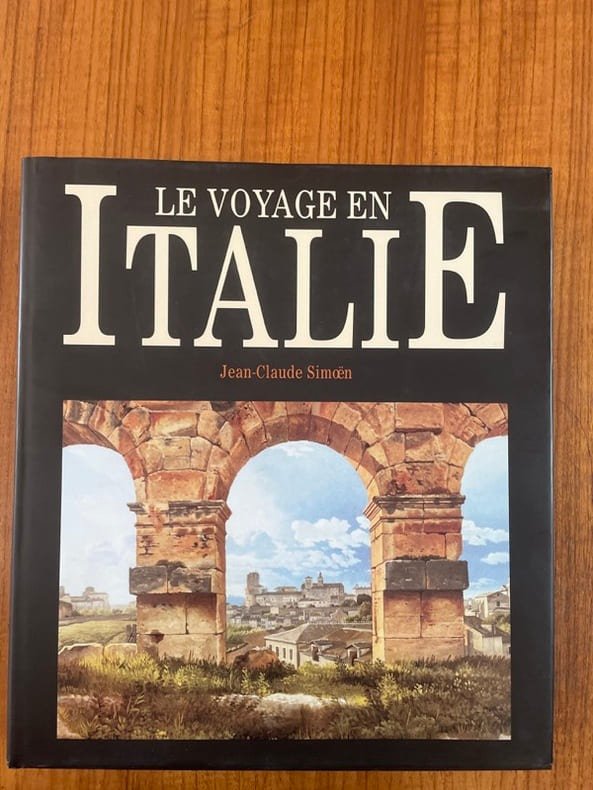
Impact Livre 2001 In-4 reliure éditeur sous jaquette, 491 pp. Illustrations couleurs
Reference : 4508
ISBN : 2739200056
Très bon état d’occasion
Bookseller's contact details
Librairie de l'Avenue
M. Henri Veyrier
Marché aux Puces. 31, rue Lecuyer
93400 Saint-Ouen
France
01 40 11 95 85
Payment mode


Sale conditions
Conforme aux usages de la profession. Paiement avec votre carte bancaire par Paypal ou en V.A.D. (Vente à distance sur le site), par virement ou chèque. Les frais de port sont de 9,50 € pour la France pour les colis de moins de 5kg en colissimo (ou 4,50 € en Mondial Relay), 12 € pour les pays de l'Union Européenne (sauf Espagne) en Mondial Relay. Nous consulter pour les autres pays et livres au dessus de 5kg. Notre téléphone : 01 40 11 95 85.
5 book(s) with the same title
Voyage D'Italie, contenant les Moeurs des peuples, la description des Villes Capitales, des Eglises, Convents, Tombeaux, Bibliotheques (...). 2 vols. - [THE MOST INFLUENTIAL GUIDEBOOK OF ITS DAY - COINING ""GRAND TOUR""]
Paris, Ballaine, 1671. 8vo. Two part bound in one contemporary full calf binding with five raised bandes. Wear to extremities. Upper capital chipped, with a bit of loss of leather, showing endbands. Inner hinges split. Previous owner's name to front free end-paper. Small worm-tract to inner margin, not affecting text. (36), 436, 341 pp.
The exceedingly rare first French translation of Lassels‘ travel-guide, considered the first comprehensive guide to Italy it quickly became the most influential English guidebook of its day. The concept of the “Grand Tour” was also first introduced here. Lassels’ asserts that any truly serious student of architecture, antiquity, and the arts must travel through France and Italy, and suggested that all ""young lords"" make what he referred to as the Grand Tour in order to understand and learn about the political, social and economic realities of the world. “The idea of tourism as self-enriching rather than soul-preserving come truly into vogue between 16th and 18th centuries. The Grand Tour, a term first used in the French translation of a ‘Voyage or a Compleat Journey through Italy’ by Richard Lassels published in 1670, encompassed experience (including sexual), education and exchange of ideas, creating the largest and most independent wandering “academy” – a sort of finishing school – that Western civilization had ever known”. (White, Museum and Heritage Tourism). “The term ‘Grand Tour’ itself first appeared in the French translation of Richard Lassels’ Voyage or a Complete Journey Through Italy, which was published in 1670. This was one of a number of accounts of travel on the Continent, most of which were written by Englishmen, and by the early eighteenth century, there was a steady stream of such publications. The eighteenth century then saw a massive growth in the production of books, newspapers, and other printed material, and this encouraged the development of different types of writing and publishing, including travel accounts. There also emerged travel guides, the most useful of which was probably The Grand Tour containing an Exact Description of most of the Cities, Towns and Remarkable Places of Europe by Mr [Thomas] Nugent, first published in four volumes in 1743, and repeatedly republished. An alternative was The Gentleman’s Pocket Companion for Travelling into Foreign Parts, first published in 1722, which contained a list of useful phrases at the end, but not, perhaps, those which the wellbred young man should employ.” (Kathleen Burk, The Grand Tour of Europe) The most influential English guidebook of the period, conditioning the first impressions of many a tourist to that country. It also provided the basis for subsequent guidebooks . . . The unprecedented attention it paid to art and architecture encouraged the phenomenon of the eighteenth-century style 'grand tour' (a term coined by Lassels) according to which art prevailed over all other subjects, religious or secular"" (ODNB). The original English edition was published in 1670. French translations were published it 1671 and 1682. A German translation titled 'Ausführliche Reise-Beschreibung durch Italien' appeared in Frankfurt editions in 1673 and 1696. It was reprinted well into the 1700ies. Provenance: A large Danish estate.

Voyage d'Italie de Monsieur Misson, avec un Mémoire contenant des avis utiles à ceux qui voudront faire le même voyage. Cinquième édition, plus ample et plus correcte que les précédentes, enrichie de nouvelles figures... 4 vols. - [BEAUTIFUL TRAVEL GUIDE TO ITALY]
Utrech, Guillaume van Water & Jacques van Poolsum, 1722. 8vo. Uniformly bound in 4 magnificent contemporary full calf Cambridge-style bindings with five raised bands and richly gilt spines. Gilt frames to boards and blind-tooled ornamentation to edges of boards. Boards with wormtracts, primarily affecting vol. IV. Small wormtract effecting frist half of vol. III. An overall nice set. (46), 339, (20) pp. + 32 folded plates (including frontispiece) 356, (24) + 39 engraved plates 414, (19) pp. + 7 plates. (6), 347, (7) pp. + 1
Fourth edition of this important and influential travel-guide to Italy. Misson travelled through Italy during 1687 and 1688, and in 1691 published the Nouveau voyage d'ltalie, which was to be the standard travel guide to Italy for the following fifty years. Provenance: From a large Danish estate.
Le Voyage d'Italie - Dictionnaire des Amoureux
Plon 1998 681 pages 15 4x4 4x24cm. 1998. broché. 681 pages. Le Voyage d'Italie de Dominique Fernandez est un dictionnaire amoureux et subjectif qui décline la passion de l'auteur pour l'Italie à travers 152 notices. Mêlant souvenirs histoire de l'art littérature et observations l'ouvrage offre un panorama bigarré et cultivé des villes des mythes et de la culture italienne
Bon état
Le voyage d'Italie
Plon 1998 688 pages 15 4x4 4x24cm. 1998. broché. 688 pages. Le Voyage d'Italie est un dictionnaire amoureux de l'Italie où Dominique Fernandez décline sa passion pour ce pays à travers 152 notices. L'ouvrage illustré par les photographies de Ferrante Ferranti mêle observations portraits histoires et explorations des lieux des mythes et de la culture italienne de la littérature à la musique
Bon état
Nouveau voyage en Italie, avec un mémoire contenant des avis utiles à ceux qui voudront faire le même voyage.
La Haye, Henry van Bulderen, 1702. 3 volumes in-12 de [56]-339-[21]; 356-[24]; 414-[20] pages, plein veau brun, dos à nerfs ornés de filets et fleurons dorés, pièces de titres bordeaux, tranches rouges.
Importante iconographie composée de 57 gravures hors-texte (14+36+7) dont 30 dépliantes; et un titre gravé au premier volume. Le nombre de planches varie d'un exemplaire à l'autre, certains exemplaires possède 80 planches d'autres moins. Fils du pasteur de Sainte-Mère-Église, le jeune Maximilien Misson se destine, comme son père au pastorat protestant et fait des études à Genève. Condamné à l'exil en Angleterre par la révocation de l'Édit de Nantes, il abandonne la carrière ecclésiastique et devient précepteur d’un jeune aristocrate britannique, Charles Butler, avec qui il voyagea trois ans à travers Europe. C'est ce voyage qu'il raconte en 41 lettres, adressées à un destinataire anglais anonyme, et publiées une première fois en 1691 (en deux volumes). Le Voyage d'Italie s'oppose aux récits des voyageurs catholiques, c'est un anti-pèlerinage. Misson porte un regard critique sur ce pays qui est pour lui le lieu de la superstition et du papisme. Cependant le texte ne saurait se réduire à son aspect polémique. C'est d'abord une relation précise, écrite dans un style élégant et fluide, de tout ce qu'on peut admirer en Italie (des oeuvres d'art aux phénomènes surnaturels), et il a été utilisé comme guide de voyage jusqu'au milieu du XVIIIe siècle, même si Pompéi et Herculanum n’avaient alors pas été découverts. C'est ici la quatrième édition, l'avant dernière publiée du vivant de son auteur. Toutes les éditions sont rares. Ex-libris manuscrit sur les pages de titre: J. J. Chaponière D. M. P. Sans les coiffes, coins frottés, un mors partiellement fendu. Brunet, 20168; Fossati-Bellani, 366: Fiammeta- Olschski 453; Biblio. du voyage français en Italie, p. 54.