 Write to the booksellers
TIBULLE (Albii Tibulli Equitis Rom.)
Quae Exstant, Ad fidem Veterum Membranarum sedulo castigata. Accedunt Notae, cum Variar. Lectionum Libello, & terni Indices ; quorum primus Omnes Voces Tibullianas Complectitur
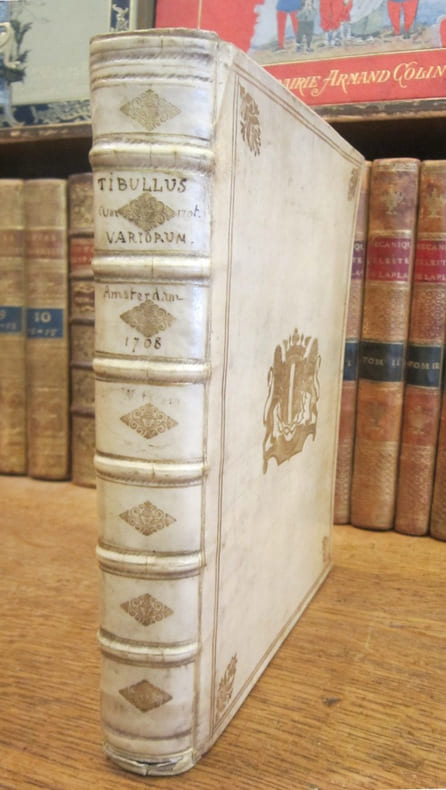
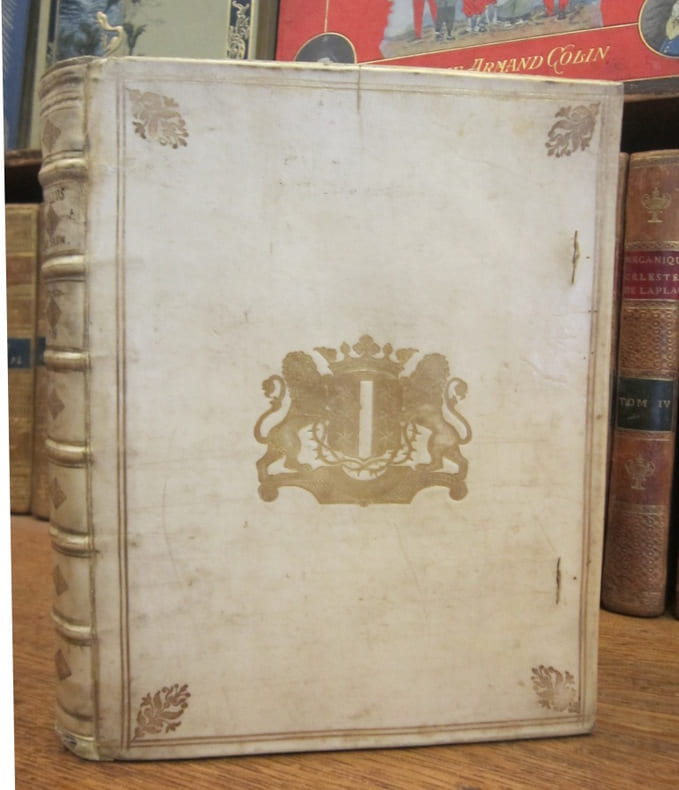
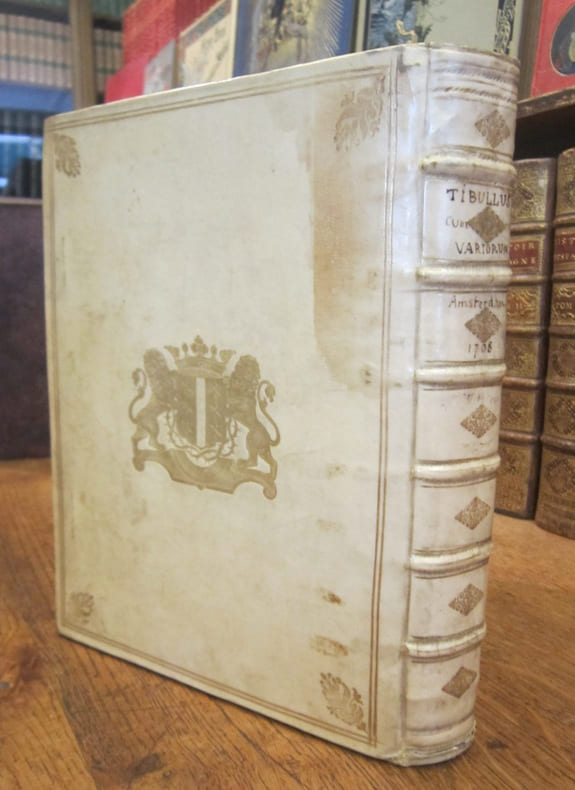
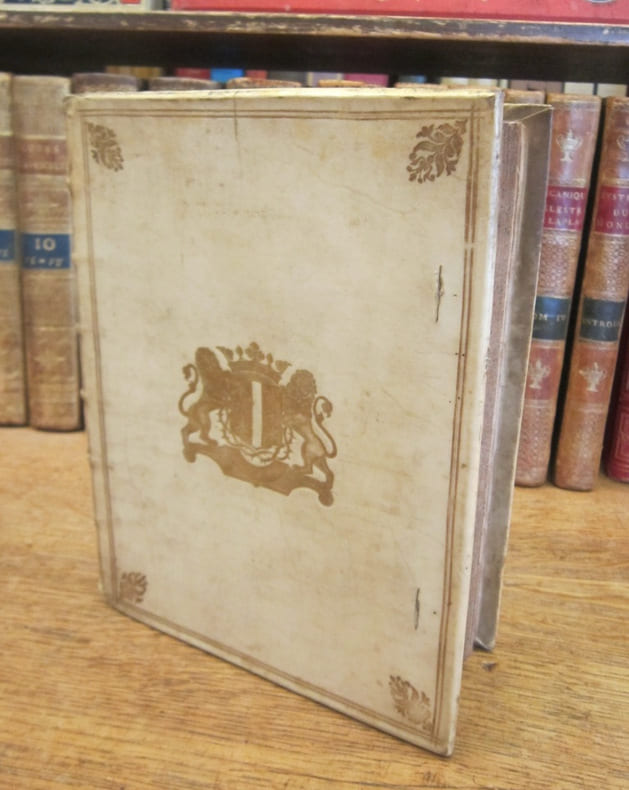
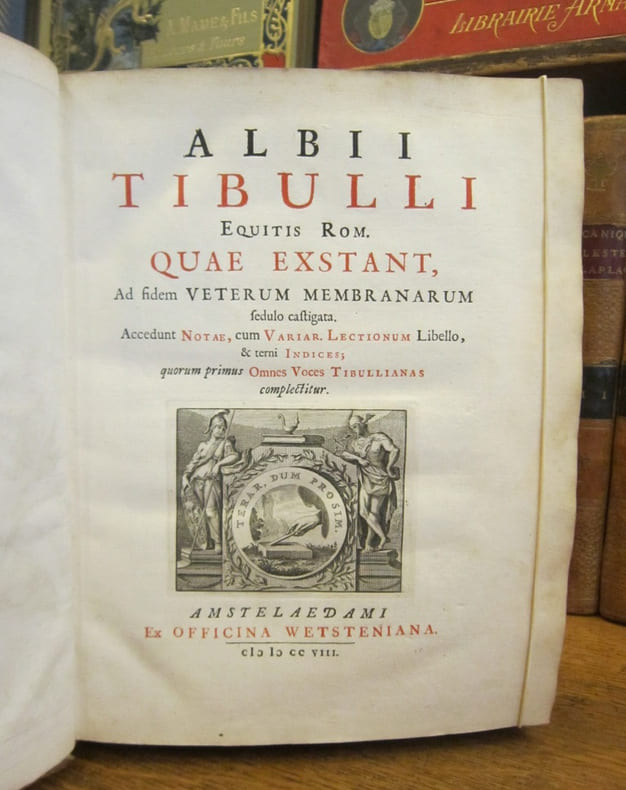
Amstelaedami (Amsterdam) Ex Officina Wetsteniana (Wetstein) 1708
Reference : 000312
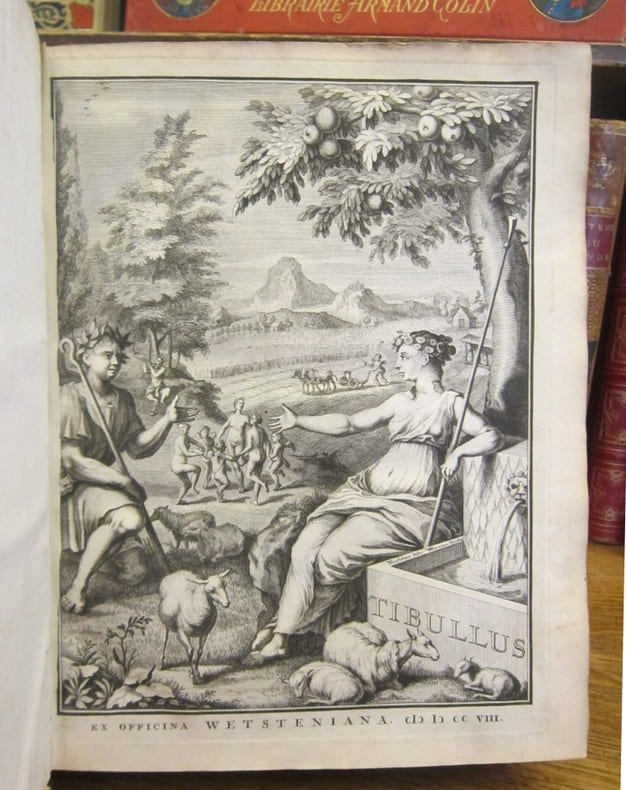
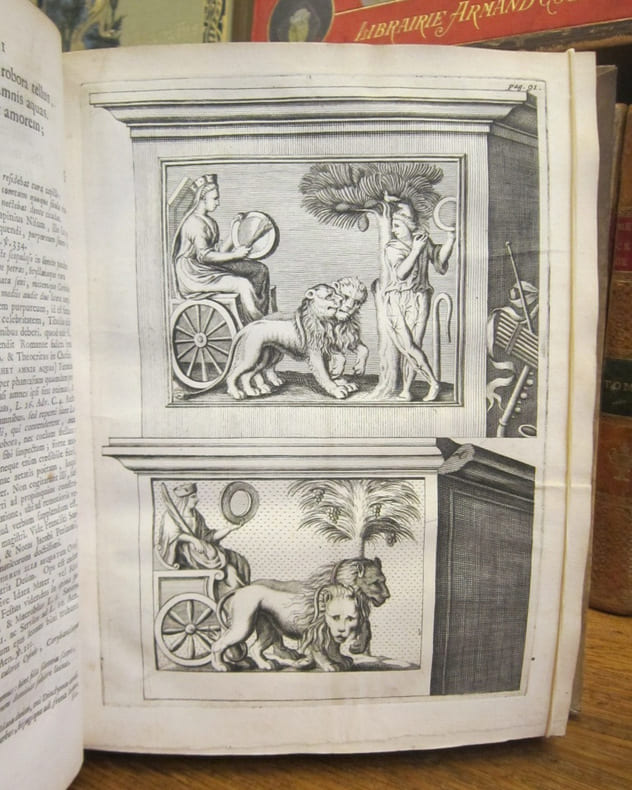
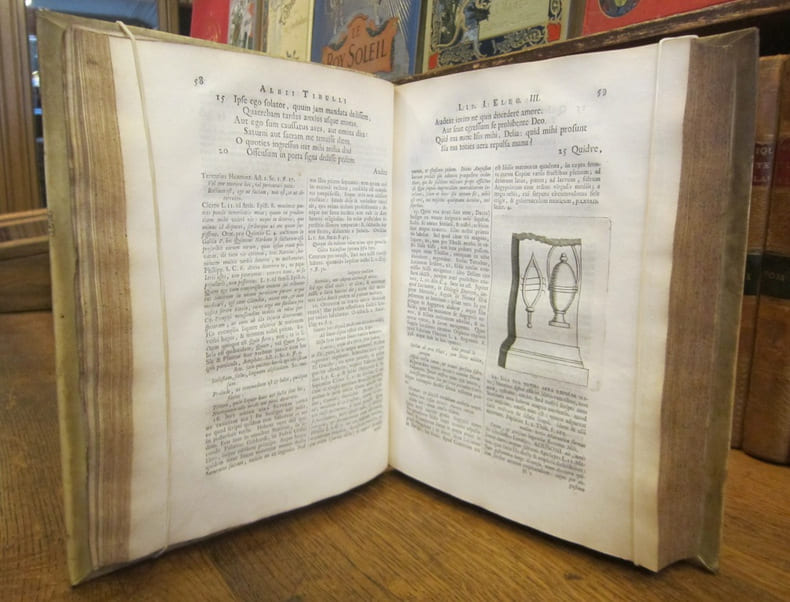
In-4 (243 x 194 mm), vélin ivoire, dos à nerfs soulignés de filets or, fleuron doré dans les caissons, titre calligraphié, armes au centre des plats, double filet en encadrement avec fleurons d'angles, tranches mouchetées (reliure d'époque). Illustré d'un frontispice, 9 gravures hors-texte, 9 vignettes dans le texte. L'une des plus belles éditions de Tibulle, "poète de la tendresse, maître de l'élégance" (Gonzague Truc). Ornée d'une très belle illustration gravée, elle fut donnée par Jean van Broekhuizen, navigateur et poète néo-latin hollandais (Brunet V, col. 856). Exemplaire en grand papier, aux armes de la Famille Victor, probablement émigrée à Amsterdam à la suite de la Révocation de l'édit de Nantes (Escoffier. Série Héraldique I, 21, fer n° 19. Riestapp II, 995). Etiquette Librairie Costey frères. (quelques défauts d'usage, coiffe inférieure usagée, trace sur le second plat, encoches sur les plats car les lacets manquent, quelques légères rousseurs). // Quarto (243 x 194 mm), ivory-colour vellum, spine raised on bands with gilt fillets and gilt flowerets, calligraphic title, central arms on covers, double fillet border and floweret on corners, sprinkled edges (contemporary binding). Illustrated with a frontispiece, 9 engraved plates and 9 engraved vignettes in the text. One of the nicest edition of Tibulle, "tenderness poet, master in the elegance" (Gonzague Truc). Decorated with fine engravings, it was set up by Jean van Broekhuizen, neo-Latin Dutch sailor and poet (Brunet V, col. 856). Copy on fine large paper, bearing arms of Victor family, who probably migrated to Amsterdam at the time of "Edit de Nantes" (Escoffier. Série Héraldique I, 21, fer n° 19. Riestapp II, 995). Stamp of Librairie Costey frères. (some defects of use, bottom of spine used, stain on lower plate, notches on covers due to lacking laces, some light spots).
Bookseller's contact details
Henri Picard et Fils
M. Christian Picard
126 rue du Faubourg Saint-Honoré
75008 Paris
France
01 43 59 28 11
Payment mode
Sale conditions
Conformes aux usages de la librairie ancienne et moderne. <br />
1 book(s) with the same title
Albii Tibulli Equitis Rom. Quae exstant, ad fidem veterum membranarum sedulo castigata. Accedunt notae, cum Variar. Lectionum libello, & terni Indices; quorum primus omnes voces Tibullianas complectitur.
Amsterdam (Amstelaedami), Ex Officina Wetsteniana, 1708.
4to. (XX, including frontispiece),476,(73 index),(1 blank) p., 9 full page engravings. Calf. 23.5 cm (Ref: STCN ppn 186442033; Schweiger 2,1093; Graesse 6/2,157; Ebert 22968; Brunet 5,856) (Details: Back gilt and with 5 raised bands. Red shield in the second compartment. Edges dyed red. Marbled endpapers. Frontispiece engraved after a design of Joseph Mulder, by Willem (de) Broen, who is also the engraver of the 9 plates. The frontispiece shows left a shepherdess, probably Delia, Tibullus first love, and the subject of book I; she leans on a fountain, holding a staff; she reaches out towards a shepherd at the left, in the distance 3 nude women (the three Graces) dancing with 3 putti; a ploughing farmer in background, sheep in foreground. Title printed in red and black. Engraved printer's mark on the title, with Wetstein's motto: 'Terar dum prosim'. Commentary in 2 columns below the text. P. 409/441 contain the 'libellus Variarum Lectionum' on, p. 442/466 the 'notae' of Nicolaas Heinsius, p. 467/476 observations by Janus Dousa) (Condition: Binding somewhat scuffed. Head & tail of the spine chafed. Paper yellowing) (Note: Latin love elegy is more or less an original Roman creation. It is a literary form of which almost every feature is derived from Greek models, but it has no analogue in Greek literature. These elegies, 'clearly Greek in inspiration, are all concerned with love, and it is predominantly as a medium for love poetry that the elegy was developed during the first century B.C. (...) What might be called the classic type of love-elegy, the cycle of short poems centred upon the poet's relationship with a single mistress, appears to have originated with Cornelius Gallus: his 'Lycoris' (...) was the prototype of Tibullus' Delia, Propertius' Cynthia, Ovid's Corinna, and Lygdamus' Neaera'. (OCD 2nd ed. p. 379) This edition of Tibullus of 1708 contains what is now called the 'Corpus Tibullianum'. Of this corpus, consisting of 4 books, only the first two belong to the Latin poet and elegist Tibullus, 55-19 B.C., who was probably a Roman knight. The first book deals with the poet's unhappy love for a mistress, Delia, a married woman, probably of a low social status, and for a boy named Marathus. The poetic attributes of these lovers are largely conventional, but they may really have existed. Book two, which is believed to be incomplete, celebrates in 3 elegies a new courtesan, Nemesis, probably also ficticious. There is also an elegy on the blessings of peace, and the impression of a rustic festival. The third and fourth book are by the hands of other poets. Book three contains six smooth but wooden elegies by a much inferior poet, who calls himself Lygdamus. The 4th book of the Tibullus collection consists of elegies of a very different quality, and opens with 211 hexameters on the achievements of Tibullus' patron M. Valerius Messalla Corvinus, the 'Panegyricus Messallae'. Incorporated in the 4th books are also a number of short elegies, written with a unique frankness by the 'docta puella' Sulpicia, a contemporary of Tibullus. This edition was produced by the Dutch scholar/soldier Joan van Broekhuizen (Janus Broukhusius), 1649-1707, who during an adventurous life pursued his classical studies and poetry at leisure. His editions of Propertius (1702) and Tibullus laid the foundation for his reputation as a classical scholar. He was admired as a latinist, for his taste and for his erudition. (NNBW 4,309/12) As a neolatin poet he is known as the 'Propertius of Holland'. (Sandys 2,329)) (Collation: *-2*4, 3*2; A-3Y4, 3Z2 (leaf 3Z2 verso blank)) (Photographs on request)

