 Write to the booksellers
LÉVINAS Emmanuel
TOTALITÉ ET INFINI. Essai sur l'extériorité.
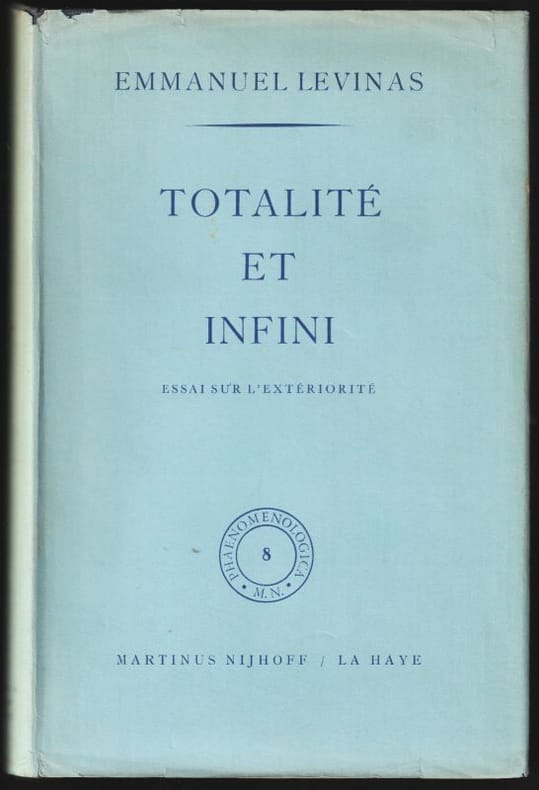
Martinus Nijhoff 1961 La Haye (Pays-Bas), Martinus Nijhoff éditeur, collection Phaenomenologica, 1961. Édition originale. In-8 de XVIII - 284 pp. Reliure de l'éditeur, pleine toile bleue imprimée en doré, jaquette bleu ciel imprimée en bleu foncé, tranche supérieure gris bleuté. Jaquette un peu usagée avec un petit manque et une tache au second plat. Le livre lui-même est en très bon état. Intérieur bien frais et sans annotations.
Reference : 19356
très bon
Bookseller's contact details
Le Livre Penseur
Dominique Bolland
23 bis rue des Ecoles
75005 Paris
France
01 44 61 00 77
Payment mode
Sale conditions
Les prix indiqués sont nets. Les frais de port sont à la charge de l'acquéreur, le montant vous sera communiqué par mail ou par téléphone. Les ouvrages sont expédiés à réception de la totalité du règlement (chèques étrangers : \+ 15 ). Les commandes se font par téléphone, mail ou courrier et doivent être réglées dans les huit jours. Passé ce délai les livres retenus sont remis en vente. Le catalogue, annuel, vous sera expédié sur simple demande. Achat permanent de livres, en lot ou à l'unité, sur Paris. <br />
2 book(s) with the same title
Totalité et infini. Essai sur l'extériorité. - [""THE FACE OF THE OTHER""]
La Haye, Nijhoff, 1961. Royal 8vo. Original blue full cloth with gilt lettering to spine, and in the original blue dust-jacket. Cloth with a white spot to spine, from removal of some sort of label. Front board a tiny bit bended towards corners. Dust-jacket unusually clean and fine with just a few tears with almost no loss, and with a bit of loss to upper layer of paper, from removal of some sort of label (exactly the same place as on cloth-spine). XVIII, 284 pp.
The rare first edition of this absolute masterpiece of 20th century philosophy and a towering achievement of philosophical ethics, Levinas' main work, in which he introduced the concepts ""the face of the other"" and ""radical alterity"".The French-Lithuanian philosopher Emmanuel Levinas was among the first French academic philosophers to come to Freiburg to study phenomenology with Edmund Husserl and Martin Heidegger and subsequently introduced this philosophical methodology in France, among others to Jean-Paul Sartre who would, a few years later, go to Germany to study phenomenology himself.""Totalité et Infini"", Levinas' first major work, grew out of his experience of the Second World War which he survived as a prisoner of war in Germany. It revolves around the possibility of ethics in a world dominated by the will to power and the inescapable reality of war. The prominence, which it rapidly attained through its enthusiastic reception by contemporaries such as Paul Ricoeur, is tied to the originality and urgency of its reflection on the foundation of ethics - and the ethical foundation of philosophy itself. This is at the heart of Levinas' claim that ethics must be understood as the primary form of philosophy.The concepts which ""Totalité et Infini"" introduced into philosophy (the face of the Other, radical alterity) now form part of the grammar of modern ethical reflection. In these years, the work is also finding reception in aesthetics, in part, through the writings of Levinas' close friend Maurice Blanchot.

Totalité et infini : essai sur l'extériorité
Broché. Autre maquette de couverture. 2006. 348 pages. Photos sur demande.
Merci de nous contacter à l'avance si vous souhaitez consulter une référence dans notre boutique à Authon-du-Perche.

