 Write to the booksellers
(NIETZSCHE) - HALÉVY Daniel
NIETZSCHE
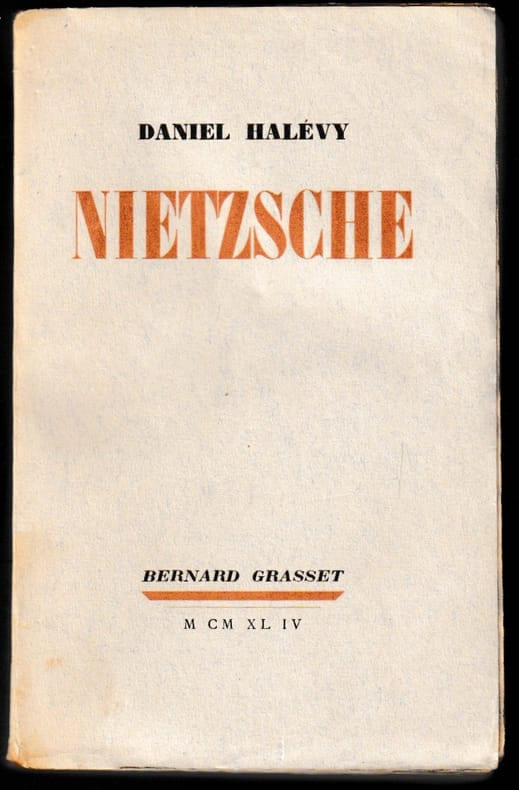
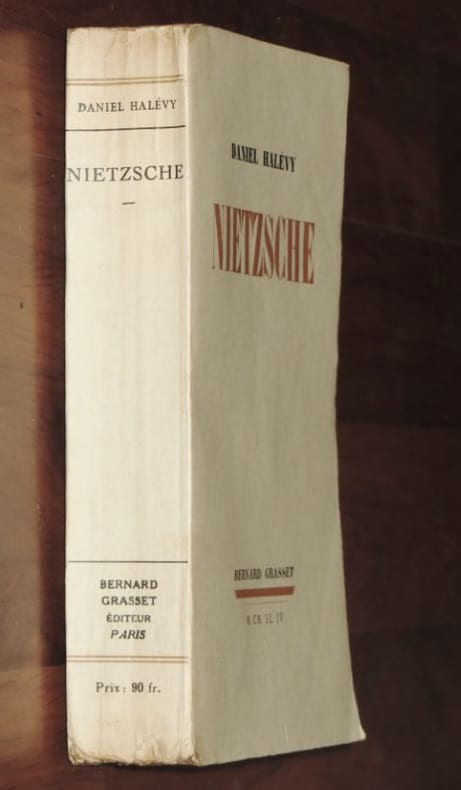
1944 Paris, éditions Bernard Grasset, 1944. Édition originale, exemplaire du tirage courant, avec mention fictive de 8è édition. In-12 broché de 590 pp., orné de 14 planches hors texte dont un portrait photographique de l'auteur en frontispice. Couverture grise imprimée en brun clair et noir. Dos un peu usagé, sans manque. A l'intérieur quelques rares et discrètes accolades en marge, sinon très bon état. Papier de l'époque, uniformément jauni.
Reference : 18166
Bookseller's contact details
Le Livre Penseur
Dominique Bolland
23 bis rue des Ecoles
75005 Paris
France
01 44 61 00 77
Payment mode
Sale conditions
Les prix indiqués sont nets. Les frais de port sont à la charge de l'acquéreur, le montant vous sera communiqué par mail ou par téléphone. Les ouvrages sont expédiés à réception de la totalité du règlement (chèques étrangers : \+ 15 ). Les commandes se font par téléphone, mail ou courrier et doivent être réglées dans les huit jours. Passé ce délai les livres retenus sont remis en vente. Le catalogue, annuel, vous sera expédié sur simple demande. Achat permanent de livres, en lot ou à l'unité, sur Paris. <br />
5 book(s) with the same title
Götzen-Dämmerung oder Wie man mit dem Hammer philosophirt. Von Friedrich Nietzsche. Leipzig, Verlag von C.G. Naumann, 1889. - (Bound with:) NIETZSCHE, F. Der Fall Wagner. Ein Musikanten-Problem. Von Friedrich Nietzsche. Zweite Auflage.
Leipzig, Verlag von C.G. Naumann, (1888.) Two works in one volume. (8), 144 pp.; (8), 57, (1) pp. 8vo. Contemporary half cloth, spine lettered gilt, marbled boards, corners. First work: Schaberg 56. First edition of the "Twilight of the Gods" and written during an incredibly productive six month period before Nietzsche's collapse in Turin. It was also the last book published during his lifetime. The title refers to an image in the preface: idols "are touched with a hammer and a tuning fork to determine whether they are hollow", which is of course a sarcastic allusion to Wagner, both personally and as a symbol of the German spirit. Nietzsche had 1,000 copies of this work privately printed. Originally to be called "A Psychologist at Leisure," Nietzsche changed the title at the suggestion of his friend, Gast and the book was released a few weeks after Nietzsche collapsed in Turin. The "Idols" that Nietzsche singles out here are those of the philosophers and the moralists. The Preface clearly states that the work at hand is to be "the revaluation of all values". Socrates and Christianity are particular targets although modern Germany and other contemporary ideas are also taken to task in the normally acerbic style of the author. (This book also contains some of Nietzsche's most frequently quoted phrases beginning with Aphorism #8: "What does not kill me only makes me stronger".)Second work: Schaberg 54.First edition, second issue. The book was published on 22 September 1888. Five hundred copies were printed, but 500 additional copies were printed at this time and falsely marked as second edition by the addition of "Zweite Auflage" in the middle of the ornamental rule and the deletion of the publication date. The true second edition of a 1000 copies was printed in October of 1891.The book is a critique of Richard Wagner and the announcement of Nietzsche's rupture with the German artist, who had involved himself too much, in Nietzsche's eyes, in the Völkisch movement and antisemitism. His music is no longer represented as a possible "philosophical affect," and Wagner is ironically compared to Georges Bizet. However, Wagner is presented by Nietzsche as only a particular symptom of a broader "disease" which is affecting Europe, that is nihilism. The book shows Nietzsche as a capable music-critic, and provides the setting for some of his further reflections on the nature of art and on its relationship to the future health of humanity.This work is in sharp contrast with the second part of Nietzsche's The Birth of Tragedy, wherein he praised Wagner as fulfilling a need in music to go beyond the analytic and dispassionate understanding of music. Nietzsche also praised Wagner effusively in his essay 'Wagner at Bayreuth' (part of the Untimely Meditations), but his disillusion with Wagner the composer and the man was first seen in his 1878 work Human, All Too Human. One of the last works that Nietzsche wrote returned to the critical theme of The Case of Wagner. In Nietzsche contra Wagner, Nietzsche pulled together excerpts from his works to show that he consistently had the same thoughts about music, only that he had misapplied them to Wagner in the earliest works. - First and last leaves a bit foxed, some scattered annotations in blue pencil and lead pencil.Provenance: from the library of A. Diepenbrock, with his signature on the first free endpaper (and date Jan. 1889) and second title-page (with the date Sept. 1888.) Alphons Diepenbrock was a Dutch composer, essayist and classicist. Although he showed musical ability he studied classics at the University of Amsterdam, gaining his doctorate cum laude in 1888 with a dissertation in Latin on the life of Seneca. The same year he became a teacher, a job which he held until 1894, when he retired from that position and decided to devote himself to music. As a composer, he had been completely self-taught from an early age. He created a musical idiom which, in a highly personal manner, combined 16th-century polyphony with Wagnerian chromaticism, to which in later years was added the impressionistic refinement that he encountered in Debussy's music. His predominantly vocal output is distinguished by the high quality of the texts used. Apart from the Ancient Greek dramatists and Latin liturgy, he was inspired by, among others, Goethe, Novalis, Vondel, Brentano, Hölderlin, Heine, Nietzsche, Baudelaire and Verlaine. As a conductor, he performed many contemporary works, including Gustav Mahler's Fourth Symphony (at the Concertgebouw) as well as works by Fauré and Debussy. Throughout his life, Diepenbrock continued his interests in the wider cultural sphere, remaining a classics tutor and publishing works on literature, painting, politics, philosophy and religion. Indeed during his lifetime his musical skills were often overlooked. Nonetheless, Diepenbrock was very much a respected figure within musical circles. He counted amongst his friends Mahler, Richard Strauss and Arnold Schoenberg.


(NVVA, )
Phone number : 31 20 698 13 75
Sur Nietzsche. Volonté de chance
In-12 (186 × 118 mm) de 284-[4] pp. ; broché, couverture imprimée.
Édition originale. Exemplaire du service de presse sur papier d’édition. Précieux volume offert par l’auteur à Sylvia Bataille et à Jacques Lacan. Il porte cet envoi de Georges Bataille à l’encre bleue sur le faux-titre : à Sylvia et à Jacques affectueusement Georges Après avoir épousé l’auteur d’Histoire de l’œil en 1928, Sylvia Bataille partagea la vie de Jacques Lacan de 1938 jusqu’à la mort de ce dernier en 1981. Bataille gardera de bonnes relations avec son ex-épouse, et fut très proche de Lacan dans les années 1940. Sur le cercle intellectuel de Georges Bataille à cette époque, fréquenté entre autres par Jacques Lacan, Michel Leiris, Jean-Paul Sartre et Simone de Beauvoir, voir Élisabeth Roudinesco. Sur Nietzsche est un des livres fondamentaux de Bataille, peut-être même la clef de tous les autres. «Si toute la pensée athéologique repose en effet tout entière sur la notion de système, elle en est en même temps l’excès. Des textes comme Madame Edwarda, Le Mort, Le Petit représentent sans conteste cet excès. Le Coupable, L’Expérience intérieure, d’une certaine façon aussi. Bataille ne les a-t-il pas sciemment expurgés de ce qui justifiait cet excès à en ruiner le système ? Mais le système existe, et Sur Nietzsche, le dernier des grands livres de cette somme, le met à nu... » (Michel Surya) «À peu d’exceptions près, ma compagnie sur terre est celle de Nietzsche...», a écrit Bataille, et aussi : « Je suis le seul à me donner, non comme un glossateur de Nietzsche, mais comme étant le même que lui.» Benoît Goetz s’est interrogé sur cette «mêmeté» de Nietzsche et de Bataille, «qui n’est pas identité, dont l’origine n’est pas d’ordre mimétique... Ou si identité il y a, elle est peut-être du même ordre que celle dont parlait Deleuze : “la grande identité” de Spinoza et de Nietzsche ». Cette « mêmeté », poursuit-il, « n’est pas sans rapport avec ce que Nietzsche a nommé “éternel retour du même”, et qui n’a rien à voir, comme Deleuze l’a bien souligné, avec la très vieille hypothèse de cycles cosmiques répétitifs. À travers la répétition tout change et varie. Bataille n’est donc pas un clone de Nietzsche, qui ne réclamait ni disciples ni épigones, mais un écho. Bataille fait écho à Nietzsche. On peut nommer ce phénomène “parodie”, même si le mot n’est plus à la mode. Cela signifie qu’une pensée et une écriture, un mode de vie, un ethos glissent le long d’autres textes et d’autres pensées, au point de les épouser, comme un anneau un autre anneau, mais sans confusion aucune. Noces contre nature, celles de la guêpe et de l’orchidée. Mélodie éternelle qui se chante elle-même.» Le saut nietzschéen dont il faut faire l’expérience, consisterait, pour Bataille, «à mordre la tête du serpent de l’esprit de vengeance (pour reprendre l’image du Zarathoustra), et à se débarrasser du ressentiment contre le temps et le “il était”. C’est le fond sans fond de la pensée du retour. [...] Comme Nietzsche, Bataille est un penseur du plus grand sérieux qui se renverse en jeu et en danse. » La pensée de Nietzsche, saisie à travers le prisme de l’œuvre de Bataille, « est por- teuse d’une affirmation qui n’est affirmation que de l’affirmation, et non d’une doctrine particulière. La “doctrine” de l’éternel retour est sans contenu, à la différence, sans doute, de la doctrine de la volonté de puissance. Pour parler comme Heidegger, cette dernière énonce quelque chose concernant l’être de l’étant. La “doctrine” de l’éternel retour, la “grande pensée” n’énonce rien de tel. Elle est l’affirmation d’une manière d’être, d’une manière de l’être lui-même, qui ne comporte rien de fixe, donc rien d’étant et qui par conséquent nous emporte nous-même...» Comme l’écrit Nietzsche dans Le Gai savoir, « L’impérieux jeu du monde / mêle l’être et l’apparence / L’éternelle extravagance / Nous y mêle pêle-mêle. » (trad. de Pierre Klossowski). Marges un peu jaunies, infimes traces d’usure à la couverture. Provenance : Sylvia Maklès (1908-1993) et Jacques Lacan (1901-1981), puis par descendance. – Sotheby’s, cat. Livres et manuscrits, 15 décembre 2020, lot 86. Références : Élisabeth Roudinesco, Jacques Lacan, Paris, Fayard,1993, pp.172-229, passim.– Michel Surya, Georges Bataille, la mort à l’œuvre, Paris, Gallimard, 1992 (rééd. 2012), p. 390, passim. – Benoît Goetz, « Éternel retour de Nietzsche », in Le Portique, revue de philosophie et de sciences humaines, no 29, 2012 (en ligne).
Nietzsche, un continent perdu
2000, Presses Universitaires de France, perspectives critiques, in-8 broché de 366 pages, Nietzsche, un continent perdu | Etat : bon état (Ref.: ref91099)
presses universitaires de France
Comprendre Nietzsche
2009, Armand Colin, in-8 broché de 270 pages, Comprendre Nietzsche | Etat : bon état (Ref.: ref89401)
Armand Colin
Du Tragique au Matérialisme (Et Retour) - vingt-six études sur Montaigne, Pascal, Spinoza, Nietzsche et quelques autres
2018, Presses Universitaires de France, in-12 broché de 730 pages, Du Tragique au Matérialisme (Et Retour) - vingt-six études sur Montaigne, Pascal, Spinoza, Nietzsche et quelques autres | Etat : bon état, coins un peu frottés (Ref.: ref85965)
presses universitaires de France

