 Write to the booksellers
GRENIER Jean
ALBERT CAMUS
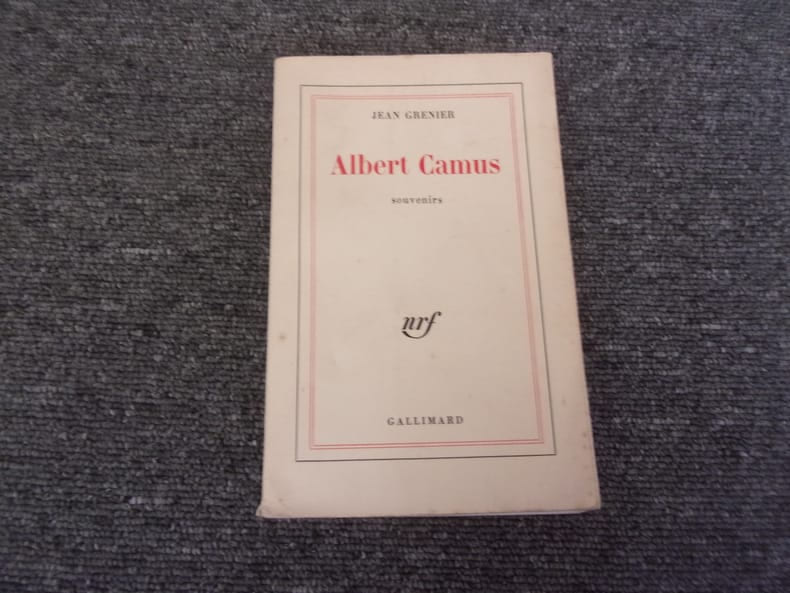
Petit format, couverture souple. 190 pages. Couverture jaunie. Intérieur bon. Une expédition par Mondial Relay vous sera proposée 1968 NRF Gallimard
Reference : 26370
Bookseller's contact details
Occasion de lire
M. Vincent Huchette
1032 rue du grand pont
62140 Aubin Saint Vaast
France
09 64 01 66 55
Payment mode

Sale conditions
Les prix sont nets.le port est en plus. une expédition par Mondial Relay vous sera proposée. Expédition des ouvrages dans un emballage protecteur soigné des la réception du règlement par chèque, virement bancaire ou Paypal.
5 book(s) with the same title
Albert Camus Essais
1972 Gallimard Hardcover Fine
Langue: français. Bibliothèque de la Pléiade Albert Camus Essais 1975 pp, reliure d'éditeur. Sous jaquette et rhodoïd. Bel exemplaire. [Cette description peut avoir été traduite par une IA.]

La dévotion de la croix. pi|ece en trois journées. Texte francais d'Albert Camus. - [PRESENTATION-COPY FROM CAMUS]
(Paris) Gallimard, 1953. 8vo. Bound uncut with the original printed wrappers in an exquisite full red morrocco binding with quadruple gilt lines over boards and spie and gilt lettering to spine (bound by Henning Jensen and gilt by Hagel Olsen). Top edge red. Gilt super ex libris to inside of front board. A splendid, near min copy in a wonderful, elegant binding. 169, (4).
First edition - nr. 3140 out of 3265 numbered copies, on alfama Marais (preceded by 65 copies on Lafuma Navarre) - signed presentation-copy from Camus, of his translation of an early 17th century historical play by the Spanish dramatist Pedro Calderón de la Barca (1600-1681), La dévotion de la croix (ES: La devoción de la cruz" EN: Devotion to the Cross). ""A keynote of Calderon’s tragic view of life is his deep-seated realization that a man can be responsible through his own wrongdoing for the wrongdoing of another. This realization probably derives from Calderón’s own family experience. In La devoción de la cruz (c. 1625"" Devotion to the Cross) [...], the heart of the tragedy lies in the fact that the greatest sinner is also the most sinned against—in that others, before he was born, had begun to dig his grave"" (Parker 2026). The play was translated for the Festival D'Angers – founded in 1950 and still existing today as Festival D'Anjou – of which he was an artistic director in 1953 and again in 1957, where he selected another Spanish play, The Knight from Olmedo, by Lope de Vega, the predecessor of Calderon. Camus translated this particular piece upon the request of the actor Marcel Herrand (1897-1953), who passed away before the festival took place (see foreword written by Camus, p. 11). The stark tradegy was performed in June 1953, starring Maria Casarès, who had assisted Camus in the translation, Serge Reggiani, Paul Oettly and Jean Marchat (Lottman: 524-25), and was a success: ""Camus' adaptations received national press attention, and locally the press would say that the Calderón work was so perfectly performed it could never again be played on an ordinary theater stage."" (Lottman: 525)After WWII, Albert Camus (1913-1960) became, as a novelist and playwright, moralist and political theorist, ""the spokesman of his own generation and the mentor of the next, not only in France but also in Europe and eventually the world"" (Cruickshank 2026). The presentation-inscription reads: ""à Sylvester | pour son salut | et avec la fidèle et | cordiale pensée | d'Albert Camus"". Sources and further reading: Aronson, Ronald. (Winter 2022 Edition). Albert Camus. In Edward N. Zalta & Uri Nodelman (eds.), The Stanford Encyclopedia of Philosophy. https://plato.stanford.edu/archives/win2022/entries/camus/ Cruickshank, J. (2026, July 31). Albert Camus. Encyclopedia Britannica. https://www.britannica.com/biography/Albert-Camus Lottman, H. R. (1979). Albert Camus: A biography. Weidenfeld & Nicolson. Parker, A.A. (2026, May 21). Pedro Calderón de la Barca. Encyclopedia Britannica. https://www.britannica.com/biography/Pedro-Calderon-de-la-Barca Todd, O. (1998). Albert Camus: A life (B. Ivry, Trans.). Vintage. Zaretsky, Robert (4 March 2018). 'No Longer the Person I Was': The Dazzling Correspondence of Albert Camus and Maria Casarès. Los Angeles Review of Books. Retrieved 04 September 2026.
Le chevalier d'Olmedo. comédie dramatique en trios journées. Texte francais d' Albert Camus. - [PRESENTATION-COPY]
(Paris) Gallimard, 1957. 8vo. Bound uncut with the original printed wrappers in an exquisite full red morrocco binding with quadruple gilt lines over boards and spie and gilt lettering to spine (bound by Henning Jensen and gilt by Hagel Olsen). Top edge red. Gilt super ex libris to inside of front board. A splendid, near mint copy in a wonderful, elegant binding.
First edition - nr. 3089 out of 3265 numbered copies, on alfa Libert (preceded by 65 copies on Lafuma Navarre) - wonderful presentation-copy from Camus to Jean Marchat, of Camus' translation of an early 17th century historical play by the Spanish dramatist Lope de Vega (1562-1635), Le chevalier d'Olmedo (ES: El caballero de Olmedo" EN: The Knight from Olmedo). ""For his historical plays Vega ransacked the medieval chronicle, the romancero, and popular legend and song for heroic themes, chosen for the most part as throwing into relief some aspect either of the national character or of that social solidarity on which contemporary Spain’s greatness rested. The conception of the crown as fount of justice and bulwark of the humble against oppression inspires some of his finest plays. Peribáñez y el comendador de Ocaña (Peribáñez and the Commander of Ocaña), El mejor alcalde, el rey (The King, the Greatest Alcalde), and Fuente Ovejuna (All Citizens Are Soldiers) are still memorable and highly dramatic vindications of the inalienable rights of the individual, as is El caballero de Olmedo (The Knight from Olmedo) on a more exalted social plane."" (see britannica.com) Camus selected this play along with his own Caligula for the Festival D'Angers – founded in 1950 and still existing today as Festival D'Anjou – of which he was, together with Jean Marchat, artistic director in 1953, where he had translated the play La dévotion de la croix (EN: Devotion to the Cross), by Calderon de la Barca, who succeeded de Vega. Camus returned as artistic director again in 1957: ""For the month of June 1957, Camus had once more agreed to direct plays at the Festival D'Angers for the Théâtre des Mathurins. He told Maria Casarès that it was sheer baraka – Arabic for 'divine favor', but that baraka also meant seventy rehearsals [...]. He had gone over it line by line with Maria Casarès, and he was to spend the final weeks of that winter of 1957 polishing it"" (Lottman: 595). Starring the play were ""Michel Herbault in the title role, the knight who is murdered by his treacherous rival, Don Rodrigo, played by Jorris" Jean-Pierre Marielle" and Dominique Blanchar."" (Lottman: 597) After WWII, Albert Camus (1913-1960) became, as a novelist and playwright, moralist and political theorist, ""the spokesman of his own generation and the mentor of the next, not only in France but also in Europe and eventually the world"" (Cruickshank 2026).Jean Marchat (1902-1966) was a French actor and stage director, who had starred in the festival in 1953 in the Calderón play. Together with marcel Herrand, he was associate director of the Théâtre des Mathurins between 1939–1953. The presenation-inscription reads: ""pour toi, mon cher Jean / qui a présenté / à la cour d'Angers / avec l'affection de / ton vieil ami / Albert Camus"". Sources and further reading: Aronson, Ronald. (Winter 2022 Edition). Albert Camus. In Edward N. Zalta & Uri Nodelman (eds.), The Stanford Encyclopedia of Philosophy. https://plato.stanford.edu/archives/win2022/entries/camus/ Britannica Editors (2026, August 23). Lope de Vega. Encyclopedia Britannica. https://www.britannica.com/biography/Lope-de-Vega Cruickshank, J. (2026, July 31). Albert Camus. Encyclopedia Britannica. https://www.britannica.com/biography/Albert-Camus Lottman, H. R. (1979). Albert Camus: A biography. Weidenfeld & Nicolson. Todd, O. (1998). Albert Camus: A life (B. Ivry, Trans.). Vintage. Zaretsky, Robert (4 March 2018). 'No Longer the Person I Was': The Dazzling Correspondence of Albert Camus and Maria Casarès. Los Angeles Review of Books. Retrieved 04 September 2026.
Reference : alb4ae709717d48060c
Albert Camus. Albert Camus. Works In Russian /Alber Kamyu. Alber Kamyu. Sochine
Albert Camus. Albert Camus. Works In Russian /Alber Kamyu. Alber Kamyu. Sochineniya Albert Camus. Albert Camus. Works. You are welcome to reach out to us for a detailed description of the copies currently available. Delivery of this book may take longer than usual including extended processing and pre-shipping time, no expedited shipping is available. Please advise us if you have a set date or a deadline to receive your order.SKUalb4ae709717d48060c
Le style d'Albert Camus. Thèse présentée à la Faculté de Lettres de l'Université de Francfort sur le Main en vue de l'obtention du doctorat de lettres.
1961 - Tapuscrit original sur pelure, A4. Agrafé, dos de toile verte. 7 ff. n. ch. - 225 folio. Envoi autographe de l'auteur.
Tapuscrit préalable à l'édition de la thèse qui sera éditée par la Johann-Wolfgang-Goethe-Universität à Frankfurt am Main en 1963. 197 pp.La thèse s'inscrit dans la tradition, instituée par Charles Bailly, de la stylistique générale, dans laquelle les faits d'expression conduisent au facteur psychologique de l'énonciateur, courant précurseur de la stylistique énonciative.A travers une étude minutieuse du lexique et de la syntaxe dans l'oeuvre de Camus, l'auteur s'attache à décrire comment une utilisation polyphonique de plusieurs styles, mais inscrite dans un certain classicisme, sert le propos de Camus, expression d'une pensée des rapports entre la conscience et les actes, l'individu et le politique.

